
Hymenectomy Instrument Set, 19 Pieces
$ 111.93
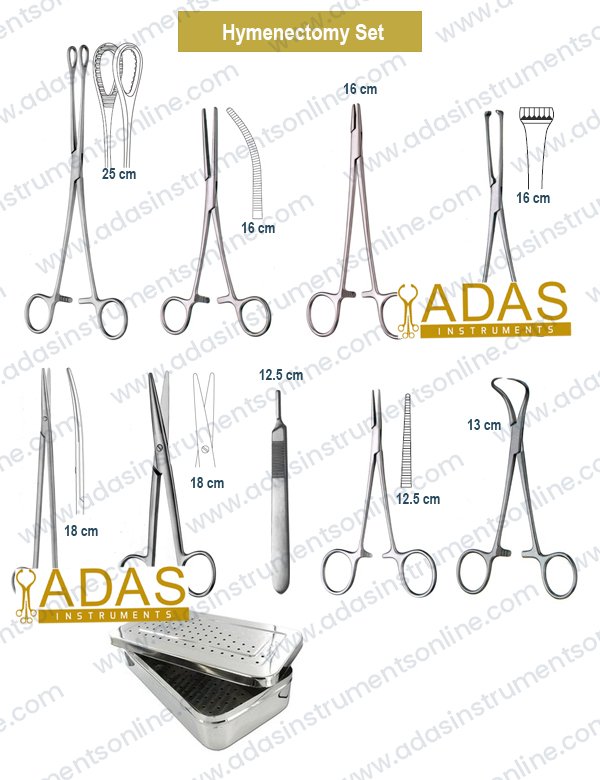
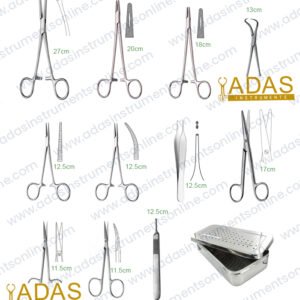
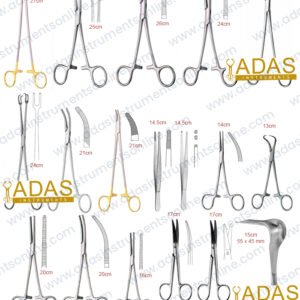
Our hymenectomy instrument set is a 19 piece tray of minor gynecology instruments for removing or opening the hymen in the operating room. It carries 9 patterns, from Allis tissue forceps and Metzenbaum-Nelson scissors to a Mayo-Hegar needle holder and six towel forceps, so the tissue can be held, cut, stopped from bleeding and closed from one box.
Key Features
- 19 pieces across 9 patterns, in a stainless steel instrument box
- Three Allis tissue forceps, 15 cm, 5×6 teeth
- Metzenbaum-Nelson scissors 18 cm curved and Mayo-Stille scissors 17 cm straight
- Two Rochester-Pean 16 cm and two Halsted-Mosquito 12.5 cm artery forceps
- Mayo-Hegar needle holder 16 cm, scalpel handle No.3, six Backhaus towel forceps
- Made from high quality medical grade stainless steel, fully autoclavable
- Three year replacement warranty against manufacturing defects
- Item code AD-95512
Available on backorder

What a hymenectomy instrument set is
A hymenectomy instrument set is the tray used to excise or open the hymen when it blocks the vaginal opening or makes it too rigid to use. Google’s own summary calls it a collection of minor gynecological surgery tools, and names the usual reasons: a rigid, imperforate or partly closed hymenal membrane. The operation is short and shallow, so the tray is about fine soft tissue work rather than reach.
Nothing in the box is unique to this operation. That is the honest way to describe it. A hymenectomy instrument set is a well chosen minor set: forceps to hold the edge, scissors to cut it, artery forceps for bleeders, a needle holder to close, and towel forceps to keep the field square. What makes it a hymenectomy tray is the balance, and that balance is the subject of the tables below.
Google’s list of typical contents runs from 12 to 19 pieces, and ours is at the top of that range. It names one pattern we do not include, the Adson forceps. Our set holds three Allis forceps instead, which grip the hymenal edge with less slipping on wet tissue. Clinics that want an Adson can add one when ordering.
Why nine patterns and not fewer? Because the commonest complaint we hear about a small gynecology tray is the missing instrument, not the extra one. A surgeon who has to cut a suture with the Metzenbaum, or catch a bleeder with an Allis, is using the wrong instrument because the right one was left out to save weight. Each pattern in this hymenectomy instrument set has its own job and none of them does another’s. The box weighs 1.33 kg full, which is light enough to sit on a Mayo stand beside the surgeon rather than on the back table.
Key design features
Three Allis forceps for the edge
Allis tissue forceps, 15 cm, with 5×6 interlocking teeth. They hold the hymenal edge under gentle tension while it is cut, and the teeth spread the grip so the thin tissue does not tear at a single point. Three are in the box because the edge is usually held at three points round the opening.
Two pairs of scissors with different jobs
The Metzenbaum-Nelson, 18 cm curved with blunt tips, is for the fine dissection itself. The Mayo-Stille, 17 cm straight, is for sutures and dressings. Using the Metzenbaum on sutures is the quickest way to blunt it, which is why the tray carries both.
Small and medium artery forceps
Two Halsted-Mosquito, 12.5 cm straight, for the tiny vessels at the cut edge, and two Rochester-Pean, 16 cm curved, for anything larger. A Mayo-Hegar needle holder, 16 cm, closes the edge with fine absorbable sutures.
Six towel forceps and two sponge forceps
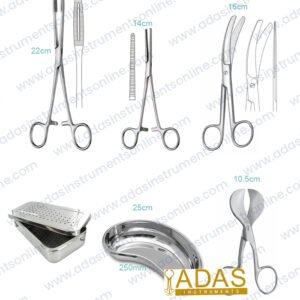
Six Backhaus towel forceps, 13 cm, square the drapes around a small field so nothing slips during the hymenectomy surgery. Two Foerster-Ballenger sponge forceps, 25 cm, straight and serrated, prepare the skin and hold swabs. A No.3 scalpel handle takes the blade for the first incision.
What is in the tray, piece by piece
Read off our own pattern record for item AD-95512. Nineteen pieces, with the box counted separately.
| Instrument | Size or pattern | Qty |
|---|---|---|
| Backhaus towel forceps | 13 cm | 6 |
| Foerster-Ballenger sponge holding forceps | 25 cm, straight, serrated | 2 |
| Scalpel handle | No.3 | 1 |
| Mayo-Stille operating scissors, blunt and blunt | 17 cm, straight | 1 |
| Metzenbaum-Nelson scissors, blunt and blunt | 18 cm, curved | 1 |
| Rochester-Pean artery forceps | 16 cm, curved | 2 |
| Halsted-Mosquito artery forceps | 12.5 cm, straight | 2 |
| Allis tissue seizing forceps | 15 cm, 5×6 teeth | 3 |
| Mayo-Hegar needle holder | 16 cm | 1 |
| Stainless steel instrument box | Holds the full set | 1 |
Where the set is used
The hymenectomy procedure comes in several forms, and the same tray covers all of them.
| Situation | What the set does | Pieces doing the work |
|---|---|---|
| Imperforate hymen | Opens a hymen that has no opening at all | Scalpel handle, Allis forceps, Metzenbaum scissors |
| Partial hymenectomy | Removes only the part of the hymen that obstructs | Allis forceps, Metzenbaum scissors, Mosquito forceps |
| Septate or microperforate hymen | Divides a band of tissue across the opening | Metzenbaum scissors, Mosquito forceps |
| Rigid hymen | Excises the rigid ring and closes the edge | Allis forceps, needle holder |
| General minor gynecology | Serves as a small soft tissue tray for vulval work | The whole set |
What it does, and what it must not be asked to do
Fine instruments on thin tissue. The limits below are what keeps them fine.
| Instrument | What it does | What it must not do |
|---|---|---|
| Metzenbaum-Nelson scissors | Dissect and cut the hymenal tissue | Cut sutures or drapes. That dulls the blades within a few cases |
| Allis forceps | Hold the edge under even tension | Clamp healthy skin that is staying. The teeth mark it |
| Halsted-Mosquito forceps | Catch the small bleeders at the cut edge | Clamp thick tissue. Use the Rochester-Pean for that |
| Mayo-Hegar needle holder | Closes the edge with fine sutures | Hold anything but a needle. Its jaw is made to grip a needle, not tissue |
| The set as a whole | Minor excision and closure at the vaginal opening | Reach deep into the vagina. It has no speculum and no long instruments |
How it compares with the other gynecology sets
This is the only soft tissue tray among our five smaller gynecology sets. The others are built around the cervix or the uterus.
| Set | Pieces | What it carries | Buy it when |
|---|---|---|---|
| Hymenectomy, this page | 19 | Allis, Mosquito and Rochester-Pean forceps, two scissors, needle holder | The work is at the vaginal opening |
| Cervical biopsy | 6 | Van Doren biopsy forceps, Kristeller specula | You sample the cervix |
| Cervix cauterization | 11 | Auvard speculum, sponge forceps, Overholt forceps | You treat the cervix with your own cautery unit |
| Dilatation and curettage | 23 | Hegar dilators, six curettes, uterine sound | The work is inside the uterus |
Materials and finish
Every piece in this hymenectomy instrument set is made from high quality medical grade stainless steel. The steel itself is made to a German specification. We do not publish a grade number. The useful question about a Metzenbaum is whether it still cuts cleanly at the very tip after months of use, and the answer to that is in the grinding, not the alloy.
The Metzenbaum-Nelson blades are set by hand so they meet from the pivot to the tip with no gap, and we test each pair by cutting a strip of wet gauze at the last few millimeters of the blades. The Allis teeth are checked under a loupe so every pair interlocks. Ring handles are polished inside, where gloved fingers rub.
Caring for it
Rinse every piece after the case and open all ratchets and box joints before the autoclave. Keep the Metzenbaum away from the drape scissors bin: one cut through paper drapes takes the edge off its tips.
Check the Mosquito tips meet when closed. A pair that crosses at the tip has been forced on tissue too thick for it, and it will let small vessels slip. We realign sprung forceps; send them back with the item code.
Ordering and wholesale
Every piece of the hymenectomy instrument set is made by Adas Instruments in our own workshop and sold direct, which is why the price sits where it does against the catalog houses. Order one for a single tray, or in quantity for a hospital list or a distributor line. We do OEM work under your own brand and your own item numbers. Send us a sample and we will hold a run to your pattern rather than ours. Stock items ship from our own workshop. Backorder items take 10 to 12 working days to make. Every instrument carries a three year replacement warranty against manufacturing defects. Production is controlled under an ISO 13485 quality management system.
Frequently asked questions
What instruments are used in hymenectomy surgery?
Fine tissue forceps, usually Allis, to hold the edge; curved Metzenbaum scissors to cut it; Mosquito and Rochester-Pean artery forceps for bleeding; a needle holder to close; towel and sponge forceps around the field. Our hymenectomy instrument set carries all of those in 19 pieces.
What is the difference in hymenotomy vs hymenectomy?
A hymenotomy cuts the hymen to open it and removes no tissue. A hymenectomy removes part or all of the hymenal tissue. Both use the same instruments, so this one tray serves either.
Can this set be used for a partial hymenectomy?
Yes. A partial hymenectomy removes only the obstructing part, and the three Allis forceps and the curved Metzenbaum scissors are what that work depends on.
Does the set include Adson forceps?
No. Some rival trays include an Adson. Ours uses three Allis tissue forceps instead, which hold wet tissue with less slipping. An Adson can be added to the order.
Why are there six towel forceps in a small set?
Because a small field still needs its drapes held square on every side, and six Backhaus forceps do that without anyone holding them. They are 13 cm, small enough to stay out of the way of the hands.
Related products and categories
Our other gynecology trays are built around the cervix and the uterus: the dilatation and curettage instrument set, the uterine evacuation instrument set and the small clinic cervical biopsy instrument set.
All of our trays for this specialty sit under gynecology and obstetrics instrument sets, and the full range of procedure trays is under surgical instrument sets.
| Weight | 1.33 kg |
|---|
Be the first to review “Hymenectomy Instrument Set, 19 Pieces”
Shipping & Delivery Policy
Processing Time: In-stock items are dispatched within 24-48 hours. For custom or out-of-stock items, production time is approximately 10-15 days.
Global Delivery Estimates
We partner with world-class couriers (DHL, FedEx) to ensure fast, tracked delivery.
- USA & Canada: 3-5 Business Days
- Europe & UK: 4-6 Business Days
- Rest of World: 5-7 Business Days
*We offer Air Cargo and Sea Freight options for bulk wholesale orders.
Customs & Duties
International buyers are responsible for any customs duties or taxes imposed by their country. Adas Instruments is not responsible for delays caused by customs clearance.
Lost Packages & Insurance
If your package is lost in transit, please contact us immediately. We offer full support and replacements for confirmed lost shipments. Note: You must report non-delivery within 3 weeks to be eligible for an insurance claim.
Reviews
There are no reviews yet.