
Dilatation and Curettage Instrument Set, 23 Pieces
$ 291.90
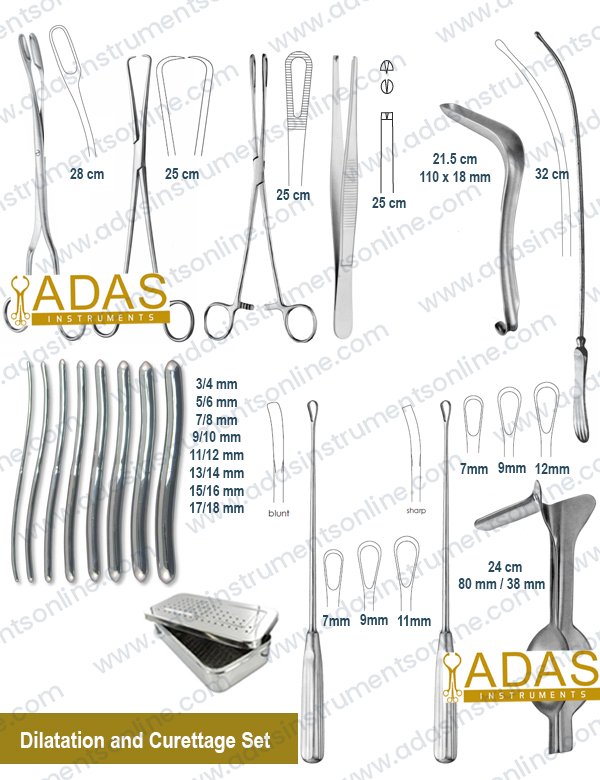
Our dilatation and curettage instrument set is the full steel tray for a D and C: 23 pieces, from the first speculum to the last curette, in one box at 291.90 dollars. It carries 8 separate Hegar dilators and both sharp and blunt Sims curettes, so the cervix can be opened one step at a time and the uterine lining sampled or cleared without leaving the tray.
Key Features
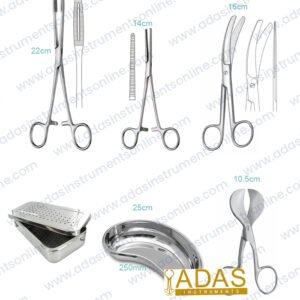
- 23 pieces across 21 patterns, packed in a stainless steel instrument box
- Eight Hegar uterine dilators, 3/4 mm to 17/18 mm, each one loose
- Six Recamier and Sims curettes, 26 cm: three sharp, three blunt
- Sims uterine sound 32 cm, malleable, and Winter ovum forceps 28 cm
- Auvard weighted speculum plus a Kristeller specula set
- Made from high quality medical grade stainless steel, fully autoclavable
- Three year replacement warranty against manufacturing defects
- Item code AD-95510
Available on backorder

What a dilatation and curettage instrument set is
A dilatation and curettage instrument set is the group of steel instruments a gynecologist needs to open the cervix, measure the uterus and then scrape or lift tissue from its lining. The procedure takes its name from those two halves: dilatation first, curettage after. Everything on our tray is there for one of the two, plus the few pieces that hold the field still while it happens.
Google’s own summary of the tray sorts it by stage of the operation: exposure, stabilizing and measuring, dilation, then curettage and retrieval. That is a fair way to read our box too, and it is how the table further down is laid out. What Google lists and we do not include is said plainly there as well, because a tray that arrives short of something the buyer assumed was in it costs a day in the operating room.
Most people searching for this search for a D and C instruments set, and in American hospitals the same tray is usually ordered as a dilation and curettage instruments set, with one syllable fewer. It is the same set. We kept dilatation in the name because that is the spelling on our own pattern record.
One thing we count differently from some catalogs: our 23 pieces count each Hegar dilator on its own, which is eight of the 23. Our uterine evacuation set counts its Hegar dilators as one set of eight. Neither is padding. It is how each tray has always been listed in our workshop.
Key design features
Eight Hegar dilators, one step at a time
The dilators run from 3/4 mm to 17/18 mm, double ended, so each piece carries two sizes a millimeter apart. Going up in single steps is the whole point of the Hegar pattern. A jump of two or three sizes is how a cervix tears, and a tray with gaps in the run invites exactly that jump.
Sharp and blunt curettes, both in the box
Three sharp Recamier curettes at 7, 9 and 12 mm and three blunt Sims curettes at 7, 9 and 11 mm, all 26 cm and rigid. A sharp curette samples the lining. A blunt one clears retained tissue with less risk to the wall. Trays that carry only one kind force the surgeon to use the wrong one.
A malleable sound before anything goes in
The Sims uterine sound is 32 cm and malleable, so it can be bent to follow the angle of the uterus before the depth is read. It is the first instrument through the cervix and the one that tells the surgeon how far every instrument after it may safely go.
Two kinds of speculum
The Auvard is the weighted speculum that sits in the posterior vagina and holds itself there, which frees a pair of hands. The Kristeller specula set, conical Fig.2, gives a second option when the anterior wall needs holding too. Two Schroeder tenaculum forceps with box locks steady the cervix against the pull of the dilators.
What is in the tray, piece by piece
Every row below is read off our own pattern record for item AD-95510. The question we are asked most about Hegar dilators, sizes, is answered in the rows marked Hegar.
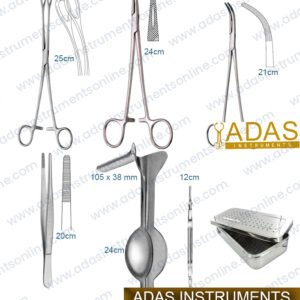
| Instrument | Size or pattern | Qty |
|---|---|---|
| Rampley sponge holding forceps | 25 cm, straight | 2 |
| Standard tissue forceps | 25 cm, straight, 1×2 teeth | 1 |
| Schroeder tenaculum forceps, box lock | 25 cm, straight | 2 |
| Winter ovum forceps | 28 cm, curved, Fig.2 | 1 |
| Sims uterine sound | 32 cm, malleable | 1 |
| Auvard vaginal speculum | 80 mm by 38 mm | 1 |
| Kristeller vaginal specula set | Conical, Fig.2 | 1 |
| Hegar uterine dilators | 3/4, 5/6, 7/8, 9/10, 11/12, 13/14, 15/16 and 17/18 mm | 8 |
| Recamier uterine curettes, sharp | 26 cm, 7, 9 and 12 mm, rigid | 3 |
| Sims uterine curettes, blunt | 26 cm, 7, 9 and 11 mm, rigid | 3 |
| Stainless steel instrument box | Holds the full set | 1 |
Where the set is used
The same tray covers several operations, which is why it is the one most gynecology departments stock first.
| Procedure | What the set does | Pieces doing the work |
|---|---|---|
| Diagnostic D and C | Samples the uterine lining after abnormal bleeding | Sound, dilators, sharp curettes |
| Management of an incomplete miscarriage | Clears retained tissue | Dilators, blunt curettes, ovum forceps |
| Removal of an endometrial polyp | Opens the cervix and lifts the polyp out | Dilators, Winter ovum forceps |
| Hysteroscopy preparation | Dilates the cervix to take the scope | Tenaculum, sound, Hegar dilators |
| Training lists | Teaches the instruments used in D and C in their order | The whole tray, laid out by stage |
What it does, and what it must not be asked to do
A D and C is a short operation done blind, by feel, so the limits of each instrument matter more than its features.
| Instrument | What it does | What it must not do |
|---|---|---|
| Hegar dilators | Open the cervical canal one millimeter at a time | Skip sizes. Going from 7/8 straight to 11/12 is how the canal splits |
| Sims uterine sound | Measures depth and direction before dilation | Be forced. Resistance means the angle is wrong, not that more push is needed |
| Sharp Recamier curettes | Take a sample of the lining | Scrape hard and long. Over-curettage scars the lining |
| Blunt Sims curettes | Clear retained tissue with less risk to the wall | Stand in for a sharp curette when a clean histology sample is the aim |
| Schroeder tenaculum | Steadies the cervix against the dilators | Be clamped and left. It grips firmly and marks the cervix if it stays on too long |
How it compares with the other gynecology sets
Three of our gynecology trays overlap. The difference is in what each one leaves out.
| Set | Pieces | What it carries | Buy it when |
|---|---|---|---|
| Dilatation and curettage, this page | 23 | Eight loose Hegar dilators, six curettes, sound, ovum forceps, two specula | You want one tray that does the whole D and C |
| Uterine evacuation | 16 | Hegar set of eight, two blunt curettes, three tenacula | The work is clearing tissue rather than sampling it |
| Cervical biopsy | 6 | Van Doren biopsy forceps, Kristeller specula | Only the cervix is being sampled, not the uterus |
| Cervix cauterization | 11 | Auvard speculum, sponge forceps, needle holder | You need the steel support for a cautery unit you already own |
Materials and finish
Every piece in this dilatation and curettage instrument set is made from high quality medical grade stainless steel. The steel itself is made to a German specification. We do not publish a grade number. A number on a certificate says nothing about whether a 26 cm curette stays straight after its hundredth autoclave cycle, and a curette that has bent a degree no longer goes where the sound said it would.
The dilators are polished to a mirror finish along their full length, because any drag on the surface is felt as resistance by the surgeon and read as a tight canal. The curette loops are left satin inside, so the surgeon can see the edge under the light. The instrument box is the same steel, with no plastic insert to crack in the autoclave.
Caring for it
Rinse every piece straight after the case, before blood and tissue dry inside the curette loops. Open the box locks on the tenaculum and the ovum forceps for cleaning and leave them open in the autoclave.
Check the curettes against the light before each tray goes back on the shelf. A sharp curette with a dull spot on its loop tears rather than samples. Lay the Hegar dilators back in size order every time: the next surgeon reaches for the next size by position, not by reading the number stamped on it.
Ordering and wholesale
Every piece of the dilatation and curettage instrument set is made by Adas Instruments in our own workshop and sold direct, which is why the price sits where it does against the catalog houses. Order one for a single tray, or in quantity for a hospital list or a distributor line. We do OEM work under your own brand and your own item numbers. Send us a sample and we will hold a run to your pattern rather than ours. Stock items ship from our own workshop. Backorder items take 10 to 12 working days to make. Every instrument carries a three year replacement warranty against manufacturing defects. Production is controlled under an ISO 13485 quality management system.
Frequently asked questions
What instruments are included in the dilatation and curettage set?
Ours has 23 pieces: two Rampley sponge forceps, tissue forceps, two Schroeder tenaculum forceps, Winter ovum forceps, a Sims uterine sound, an Auvard speculum, a Kristeller specula set, eight Hegar dilators and six curettes, three sharp and three blunt, in a steel box.
What are the names of the instruments used in D&C?
The core names are the speculum, the tenaculum, the uterine sound, the Hegar dilators and the curettes, usually Sims or Recamier. Ovum forceps and sponge forceps complete most trays, and every one of those is in this dilatation and curettage instrument set.
Which instrument is used for curettage?
A uterine curette: a long rigid handle with a loop at the tip. A sharp curette samples the lining and a blunt one clears retained tissue with less risk to the wall. This tray carries three of each, all 26 cm.
What are the common sizes of Hegar dilators?
Sizes are named by diameter in millimeters, and double ended dilators carry two sizes, such as 3/4 or 9/10. Our set runs from 3/4 mm to 17/18 mm in eight pieces with no gaps, which covers ordinary gynecology work.
Is a D and C set the same as a dilation and curettage set?
Yes. Dilatation is the older spelling and dilation the usual American one. D and C, D&C and dilation and curettage all name the same operation and the same tray.
Related products and categories
For clearing tissue rather than sampling it, the uterine evacuation instrument set carries a Hegar set of eight and blunt curettes in a smaller box. Where only the cervix is sampled, the cervical biopsy instrument set is the lighter tray, and the cervix cauterization instrument set holds the steel support for a cautery unit.
All of our trays for this specialty sit under gynecology and obstetrics instrument sets, and the full range of procedure trays is under surgical instrument sets.
| Weight | 1.64 kg |
|---|
Be the first to review “Dilatation and Curettage Instrument Set, 23 Pieces”
Shipping & Delivery Policy
Processing Time: In-stock items are dispatched within 24-48 hours. For custom or out-of-stock items, production time is approximately 10-15 days.
Global Delivery Estimates
We partner with world-class couriers (DHL, FedEx) to ensure fast, tracked delivery.
- USA & Canada: 3-5 Business Days
- Europe & UK: 4-6 Business Days
- Rest of World: 5-7 Business Days
*We offer Air Cargo and Sea Freight options for bulk wholesale orders.
Customs & Duties
International buyers are responsible for any customs duties or taxes imposed by their country. Adas Instruments is not responsible for delays caused by customs clearance.
Lost Packages & Insurance
If your package is lost in transit, please contact us immediately. We offer full support and replacements for confirmed lost shipments. Note: You must report non-delivery within 3 weeks to be eligible for an insurance claim.
Reviews
There are no reviews yet.