
Bent or Worn Cannulas: Inspection and Retirement Rules
Sep
In this guide: when to replace liposuction cannula. Seven inspection findings that end a cannula life.
A worn cannula does not announce itself: the tip dulls, the shaft bows a degree, the hub loosens, and the surgeon blames technique for the uneven result. Knowing when to replace a liposuction cannula is a safety and quality discipline, not a budget one. Here are the inspection points and the retirement rules, in the order to check them.
A liposuction cannula is a hollow stainless steel tube with side ports near the tip, drawn through subcutaneous fat on a syringe or an aspirator so that fat can be removed or transferred. It is used in body contouring, gynecomastia correction and fat grafting. Adas Instruments, a surgical instrument manufacturer in Sialkot, Pakistan, makes the pattern in German medical grade stainless steel, in 2 mm to 5 mm bores and 15 cm to 35 cm working lengths, with Luer Lock, Toomey and threaded hubs.

The Tip: Sharpness and Shape
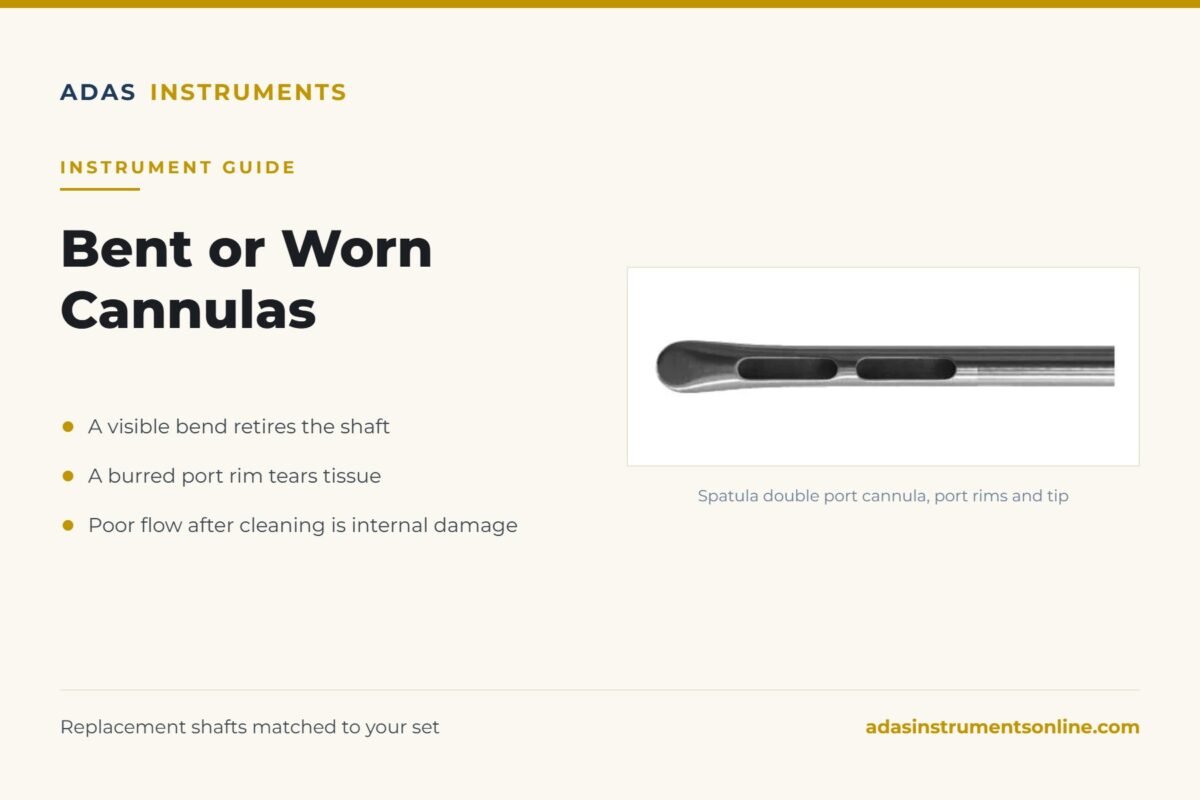
Run the tip openings under magnification at every reprocessing. Retire for: burred or nicked port edges (they scratch tunnels and tear tissue), a dulled or deformed leading nose that no longer glides, and any opening whose rim has rolled. Patterned cannulas that cut as well as aspirate, such as basket cannulas, dull sooner because the crossbars take the load. A blunt cannula that once glided now pushes, and pushing bruises, per the port geometry set out in our cannula types and port patterns guide.
The Shaft: Straightness and Integrity
Roll the cannula on a flat surface, a bow shows instantly as a wobble. Any visible curve retires the instrument and most bends come from loose stacking in a tray or a dropped instrument, not from cutting. Check too for surface pitting (the corrosion end-state) and any dent that narrows the lumen.
The Hub: Seal and Thread
A worn hub leaks air and drops suction, the fault often misread as a weak machine or as a blocked lumen. Check thread wear, seal condition and, on PAL patterns, the locking interface: a loose PAL hub transmits vibration poorly and wears fast.
The Lumen: The Hidden One
Flush and look through: a lumen narrowed by protein varnish or corrosion clogs early and cleans poorly, as set out in our autoclave and cleaning guide. A cannula that resists cleaning is telling you it is near retirement.
The Retirement Rule
Any single failure, burred port, bowed shaft, leaking hub, pitted surface, narrowed lumen, retires the instrument. Quality medical grade steel cannulas reach this point after years, not months, which is the reusable economics set out in our liposuction cannula guide; the point is to catch it at inspection, not mid-case.
When to Replace Liposuction Cannula Shafts: The Signals
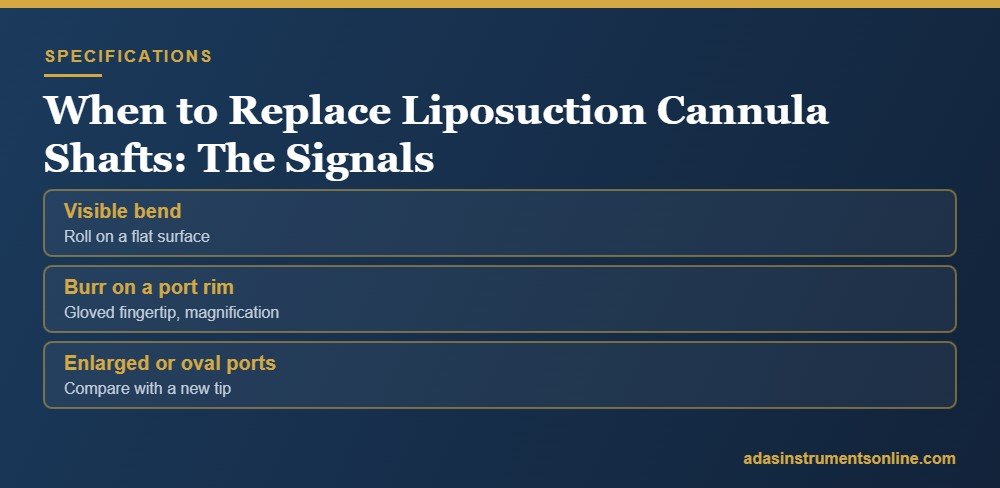
Knowing when to replace liposuction cannula shafts is an inspection habit, not a calendar. Cannulas are retired on condition, and seven findings between them cover almost every case.
| Finding | How to check | Verdict | Why |
|---|---|---|---|
| Visible bend | Roll on a flat surface | Retire | Depth control is already compromised |
| Burr on a port rim | Gloved fingertip, magnification | Retire | Tears tissue on withdrawal |
| Enlarged or oval ports | Compare with a new tip | Retire | Removal rate no longer predictable |
| Hub play or wobble | Flex the hub by hand | Retire | Air leak and possible separation |
| Poor flow after cleaning | Flow test with saline | Reprocess, then retire if unchanged | Internal residue or damage |
| Pitting or staining | Inspect under good light | Retire | Surface corrosion spreads |
| Dull or scratched tip | Compare against a reference tip | Judge case by case | Drag increases, feel changes |

Common Mistakes in Instrument Retirement
Instruments are usually kept too long and occasionally thrown away too early. Five points get it right.
- Retiring by case count. A well cared for cannula outlasts a badly handled one many times over, so inspect rather than count.
- Straightening a bent shaft. Bending it back work hardens the metal and creates a weak point exactly where you cannot see it.
- Polishing a burred port. Local polishing changes the port geometry, so the tip no longer matches the others in the set.
- Inspecting only before the case. Damage happens during reprocessing, so check on the way out of the wash room as well.
- No reference tip. Keep one unused cannula of each size sealed as a comparison standard; wear is invisible without it.
Planning Replacements With Your Manufacturer
Retirement is predictable enough to plan around once you have an inspection routine, and a standing replacement schedule is cheaper than an emergency order. Adas Instruments makes cannulas to order in German medical grade stainless steel, matched to the lengths, bores, port patterns and hub standards you already run, with OEM or white label marking. Production time on custom work is 10 to 15 working days, normally 15 working days depending on order size.
Written inspection and reprocessing protocols are part of standard perioperative practice, and guidance from bodies such as AORN is where most departments start. Keep a reorder list against your current liposuction cannula set so a retirement does not leave a gap in the size range.

How Retirement Fits Your Wider Instrument Routine
Deciding when to replace liposuction cannula shafts becomes easy once inspection is built into the same routine as cleaning and packing, rather than treated as a separate audit. The racks and brushes that make that routine practical come from the liposuction accessories range.
Cycle conditions affect instrument life directly, and a set that is dried properly lasts noticeably longer than one that is not. Our autoclaving surgical instruments guide sets out the parameters, and following them is the cheapest life extension available to any department.
Time to renew the rack? Replacement cannulas in every bore, medical grade steel.
Frequently Asked Questions
When should a liposuction cannula be replaced?
At the first reliable failure sign: a burred or dulled tip, a bowed shaft, a leaking hub, surface pitting or a narrowed lumen. Any one of these retires the instrument.
How do you check a cannula for bends?
Roll it on a flat surface; any bow shows as a wobble. Even a slight curve makes the cannula wander off plane and should retire it.
How long should a quality cannula last?
Years of regular use with proper cleaning and a protective rack; quality steel cannulas are retired for tip or shaft damage, not corrosion, when cared for correctly.
How many times can a liposuction cannula be reused?
There is no fixed number. Cannulas made from high quality medical grade stainless steel are retired on condition, and a carefully handled instrument can outlast a mishandled one several times over. Inspection replaces counting.
Can a bent liposuction cannula be straightened?
It should not be. Bending the shaft back work hardens the metal and leaves a weak point that is invisible from outside, which can fail under load. A bent shaft is a retirement, not a repair.
How do I check a cannula for burrs?
Under good light with magnification, and by running a gloved fingertip lightly along the port rims. Any catch means the tip is tearing on the withdrawal stroke, which shows up clinically as extra bruising.
Why does an old cannula clog more often?
Internal residue, port wear and surface roughening all reduce flow. If a flow test with saline stays poor after a full reprocessing cycle including lumen brushing, the shaft has reached the end of its useful life.
