
Vesicovaginal Fistula Repair Instrument Set, 5 Pieces
$ 23.10
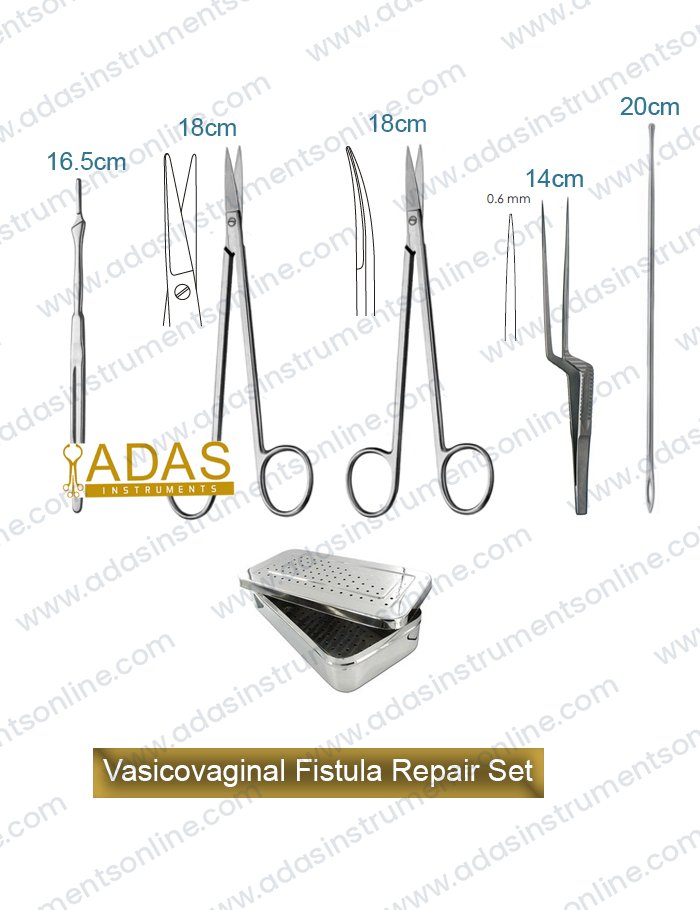
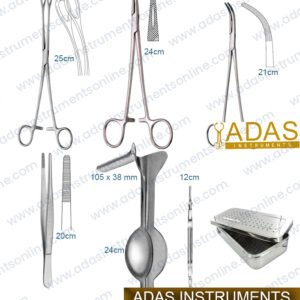
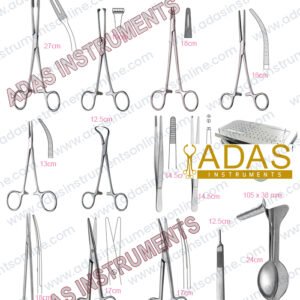
Our vesicovaginal fistula repair instrument set is a five piece specialist tray for finding, freeing and closing a fistula between the bladder and the vagina. It holds the fine instruments a general tray lacks: Kelly fistula scissors straight and curved at 18 cm, a bayonet micro forceps with a 0.6 mm tip, a 20 cm probe with an eye and a No.7 scalpel handle, at 23.10 dollars.
Key Features
- 5 pieces across 4 patterns, in a stainless steel instrument box
- Kelly fistula scissors, 18 cm, one straight and one curved
- Micro forceps, bayonet, 18 cm, 0.6 mm tip
- Probe with eye, 20 cm, 2 mm
- Scalpel handle No.7, the long slim handle for a deep field
- Made from high quality medical grade stainless steel, fully autoclavable
- Three year replacement warranty against manufacturing defects
- Item code AD-95552
Available on backorder

What a vesicovaginal fistula repair instrument set is
A vesicovaginal fistula repair instrument set is the group of fine instruments used to close an abnormal opening between the bladder and the vagina, through which urine leaks continuously. Google’s own summary describes the work as delicate dissection, mobilization and layered closure of the tract, done deep in a narrow space, which is why the instruments are long and fine.
Ours is five pieces, and that needs explaining at once. It is not a complete tray. It is the specialist part of one, made to sit beside a vaginal surgery set that already provides the specula, retractors, clamps and needle holders. Google’s list includes an Auvard speculum, a Sims speculum and Deaver and Langenbeck retractors. None of those are in this box. Our major vaginal repair set carries the specula, retractors and two Simon fistula hooks, and the two sets together make a full fistula tray.
Why sell the fine instruments separately? Because they are the ones that wear out and go missing. A fistula surgeon may own a perfectly good vaginal set and still be short of a sharp Kelly fistula scissor or a probe that passes the tract cleanly. At 23.10 dollars, replacing the specialist pieces costs far less than a second full tray.
Vesicovaginal fistula repair is most often needed after prolonged obstructed labor, and it is a major part of the surgical work in regions where emergency obstetric care is hard to reach. It also follows pelvic surgery and radiotherapy. Fistula surgeons and the programs that train them are the buyers we make this tray for.
A training program has a particular reason to buy the specialist pieces in quantity. Each trainee learns faster with their own probe and fistula scissors, and a teaching list that runs several repairs in a day can keep one vesicovaginal fistula repair instrument set per table without buying a full vaginal tray for each. The exposure instruments are shared; the fine instruments, which decide how well the repair holds, are not.
Key design features
Kelly fistula scissors, straight and curved
Both 18 cm. The long shanks reach the fistula from the vaginal opening, and the blades are short and fine for cutting scar round the tract. The straight pair trims the fistula edge; the curved pair works round the bladder wall when the layers are separated.
A bayonet micro forceps
18 cm with a 0.6 mm tip. The bayonet bend keeps the surgeon’s hand out of the line of sight down a narrow vaginal field, and the fine tip holds the bladder mucosa at a single point without tearing it.
A probe with an eye
20 cm, 2 mm. Among fistula repair instruments, the probe is the one that finds the tract and shows its direction, and the eye at the end can carry a thread or a fine catheter through it. A smooth probe that does not catch is worth more than any other piece in the set.
A long, slim scalpel handle
The No.7 handle takes small blades and is slimmer than a No.3, so it can work at depth without blocking the view. The first incision round the fistula is made with it.
What is in the tray, piece by piece
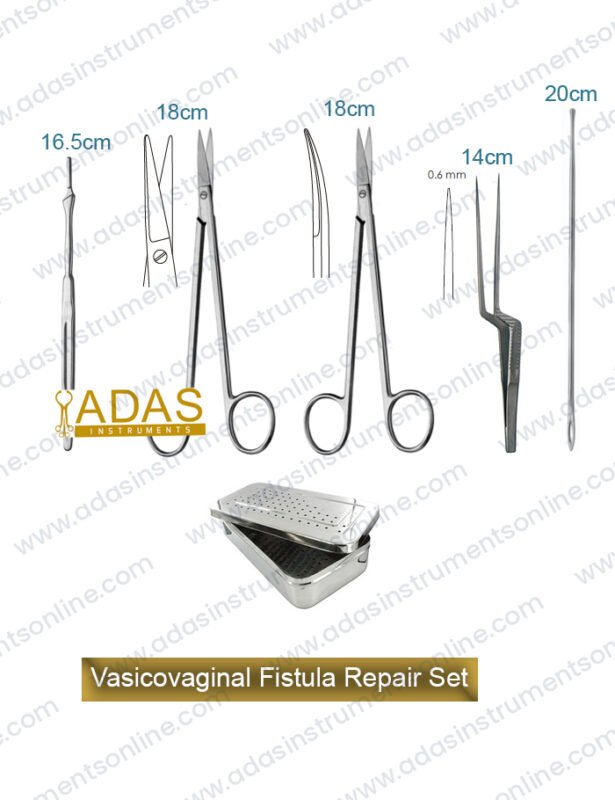
Read off our own pattern record for item AD-95552. Five pieces, the box counted separately, and the rows below say what is not here as well.
| Instrument | Size or pattern | Qty |
|---|---|---|
| Scalpel handle | No.7 | 1 |
| Kelly fistula scissors | 18 cm, straight | 1 |
| Kelly fistula scissors | 18 cm, curved | 1 |
| Micro forceps | 18 cm, 0.6 mm tip, bayonet | 1 |
| Probe with eye | 20 cm, 2 mm | 1 |
| Stainless steel instrument box | Holds the full set | 1 |
| Specula, retractors, needle holders | NOT included. Use with a vaginal surgery set | 0 |
Where the set is used
Every use below pairs this tray with a vaginal surgery set that provides the exposure.
| Situation | What the set does | Pieces doing the work |
|---|---|---|
| Obstetric fistula after obstructed labor | Finds, frees and trims the tract | Probe with eye, Kelly scissors |
| Fistula after pelvic surgery | Dissects scar round the bladder | Curved Kelly scissors, micro forceps |
| Small or pinhole fistula | Locates a tract too small to see | Probe with eye |
| Fistula surgery training | Gives each trainee the fine instruments | The whole tray |
| Replacing worn fistula instruments | Replaces the pieces that wear first | Kelly scissors, probe |
What it does, and what it must not be asked to do
Fine instruments for tissue that has usually been damaged already. The limits matter.
| Instrument | What it does | What it must not do |
|---|---|---|
| Probe with eye | Finds the tract and shows its direction | Be forced. A probe pushed through tissue makes a new tract |
| Kelly fistula scissors | Cut scar and trim the fistula edge | Cut sutures. Keep their edge for tissue |
| Micro forceps | Hold bladder mucosa at one point | Grip thick tissue. The 0.6 mm tip will spring |
| No.7 scalpel handle | Makes the first incision at depth | Be used for heavy cutting |
| The set as a whole | The fine work of a fistula repair | Stand alone. It has no speculum, retractor or needle holder |
How it compares with the other vaginal sets
This is the smallest of our vaginal trays, and the one meant to be used beside another.
| Set | Pieces | What it carries | Buy it when |
|---|---|---|---|
| Vesicovaginal fistula repair, this page | 5 | Kelly fistula scissors, bayonet micro forceps, probe with eye | You need the fine fistula instruments |
| Major vaginal repair | 63 | Five specula, four retractors, Simon fistula hooks | You need the full vaginal tray to go with it |
| Vaginal closure | 24 | Eight Mosquitoes, two needle holders, Allis | Closure and repair |
| Bartholin cyst excision | 28 | Auvard speculum, four Allis, Metzenbaum | Work on the gland or the vestibule |
Materials and finish
Every piece in this vesicovaginal fistula repair instrument set is made from high quality medical grade stainless steel. The steel itself is made to a German specification. We do not publish a grade number. The question that matters is whether the Kelly scissors still cut scar cleanly at the tip, and whether the probe stays straight and smooth, after years of use.
The probe is polished along its full length so it slides through a tract without catching, and its eye is smoothed inside so a thread passes freely. The Kelly blades are set by hand to meet right to the tip. The micro forceps tips are aligned under a loupe so they close evenly.
Caring for it
Wash the micro forceps and the scissors separately from heavy instruments. A fine tip bent in the washer is the commonest way this tray is damaged. Open the scissors and the forceps for the autoclave.
Run a finger along the probe after each case. Any roughness or bend means it should come out of use until it is polished or replaced. Send it back to us with the item code. Keep a spare probe in the store; it is the one piece a fistula list cannot run without.
Ordering and wholesale
Every piece of the vesicovaginal fistula repair instrument set is made by Adas Instruments in our own workshop and sold direct, which is why the price sits where it does against the catalog houses. Order one for a single tray, or in quantity for a hospital list or a distributor line. We do OEM work under your own brand and your own item numbers. Send us a sample and we will hold a run to your pattern rather than ours. Stock items ship from our own workshop. Backorder items take 10 to 12 working days to make. Every instrument carries a three year replacement warranty against manufacturing defects. Production is controlled under an ISO 13485 quality management system.
Frequently asked questions
What instruments are used for vesicovaginal fistula repair?
Exposure instruments such as an Auvard and a Sims speculum and retractors, then fine instruments for the repair itself: a probe, fistula scissors, fine forceps, a long scalpel handle and needle holders. This set carries the fine instruments; a vaginal surgery set provides the rest.
What instruments are used for suturing?
A needle holder, tissue forceps to hold each edge, and scissors to cut the suture. They are not in this five piece set and come from the vaginal tray it is used with.
What is the most effective way to repair a fistula?
That is a clinical decision for the surgeon. In general a vesicovaginal fistula is freed from scar, the bladder and vagina are separated, and each is closed in its own layer without tension.
What is a fistula probe instrument used for?
Finding the tract and showing its direction before any cut is made. Ours is 20 cm, 2 mm, with an eye that can carry a thread.
Why is the set only five pieces?
Because it is the specialist add on to a vaginal surgery tray. Our major vaginal repair set provides the specula, retractors and clamps it is meant to be used with.
Related products and categories
The full tray to use with this one is the major vaginal repair instrument set. For closure work, see the vaginal closure instrument set, and for the vestibule the Bartholin cyst excision instrument set.
All of our trays for this specialty sit under gynecology and obstetrics instrument sets, and the full range of procedure trays is under surgical instrument sets.
| Weight | 0.35 kg |
|---|
Be the first to review “Vesicovaginal Fistula Repair Instrument Set, 5 Pieces”
Shipping & Delivery Policy
Processing Time: In-stock items are dispatched within 24-48 hours. For custom or out-of-stock items, production time is approximately 10-15 days.
Global Delivery Estimates
We partner with world-class couriers (DHL, FedEx) to ensure fast, tracked delivery.
- USA & Canada: 3-5 Business Days
- Europe & UK: 4-6 Business Days
- Rest of World: 5-7 Business Days
*We offer Air Cargo and Sea Freight options for bulk wholesale orders.
Customs & Duties
International buyers are responsible for any customs duties or taxes imposed by their country. Adas Instruments is not responsible for delays caused by customs clearance.
Lost Packages & Insurance
If your package is lost in transit, please contact us immediately. We offer full support and replacements for confirmed lost shipments. Note: You must report non-delivery within 3 weeks to be eligible for an insurance claim.
Reviews
There are no reviews yet.