
Abdominal Hysterectomy Instrument Set, 85 Pieces
$ 741.30
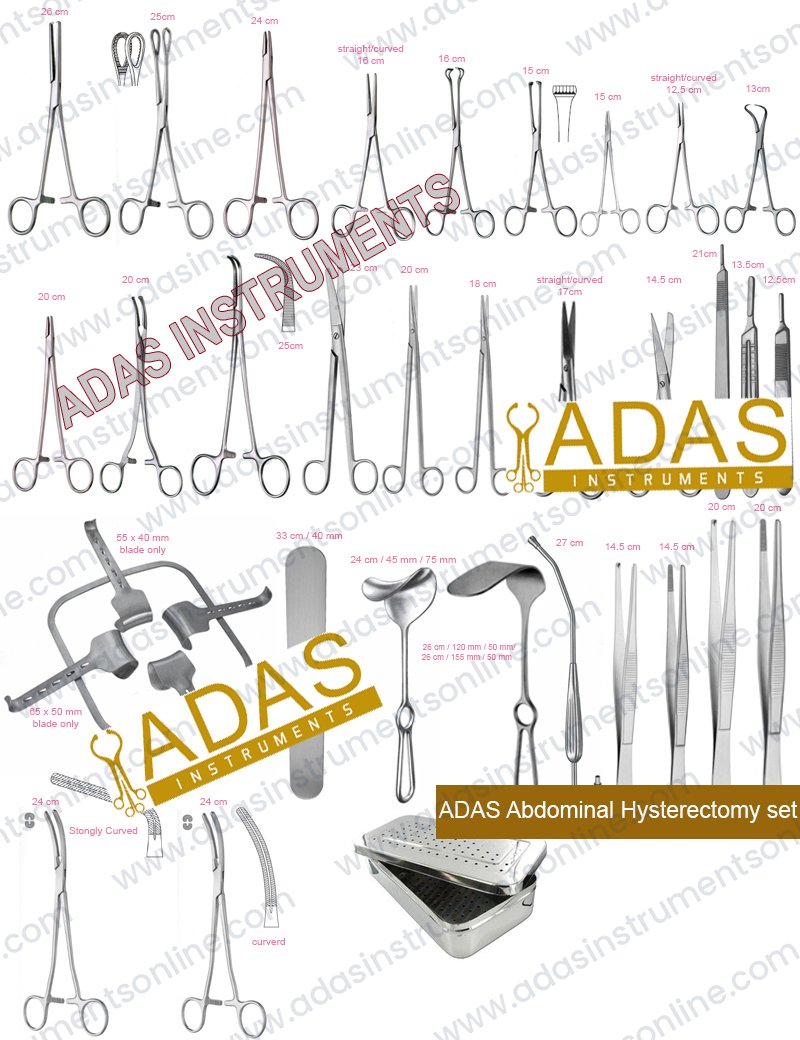
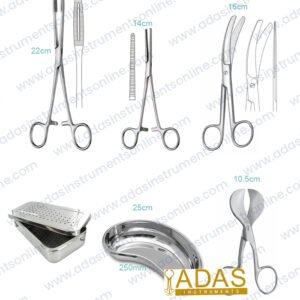
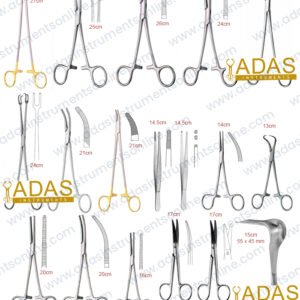
Our abdominal hysterectomy instrument set is the full 85 piece open tray for removing the uterus through an abdominal incision. It brings heavy parametrium and Mikulicz clamps for the pedicles, a Kirschner self retaining retractor with Fritsch and Mikulicz blades for the pelvis, 30 artery forceps and a Yankauer suction tube, so a total abdominal hysterectomy can run start to finish from one box.
Key Features
- 85 pieces across 36 lines, in a stainless steel instrument box
- Four parametrium forceps 24 cm, curved and strongly curved, and four Mikulicz clamps 20.5 cm
- Kirschner abdominal retractor complete, two Fritsch and two Mikulicz retractors
- Twenty Halsted-Mosquito, eight Crile-Rankin and two Ochsner-Kocher 26 cm forceps
- Six Allis, two Babcock, Yankauer suction tube 27 cm, three needle holders
- Made from high quality medical grade stainless steel, fully autoclavable
- Three year replacement warranty against manufacturing defects
- Item code AD-95503
Available on backorder

What an abdominal hysterectomy instrument set is
An abdominal hysterectomy instrument set is the operating room tray for removing the uterus through the abdominal wall. Google’s own summary describes it as a large collection built around heavy hysterectomy clamps that hold thick vascular pedicles and the cardinal ligaments without slipping, plus strong retraction for the pelvis, with 60 to over 100 instruments. Ours is 85 pieces, which sits in the middle of that range.
The instruments used in abdominal hysterectomy fall into four groups, and this tray is laid out the same way: opening and retraction, clamping the pedicles, dissection, and closure. The pedicle clamps decide whether the operation goes well. Ours are parametrium forceps, two curved and two strongly curved at 24 cm, with four extra strong Mikulicz clamps for the heaviest tissue.
One difference from Google’s summary needs saying plainly. Google names Heaney hysterectomy forceps as the usual pedicle clamp. This tray does not carry Heaney forceps; it carries parametrium forceps instead, which are the pattern many European trained surgeons prefer for the same job. A unit that works with Heaney clamps will find six Heaney-Kanter forceps in our pelvic instrument set, or can add Heaney forceps to this one.
At 741.30 dollars and 6.16 kg with the box, this is the largest tray in our gynecology range. An abdominal hysterectomy tray gets heavy use in most hospitals, so the price per case over the life of the steel is small next to buying cheaper clamps twice.
Key design features
Parametrium and Mikulicz clamps
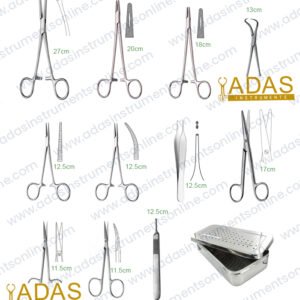
Four parametrium forceps at 24 cm, two curved and two strongly curved, clamp the uterine vessels and the cardinal and uterosacral ligaments. The strong curve reaches down beside the cervix where a straight jaw cannot. Four Mikulicz peritoneal clamps, 20.5 cm, extra strong with 1×2 teeth, hold peritoneum and thick tissue.
A Kirschner retractor with extra blades
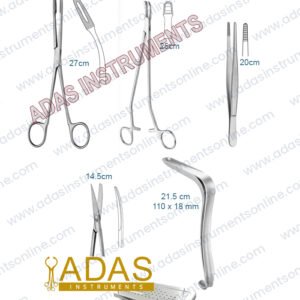
The Kirschner abdominal retractor comes complete. Two Fritsch retractors, 24 cm with 45 by 75 mm blades, and two Mikulicz retractors, 26 cm with 120 and 155 by 50 mm blades, give more depth where the frame alone is not enough. Two malleable abdominal spatulas, 33 cm by 40 mm, pack the bowel away.
Thirty artery forceps
Ten straight and ten curved Halsted-Mosquito, 12.5 cm; four straight and four curved Crile-Rankin, 16 cm; two long Ochsner-Kocher, 26 cm. An open pelvic operation needs many clamps on at once, and running short mid case is how a tray fails a surgeon.
Holding, dissecting and suction
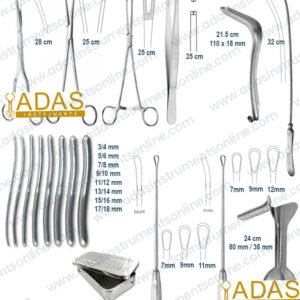
Six Allis, 15 cm, and two Babcock, 16 cm, hold tissue and tube. A Gemini dissecting forceps, 25 cm, curved, passes under vessels. Metzenbaum-Nelson scissors at 18 and 20 cm, a Sims gynecology scissors at 23 cm, three needle holders and a Yankauer suction tube, 27 cm, complete the working set.
What is in the tray, piece by piece
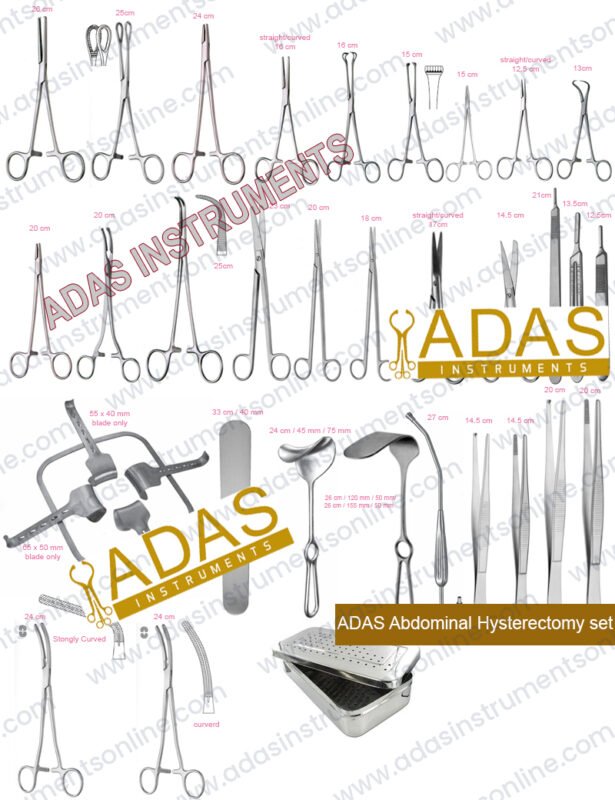
Read off our own pattern record for item AD-95503, grouped so the table stays readable. Eighty five pieces, the box counted separately.
| Group | Instruments and sizes | Qty |
|---|---|---|
| Draping and swabs | Foerster-Ballenger sponge forceps 25 cm x4, Backhaus towel forceps 13 cm x8 | 12 |
| Cutting | Scalpel handles No.3, No.4 and No.3L; Mayo gyn scissors 17 cm straight and curved; Metzenbaum-Nelson 18 and 20 cm curved; Sims gyn scissors 23 cm; operating scissors 14.5 cm | 10 |
| Dressing and tissue forceps | Dressing 14.5 cm x2 and 20 cm; tissue 1×2 teeth 14.5 cm x2 and 20 cm | 6 |
| Holding forceps | Allis 15 cm 5×6 teeth x6, Babcock 16 cm x2, Gemini dissecting 25 cm curved | 9 |
| Artery forceps | Halsted-Mosquito 12.5 cm straight x10 and curved x10, Crile-Rankin 16 cm straight x4 and curved x4, Ochsner-Kocher 26 cm x2 | 30 |
| Pedicle clamps | Parametrium forceps 24 cm curved x2 and strongly curved x2, Mikulicz 20.5 cm extra strong x4 | 8 |
| Retraction | Kirschner abdominal retractor complete, Fritsch 24 cm x2, Mikulicz retractors 26 cm x2, malleable spatulas 33 cm x2 | 7 |
| Closure and suction | Mayo-Hegar 20 and 24 cm, Crile-Wood 15 cm, Yankauer suction tube 27 cm | 4 |
| Box | Stainless steel instrument box | 1 |
Where the set is used
Every operation below is open abdominal gynecology, with the uterus or the adnexa reached through the abdominal wall.
| Operation | What the set does | Pieces doing the work |
|---|---|---|
| Total abdominal hysterectomy | Removes the uterus and cervix | Parametrium forceps, Kirschner retractor |
| Subtotal hysterectomy | Removes the uterus above the cervix | Parametrium forceps, Mikulicz clamps |
| Hysterectomy with salpingo-oophorectomy | Removes the tubes and ovaries as well | Babcock forceps, Crile-Rankin forceps |
| Myomectomy by laparotomy | Removes fibroids and keeps the uterus | Allis forceps, Metzenbaum scissors, needle holders |
| Ovarian cyst surgery | Removes a cyst through an open incision | Babcock forceps, Mosquito forceps |
What it does, and what it must not be asked to do
Big clamps and big retractors near the ureter and the bladder. These are the limits that matter.
| Instrument | What it does | What it must not do |
|---|---|---|
| Parametrium forceps | Clamp the uterine vessels and ligaments | Be placed without seeing the ureter. Stay close to the uterus |
| Mikulicz clamps | Hold peritoneum and thick tissue | Be used on bowel. The 1×2 teeth damage it |
| Kirschner retractor | Holds the abdominal wall open | Be opened hard against the pelvic side wall. It can compress the femoral nerve |
| Babcock forceps | Hold the tube and bowel without piercing | Clamp vessels. They are holding forceps |
| Yankauer suction tube | Clears the pelvis of blood and fluid | Be used against bowel wall at full suction |
How it compares with the other open gynecology sets
Our three open trays split the work by depth and by organ.
| Set | Pieces | What it carries | Buy it when |
|---|---|---|---|
| Abdominal hysterectomy, this page | 85 | Parametrium and Mikulicz clamps, Kirschner retractor, 30 artery forceps | Open hysterectomy is a regular operation |
| Pelvic instrument set | 70 | Six Heaney-Kanter forceps, long Kocher and Pean forceps | Deep pelvic work, or a Heaney based team |
| Salpingostomy | 25 | Iris scissors, Adson forceps, fine Mosquitoes, probe | Tubal surgery |
| Major vaginal repair | 63 | Five specula, Heaney forceps, retractors | The hysterectomy is done vaginally |
Materials and finish
Every piece in this abdominal hysterectomy instrument set is made from high quality medical grade stainless steel. The steel itself is made to a German specification. We do not publish a grade number. The question that matters is whether a parametrium forceps still holds a thick pedicle on its last ratchet tooth after years of use, and that depends on the joint and the jaw, not on a number.
The pedicle clamps have box joints, which keep the jaws aligned under the load a pedicle puts on them. The retractor blades are polished on the side that touches tissue and satin on the back. The Kirschner frame is assembled and checked as a unit before it is packed, so every blade fits the frame it ships with.
Caring for it
With 85 pieces, pack the tray in the same order every time and count against the table on this page. Strip the Kirschner retractor down to frame and blades for washing, and open every ratchet and box joint for the autoclave.
Flush the Yankauer tube straight after the case; dried blood inside it is very hard to shift later. Check the parametrium forceps jaws meet evenly on the first ratchet tooth. We realign and reset clamps; send them back with the item code.
Ordering and wholesale
Every piece of the abdominal hysterectomy instrument set is made by Adas Instruments in our own workshop and sold direct, which is why the price sits where it does against the catalog houses. Order one for a single tray, or in quantity for a hospital list or a distributor line. We do OEM work under your own brand and your own item numbers. Send us a sample and we will hold a run to your pattern rather than ours. Stock items ship from our own workshop. Backorder items take 10 to 12 working days to make. Every instrument carries a three year replacement warranty against manufacturing defects. Production is controlled under an ISO 13485 quality management system.
Frequently asked questions
What are the instruments used in hysterectomy?
For an open hysterectomy: a self retaining retractor, heavy pedicle clamps such as parametrium or Heaney forceps, artery forceps, tissue forceps, scissors, needle holders and suction. This abdominal hysterectomy instrument set carries all of those groups.
What instruments are commonly used in abdominal surgery?
A retractor such as the Kirschner, artery forceps such as the Mosquito and Crile, tissue forceps such as the Allis and Babcock, Metzenbaum and Mayo scissors, needle holders and a suction tube. All are in this tray.
Does this set include Heaney forceps?
No. It carries parametrium forceps for the pedicles. Six Heaney-Kanter forceps are in our pelvic instrument set, or Heaney forceps can be added to this tray.
Which total abdominal hysterectomy instruments clamp the pedicles?
In this set, the four parametrium forceps at 24 cm and, for the heaviest tissue, the four Mikulicz clamps at 20.5 cm.
Is a self retaining retractor included?
Yes. The Kirschner abdominal retractor comes complete, with two Fritsch and two Mikulicz retractors and two malleable spatulas.
Related products and categories
For deep pelvic work with Heaney clamps, see the pelvic instrument set. Tubal surgery uses the salpingostomy instrument set, and a hysterectomy done vaginally uses the major vaginal repair instrument set.
All of our trays for this specialty sit under gynecology and obstetrics instrument sets, and the full range of procedure trays is under surgical instrument sets.
| Weight | 6.16 kg |
|---|
Be the first to review “Abdominal Hysterectomy Instrument Set, 85 Pieces”
Shipping & Delivery Policy
Processing Time: In-stock items are dispatched within 24-48 hours. For custom or out-of-stock items, production time is approximately 10-15 days.
Global Delivery Estimates
We partner with world-class couriers (DHL, FedEx) to ensure fast, tracked delivery.
- USA & Canada: 3-5 Business Days
- Europe & UK: 4-6 Business Days
- Rest of World: 5-7 Business Days
*We offer Air Cargo and Sea Freight options for bulk wholesale orders.
Customs & Duties
International buyers are responsible for any customs duties or taxes imposed by their country. Adas Instruments is not responsible for delays caused by customs clearance.
Lost Packages & Insurance
If your package is lost in transit, please contact us immediately. We offer full support and replacements for confirmed lost shipments. Note: You must report non-delivery within 3 weeks to be eligible for an insurance claim.
Reviews
There are no reviews yet.