
Insulated Instruments for Electrosurgery: When Standard Steel Is Not Safe
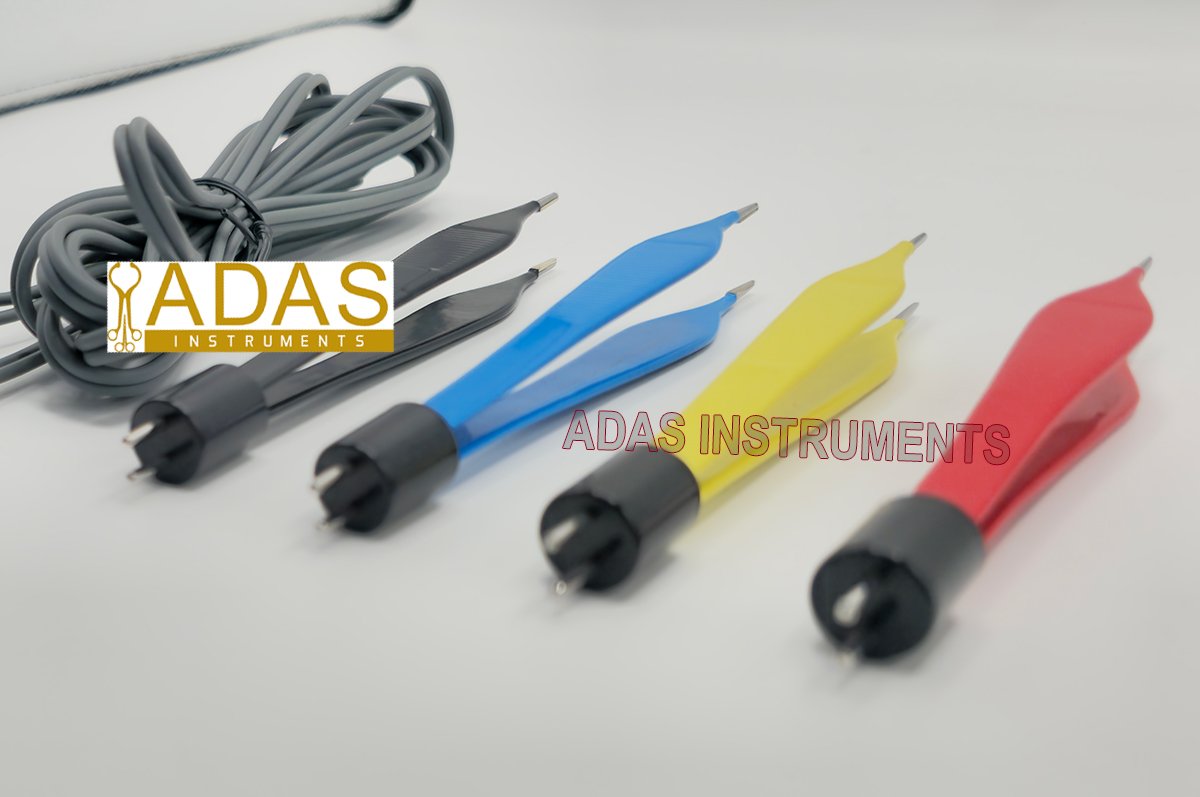
Aug
Covered here: insulated surgical instruments. Current finds the shortest path, not the planned one.
Every OR that runs electrosurgery owns this risk: bare steel instruments in a field where current flows. Insulated surgical instruments answer it with a bonded coating that keeps energy where the surgeon aims it, and knowing when insulation is mandatory versus optional separates safe theatres from lucky ones. Here is the working guide.
How Instrument Insulation Works
A dielectric polymer coating covers the instrument shaft, leaving only the working tip conductive or, on purely mechanical instruments, nothing at all. The coating blocks two failure modes: direct coupling, where an energized electrode touches another instrument and current jumps to unintended tissue, and capacitive coupling in tight fields. Coating integrity is the entire safety story, which is why inspection matters more than age.
Where Insulated Patterns Are Standard
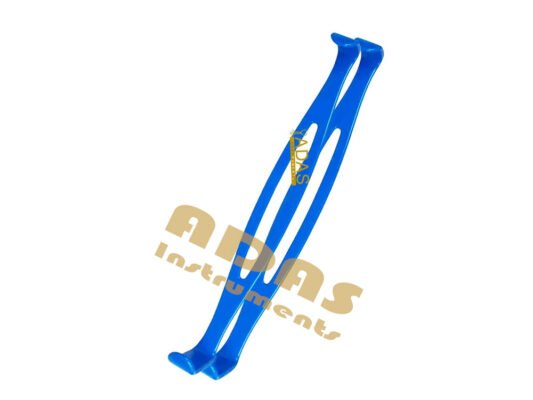
Retractors holding a field where monopolar works nearby (our insulated Army-Navy set exists for exactly this), forceps that grasp while the pencil coagulates against them (buzzing the forceps, done properly through insulated patterns only), suction tips active near the electrode per our suction guide, and everything in minimal-access surgery where instruments cross unseen. The bipolar vs monopolar guide covers the energy logic behind the risk.
Inspection: The Coating Is a Consumable
Insulation fails by nick and abrasion, invisibly at glove level: inspect coatings under magnification at every reprocessing cycle, and retire any instrument with a breach, because a pinhole concentrates current into a burn smaller and deeper than any surgeon intends. Formal insulation testers earn their cost in laparoscopic sets; visual-plus-magnification discipline covers open-field instruments.
Buying Notes
Look for bonded coatings rated for repeated autoclaving (peeling paint is not insulation), clear delineation of the conductive tip, and pattern-for-pattern equivalence with your standard tray so surgeons swap without relearning. Coated instruments cost more once and prevent injuries that cost careers.
Insulated Surgical Instruments and How the Coating Works
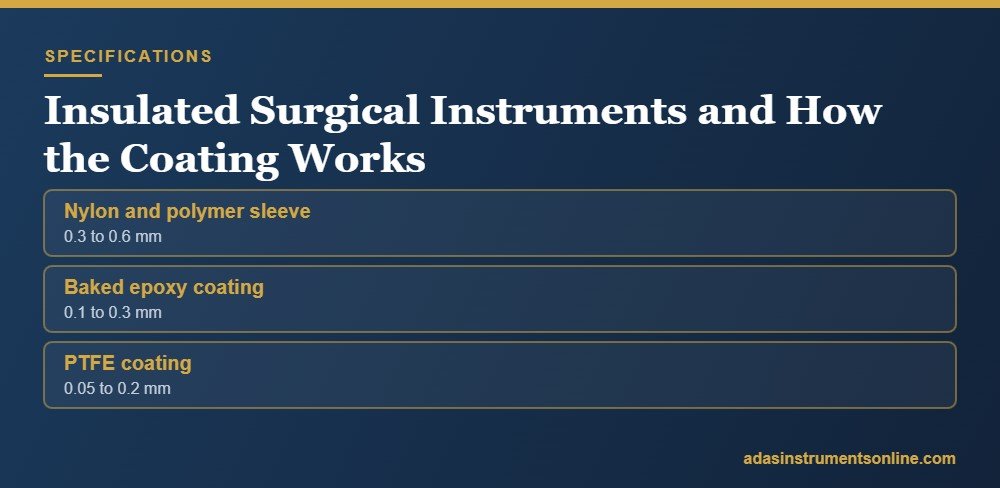
Insulated surgical instruments exist because current takes the shortest path to ground, not the path the surgeon intended. The coating decides where that path can start, and the table below sets out what each type is actually rated to do.
| Insulation type | Typical thickness | Durability | Where it suits |
|---|---|---|---|
| Nylon and polymer sleeve | 0.3 to 0.6 mm | Good, replaceable | Laparoscopic shafts |
| Baked epoxy coating | 0.1 to 0.3 mm | Moderate | Bipolar forceps handles |
| PTFE coating | 0.05 to 0.2 mm | Moderate, low friction | Fine bipolar tips |
| Ceramic coating | 0.1 to 0.2 mm | High, heat resistant | Tips near active electrode |
| Silicone sheath | 0.5 to 1 mm | Low, single use | Temporary shielding |
| Full body dip | Variable | High | Retractors and forceps bodies |
How Insulation Fails Without Anyone Noticing
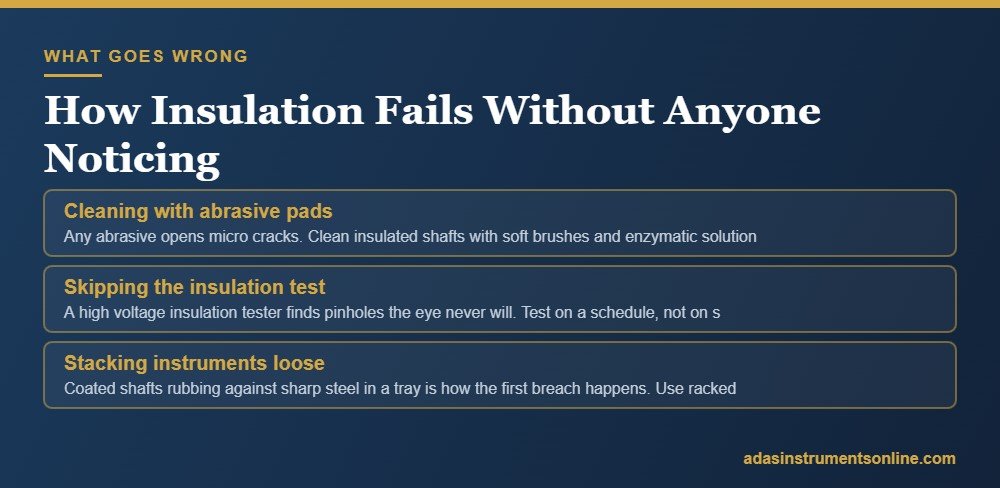
Insulation failure is invisible until it burns something. Five habits cause most of the pinholes and most of the injuries that follow.
- Cleaning with abrasive pads. Any abrasive opens micro cracks. Clean insulated shafts with soft brushes and enzymatic solution only.
- Skipping the insulation test. A high voltage insulation tester finds pinholes the eye never will. Test on a schedule, not on suspicion.
- Stacking instruments loose. Coated shafts rubbing against sharp steel in a tray is how the first breach happens. Use racked trays.
- Using a higher power setting than needed. Higher voltage finds smaller defects. Coagulation waveforms stress insulation far more than cutting.
- Mixing coated and uncoated in one field. An uncoated instrument touching an active tip becomes an electrode. Keep the field consistent.
Specifying Insulated Instruments
Ask what the insulation is, not just that it exists. Specify the coating material, the covered length in millimeters, and whether the coating is rated to survive the sterilization cycle you actually run. The underlying instrument should still be high quality medical grade stainless steel, because the coating protects the field, not the instrument. Our electrosurgery instruments range lists coated patterns with their covered lengths.
Custom coating lengths, alternative colors for tray identification, recoating of existing instruments and practice or distributor marking are available on request, and matched bipolar sets can be built to a written list. Production time on custom work is 10 to 15 working days, normally 15 working days depending on order size. General device safety expectations are published on the US FDA medical device pages.

Where Insulated Instruments Sit in the Set
Insulated surgical instruments are usually a subset of a normal tray rather than a tray of their own. Bipolar forceps sit with the dressing and tissue forceps, and the coated retractors sit with everything else, which is exactly why they need a racked position rather than a loose one.
Because the coating is the safety feature, storage matters as much as use. Most practices move coated items into a dedicated case from the holloware and sterilization range and inspect them at the point of packing rather than at the point of use, when it is already too late to swap.
Hardening your electrosurgery field? Insulated retractors, forceps and suctions in coated medical grade steel.
Frequently Asked Questions
What are insulated surgical instruments?
Instruments whose shafts carry a bonded dielectric coating so electrosurgical current cannot jump from them to unintended tissue, leaving only the intended tip conductive.
When must insulated instruments be used?
Wherever energized electrodes and steel share a tight field: retractors near monopolar work, forceps that are buzzed for coagulation, active suction beside the pencil, and all minimal-access surgery.
How often should insulation be checked?
Every reprocessing cycle, under magnification, with formal testers for laparoscopic sets: coating breaches are invisible in use and every breach is a potential burn.
How often should insulated instruments be tested?
Before every reprocessing cycle if a tester is available, and at minimum on a documented periodic schedule. Insulation failures are progressive, so an instrument that passed last month can have a pinhole today after a single abrasive clean.
What is capacitive coupling?
Energy transferring through intact insulation into a nearby conductive instrument or tissue, without any break in the coating. It is one reason insulation alone is not a complete safety strategy and why power settings and field layout still matter.
Can damaged insulation be recoated?
Yes for many patterns. Recoating restores the barrier at a fraction of replacement cost, but the instrument must be inspected and tested afterwards. Instruments with underlying pitting or joint wear are better replaced than recoated.
Does insulation survive autoclaving?
Quality coatings do, through hundreds of standard steam cycles. What kills them is mechanical damage in the tray and abrasive cleaning, not the cycle itself, which is why racked storage extends coating life more than anything else.
