
Breast Fat Grafting Cannulas: Composite Augmentation Tools
Oct
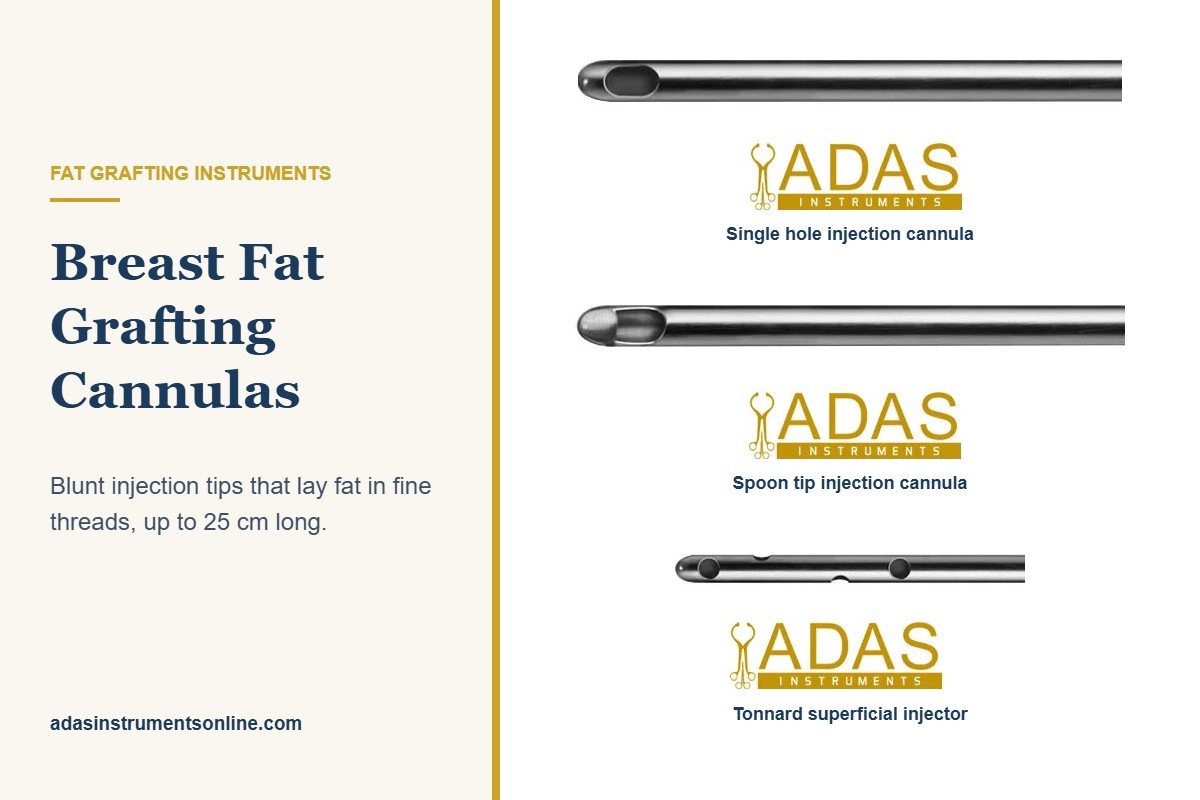
Breast fat grafting cannulas are long, blunt injection cannulas that lay purified fat through the breast in fine threads, either beside an implant in composite augmentation or on their own. Surgeons work from 2 to 4 small ports at the inframammary fold and the areola. Adas Instruments makes blunt single hole injection cannulas up to 1.6 mm (16 gauge) and 25 cm long, in high quality medical grade stainless steel, listed in our fat injection cannula range.
Fat grafting to the breast, whether composite augmentation alongside an implant, or full autologous augmentation, has moved from fringe to mainstream, and it demands its own injection instruments: long, blunt, multi-plane cannulas that distribute fat in fine threads across a large three-dimensional volume without pooling. This guide covers the sizes, planes and tray that breast work asks of them.
Key takeaways
- Breast grafting uses long blunt injection cannulas of 15 to 25 cm, so a few ports reach the whole breast.
- Fat goes in on the withdrawal stroke, in thin threads, never as a pool.
- Harvest runs through a wider 3 to 4 mm bore; injection through a fine 1.4 to 1.6 mm blunt bore.
- The accepted planes are subcutaneous, retromammary and pectoral, not the breast tissue itself.
Why Breast Grafting Cannulas Differ
Volume retention in the breast depends on distributing fat in countless fine tunnels, each parcel close to a blood supply, never in pools that necrose into oil cysts and calcifications. That means long injection cannulas (15 to 25 cm) reaching the whole breast from few ports, blunt tips crossing planes safely around gland and implant, and controlled fine delivery per pass, the retention-first logic that governs the whole transfer chain.
The Multi-Plane Technique
Grafting spans subcutaneous, retromammary and pectoral planes in a fan from inframammary and periareolar ports, layering fine threads on withdrawal. Cannula length lets few ports reach every plane; blunt tips make the plane crossings safe, especially in composite cases where an implant is already in the pocket per the breast surgery guide. Larger-bore delivery than facial work, finer than gluteal, the breast sits in the middle of the injection-cannula range.
Harvest and Processing Pairing
Breast volumes are significant, so harvest runs at the Toomey volume end while injection stays controlled: the harvest-process-inject chain scaled for hundreds of milliliters, with viability discipline throughout since breast graft results are judged in retained volume at a year.
Buying Notes
Stock breast fat grafting cannulas in 15 to 25 cm blunt patterns, luer or Toomey hubs to match the syringe system, and confirm side-port versus end-port delivery for the surgeon’s technique. Composite cases add the caution of implant-safe blunt tips, a specification worth stating on the order.
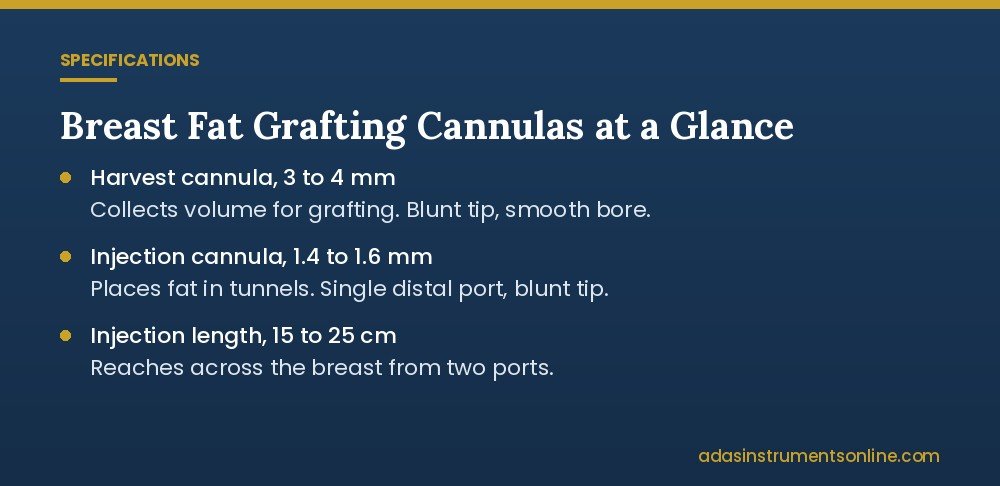
Breast Fat Grafting Cannulas at a Glance
Breast fat grafting cannulas are chosen for volume with control: wide enough that the parcels pass without shearing, blunt enough to stay out of vessels and long enough to reach across the breast from two ports.
| Item | Typical size | Role | What to check |
|---|---|---|---|
| Harvest cannula | 3 to 4 mm | Collects volume for grafting | Blunt tip, smooth bore |
| Injection cannula | 1.4 to 1.6 mm (17 to 16 gauge) | Places fat in tunnels | Single distal port, blunt tip |
| Injection length | 15 to 25 cm | Reach across the breast | Long enough for two port access |
| Syringe | 10 cc with Toomey or luer | Controlled delivery | Fitting matches the cannula |
| Delivery rate | Fat on withdrawal only | Prevents pooling | Never inject on the advance |
| Layers | Subcutaneous, retromammary and pectoral planes | Distributes volume | Stay out of breast parenchyma |
| Ports | 2 to 4 around the breast | Crossing tunnels | Inframammary fold hides them well |

Shop fat grafting cannulas direct from the maker
Adas Instruments makes the blunt single hole injection cannula from 0.7 to 1.6 mm, in lengths up to 25 cm, alongside spoon tip, V tip and Tonnard superficial injectors and a fat injection gun for 10, 20, 50 and 60 cc syringes. Wholesale pricing for clinics and distributors, branded or plain.
Buy fat grafting cannulas now or try the single hole cannula
Common Mistakes in Breast Fat Transfer
Graft survival is decided by how the fat is placed, not by how much is placed. Five points matter.
- Injecting in boluses. Large pools outrun their blood supply and become the oil cysts that show up on later imaging.
- Injecting on the advance. Fat should be laid down on withdrawal, which is what keeps the ribbon thin and evenly spread.
- Using a sharp needle. A blunt cannula is the standard for a reason: it displaces vessels rather than entering them.
- Placing into parenchyma. Grafting into breast tissue complicates future imaging; the subcutaneous and pectoral planes are the accepted targets.
- One port only. Single direction tunnels stack on each other, so use two to four ports and cross the passes.
Ordering a Breast Grafting Cannula Set
A breast set is usually two or three injection bores in two lengths, plus matched harvest cannulas and adapters. All of it is made in high quality medical grade stainless steel, with hub standards matched to your syringes and branded or plain marking for clinics and distributors.
Composite augmentation and fat transfer to the breast continue to grow as a share of aesthetic practice, which the annual statistics from the American Society of Plastic Surgeons track directly. When you order, buy the injection bores together from the fat grafting and injection cannula range so the sizes step evenly rather than overlapping.
What Else Belongs on the Breast Grafting Tray
Breast fat grafting cannulas share a tray with the wider breast instrument set, because the same case often involves dissection, retraction and closure. Those items come from the breast surgery instrument range rather than from the liposuction shelf.
The donor side is a full liposuction setup in its own right, with wetting, harvest and refinement passes at the abdomen or thighs. Keep it stocked from the aspiration cannula range, and remember that the donor contour is judged by the patient just as closely as the recipient result.
Frequently Asked Questions
What cannulas are used for breast fat grafting?
Breast fat grafting cannulas are long blunt injection cannulas of 15 to 25 cm. They reach the whole breast from a few small ports and lay fine threads of fat across the subcutaneous, retromammary and pectoral planes without pooling.
What size cannula is used for breast fat grafting?
Injection is usually done with fine blunt cannulas, our range running up to 1.6 mm (16 gauge) and 25 cm long, while harvest uses 3 to 4 mm blunt tips. The wider harvest bore protects the parcels; the blunt injection tip protects the vessels.
Are special cannulas needed for composite augmentation?
Blunt tips matter most when grafting around an existing implant, because the cannula has to cross planes close to the device. Confirm a blunt atraumatic tip on the order rather than assuming it.
Why must fat be injected on withdrawal?
Injecting while advancing pushes fat ahead of the cannula into a pool. Laying it down on the withdrawal stroke leaves a thin ribbon in a tunnel already made, which is what lets the graft pick up a blood supply.
Should fat be placed inside breast tissue?
The accepted planes are subcutaneous, retromammary and along the pectoral muscle rather than within the breast tissue itself, partly for graft survival and partly to keep future imaging easy to read.
