
Types of Thumb Forceps: Adson, DeBakey and More
Oct
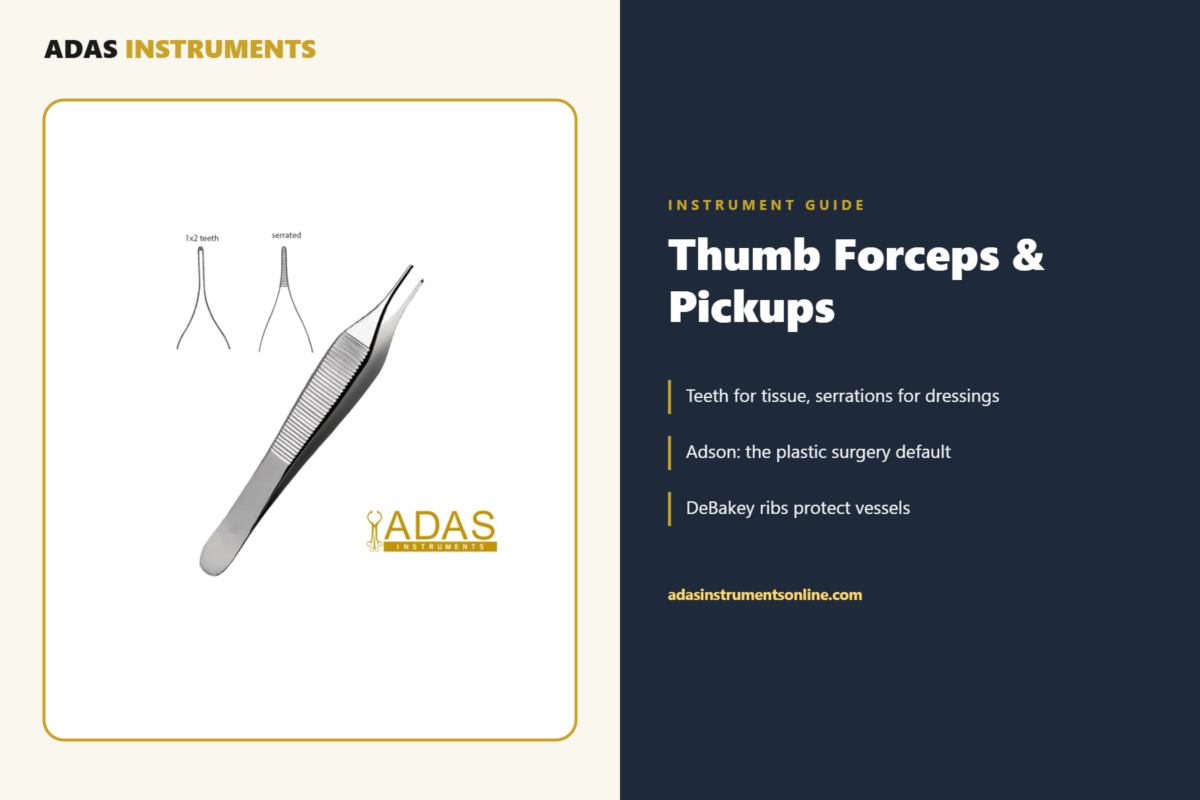
Thumb forceps are spring handled forceps with two arms joined at one end, held like a pencil and closed by finger pressure to grip tissue, needles, dressings or sutures. The types of thumb forceps split by the tip: toothed tissue forceps hold skin and fascia, while serrated dressing forceps handle delicate tissue and gauze. Adas Instruments makes 19 patterns in high quality medical grade stainless steel, from an 11.5 cm dressing thumb forceps to 30 cm, listed with our dressing and tissue forceps.
In US operating rooms they are called pickups, and a surgeon holds a pair in the non dominant hand for most of a closure. This guide sorts the main types of thumb forceps by tip and by length, so a tray can be built without guessing.
Key takeaways
- Every thumb forceps is either toothed or smooth. Teeth grip skin firmly but mark it; serrations are gentler and suit vessels and bowel.
- Rat tooth thumb forceps carry a 1×2 tip: one tooth on one side seats between two on the other.
- The Adson, at 12 cm, is the standard plastic surgery pickup. The DeBakey, from 15 to 25 cm, is the standard atraumatic one.
- Length follows depth. Short forceps for skin and face, long forceps for deep cavities.
What Are Thumb Forceps?
A thumb forceps has no ratchet and no box joint. The two arms are welded or brazed together at the heel, and the spring of the steel holds the tips apart until the fingers close them. Let go and they open. That simple action is the point: the surgeon can grip and re grip tissue dozens of times a minute with nothing to lock open.
The grip matters as much as the tip. Thumb forceps are held between the thumb and the first two fingers, like a pen, with the arms resting in the web of the hand. Held in the palm like a pair of tongs, they crush tissue and tire the hand fast. Most handles carry cross serrations or a flat grip zone so wet gloves do not slip.
Toothed or Smooth: The First Choice
Tissue forceps with teeth hold by small interlocking points at the tip. The classic is the 1×2 pattern, also called rat tooth thumb forceps: a single tooth on one arm drops between two teeth on the other. The teeth spread the load over a few points instead of the whole jaw, so a toothed forceps needs less squeeze to hold skin, which in practice means less crushing. Teeth belong on skin and fascia.
Smooth or serrated forceps, often sold as dressing forceps, have fine cross grooves instead of teeth. They are kinder to soft structures but need more pressure for the same hold, so they slip on skin. Bowel, vessels, nerves and gauze are their jobs. The DeBakey vascular forceps sits between the two: rows of fine longitudinal ridges that grip a vessel wall without puncturing it, which is why it became the default atraumatic pickup in vascular and general surgery.
A useful rule on our side of the bench: if a buyer cannot tell us the tissue, we send toothed for the plastics tray and DeBakey for the general tray. Those two cover most of what a surgeon will reach for.
The Main Types of Thumb Forceps
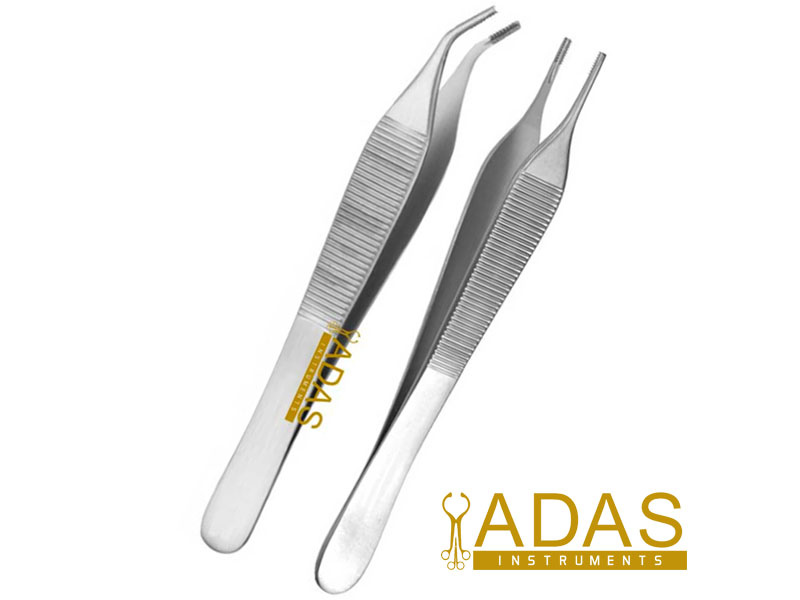
Most catalogs list dozens of names, but the working set is small. The Adson forceps has a narrow tip on a wide, flat thumb grip, so it is precise at the tip and comfortable in the hand. It is 12 cm or 15 cm, toothed or serrated, and is the pickup most plastic surgeons close skin with. The Adson Brown forceps keeps the Adson body but adds rows of tiny teeth, 7×7 or 9×9, along each side of the tip. Many fine points instead of three spread the grip further, which is why plastic surgeons prefer it on facial skin that marks easily.
For finer work the scale drops. The Bishop Harmon forceps has 0.4 mm or 0.6 mm tips and a fenestrated handle for eyelid and microsurgery. The micro Adson forceps offers 0.3, 0.5 or 0.9 mm tips. The Castroviejo suture forceps adds a tying platform behind the 1×2 teeth so the same instrument holds tissue and ties fine sutures. The Gillies tissue forceps is the longer 1×2 plastic surgery pickup with a broad grip. The Cushing tissue forceps is long and slim for deep work, and Russian thumb forceps, with a rounded cupped tip, are used in gynecology and general surgery for bulky tissue.
Types of Thumb Forceps Compared
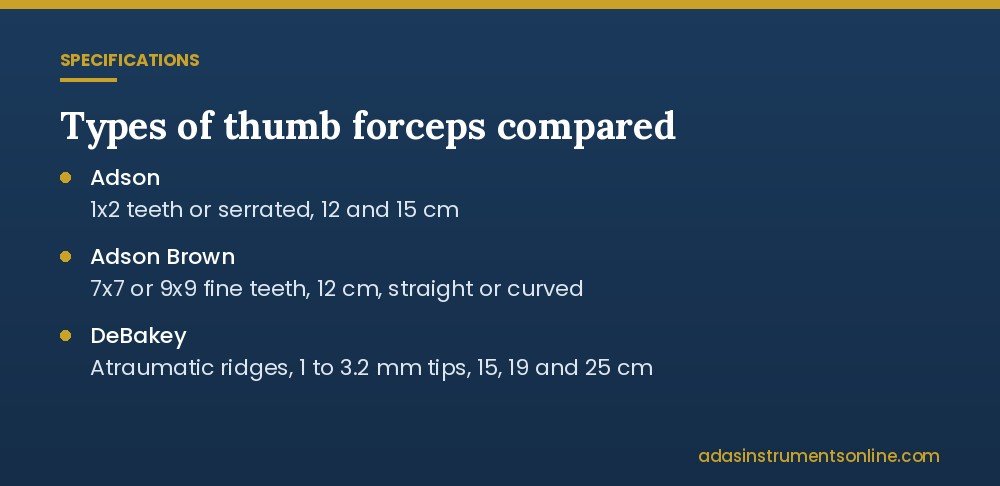
| Pattern | Tip | Lengths we make | Typical use |
|---|---|---|---|
| Adson forceps | 1×2 teeth or serrated | 12 and 15 cm | Skin closure, plastics, general |
| Adson Brown | 7×7 or 9×9 fine teeth | 12 cm, straight or curved | Facial and delicate skin |
| DeBakey forceps | Atraumatic ridges, 1 to 3.2 mm | 15, 19 and 25 cm | Vessels, bowel, general surgery |
| Dressing thumb forceps | 1×2 teeth or serrated | 11.5 to 30 cm | Dressings, packing, general tissue |
| Gillies forceps | 1×2 teeth or serrated | Standard or carbide jaws | Plastic surgery handling |
| Bishop Harmon | 0.4 or 0.6 mm, teeth or serrated | Fine, fenestrated handle | Eyelid and microsurgery |
| Castroviejo suture | 1×2 teeth, tying platform | 12 cm, 0.3 to 0.9 mm tip | Fine suturing |
Buy thumb forceps direct from the maker
All seven patterns in the table are made in the Adas Instruments workshop, with tungsten carbide jaws on the Adson, Adson Brown and Gillies. Dressing thumb forceps from 8 dollars, Adson from 8.50. Wholesale pricing for clinics and distributors, plain or laser marked.
Choosing the Length
Length follows depth, not hand size. For skin on the face or hands, 12 cm is right: an Adson or Adson Brown keeps the fingers close to the work and the tips steady. For breast, abdominal wall and general soft tissue, 15 to 18 cm gives reach without wobble. In deep pelvic, chest or abdominal cavities, 20 to 30 cm forceps reach the tissue without the surgeon’s hand blocking the view. Our dressing thumb forceps runs the whole range, 11.5, 14, 15, 16, 18, 20, 25 and 30 cm, so one pattern can be stocked at several depths.
A longer forceps also needs a stiffer spring, or the tips flex apart under load. That is one reason not to buy a long forceps on price alone: a soft 25 cm pair closes at the handle and stays open at the tip.
Tungsten Carbide Jaws
Teeth and serrations wear. After many cycles a steel 1×2 tip rounds off and starts to slip, and the surgeon squeezes harder to compensate. A tungsten carbide insert at the tip holds its edge far longer and can be replaced or re tipped instead of retiring the whole instrument. We make carbide versions of the carbide Adson, the carbide Adson Brown and the Gillies. For a teaching hospital or a busy day surgery unit that runs the same pickups every day, the carbide version usually costs less per year than buying steel twice.
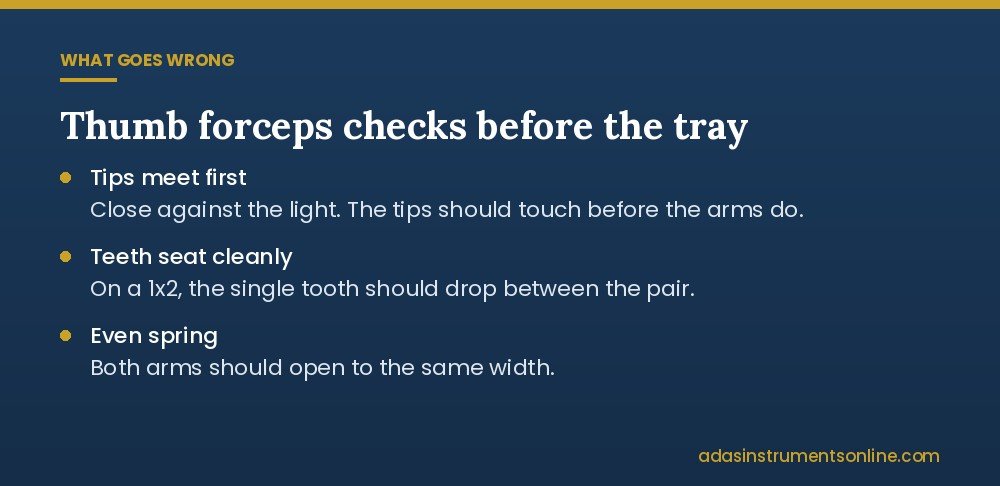
What to Check Before a Thumb Forceps Goes on the Tray
- Tips meet first. Close the forceps gently against the light. The tips should touch before the arms do, with no gap along the tip.
- Teeth seat cleanly. On a 1×2, the single tooth should drop between the pair without riding on top. Teeth that clash will tear tissue.
- Even spring. Both arms should open to the same width and feel the same under the fingers. A weak arm makes the tips cross.
- No burrs. Run a gauze swab over the tips. A burr that catches cotton will catch tissue.
- Clean serrations. Dried protein hides in the grooves. Brush them open before the autoclave, not after.
Every pair leaves our bench after the first three checks, but the last two are the ones that fail in use. Our autoclave temperature and time guide covers the cycle, and the wider forceps family is set out in our guide to hemostats and surgical forceps.
Ordering Thumb Forceps
Pickups are bought in pairs or by the dozen, because every tray holds at least two and some hold six. Adas Instruments ships them with the rest of the dressing and tissue forceps range, plain or laser marked with a clinic or distributor name, by DHL or FedEx. For quotes and WhatsApp orders, message +92 321 6126225. Teams writing their own instrument handling policy often start from the perioperative guidance published by AORN.
Frequently Asked Questions
What are thumb forceps used for?
Thumb forceps grip and hold tissue during dissection and suturing, steady a needle as it passes, and handle dressings and packing. The surgeon holds them like a pen in the non dominant hand and closes them by finger pressure, with no ratchet to set.
What is the difference between thumb forceps and tissue forceps?
Thumb forceps is the family name for all spring handled pickups. Tissue forceps are the toothed members of that family, made to hold skin and fascia. Dressing forceps are the smooth or serrated members, used for gauze and delicate tissue.
What are rat tooth thumb forceps?
Rat tooth thumb forceps have a 1×2 tip: one sharp tooth on one arm that seats between two teeth on the other. The teeth hold skin and tough tissue with less squeeze than a smooth tip, so they are a standard choice for skin closure.
Are DeBakey forceps toothed or smooth?
DeBakey forceps are atraumatic. Instead of teeth they carry fine longitudinal ridges that grip a vessel or bowel wall without puncturing it. Tips run from about 1 mm to 3.2 mm, and lengths from 15 to 25 cm.
What size thumb forceps do plastic surgeons use?
Most plastic surgery skin work uses 12 cm forceps, usually an Adson or Adson Brown, with fine 0.3 to 0.6 mm tips for eyelid and microsurgery. Longer 15 to 18 cm forceps are kept for breast and body contouring.
