

Gillies Tissue Forceps, 1×2 Teeth and Serrated Jaws
Price range: $ 12.00 through $ 18.00
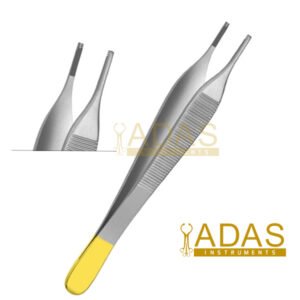
Gillies dissecting forceps are non locking thumb forceps used in plastic and reconstructive surgery to hold a skin edge steady while it is cut or stitched. At about 15 cm they run longer and narrower than an Adson, so the tips reach into a deeper or tighter field while the hand stays clear of the work. That reach is why the pattern turns up well past facial surgery, on hand lists, on dermatology lists and anywhere a fine wound edge has to be held exactly where the needle is going.
Key Features
- 1×2 teeth or fine cross serrations, specified on the order
- Standard steel or tungsten carbide inserts on the working faces
- About 15 cm, longer and narrower than an Adson pattern
- No lock and no ratchet, so the grip stays under finger control
- High quality medical grade stainless steel, passivated and boil tested
- Satin finish, no glare under an operating room lamp
- Reusable and fully autoclavable
- Item code AC-31.16

What Gillies dissecting forceps are
Gillies dissecting forceps are a slim non locking thumb forceps, about 15 cm long, with either two fine teeth against one or a cross serrated jaw. There is no box lock, no ratchet and no ring handle: the arms close under finger pressure and spring open when you let go. They are made by Adas Instruments, reusable and fully autoclavable.
The pattern carries the name of Harold Gillies, the surgeon who built much of modern facial reconstruction, and it is still a plastic surgery instrument first. Catalogs also list it as gillies tissue forceps, as a gillies skin forceps and as a gillies dissecting forceps, and orders arrive under all three.
Everything about the shape serves one job. A wound edge has to be held still, in one exact place, without being crushed, for as long as it takes to put a stitch through it. A toothed jaw does that by holding rather than squeezing, and a hand that can feel the pressure does it better than a mechanism that cannot.
Adson vs Gillies forceps, the comparison buyers actually make
This is the comparison that decides the order, so it is worth being plain about.
The two instruments do the same job. Both are non locking toothed thumb forceps for skin, both come in 1×2 teeth, and in most closures either one would work. The difference is the body, not the jaw.
A Gillies is the longer instrument with a narrower shank. The extra length puts the hand further from the tips, which helps when the field is deeper than the skin surface or when a retractor is already occupying the space, and many surgeons simply find the longer body easier to balance. An Adson is shorter with a broad thumb grip and is quicker to pick up and put down, which is why it dominates straightforward surface closure.
- Two jaws. 1×2 teeth for skin, serrated for anything a tooth would tear.
- Two tip faces. Standard steel, or tungsten carbide for a grip that lasts.
- About 15 cm. Longer and slimmer than an Adson.
- No lock. A pure thumb forceps, pressure under finger control.
Jaw and tip face, and what each is for
Two choices on this page, and between them they decide what the instrument can safely touch.
| JAW | TIP FACE | WHAT IT IS FOR | ITEM CODE |
|---|---|---|---|
| 1×2 teeth | Standard steel | Skin edges in routine closure | AC-31.16 |
| 1×2 teeth | Tungsten carbide | Daily skin closure, the bite lasts longer | AC-31.16 |
| Serrated | Standard steel | Thin flap edges and mucosa | AC-31.16 |
| Serrated | Tungsten carbide | High turnover lists on delicate tissue | AC-31.16 |
| Serrated | Standard steel | Dressing and suture material | AC-31.16 |
Nothing is listed there that we do not build. The jaw and the tip face are specified on the order rather than carried as separate item codes, so tell us which pair you want.
Where these are used
Gillies dissecting forceps go wherever a fine wound edge has to be held exactly still.
| SPECIALTY | WHAT THE FORCEPS IS DOING THERE |
|---|---|
| Plastic and reconstructive surgery | Skin flap edges held while they are trimmed and closed |
| Facial cosmetic surgery | Fine facial skin held without crushing the edge |
| Hand surgery | Small incisions where a shorter instrument crowds the field |
| Dermatologic surgery | Excision margins and small closures |
| General surgery | Soft tissue held under gentle traction |
| ENT surgery | Fine tissue work through a narrow opening |
| Teaching hospitals | A longer body teaches a steadier pencil grip |
The pattern travels past facial surgery for the same reason it was designed. Holding a delicate edge without marking it is a problem in a lot of specialties, and a long slim toothed forceps answers it the same way every time.
What you are holding, and what to ask for
Match the jaw to the tissue and this instrument will not damage anything by accident.
| WHAT YOU ARE HOLDING | WHAT TO ASK FOR | WHY |
|---|---|---|
| Facial skin edge | 1×2 teeth, standard | Teeth hold the edge without squeezing it flat |
| Skin graft edge | Serrated | A tooth perforates a graft, friction does not |
| Subcutaneous fat | 1×2 teeth | Enough purchase on tissue that slides |
| Thin flap margin | Serrated | A wide face spreads the load along the edge |
| Mucosal margin | Serrated | Mucosa tears on teeth |
| Dressing material | Serrated | Gauze shreds on teeth |
| Daily closure lists | Tungsten carbide | The teeth keep their bite far longer |
Ordering one pair? Take 1×2 teeth in standard steel. It is the pair that gets picked up most on a closure list. Ordering two? Make the second a serrated jaw, and between them skin, graft and mucosa are all covered.
How it compares with the neighbours
These are the instruments buyers weigh against each other before the order goes in.
| INSTRUMENT | LENGTH AND JAW | WHEN YOU REACH FOR IT |
|---|---|---|
| Gillies dissecting forceps | About 15 cm, slim shank, 1×2 teeth or serrated | Skin edges in a deeper or narrower field |
| Adson forceps | Shorter, wide thumb grip, 1×2 teeth | Fast surface closure at the skin |
| Adson Brown forceps | Short grip, many fine teeth in rows | Delicate skin flaps in plastics |
| Cushing tissue forceps | Long slender shank, carbide faces | Deep narrow fields, neurosurgery first |
| Dressing thumb forceps | Plain serrated jaw, many lengths | Dressings and packing, never skin closure |
Two things gillies dissecting forceps will not do. They will not beat an adson forceps for speed on a straightforward surface closure, where the short wide grip wins. And they will not reach the bottom of a cranial or spinal opening, which is what a cushing tissue forceps is built for.
Materials and finish
Every pair of gillies dissecting forceps is made in high quality medical grade stainless steel, with tungsten carbide inserts brazed into the working faces where that option is taken. The steel itself is made to a German specification. Every pair is passivated and boil tested before packing, and the finish is satin rather than mirror so there is no glare under a lamp.
On a toothed forceps the teeth decide the working life. Two teeth have to drop cleanly between the opposing two, and a pair that has been dropped or sprung will meet at one corner instead of engaging. Close the jaws slowly against a bright light before each list and look at where the teeth land.
Care and sterilization
Rinse in cool water straight after use so nothing dries in the serrations or between the teeth. Clean with a neutral pH enzymatic detergent and an ultrasonic bath, rinse in deionized water, dry fully, then steam autoclave at 134 degrees Celsius.
Do not run a wire brush over carbide faces. Store the instrument tip protected and flat, because a slim shank stored loose in a drawer is the commonest way this pattern is ruined. Retire any pair whose teeth no longer interlock cleanly.
Ordering and wholesale
Gillies dissecting forceps are supplied by Adas Instruments to hospitals, surgical distributors and OEM buyers, in single units and in bulk. The item code is AC-31.16 and it is printed in the jaw table above so a procurement search finds it. Backorder items dispatch in 10 to 12 working days, and every instrument carries a three year replacement against manufacturing defects.
For wholesale and OEM orders, instruments ship unpackaged in bulk or individually poly bagged, and laser marking with a distributor code or a hospital asset number is available on the shank. Tell us the jaw, the tip face and the quantity, and the quotation comes back with the lead time for that run.
Production is controlled under an ISO 13485 quality management system.
Frequently asked questions
What are Gillies tissue forceps used for?
Holding skin edges and fine tissue while they are cut or sewn, mostly in plastic and reconstructive surgery, facial work, hand surgery and dermatology. The jaw takes the wound edge, the other hand takes the needle, and the forceps holds the edge still until the stitch is through.
What is the difference between Gillies forceps and Adson forceps?
Length and the way it sits in the hand. Both are non locking toothed thumb forceps for skin, and the jaw patterns overlap. A Gillies is the longer of the two with a narrower shank, which reaches a little further and suits a deeper or narrower field, and a lot of surgeons find the longer body easier to balance. An Adson is shorter with a wider thumb grip and is the faster instrument at the surface.
Should I order the 1×2 teeth or the serrated jaw?
Teeth for skin and anything that must not slide. One tooth drops between two, so the edge is held rather than squeezed, which is why toothed forceps are the skin closure instrument. Serrated for anything you would tear with a tooth, a thin flap edge, mucosa, or a dressing. Tell us which on the order and we build that jaw.
What does the tungsten carbide option change?
How long the grip lasts, not what the instrument does. Carbide inserts are brazed into the working faces and they are harder than the surrounding steel, so the teeth keep their edge where a plain steel jaw slowly polishes smooth. On a pattern that gets picked up every day that is the difference between a year and several.
What does a Gillies forceps look like?
A slim straight instrument about 15 cm long, two flat arms joined at the top, no box lock, no ratchet and no ring handles. Near the tip the arms narrow to the jaw, which carries either two fine teeth against one, or cross serrations. Held like a pencil between thumb and forefinger, closed by finger pressure alone, and open the moment you let go.
Related products and categories
Buyers usually compare gillies dissecting forceps against the adson brown forceps, which trades the two teeth for rows of many fine ones. The pattern sits in dressing and tissue forceps, and it is also listed under facelift and neck lift instruments.
| Weight | 0.04 kg |
|---|---|
| Tip options | Standard, Tungsten Carbide |
| Select Fig | Serrated, Serrated 1 X 2 teeth |
Be the first to review “Gillies Tissue Forceps, 1×2 Teeth and Serrated Jaws”
Shipping & Delivery Policy
Processing Time: In-stock items are dispatched within 24-48 hours. For custom or out-of-stock items, production time is approximately 10-15 days.
Global Delivery Estimates
We partner with world-class couriers (DHL, FedEx) to ensure fast, tracked delivery.
- USA & Canada: 3-5 Business Days
- Europe & UK: 4-6 Business Days
- Rest of World: 5-7 Business Days
*We offer Air Cargo and Sea Freight options for bulk wholesale orders.
Customs & Duties
International buyers are responsible for any customs duties or taxes imposed by their country. Adas Instruments is not responsible for delays caused by customs clearance.
Lost Packages & Insurance
If your package is lost in transit, please contact us immediately. We offer full support and replacements for confirmed lost shipments. Note: You must report non-delivery within 3 weeks to be eligible for an insurance claim.
Related products

Reviews
There are no reviews yet.