
Tebbetts Breast Augmentation Retractor | Fiber Optic, Suction, Insulated, 4 Blade Sizes
$ 220.00
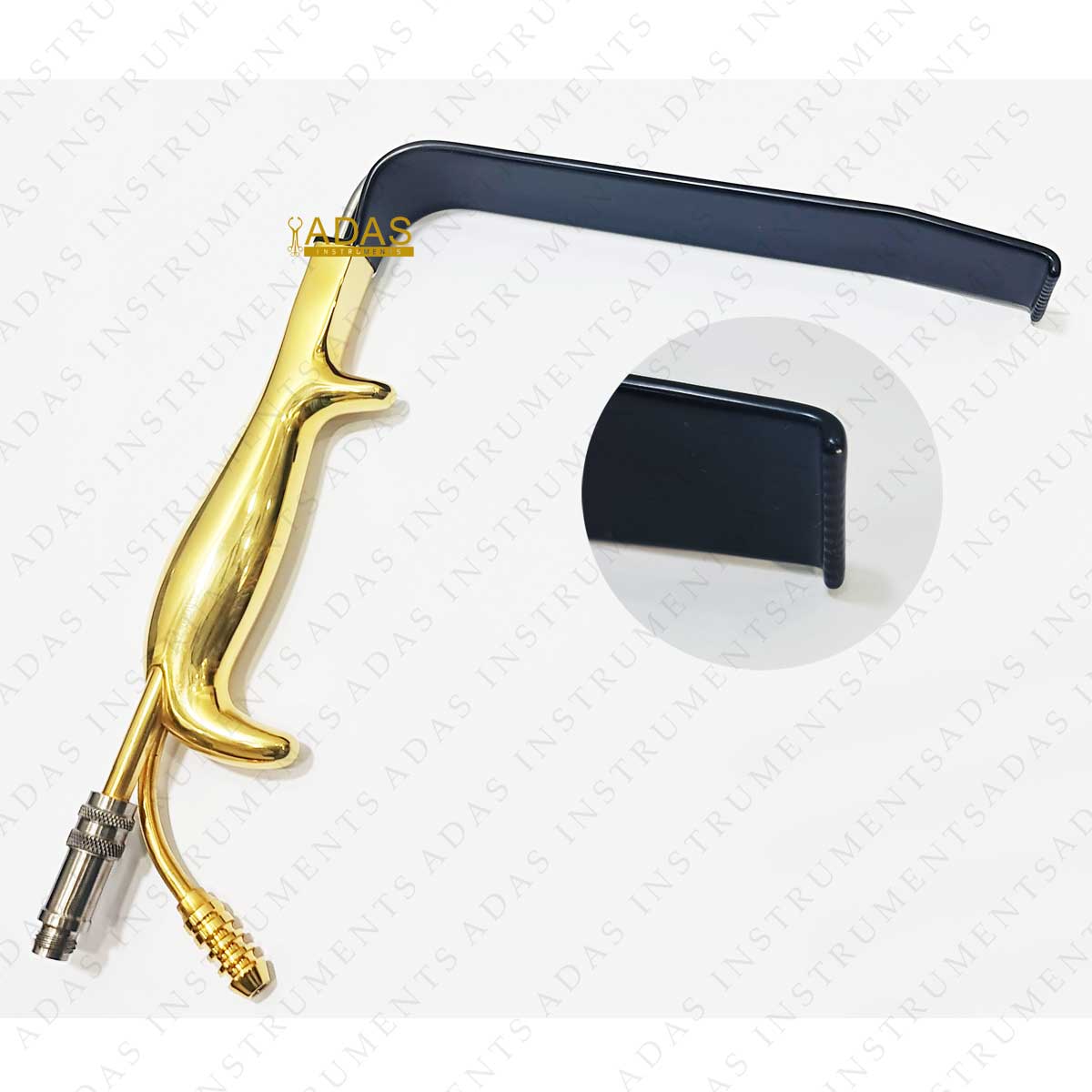
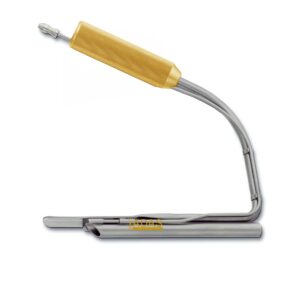
A breast augmentation retractor holds the breast flap and the lower edge of the pectoral muscle clear while the pocket for an implant is made underneath, and this is the Tebbetts pattern of it with everything built in: a fiber optic light guide, a suction channel and an insulated tip, on four blade sizes from 9 cm to 19 cm. The Tebbetts blade is angled rather than curved and it is the pattern that takes teeth at the tip, which is what you want when tissue slips under load. The insulation is here because an insulated blade will not carry heat or a stray arc from the cautery pencil into the tissue it is holding.
Key Features
- Fiber optic light guide, suction channel and insulated tip on one blade
- Insulation in black or blue
- Four blade sizes: 9 x 22 mm, 15 x 25 mm, 17 x 25 mm, 19 x 25 mm
- Angled Tebbetts blade, handle clear of the incision
- Cut from high quality medical grade stainless steel and fully autoclavable
- Three year replacement warranty against manufacturing defects
- Item code AP-103.279

What a breast augmentation retractor is
A breast augmentation retractor does one thing: it holds a flap of breast tissue, and usually the lower edge of the pectoral muscle, up and out of the way so that a pocket can be made underneath it. Every other feature on the instrument exists to make that one job survivable in a space that is deep, dark and reached through an opening smaller than itself.
There are two reusable patterns in general use and Google’s own description of the class names both. Tebbetts style is an angled blade with teeth or serrations available at the tip and ports for fiber optic light. Ferreira style is a smooth blunt curved blade for more delicate tissue planes. This page is the Tebbetts, with the light, the suction and the insulation all on the same blade.
Every breast augmentation retractor in this family does that one job and differs only in what is built into the blade. Dr John B Tebbetts described the approach these instruments are named for, and the name is used generically across the trade: one seller publishes it with a trademark symbol, another writes “Tebbetts style”, a third sells a Konig Tebbetts. We make it as a pattern name, which is what it is, and we claim no relationship with anyone.
The same instrument is listed as a Tebbetts fiber optic breast retractor, as a Tebbetts lighted breast retractor, and by one seller as a Tebbetts style endo breast retractor when it is sold for endoscopic work. They are three names for the blade on this page.
What the three built in features buy is set out plainly below, including the case for NOT buying this version. A retractor with a light, a channel and a coating has three things that need looking after, and a surgeon whose cautery pencil never touches the blade is paying for a coating he will not use.
Key design features
The angled blade
The Tebbetts blade is angled rather than curved along its length. The angle puts the working face flat against the flap while the handle sits outside the incision, and it gives a slightly more aggressive lift than a curve does for the same hand position. It is the reason this pattern is the one that takes teeth: the geometry already loads the tip.
Insulation, and where it stops
The coating runs over the tip and the shaft and stops back from the handle, because fingers need steel to grip. It is there so that an insulated blade will not carry heat or a stray arc from the cautery pencil into the tissue it is holding. Black and blue are the same coating in two colors, so two instruments on one tray can be told apart under a drape.
Light in, smoke out
The light guide runs inside the blade and exits at the working end. The suction channel runs on its own path with a port at the handle, and it is there because electrocautery inside a closed pocket makes smoke that has nowhere to go, and a suction channel on the blade clears it without a second instrument in the wound.
Four blade sizes, 9 cm to 19 cm
9 cm by 22 mm, 15 cm by 25 mm, 17 cm by 25 mm and 19 cm by 25 mm. The three longer blades share a 25 mm width and the short one is 22 mm. A 9 cm blade is not a compromise size: in a small pocket a 19 cm blade is levering off the far wall.
Which blade and which tip color to order
Two decisions. The blade is clinical and the color is only about telling two instruments apart.
| Choice | Options | How to decide |
|---|---|---|
| Blade | 9 cm x 22 mm | A shallow pocket, periareolar work, a small frame |
| Blade | 15 cm or 17 cm x 25 mm | Most primary augmentations |
| Blade | 19 cm x 25 mm | Transaxillary work, revision, reconstruction |
| Tip color | Black or blue insulated | Order two colors if you want a pair on one tray |
Where it is used
This is the version for cases where the pencil works along the surface the retractor is pressed against.
| Procedure | What it holds | Note |
|---|---|---|
| Breast augmentation | The flap and the lower pectoral edge | The operation the pattern is named for |
| Breast reduction | The pocket wall while the pedicle is shaped | Teeth help here; the tissue is denser |
| Implant exchange and capsulectomy | A scarred pocket under constant cautery | The clearest case for the insulated version |
| Mastectomy and reconstruction | A flap over an expander or implant | Order the 19 cm |
What it holds back, and what it must not do
The more a retractor carries, the more there is to trust too far.
| The task | What this retractor does | What it must not do |
|---|---|---|
| Working near cautery | The coating will not pass heat or an arc into the tissue it holds | It is NOT a reason to rest the pencil on the blade. Coatings wear invisibly |
| Holding dense tissue | An angled blade and, on the toothed pattern, grip at the tip | This version has no teeth axis on file. If you need teeth, order the toothed sibling |
| Clearing smoke | Takes plume as the cautery makes it | It is not a sump and will not clear a bleed |
| Lighting | Carries light from a source on the field | There is no bulb and no battery in it |
How it compares with the rest of the family
Three Tebbetts retractors and four Ferreiras sit on the same tray. Two questions settle it: teeth or blunt, and how much plumbing.
| Instrument | Tip | Light | Suction | Insulated |
|---|---|---|---|---|
| Tebbetts, this page | Smooth, angled | Yes | Yes | Yes |
| Tebbetts toothed tip | Toothed | Yes | Yes | No |
| Tebbetts double end | Two working ends | No | No | Optional |
| Ferreira fiber optic and suction insulated | Smooth, curved, blunt | Yes | Yes | Yes |
Materials and finish
Every Tebbetts breast augmentation retractor we make is cut from high quality medical grade stainless steel. The steel itself is made to a German specification. We do not publish a grade number. The number on a certificate tells a surgeon nothing about whether a coating is still unbroken and a channel still clear after two hundred autoclave cycles, and the answer to that is in the making rather than in the alloy.
The blade is polished and finished before the insulation goes on. A coating laid over an unfinished edge fails at that edge, from underneath, which is the failure nobody sees until there is bare steel at the tip.
Both channels are formed into the instrument rather than clamped to the outside of it, so the footprint against tissue is the footprint of the blade and nothing catches on the incision edge going in.
Caring for it
Flush the suction channel before anything in it dries, every single time. Then flush the light port and dry it with air; it is a blind hole and a blind hole autoclaved wet comes back marked from the inside.
Clean the coated section with a soft brush and nothing abrasive, then look at the tip under good light before the instrument is put back on a tray. Retire it when steel shows through. Store it flat, because an angled blade that has been bent a degree out of true no longer sits flat against a flap and has to be rolled to seat.
Ordering and wholesale
The Tebbetts breast augmentation retractor is made by Adas Instruments in our own workshop and sold direct, which is why the price sits where it does against the catalog houses. Order one for a single tray, or in quantity for a hospital list or a distributor line. We do OEM work under your own brand and your own item numbers. Send us a sample and we will hold a run to your pattern rather than ours. Stock items ship from our own workshop. Backorder items take 10 to 12 working days to make. Every instrument carries a three year replacement warranty against manufacturing defects. Production is controlled under an ISO 13485 quality management system.
Frequently asked questions
What is a breast augmentation retractor used for?
Holding the breast flap, and usually the lower edge of the pectoral muscle, up and clear while the pocket for an implant is made underneath. It is used in augmentation, in reduction, in implant exchange and in reconstruction.
What is the difference between a Tebbetts and a Ferreira retractor?
The blade. Tebbetts is angled and is the pattern that takes teeth at the tip, for tissue that slips under load. Ferreira is curved, tapered and smooth, for tissue planes you would rather not mark. Google publishes them as the two reusable styles in this class.
Why is this Tebbetts retractor insulated?
Because an insulated blade will not carry heat or a stray arc from the cautery pencil into the tissue it is holding. It is the version for capsulectomy and revision, where the pencil runs along the pocket wall the blade is pressed against.
What blade sizes does it come in?
Four: 9 cm by 22 mm, 15 cm by 25 mm, 17 cm by 25 mm and 19 cm by 25 mm.
Is Tebbetts a brand or a pattern?
A pattern, named after the surgeon who described the approach. It is published generically across the trade, including as “Tebbetts style” and as a house brand by at least one distributor. We make it under our own name and claim no relationship with anyone.
Related products and categories
For teeth at the tip rather than a smooth face, with the same light and suction, the Tebbetts breast retractor with a toothed tip is the one to order. For two working ends on one handle and no plumbing at all, the Tebbetts double end breast retractor. For a flat blade that is bent by hand rather than an angled one, the semi malleable spatula retractor.
The rest of this family sits under breast dissectors and spreaders, and the instruments made to work beside a cautery pencil are under electrosurgery instruments.
| Weight | 0.2 kg |
|---|---|
| Blade Size | 15cm long X 25mm Wide, 17cm long X 25mm Wide, 19cm long X 25mm Wide, 9cm long X 22mm Wide |
| Tip options | Black Insulated, Blue Insulated |
Be the first to review “Tebbetts Breast Augmentation Retractor | Fiber Optic, Suction, Insulated, 4 Blade Sizes”
Shipping & Delivery Policy
Processing Time: In-stock items are dispatched within 24-48 hours. For custom or out-of-stock items, production time is approximately 10-15 days.
Global Delivery Estimates
We partner with world-class couriers (DHL, FedEx) to ensure fast, tracked delivery.
- USA & Canada: 3-5 Business Days
- Europe & UK: 4-6 Business Days
- Rest of World: 5-7 Business Days
*We offer Air Cargo and Sea Freight options for bulk wholesale orders.
Customs & Duties
International buyers are responsible for any customs duties or taxes imposed by their country. Adas Instruments is not responsible for delays caused by customs clearance.
Lost Packages & Insurance
If your package is lost in transit, please contact us immediately. We offer full support and replacements for confirmed lost shipments. Note: You must report non-delivery within 3 weeks to be eligible for an insurance claim.
Related products
Reviews
There are no reviews yet.