
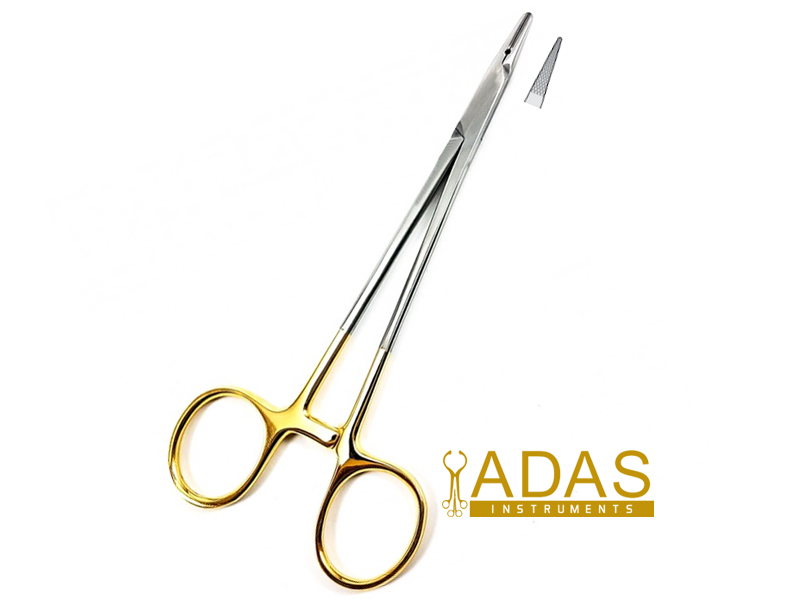
Crile Wood Needle Holder (TC Serrated Fine Tip)
Price range: $ 22.00 through $ 32.00
The Crile Wood needle holder, also called a Crile Wood needle driver, is a fine tipped ratcheted instrument for 4-0 to 6-0 suture, built by Adas Instruments in high quality medical grade stainless steel with a tungsten carbide jaw option. It is used for fascia, bowel, facelift and vessel closure.
Key Features
- Tapered narrow jaws, finer than a Mayo Hegar, for delicate tissue and small needles
- Cross serrated jaw face with a central longitudinal groove to stop the needle rolling
- Multi position ratchet lock at the finger rings, released with a thumb roll
- Tungsten carbide inserts brazed into the jaw, replaceable rather than worn out with the instrument
- Gold plated finger rings identify the tungsten carbide models at a glance
- Four lengths: 15 cm (6 inch), 18 cm (7 inch), 20 cm (8 inch) and 23 cm (9 inch)
- Fully autoclavable, reusable, non magnetic, passivated finish
- Made by Adas Instruments, SKU AF-12.135, left handed build available

What a Crile Wood needle holder is
A Crile Wood needle holder, also called a Crile Wood needle driver, is the ring handled instrument a surgeon reaches for when the suture is fine and the site is tight. The jaw is slim and tapers to a blunt tip, the box joint keeps the two halves in line under load, and a multi position ratchet on the shanks holds the needle without the hand holding pressure. This pattern sits between a heavy Mayo Hegar and a micro spring holder, and it takes 4-0 to 6-0 suture comfortably.
Why the Crile Wood rather than a Mayo Hegar
The two look alike across a tray and they are not the same tool. A Mayo Hegar carries a broader jaw built for 2-0 and heavier needles in deep layers. The Crile Wood needle holder narrows the jaw and lengthens the taper, so the tip reaches into a corner a Mayo Hegar cannot enter and still grips a 5-0 needle without splaying.
Against a Webster the comparison runs the other way. A Webster is 12.5 cm with smooth jaws for skin work at 5-0 and 6-0. The Crile Wood runs longer and keeps its serrations, so it holds a needle more firmly at the cost of being slightly less kind to a fine suture coating. If the choice is one holder for a mixed list, this is usually the one that stays on the tray.
Clinical applications
A Crile Wood needle holder is used across general and visceral surgery, plastic and reconstructive work, cardiovascular repair, oral surgery and veterinary practice, wherever the suture is fine and the site is tight.
| Specialty | What the Crile Wood does there | Usual length |
|---|---|---|
| General and visceral surgery | Closing fascia and bowel layers where the needle has to be driven at depth | 20 cm to 23 cm |
| Plastic and reconstructive | Facelift, breast and body closure at fine suture grades | 15 cm to 18 cm |
| Cardiovascular | Vessel and graft suturing at 5-0 and 6-0 in a confined field | 18 cm to 20 cm |
| Oral and maxillofacial | Flap closure at the back of the mouth | 15 cm to 18 cm |
| Veterinary | Fine needle work in small animal surgery | 15 cm |
Size chart
Four lengths are sold, and the choice is about reach rather than strength. The 15 cm is a skin and hand instrument, the 23 cm exists so the knuckles stay out of a deep field. Inches are given because most United States buyers order by inch.
| Length (cm) | Length (inch) | Suits |
|---|---|---|
| 15 cm | 6 inch | Skin, hand, oral and small animal work. The standard Crile Wood needle holder 15cm build |
| 18 cm | 7 inch | General operating room and plastic surgery closure |
| 20 cm | 8 inch | Cardiovascular and deeper general work |
| 23 cm | 9 inch | Deep field closure, where the hand stays outside the cavity |
Tungsten carbide and plain steel jaws
A plain stainless jaw wears smooth. It does not fail suddenly, it just stops gripping, and the surgeon compensates with more closing force until a needle rotates in the jaws at the wrong moment. Tungsten carbide inserts are brazed into the jaw and are several times harder than surgical stainless, so they hold their bite far longer. On this tungsten carbide needle holder the inserts carry a cross serration with a shallow longitudinal groove, which seats the curve of the needle instead of letting it roll.
This is also why buyers search for a gold handle needle holder. Across the trade, gold plated finger rings are the agreed marker for brazed carbide inserts, not a decorative choice, so a gold plated needle holder on a operating room tray is telling you what is in the jaw before anyone picks it up. The practical reason for the marker is service: a sharpening wheel set up for steel will lift a carbide insert clean off, so whoever reprocesses or repairs the instrument needs to know what it is holding before they start. Gold rings on needle holders mean carbide, and plain steel rings mean steel. The steel itself is made to a German specification.
Technical specification
| Specification | Detail |
|---|---|
| SKU | AF-12.135 |
| Pattern | Crile Wood, ring handled, box joint |
| Jaw face | Cross serrated with a shallow longitudinal groove |
| Jaw insert | Brazed tungsten carbide, replaceable |
| Finger rings | Gold plated on carbide models |
| Lock | Multi position ratchet at the finger rings |
| Lengths | 15, 18, 20 and 23 cm |
| Material | High quality medical grade stainless steel |
| Finish | Passivated, non magnetic |
| Reprocessing | Steam autoclave, fully immersible |
| Handedness | Right handed standard, left handed listed separately |
Care and reprocessing
Rinse before anything dries. Blood left in a serration sets hard and then it has to be brushed out, and brushing a carbide insert with a wire brush is how the serration gets rounded off. Open the ratchet fully for cleaning and for the autoclave cycle, because a closed ratchet traps moisture at the joint and the joint is where corrosion starts on a needle holder.
Check the jaw against the light every few cycles. Hold a 5-0 needle in the first ratchet position and try to rotate it with a finger. If it turns, the insert has polished and the instrument should go for service rather than into the next case. Tell whoever sharpens it that the jaw carries carbide, because a steel wheel will take the insert off.
Made by Adas Instruments
Adas Instruments manufactures this Crile Wood needle holder in house, in all four lengths, with the carbide inserts brazed and the jaws matched by hand before the instrument is passivated and boil tested. Left handed builds of the same pattern are held as stock rather than made to order.
We supply branded or plain for distributors, and marked to a customer reference on request, so an OEM order arrives ready for the buyer own catalogue. For bulk, O.R. grade and hospital supply, a Crile Wood needle holder price on quantity, or a tender quote, send the purchaser specification sheet with the enquiry and the response comes back against the exact lengths and jaw builds on it. Items shown as backorder are made to order, with a typical dispatch time of 10 to 12 working days.
Production is controlled under an ISO 13485 quality management system.
For close work needing more clamping force over less reach, compare the Baumgartner needle holder.
The same body is also made as a plain tip crile wood needle holder with smooth jaw faces, for closures where the suture must not be scored.
Frequently asked questions
What is a Crile Wood needle holder?
A Crile Wood needle holder is a ring handled surgical instrument that grasps and guides a suture needle through tissue during closure. It has a fine tapered jaw, a box joint and a multi position ratchet lock, and the pattern is named after the surgeons Crile and Wood.
What is a Crile Wood needle holder used for?
Crile Wood needle holder uses centre on fine to medium suturing: fascia and bowel closure in general surgery, facelift and breast closure in plastics, vessel work in cardiovascular, and flap closure at the back of the mouth. It suits 4-0 to 6-0 suture across those jobs.
What is the difference between a Mayo Hegar needle holder and a Crile Wood needle holder?
Choose the Mayo Hegar needle holder for 2-0 and heavier needles in deep layers, where a broad jaw helps. Choose the Crile Wood when the suture is 4-0 to 6-0 and the site is tight, because the narrower tapered jaw reaches where the Mayo Hegar cannot and still grips without splaying.
What suture sizes suit a Crile Wood needle holder?
4-0 to 6-0 is the working range. Heavier than 4-0 and a broader Mayo Hegar jaw holds the needle better. Finer than 6-0 and a spring handled micro holder is the right instrument, because a ratchet click transmits a small shock up a fine needle.
Is the tungsten carbide version worth the extra?
If the instrument sees more than a few cases a week, yes. A plain steel jaw polishes smooth over time and stops gripping, while brazed carbide inserts hold their bite for far longer. Below that workload the carbide inserts will outlast the handle either way.
Related products and categories
Surgeons who work with the Crile Wood needle holder usually compare it against the Mayo Hegar needle holder, the Olsen Hegar needle holder and the Webster needle holder. The whole family sits in Plastic Surgery Needle Holders, and this pattern is also listed under Breast Surgery Instruments.
| Weight | 0.05 kg |
|---|---|
| Select Size | 15cm / 6", 18cm / 7", 20cm / 8", 23 cm / 9" |
Be the first to review “Crile Wood Needle Holder (TC Serrated Fine Tip)”
Shipping & Delivery Policy
Processing Time: In-stock items are dispatched within 24-48 hours. For custom or out-of-stock items, production time is approximately 10-15 days.
Global Delivery Estimates
We partner with world-class couriers (DHL, FedEx) to ensure fast, tracked delivery.
- USA & Canada: 3-5 Business Days
- Europe & UK: 4-6 Business Days
- Rest of World: 5-7 Business Days
*We offer Air Cargo and Sea Freight options for bulk wholesale orders.
Customs & Duties
International buyers are responsible for any customs duties or taxes imposed by their country. Adas Instruments is not responsible for delays caused by customs clearance.
Lost Packages & Insurance
If your package is lost in transit, please contact us immediately. We offer full support and replacements for confirmed lost shipments. Note: You must report non-delivery within 3 weeks to be eligible for an insurance claim.
Related products


Reviews
There are no reviews yet.