
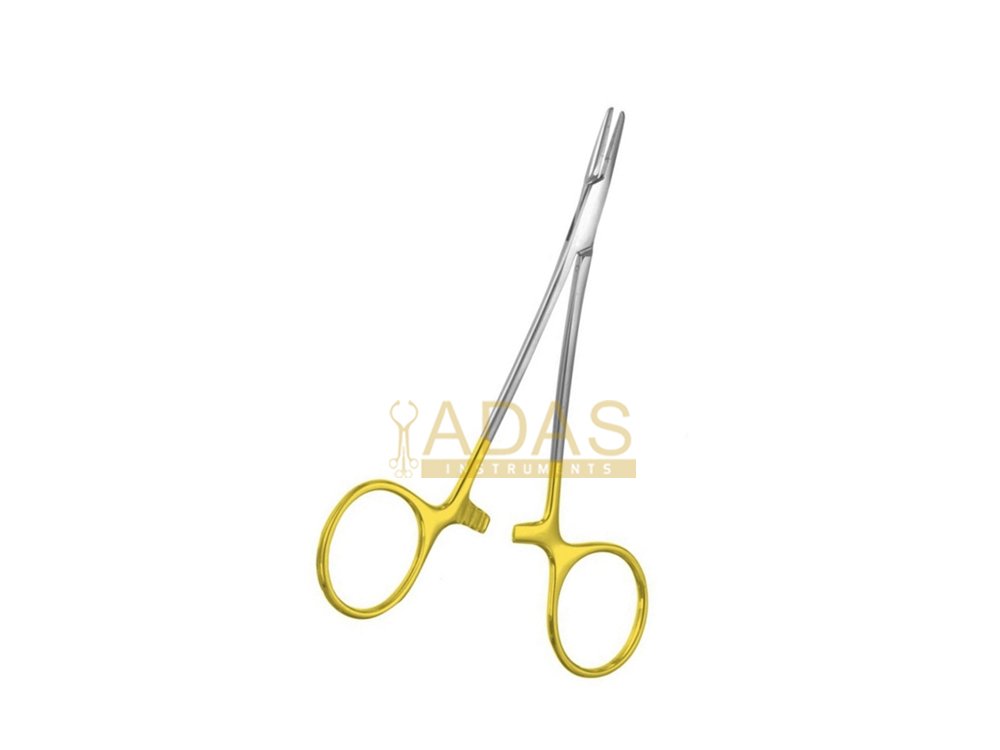
Webster Needle Holder Tungsten Carbide, Delicate, Smooth Jaws
Price range: $ 18.00 through $ 24.00
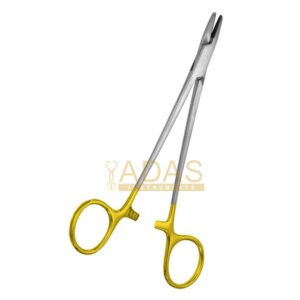
The Webster needle holder is a short, slender needle driver with smooth jaws, made for fine gauge suture in small surgical fields where a serrated jaw would crush the thread. It is used for eyelid, nasal and facial closure where a serrated jaw would damage fine thread.
Key Features
- Smooth jaw faces that grip the needle without fraying or flattening fine suture
- Two tip grades: Delicate Smooth and Extra Delicate Smooth, both 12.5 cm (5 inch)
- Tungsten carbide inserts brazed into the jaw, replaceable rather than worn out with the instrument
- Gold plated finger rings, the trade marker that the jaw carries carbide
- Short jaw and slim shank for eyelid, nasal and other restricted fields
- Multi position ratchet lock, box joint, matte anti glare finish
- High quality medical grade stainless steel body, fully autoclavable
- Made by Adas Instruments, SKU AF-04.32

What a Webster needle holder is
The Webster needle holder is a short, straight, slender jawed driver built for fine work. The jaw faces are smooth rather than serrated, the jaw itself is short, and the shank is slim enough to sit inside a small field without the hand blocking the view. Surgeons also call it a Webster needle driver or Webster suture forceps. It is the instrument reached for when the suture is fine enough that a cross serrated jaw would do more harm than good.
Webster needle holder smooth jaws, and why this pattern exists
A serrated jaw grips by biting. On a heavy needle and heavy thread that is exactly what is wanted. On fine gauge suture the same teeth flatten the needle body, score the thread and leave a weak point in the knot. The smooth jaw holds by pressure across a flat face instead, which is why this pattern survives in eyelid, nasal and facial closure where the thread is the most fragile thing on the tray.
Two tip grades are made. Delicate Smooth is the general fine work jaw. Extra Delicate Smooth is narrower again and takes suture down to 10-0, which is why this instrument also belongs in microsurgery.
Against a Crile Wood needle holder, the Webster is shorter and the jaw is smooth rather than serrated. Against a Mayo Hegar needle holder it is a different class of instrument entirely: the Mayo Hegar is built for fascia and deep soft tissue. The closest comparison buyers make is with the Halsey needle holder, and that question is answered in full below.
Clinical applications
The Webster belongs in small, shallow, visible fields where the closure will be seen afterwards: plastic surgery, blepharoplasty, rhinoplasty, dermatology, ophthalmic and pediatric work. The Delicate Smooth works at 4-0 to 6-0, and the Extra Delicate Smooth goes down to 10-0.
| Specialty | Typical use | Tip usually chosen |
|---|---|---|
| Plastic and reconstructive | Facial and body closure where the scar matters | Delicate Smooth |
| Blepharoplasty and oculoplastic | Eyelid skin closure | Extra Delicate Smooth |
| Rhinoplasty and ENT | Columella, alar and intranasal closure | Delicate Smooth |
| Dermatology | Excision closure on the face and hands | Delicate Smooth |
| Ophthalmic and microvascular | Work at the finest suture grades | Extra Delicate Smooth |
| Pediatric surgery | Small field closure on small patients | Extra Delicate Smooth |
| Oral and maxillofacial | Mucosal closure in a confined field | Delicate Smooth |
Tip options
Both Webster needle holder variants are 12.5 cm, which is 5 inches. The choice here is not length, it is how fine the jaw is, so this is a tip chart rather than a size chart.
| Tip option | Length | Choose it when |
|---|---|---|
| Delicate Smooth | 12.5 cm / 5 inch | General fine closure, facial and nasal work, most first orders |
| Extra Delicate Smooth | 12.5 cm / 5 inch | Eyelid, ophthalmic and microvascular work at the finest suture grades |
We do not stock this pattern in other lengths. Listings elsewhere showing 11.5 cm or 14 cm Websters are other manufacturers, and the numbers are not interchangeable.
Jaw, carbide and handle
The jaw faces are ground flat and polished. There is no serration at all, and the grip comes from the closing pressure and the flatness of the two faces meeting squarely. A jaw that has lost that flatness lets the needle rotate, which is the first sign the instrument needs attention.
Two builds are made. A plain steel jaw is machined from the instrument and wears with it. A tungsten carbide version has carbide plates brazed into the jaw faces; carbide is harder than the needle, so the face stays flat and the grip stays true far longer, and the plates can be replaced rather than the instrument.
Gold plated finger rings are the trade signal for those carbide inserts. Gold rings mean carbide, plain steel rings mean steel. It is a code read across a tray at a glance, not a decoration, and our plain steel models never carry the plating.
The body is high quality medical grade stainless steel with a matte anti glare finish, which matters more on a fine instrument than a heavy one, because this work is done under a strong light at close range. The steel itself is made to a German specification.
Technical specification
| Specification | Detail |
|---|---|
| SKU | AF-04.32 |
| Pattern | Webster, straight, ring handle |
| Jaw face | Smooth, no serration |
| Tip options | Delicate Smooth and Extra Delicate Smooth |
| Jaw insert | Tungsten carbide, brazed and replaceable |
| Finger rings | Gold plated on carbide models |
| Lock | Multi position ratchet in the shank |
| Joint | Box joint |
| Length | 12.5 cm / 5 inch, both variants |
| Material | High quality medical grade stainless steel |
| Finish | Matte, anti glare |
| Reprocessing | Steam autoclave, 134 C, fully immersible |
Care and reprocessing
Rinse in cool water immediately after use. Warm water sets blood and protein into the box joint, and on an instrument this size the joint is small enough that a set deposit is difficult to reach later. Clean with a soft brush and a neutral pH enzymatic detergent, then rinse with deionized water.
Never use an abrasive pad on a smooth jaw. The whole function of the face depends on it staying flat and polished, and a scratched face grips worse than a new one, not better. Dry completely, autoclave open rather than locked on the ratchet, and steam sterilize at 134 C for the cycle your unit validates.
Store the fine instruments apart from the heavy ones. A Mayo Hegar dropped on top of an Extra Delicate Webster in a drawer will damage the jaw, and the damage is not always visible.
Made by Adas Instruments
Adas Instruments manufactures this pattern in house in both tip grades, in plain steel or with tungsten carbide inserts. We supply hospitals, surgical distributors, oculoplastic and dermatology clinics, and teaching labs across the United States, Latin America and Europe.
For bulk or O.R. grade orders, hospital and clinic supply, or a wholesale quote on fine tip Webster needle drivers, send us SKU AF-04.32 and the quantities and tip grades you need. Items shown as backorder are made to order, with a typical dispatch time of 10 to 12 working days.
Production is controlled under an ISO 13485 quality management system.
For the same fine closure with a shorter, stiffer jaw, see the Derf needle holder.
For a shorter ring handle instrument in the same delicate class, Adas also makes the par needle holder in 11.5 cm and 12.5 cm.
Frequently asked questions
What is a Webster needle holder used for?
It is used to hold and drive fine gauge suture needles in small surgical fields: eyelid and facial closure, nasal work, dermatological excisions and microvascular repair. The smooth jaw is the point of it, because it holds the needle without crushing thread that a serrated jaw would damage. The working range is 4-0 to 6-0, and the Extra Delicate Smooth handles down to 10-0.
Are all Webster needle holders smooth?
Ours are. This pattern is defined by its smooth jaw, and we make it only in Delicate Smooth and Extra Delicate Smooth. Some manufacturers offer a serrated Webster, which is really a different instrument wearing the same name. If you want a serrated tip in a short fine driver, the Halsey needle holder is made with one.
What are the key differences between a Crile Wood needle holder and a Webster needle holder?
Length and jaw face. A Crile Wood needle holder runs from 15 cm upward and carries a cross serrated jaw, so it grips by biting and suits general closure. The Webster is 12.5 cm with a smooth jaw, so it grips by flat pressure and does not score fine thread. Work in a small visible field with fine suture takes the Webster; general closure takes the Crile Wood.
What is the difference between a Halsey and a Webster needle holder?
Both are short fine drivers of about the same length. The Webster is supplied only with smooth jaws, in two grades of delicacy, and is the finer instrument of the two. The Halsey is offered with either a plain or a serrated tip, and in left handed versions of both, so it covers a slightly broader range of thread. Take the Webster for the finest suture and the Halsey when more grip is wanted or a left handed instrument is needed.
Which Webster tip option should I order?
Order Delicate Smooth for general fine closure in plastic surgery, dermatology and rhinoplasty. Order Extra Delicate Smooth for eyelid, ophthalmic and microvascular work at the finest suture grades. Most buyers start with the Delicate Smooth and add the finer one later.
Related products and categories
Surgeons who work with the Webster needle holder usually compare it against the Halsey needle holder, the Castroviejo needle holder and the Neivert needle holder. The whole family sits in Plastic Surgery Needle Holders, and this pattern is also listed under Blepharoplasty Instruments.
| Weight | 0.045 kg |
|---|---|
| Tip options | 12.5cm / 5" Delicate Smooth, 12.5cm / 5" Extra Delicate Smooth |
Be the first to review “Webster Needle Holder Tungsten Carbide, Delicate, Smooth Jaws”
Shipping & Delivery Policy
Processing Time: In-stock items are dispatched within 24-48 hours. For custom or out-of-stock items, production time is approximately 10-15 days.
Global Delivery Estimates
We partner with world-class couriers (DHL, FedEx) to ensure fast, tracked delivery.
- USA & Canada: 3-5 Business Days
- Europe & UK: 4-6 Business Days
- Rest of World: 5-7 Business Days
*We offer Air Cargo and Sea Freight options for bulk wholesale orders.
Customs & Duties
International buyers are responsible for any customs duties or taxes imposed by their country. Adas Instruments is not responsible for delays caused by customs clearance.
Lost Packages & Insurance
If your package is lost in transit, please contact us immediately. We offer full support and replacements for confirmed lost shipments. Note: You must report non-delivery within 3 weeks to be eligible for an insurance claim.
Related products

Reviews
There are no reviews yet.