
Gillies Needle Holder with Scissors, Tungsten Carbide Curved 6-1/4 in
$ 28.60
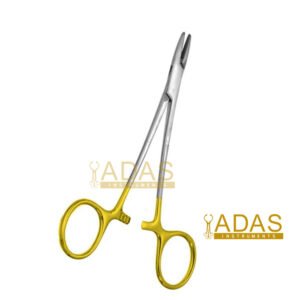
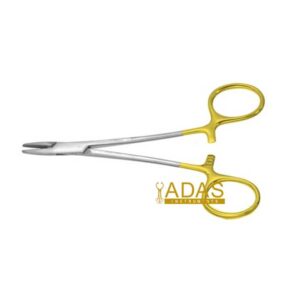
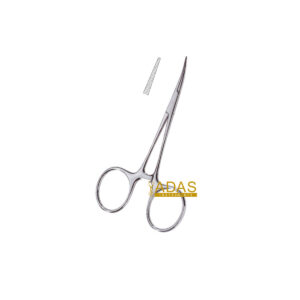
The Gillies needle holder, also called a Gillies needle driver or the Foster Gillies pattern, is a combined holder and scissor for plastic, reconstructive, dermatology and dental surgery. One instrument drives the needle and cuts the thread, with offset finger rings and no ratchet, so the needle releases the moment you open the jaws.
Key Features
- Needle jaws and scissor blades in one instrument, 159 mm or 6.25 in
- Asymmetric finger rings, the thumb ring larger and set at an angle
- No ratchet, so nothing has to be unlocked before the needle comes free
- Cross serrated jaw faces with brazed tungsten carbide inserts
- Scissor blades sit behind the jaws, close to the hinge, for a clean cut
- Takes 4-0 to 6-0 suture
- Gold plated rings mark the tungsten carbide build
- Item code AF-33.12
10 in stock (can be backordered)

What the Gillies needle holder is
The Gillies needle holder is a combination instrument: a needle holder and a pair of suture scissors built into one body. You drive the needle, tie the knot and cut the thread without putting the instrument down or asking anyone to hand you scissors. Catalogues list it as a Gillies needle driver, and its full pattern name is the Foster Gillies needle holder, after the surgeons the design is credited to.
Buyers often ask whether a needle holder and a needle driver are different tools. They are the same instrument under two names, and which name you use depends on where you trained. We write both on this page because both are searched.
It is a plastic surgery instrument first. Sir Harold Gillies built his reputation on facial reconstruction, and the tool carries the habits of that work: light in the hand, quick to release, made for a surgeon operating without a scrub nurse at each elbow.
Key design features of the Gillies needle holder
Two things separate this pattern from every other holder in the family, and both are visible the moment you pick it up.
- Asymmetric finger rings. The thumb ring is larger and set at an angle to the finger ring. Your hand sits in a natural half rotation rather than square, which matters when you are suturing inside a mouth or under a brow and the instrument has to come in at an angle.
- No ratchet at all. This is a deliberate omission, not a cheaper build. A ratchet has to be released before the needle can come free, and on a face with twenty interrupted sutures to place, that release is twenty small pauses. Open the jaws and the needle is out.
- Scissor blades set proximal to the needle jaws, beside the hinge. Putting them there keeps the blade short, which is what gives a crisp cut on fine thread instead of a chew.
- Cross serrated jaw faces carrying brazed tungsten carbide. The crosshatch holds a 6-0 needle without the jaw pressure that would flatten it.
- Gold plated finger rings on the carbide build, the trade’s standard marker.
The trade off is honest and worth stating: because there is no lock, you carry the closing force in your hand for as long as the needle is loaded. On a long fascial closure that is tiring. On thirty fine facial sutures it is faster than anything with a ratchet.
Gillies needle holder sizes and build options
One length, one configuration. The figures below are what we ship.
| Feature | Specification |
|---|---|
| Overall length | 159 mm / 6.25 in |
| Jaw face | Cross serrated, tungsten carbide inserts |
| Scissor blades | Proximal to the jaws, beside the hinge |
| Handle | Asymmetric finger rings, offset thumb ring |
| Lock | None. Non locking by design |
| Finger rings | Gold plated on the carbide build |
Gillies needle holder uses, by specialty
What these share is a surgeon who is closing skin or mucosa, in fine thread, often alone, and who cuts as many times as they stitch.
| Specialty | What it is used for |
|---|---|
| Plastic surgery | Facial and eyelid closure, flap inset, scar revision |
| Reconstructive surgery | Graft fixation where the surgeon works alone |
| Dermatology | Excision closure, punch biopsy, office procedures |
| Oral and dental surgery | Intraoral suturing, extraction site closure, periodontal flaps |
| Maxillofacial surgery | Soft tissue closure in confined access |
| Veterinary surgery | Small animal skin closure in single handed practice |
Suture sizes the Gillies needle holder handles
This is a fine pattern. It is built around 4-0 to 6-0 and it should not be asked to drive heavy fascial thread.
| Suture size | Typical use |
|---|---|
| 4-0 | Skin closure on the trunk and limbs |
| 5-0 | Facial skin, intraoral mucosa |
| 6-0 | Eyelid, nasal tip, fine facial work |
How the Gillies needle holder compares with other patterns
The only other combined holder and scissor we make is the Olsen Hegar, and the choice between them comes down to one question: do you want the jaws to stay shut on their own?
| Pattern | Cuts thread | Lock | Where it wins |
|---|---|---|---|
| Gillies | Yes | None | Fast, repeated suturing where the needle must release instantly |
| Olsen Hegar | Yes | Multi position ratchet | The same single handed job when you want the jaws to stay closed |
| Webster | No | Multi position ratchet | Fine facial closure when an assistant cuts |
| Castroviejo | No | Catch and release | Microsurgical work under magnification |
If you want the lock, take the Olsen Hegar needle holder. For fine facial closure without a scissor, the Webster needle holder is the lighter choice, and for work under magnification the Castroviejo needle holder. The full range sits in plastic surgery needle holders.
Materials and finish
The body is high quality medical grade stainless steel. The steel itself is made to a German specification. The jaw inserts are brazed tungsten carbide and the scissor blades are hardened separately from the body, because a blade and a jaw want different tempers and grinding them to the same hardness makes one of them wrong.
The finish is satin. On an instrument used this close to a patient’s face under a surgical light, a mirror polish is a distraction.
The hinge deserves a word. A combined instrument has more moving parts than a plain holder, and the hinge is where a badly made one fails first. Ours is a box joint, assembled and then ground as a pair, so the jaws and the blades stay in register through years of autoclaving.
Gillies needle holder care and sterilization
Rinse before the blood dries. Because this instrument cuts as well as holds, there are two working surfaces to clean and the scissor blades are the one people forget. Open the instrument fully, brush along the jaw serrations, then along each blade edge from hinge to tip. Neutral pH detergent, deionized water rinse, dry completely, then autoclave.
Test the scissor action on a single strand of suture every few months. If the thread folds instead of parting, the blades have gone and the instrument needs regrinding by someone who knows the pattern. Do not sharpen it on a bench stone; the blade geometry is short and shallow and it is easy to destroy.
Ordering and wholesale
Adas Instruments makes this pattern to order. The item code is AF-33.12. Backorder items dispatch in 10 to 12 working days. Wholesale pricing is available on volume, and we build instrument sets to a customer’s own list. Every instrument carries a three year replacement against manufacturing defects.
Production is controlled under an ISO 13485 quality management system.
For dental and orthodontic work where the instrument sits in the palm rather than on finger rings, compare the Mathieu needle holder, and for short jawed eyelid and dental closure the Derf needle holder.
Frequently asked questions
What is a Gillies needle holder used for?
It is used to drive a suture needle and cut the thread with one instrument, mainly in plastic, reconstructive, dermatological and dental surgery. It suits a surgeon working without an assistant to cut, and it is at its best on fine skin and mucosa at 4-0 to 6-0.
Does a Gillies needle holder have a ratchet?
No, and that is intentional. The pattern is non locking. You hold the closing pressure yourself, and the needle releases the instant you open the jaws. It makes repeated suturing faster and it is the main thing that separates a Gillies from an Olsen Hegar.
What is the difference between a Gillies and an Olsen Hegar needle holder?
Both combine a needle holder with suture scissors. The Olsen Hegar has a multi position ratchet and symmetric finger rings; the Gillies has no lock and asymmetric, offset rings. Choose the Olsen Hegar for heavier thread and longer holds, the Gillies for fast fine work.
Why is it called a Foster Gillies needle holder?
Foster Gillies is the full pattern name used in several catalogues, and it is the same instrument. If you search for a Gillies needle holder with scissors, a Gillies needle driver or a Foster Gillies, you are looking at this pattern.
What suture size does a Gillies needle holder take?
4-0 to 6-0 is the working range. Below 6-0 the jaw is coarser than the needle wants, and above 4-0 you will notice the absence of a lock, because heavier thread needs sustained closing force that your hand has to supply.
Related products and categories
Surgeons who work with the Gillies needle holder usually compare it against the Olsen Hegar needle holder, the Webster needle holder and the Derf needle holder. The whole family sits in Plastic Surgery Needle Holders, and this pattern is also listed under Rhinoplasty Instruments.
| Weight | 0.065 kg |
|---|
Shipping & Delivery Policy
Processing Time: In-stock items are dispatched within 24-48 hours. For custom or out-of-stock items, production time is approximately 10-15 days.
Global Delivery Estimates
We partner with world-class couriers (DHL, FedEx) to ensure fast, tracked delivery.
- USA & Canada: 3-5 Business Days
- Europe & UK: 4-6 Business Days
- Rest of World: 5-7 Business Days
*We offer Air Cargo and Sea Freight options for bulk wholesale orders.
Customs & Duties
International buyers are responsible for any customs duties or taxes imposed by their country. Adas Instruments is not responsible for delays caused by customs clearance.
Lost Packages & Insurance
If your package is lost in transit, please contact us immediately. We offer full support and replacements for confirmed lost shipments. Note: You must report non-delivery within 3 weeks to be eligible for an insurance claim.
Related products