
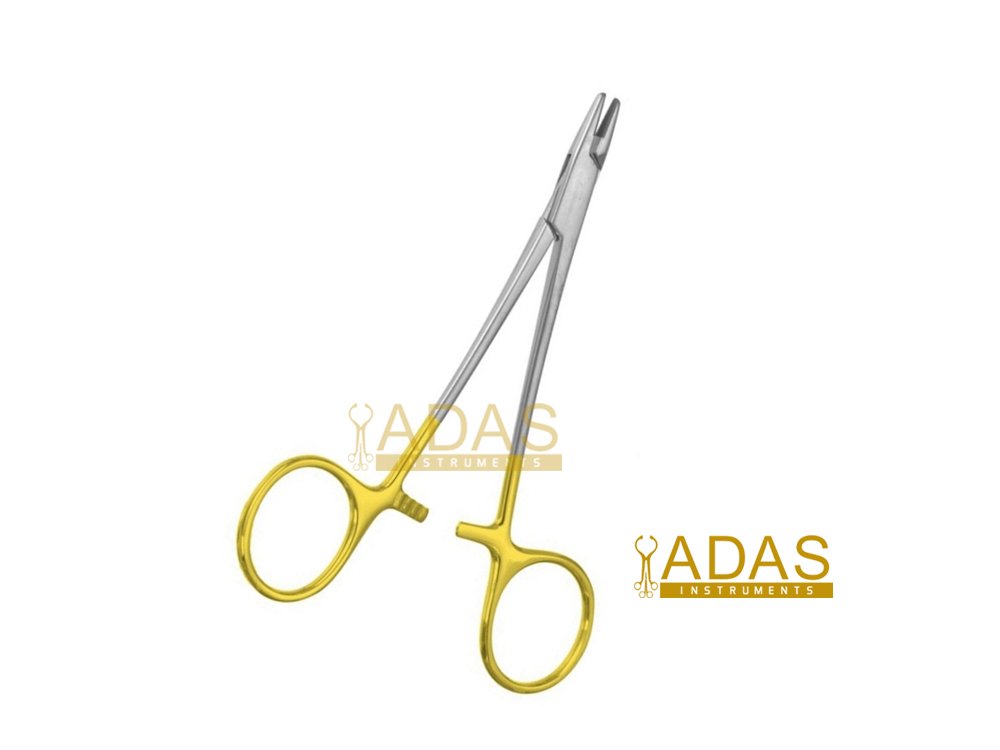
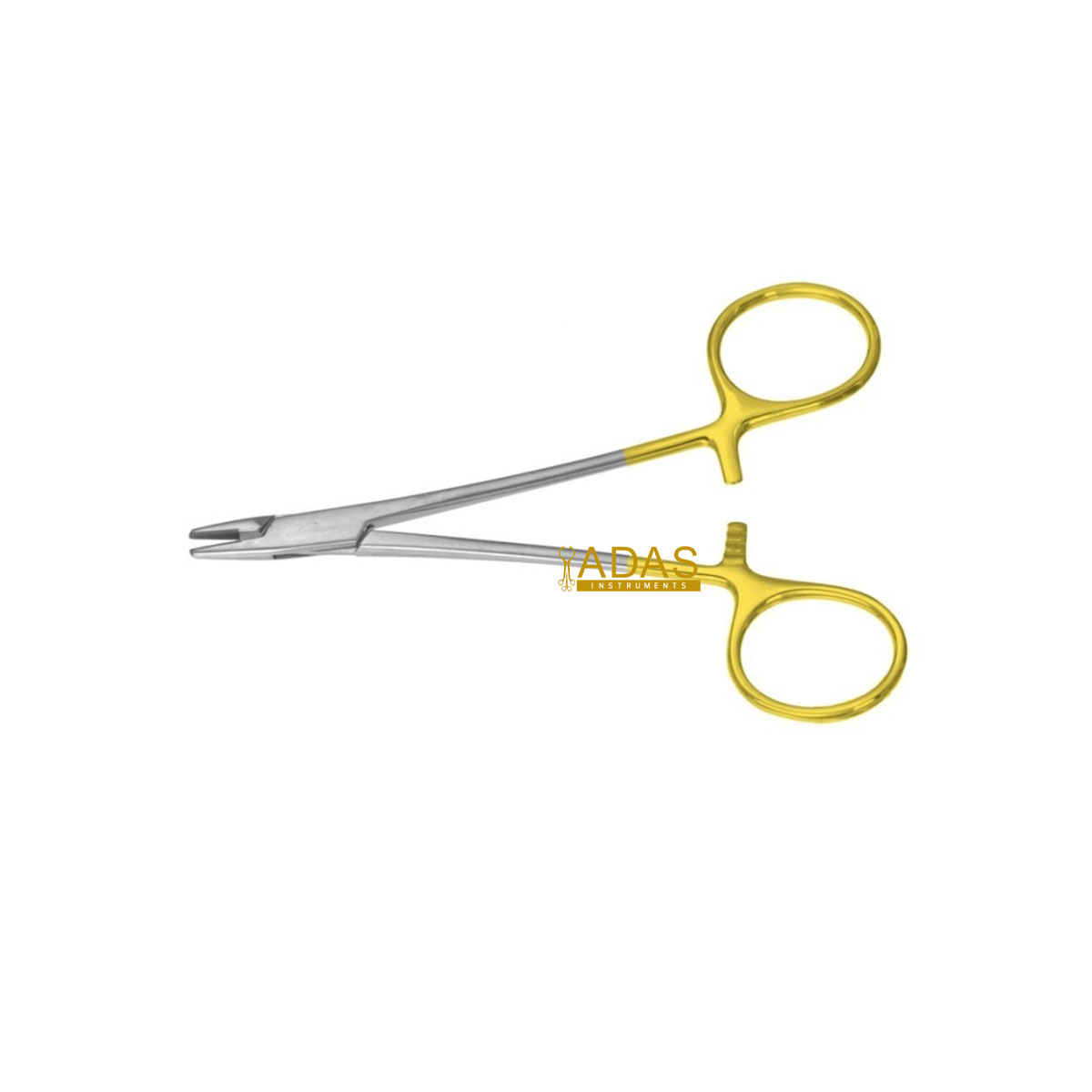
Derf Needle Holder, Tungsten Carbide (TC), Small Suture Driver
$ 22.00
The Derf needle holder is a short jawed ring handled needle driver, 12 cm long, built to hold a small needle steady while it is passed through thin or superficial tissue. Cross serrated jaws with a central groove stop a 5-0 or 6-0 needle from rotating in the grip, which is what makes this pattern the one reached for in eyelid, facial, dental and ophthalmic closures where the working space is tight.
- Jaws: 10 mm long, roughly 2.4 mm wide, plain or cross serrated with a central groove
- Handle: finger ring with a multi position ratchet lock, gold plated rings mark the tungsten carbide build
- Length: 12 cm, 4.75 inches, a single size
- Sutures: 5-0 and 6-0, down to 7-0 monofilament with the tungsten carbide jaws
- Specialties: oculoplastic, plastic, dental and oral, ENT, dermatology, veterinary
- Item code: AF-01.32

What a Derf needle holder is
A Derf needle holder is a compact ring handled instrument that grips, holds and guides a small suture needle through tissue. The pattern is defined by its jaws rather than its length: they are short, narrow and cross serrated, and most builds carry a shallow groove down the center line of the jaw face. That groove is the working detail. It seats the shaft of a fine needle so the needle cannot roll when the wrist turns, which is the failure that ruins a stitch in thin skin.
Surgeons and buyers in the United States also call this instrument a Derf needle driver, and the two names describe the same thing. Some older catalogues list it as Derf suture forceps. Whichever term is used, the instrument is the short jawed answer to the problem of driving 5-0 and 6-0 needles accurately in a field that does not give you room to swing a longer driver.
Key design features of the Derf needle holder
Four features between them explain what this pattern does and why a longer driver is not a substitute.
Short jaws. The jaw is about 10 mm long and roughly 2.4 mm wide. Short jaws sit closer to the pivot, so the same squeeze at the rings delivers more closing force at the tip than a long jawed driver of the same overall length. That is what lets a small instrument hold a fine needle firmly.
Central groove. The groove between the serrated fields cradles the needle shaft. Without it, a round bodied 6-0 needle will pivot in the jaw under load. With it, the needle holds the angle you set.
Ratchet lock. The finger rings carry a multi position ratchet. Once engaged, the jaws hold the chosen pressure without any further squeezing, so the hand can relax between passes across a long closure.
Jaw surface. Two builds are offered. The plain jaw is smooth and is chosen for the very finest monofilament, where serrations can score the suture. The cross serrated jaw grips harder and is the general choice. On the tungsten carbide build the finger rings are gold plated, which is the standard visual code across the industry for carbide inserts.
Derf needle holder sizes and build options
This pattern is made in one length. Unlike the longer ring handled families, the Derf is not scaled up and down, because its whole purpose is short reach work.
| Specification | Detail |
|---|---|
| Overall length | 12 cm, 4.75 inches |
| Jaw length | approximately 10 mm |
| Jaw width | approximately 2.4 mm |
| Jaw face | plain, or cross serrated with a central groove |
| Handle | finger ring, multi position ratchet lock |
| Carbide marker | gold plated finger rings on the tungsten carbide build |
| Item code | AF-01.32 |
Derf needle holder uses by specialty
Search Derf needle holder uses and the answer always comes back the same shape: closures in small, shallow or awkward fields where a 5-0 or 6-0 needle is the right needle.
In oculoplastic and eyelid work it is the standard driver for blepharoplasty closure and lid margin repair, where the skin is thin and the incision short. In plastic and facial surgery it handles rhinoplasty columellar closure, facelift skin edges and small graft insets. In dental and oral surgery it suits flap closure and implant site suturing, where the mouth limits how far the handles can open. ENT teams use it for ear and nasal work, and dermatology for excision closures on the face. The Derf needle holder is also a common tray instrument in veterinary practice for small animal and avian closures, where patient scale rather than field depth is the constraint.
For the same jobs on a longer reach, the Webster needle holder and the Halsey needle holder are the patterns to compare, and the whole range sits together on the plastic surgery needle holders page.
Suture sizes the Derf needle holder handles
The jaw dimensions set the useful range. Below 7-0 the needle becomes small enough that a micro pattern with a spring handle gives better feel.
| Suture size | Fit | Typical use |
|---|---|---|
| 4-0 | Workable but oversized | Only if nothing else is on the tray |
| 5-0 | Ideal | Facial and eyelid skin, oral flaps |
| 6-0 | Ideal | Lid margin, fine facial closure, dermatology |
| 7-0 | Good with carbide jaws | Delicate monofilament, use the plain jaw |
| 8-0 and finer | Not recommended | Move to a micro pattern |
How the Derf needle holder compares with other patterns
The question buyers actually ask is which short driver to put on the tray. This is how the Derf needle driver sits against the patterns nearest to it.
| Pattern | Length | Jaw | Where it wins |
|---|---|---|---|
| Derf | 12 cm | Short, grooved | Shallow fields, 5-0 and 6-0, tight access |
| Webster | 12.5 cm | Fine, smooth or serrated | Very fine facial work, smooth jaw option |
| Halsey | 13 cm | Fine, tapered | Slightly longer reach, four tip choices |
| Castroviejo with ratchet | 14 to 23 cm | Delicate, flat handle | Pen grip control, deep or micro fields |
| Crile Wood | 15 to 23 cm | Narrow, long | General closure at depth |
The short version: if the field is shallow and the needle is small, the Derf needle holder is the pattern. If you need pen grip rotation rather than a ring handle, step across to a Castroviejo. If the needle has to reach, step up to a Crile Wood.
Materials and finish
Every unit is made from high quality medical grade stainless steel, hardened and passivated, then given a satin finish that cuts glare under operating room lights. The steel itself is made to a German specification. The tungsten carbide build carries carbide inserts brazed into the jaw faces and gold plated finger rings so the instrument can be identified at a glance on a crowded tray. The plain steel build costs less and is the sensible choice where the instrument will see light or occasional use.
Derf needle holder care and sterilization
A Derf needle holder will outlast most of the tray if it is treated properly. Rinse immediately after use, before blood and saline have a chance to dry in the serrations. Clean with a soft brush and a neutral pH enzymatic detergent, paying attention to the groove and the ratchet teeth, then rinse in deionized water and dry fully. Sterilize by steam autoclave at 134 degrees Celsius for the cycle your facility validates, with the ratchet left open so the jaws are not held under tension. Store the instrument unlocked. Check the jaw faces against the light every few cycles: when the serrations flatten or the groove wears smooth, needle slip begins and the instrument should be retired from fine work.
Ordering and wholesale
Adas Instruments manufactures this Derf needle holder and ships it worldwide. Single units and clinic quantities are available, and wholesale pricing applies on bulk orders for distributors, hospital groups and veterinary practices. Backorder items dispatch in 10 to 12 working days. Every instrument carries a three year replacement against manufacturing defects. If you need this pattern in a set alongside forceps and scissors, tell us the procedure and we will quote the tray.
Production is controlled under an ISO 13485 quality management system.
Frequently asked questions
What is a Derf needle holder used for?
It is used to hold and drive small suture needles, typically 5-0 and 6-0, through thin or superficial tissue. It is standard in eyelid and oculoplastic closure, facial plastic surgery, dental flap and implant suturing, ENT, dermatology and small animal veterinary work, wherever the field is shallow and a longer driver would be clumsy.
Why are the jaws on this pattern so short?
Short jaws put the gripping surface close to the pivot, so a given squeeze at the rings produces more force at the needle. That is how a 12 cm instrument holds a fine needle as firmly as a much larger driver. The trade is reach: it cannot work at depth.
What is the difference between a Derf needle holder and a Webster needle holder?
Both are short and both are for fine work. The Derf needle holder has a grooved, cross serrated jaw and is 12 cm; the Webster is 12.5 cm and is offered with a smooth jaw for the most delicate monofilament. In practice surgeons pick the Derf needle holder when they want grip and the Webster when they want to protect the suture.
Do the gold rings mean anything?
Yes. Gold plated finger rings are the industry code for tungsten carbide inserts in the jaws. Carbide holds its grip far longer than steel and can be replaced when it does wear. A plain steel instrument has plain steel rings.
How should this instrument be cleaned and sterilized?
Rinse straight after use, brush the serrations and the groove with a neutral pH enzymatic detergent, rinse in deionized water, dry, then steam autoclave with the ratchet open. Store unlocked so the spring and jaws are not held under load between cases.
If you also need to cut the thread without changing instruments, the Gillies needle holder carries suture scissors in the same body.
Related products and categories
Surgeons who work with the Derf needle holder usually compare it against the Webster needle holder, the Gillies needle holder and the Castroviejo micro needle holder. The whole family sits in Plastic Surgery Needle Holders, and this pattern is also listed under Blepharoplasty Instruments.
| Weight | 0.05 kg |
|---|---|
| Tip options | plan, serrated |
Be the first to review “Derf Needle Holder, Tungsten Carbide (TC), Small Suture Driver”
Shipping & Delivery Policy
Processing Time: In-stock items are dispatched within 24-48 hours. For custom or out-of-stock items, production time is approximately 10-15 days.
Global Delivery Estimates
We partner with world-class couriers (DHL, FedEx) to ensure fast, tracked delivery.
- USA & Canada: 3-5 Business Days
- Europe & UK: 4-6 Business Days
- Rest of World: 5-7 Business Days
*We offer Air Cargo and Sea Freight options for bulk wholesale orders.
Customs & Duties
International buyers are responsible for any customs duties or taxes imposed by their country. Adas Instruments is not responsible for delays caused by customs clearance.
Lost Packages & Insurance
If your package is lost in transit, please contact us immediately. We offer full support and replacements for confirmed lost shipments. Note: You must report non-delivery within 3 weeks to be eligible for an insurance claim.
Related products


Reviews
There are no reviews yet.