
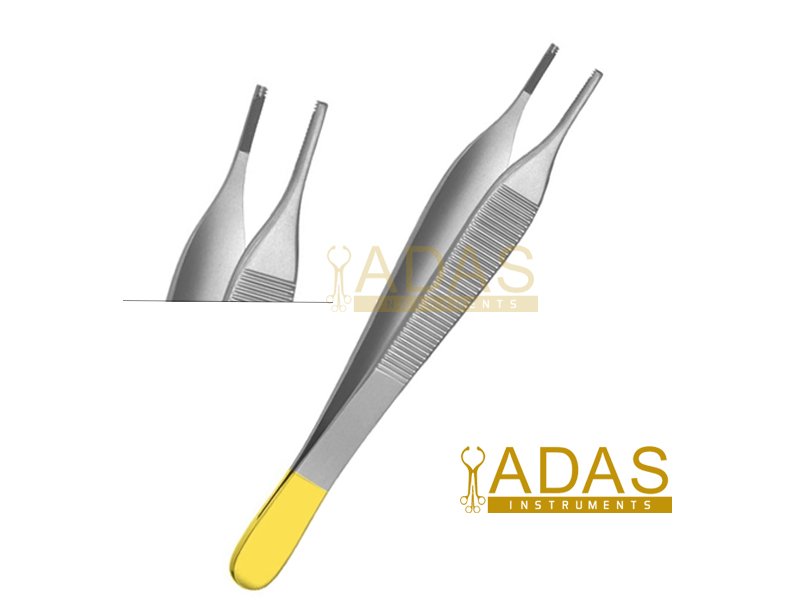
Adson Brown Forceps Tungsten Carbide, 7×7 or 9×9 Teeth, 12 cm
$ 18.50
The adson brown forceps tungsten carbide build carries multiple rows of fine interlocking teeth, 7×7 or 9×9, on a carbide gripping face, for a secure and atraumatic hold on skin, dermis, fascia and muscle sheath.
A row of nine small teeth has far less metal per tooth than one 1×2 tooth. One rounded tooth in that row makes the whole jaw grip unevenly, holding at the teeth that still bite and pinching at the ones that no longer do. Carbide is what keeps the row even.
Key Features
- Tungsten carbide insert brazed into the jaw, not a coating
- Two tooth counts: 7×7, fourteen teeth in all, and 9×9, eighteen in all
- Straight or curved tip in both tooth counts, four builds
- 12 cm, 4 3/4 inch
- No lock and no ratchet, so the grip on a flap stays under your control
- Also written brown adson thumb forceps or adson brown tc forceps
- High quality medical grade stainless steel body, passivated and boil tested
- Item code AC-41.122-1

What the adson brown forceps tungsten carbide build is
An adson brown forceps tungsten carbide is the standard Adson Brown with its gripping face changed. The rows of fine interlocking teeth, seven against seven or nine against nine, are cut into a tungsten carbide insert brazed into the jaw instead of into the stainless steel of the jaw itself. It is 12 cm long, made by Adas Instruments, reusable and fully autoclavable.
Catalogues write the pattern in several ways, and they all mean this instrument: brown adson thumb forceps, brown-adson thumb forceps, tungsten carbide adson brown forceps, or simply adson brown tc forceps. Thumb forceps is the accurate description, because there is no ratchet and no catch anywhere on it.
The jaws close by finger pressure only, which is what lets a surgeon hold a facial flap at one pressure and a breast skin edge at another without putting the instrument down.
Why carbide matters more on a fine tooth row
This is the part that is worth understanding before paying the difference.
A 1×2 tooth is a big point of steel. It can lose a little and still bite. A row of nine teeth is nine much smaller points, and each one has only a fraction of that metal to give away.
So the same wear that barely dulls a 1×2 jaw is enough to round three or four teeth in a 9×9 row. A row with three rounded teeth grips unevenly: the flap is held at the teeth that still bite, and pinched at the ones that no longer do.
That is why a tungsten carbide adson brown forceps is the build that makes the most sense of the two carbide options. The finer the jaw, the more the hardness is worth.
- Brazed, not plated. A coating on teeth this small would wear through unevenly.
- Two tooth counts. 7×7 for a firmer bite, 9×9 for the gentlest hold.
- Straight or curved. Curved reaches around a flap edge without your hand blocking the view.
- No locking mechanism. A pure thumb forceps.
Tooth counts and builds we ship
Four builds of the adson brown forceps tungsten carbide, all at 12 cm. Imperial is beside metric because buyers in the United States search in inches.
| TOOTH COUNT | TEETH IN ALL | TIP | GRIPPING FACE | ITEM CODE |
|---|---|---|---|---|
| 7×7 | 14 | Straight | Tungsten carbide insert | AC-41.122-1 |
| 7×7 | 14 | Curved | Tungsten carbide insert | AC-41.122-1 |
| 9×9 | 18 | Straight | Tungsten carbide insert | AC-41.122-1 |
| 9×9 | 18 | Curved | Tungsten carbide insert | AC-41.122-1 |
Nothing is listed there that we do not hold. If a set needs a length we do not show, ask. A change of length is a tooling change, not a new instrument.
Where the carbide build earns its price
An adson brown forceps tungsten carbide earns its price on volume, and nowhere else. It is the same honest answer as for any carbide instrument.
| SPECIALTY | WHY THE CARBIDE TOOTH ROWS |
|---|---|
| Plastic and reconstructive surgery | Flap inset, where the same skin is held thirty times |
| Breast surgery | Long skin envelope work on a full list |
| Oculoplastic surgery | Eyelid skin, where one slipped hold is visible for life |
| Hand surgery | Tendon sheath and thin dorsal skin, daily lists |
| Burns and grafting | Graft edges handled repeatedly in one sitting |
| ENT, ear nose and throat | Rhinoplasty skin envelope |
| Teaching hospitals | Sets handled by many hands and cleaned hard |
A pair used twice a month will not notice the difference in five years. A pair on a daily flap list will outlast two or three plain steel pairs, and it will spend far less of its life in the state where it still looks fine but no longer grips evenly.
Tissue this pattern handles, and the tooth count to ask for
The instrument carries no needle and no suture, so the only question is what it is holding. That decides the tooth count, exactly as it does on the plain steel Adson Brown.
| TISSUE | TOOTH COUNT | WHAT THE CARBIDE CHANGES |
|---|---|---|
| Thin facial flap | 9×9 | Eighteen fine teeth stay fine instead of rounding |
| Eyelid skin | 9×9 | The gentlest hold in the range, held for years |
| Graft edge | 9×9 | No perforation, and no creeping need for more pressure |
| Breast skin envelope | 7×7 | A firm bite that does not soften over a year of lists |
| Subcuticular edge | 7×7 | Everts the edge cleanly for the needle |
| Tendon sheath | 7×7 | Tough and slippery, the hardest wear on the row |
| Fascia | Use a 1×2 Adson instead | Fascia needs point pressure, not spread pressure |
Ordering one adson brown forceps tungsten carbide for facial work? Take the 9×9 curved. Ordering two? Make the second a 7×7 straight. Those two cover almost everything a plastics closure tray is asked to do.
How it compares with the other builds
These are the builds people weigh against each other before they order.
| BUILD | JAW | WHEN YOU REACH FOR IT |
|---|---|---|
| This build | Fine tooth rows with a carbide face | Flap work on a daily list |
| Adson Brown, plain steel | The same tooth rows in steel | Occasional use, or a spare pair |
| Adson carbide, 1×2 teeth | One tooth meeting two, carbide face | Skin edges and fascia, daily |
| Micro Adson | Finer, shorter tip | Microsurgery and eyelid work |
| DeBakey | Long atraumatic jaw, central row | Vessels and bowel, not skin |
| Rat tooth | Trade shorthand, not a pattern | Any thumb forceps with interlocking teeth |
Two things an adson brown forceps tungsten carbide does not do. It does not make a toothed jaw safe on tissue that needs a serrated one, and it does not change which tooth count is right for the tissue in front of you. It buys time, not forgiveness.
Materials and finish
The body is made in high quality medical grade stainless steel, with the tungsten carbide insert brazed into the jaw. The steel itself is made to a German specification. Every pair is passivated and boil tested before packing, and the finish is satin rather than mirror so the tooth rows stay readable against wet tissue.
The braze decides whether a carbide instrument is worth owning. A weak joint loosens after repeated autoclave cycles, and on a jaw this small any movement at all means the two tooth rows stop interdigitating. Boil testing every pair is how a weak joint is found at the bench instead of in theatre.
Care and sterilization
Rinse in cool water straight after use so blood does not dry between the teeth. Clean with a neutral pH enzymatic detergent and an ultrasonic bath, rinse in deionized water, dry fully, then steam autoclave at 134 degrees Celsius.
An adson brown forceps tungsten carbide needs one habit that a steel pair does not: keep abrasives away from the insert. No wire brush, no scouring pad, no abrasive paste: scratching a carbide face is the fastest way to undo the reason you bought it. Then close the jaws slowly against the light and look along the row. Daylight at two or three teeth while the rest meet is the sign to retire the pair.
Ordering and wholesale
The adson brown forceps tungsten carbide is supplied by Adas Instruments to hospitals, surgical distributors and OEM buyers, in single units and in bulk. The item code is AC-41.122-1 and it is printed in the size table above so a procurement search finds it. Backorder items dispatch in 10 to 12 working days. Every instrument carries a three year replacement against manufacturing defects.
For wholesale and OEM orders, instruments ship unpackaged in bulk or individually poly bagged, and laser marking with a distributor code or a hospital asset number is available on the shaft. Tell us the tooth count, the tip and the quantity and the quotation comes back with the lead time for that run.
Production is controlled under an ISO 13485 quality management system.
Frequently asked questions
What are tungsten carbide Adson Brown forceps used for?
Gripping and lifting delicate tissue in plastic and reconstructive surgery, where rows of 7×7 or 9×9 fine teeth spread the load instead of pinching at one point. The tungsten carbide sits on the working faces, so a multi toothed jaw that would otherwise round off under daily use keeps its bite.
Why put tungsten carbide on a multi toothed jaw?
Because small teeth have less metal to lose. A 1×2 tooth is a substantial point and takes a long time to round over. Seven or nine teeth in a row are each a fraction of that size, so the same wear takes a bigger share of each tooth. Carbide is where the fine tooth rows hold their shape.
What are brown adson thumb forceps?
The same instrument. Thumb forceps means a forceps held closed by finger pressure with no ratchet, which is what this is, and catalogues write the pattern as both brown-adson thumb forceps and adson brown. This build adds a carbide gripping face to that jaw.
Should I order 7×7 or 9×9 in the carbide build?
The same rule as plain steel. 7×7 has fourteen teeth in all and a firmer bite, which suits breast skin and subcuticular edges. 9×9 has eighteen, finer and closer together, for facial flaps and eyelid skin. The carbide changes how long that choice lasts, not which choice is right.
Is the carbide insert on Adson Brown forceps coated or solid?
Solid, and brazed into the jaw. A coating on a tooth row that fine would wear through and leave you guessing which teeth were still gripping. There is no plating to lose here.
Related products and categories
Buyers usually compare an adson brown forceps tungsten carbide against the plain steel adson brown forceps, the carbide adson forceps tungsten carbide with 1×2 teeth, the finer micro adson forceps, and the micro adson forceps extra delicate. The family sits in dressing and tissue forceps, and this build is also listed under blepharoplasty instruments.
| Weight | 0.035 kg |
|---|---|
| Tip options | 7×7 Curved Tip, 7×7 Straight Tip, 9×9 Curved Tip, 9×9 Straight Tip |
Be the first to review “Adson Brown Forceps Tungsten Carbide, 7×7 or 9×9 Teeth, 12 cm”
Shipping & Delivery Policy
Processing Time: In-stock items are dispatched within 24-48 hours. For custom or out-of-stock items, production time is approximately 10-15 days.
Global Delivery Estimates
We partner with world-class couriers (DHL, FedEx) to ensure fast, tracked delivery.
- USA & Canada: 3-5 Business Days
- Europe & UK: 4-6 Business Days
- Rest of World: 5-7 Business Days
*We offer Air Cargo and Sea Freight options for bulk wholesale orders.
Customs & Duties
International buyers are responsible for any customs duties or taxes imposed by their country. Adas Instruments is not responsible for delays caused by customs clearance.
Lost Packages & Insurance
If your package is lost in transit, please contact us immediately. We offer full support and replacements for confirmed lost shipments. Note: You must report non-delivery within 3 weeks to be eligible for an insurance claim.
Related products

Reviews
There are no reviews yet.