
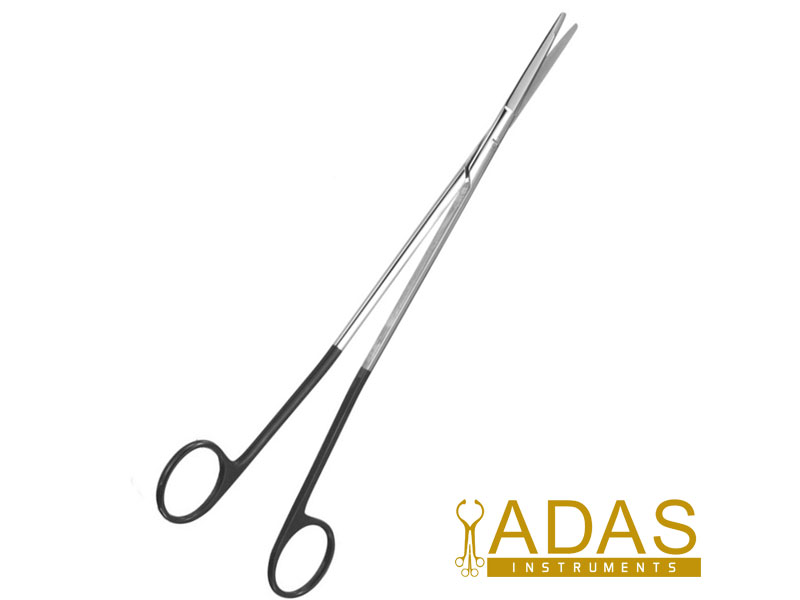
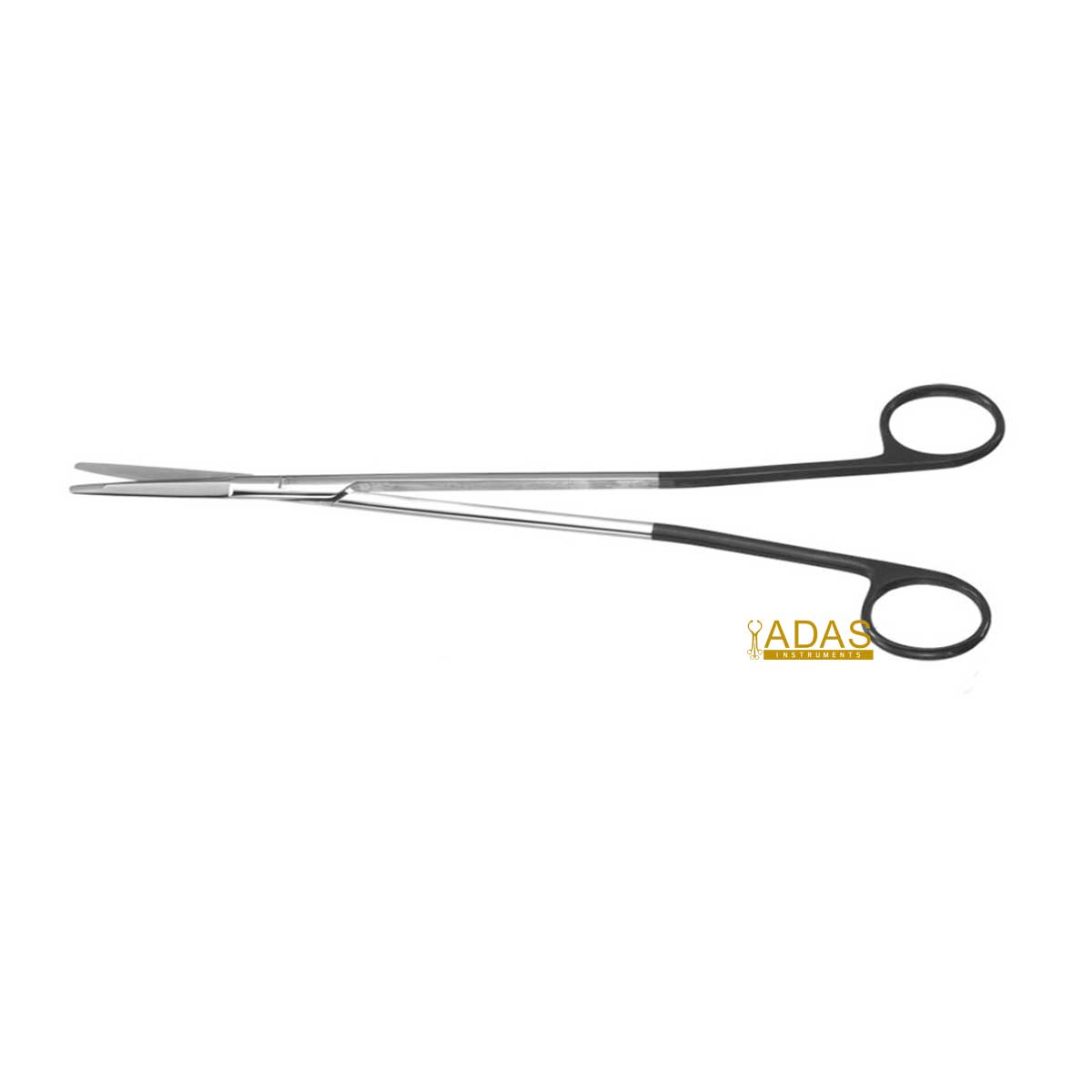
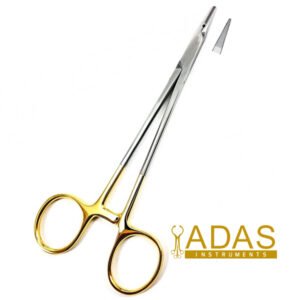
Gorney Platysma Scissors, Razor Edge, 23 cm
Price range: $ 23.00 through $ 28.00
Gorney platysma scissors are long razor edged surgical scissors made for transecting the platysma, the wide thin muscle lying just under the skin of the throat. Since the divided halves are usually stitched back together, what counts is not raw sharpness but how clean the muscle margin is afterwards, and an acute grind compresses far less than an ordinary bevel.
- 23 cm, nine inches, enough to cross the throat from one incision
- Straight blades along the midline, curved ones where the contour rises to the mandible
- Standard razor grind, or that same grind on a tungsten carbide insert

What Gorney platysma scissors are
Gorney platysma scissors are the 23 cm razor edged pattern taken up when the muscle sheet of the neck has to be transected, whether in a dedicated neck procedure or the cervical stage of a rhytidectomy.
The muscle itself is an awkward target: thin, broad, and held under tension. A blade that compresses tissue before parting it leaves a frayed margin, and a frayed margin will not seat neatly once the halves are drawn back together. As tightening and reapproximating is normally the whole object, the state of that margin decides the result.
Adas Instruments makes the pattern at 23 cm, which is 9 inches, with curved or straight blades, in a standard razor edge or a tungsten carbide razor edge.
Why Gorney platysma scissors carry a razor edge
A conventional surgical bevel has two ground faces meeting at the cutting line. It is strong, it is easy to resharpen, and on fascia or fat it is entirely adequate.
A razor edge is ground much more acutely on one blade, so it slices rather than shears. The practical difference on muscle is the amount of closing force needed: less force means less crushing at the cut line, and less crushing means the divided platysma has clean edges that appose properly under suture.
That is the whole argument for razor edge facelift scissors on this tissue, and the reason Gorney platysma scissors are ground the way they are. It is not about sharpness in the abstract; it is about what the edge of the muscle looks like after it has been cut, because that edge has to heal against its opposite number.
The cost of the grind is servicing. A razor edge cannot be restored by anyone with a wheel, and an ordinary regrind will simply flatten it back to a conventional bevel, at which point the instrument is a long pair of ordinary scissors.
Clinical applications
| Procedure | What the instrument does |
|---|---|
| Neck lift, cervicoplasty | Divides the platysma in the midline or laterally before it is tightened |
| Platysmaplasty | Cuts the muscle for a corset or partial transection repair |
| Facelift, cervical component | Works the neck portion of a rhytidectomy, where 23 cm reaches across from a single incision |
| Submental dissection | Neck lift dissection beneath the chin, opening and then dividing tissue |
| Platysmal band release | Selective division of a visible band, the finest platysma dissection these are asked to do |
| Revision neck surgery | Cuts through scarred muscle where a blunt bevel would drag |
| Head and neck reconstruction | General muscle division outside cosmetic practice |
The two edges and two blade shapes of Gorney platysma scissors
Four combinations in total, all stock.
A standard razor edge is the grind in stainless. It gives the slicing action described above at the lower price, and it is the sensible choice if neck work is an occasional rather than a weekly part of a list.
A tungsten carbide razor edge puts the same grind on a carbide insert. The edge holds far longer, which matters on this pattern more than on most, because the razor grind is the thing you are paying for and a razor grind that has dulled is just a bevel.
Blade shape follows the plane. Straight blades suit the midline, where the cut runs along a flat surface and to a line. Curved blades follow the contour where the neck turns towards the jaw, and they keep the tips visible when the hand is working under a skin flap.
Technical specification
Taken from the Gorney platysma scissors we hold rather than from a catalogue.
| Detail | Specification |
|---|---|
| Instrument type | Gorney platysma scissors, razor edge |
| Overall length | 23 cm, 9 inches |
| Blade | Long and slim, curved or straight |
| Edge options | Standard razor edge, or tungsten carbide razor edge |
| Handle | Standard finger ring |
| Material | High quality medical grade stainless steel |
| Sterilisation | Reusable, fully autoclavable, supplied non-sterile |
| Rust prevention | Passivated and boil tested, ultrasonically cleaned before packing |
| Marking | Laser marked with the pattern name and the Adas Instruments reference |
| Reference | AD-227-39 |
| Price | From 23 dollars |
Care and sterilisation of Gorney platysma scissors
Gorney platysma scissors have two things worth protecting, and they pull in different directions.
The edge is the first. A razor grind is thinner than a conventional bevel, which makes it more vulnerable to being chipped against anything hard. So Gorney platysma scissors never cut suture wire, never cut drain tubing, and never get used as a general purpose pair because they happen to be the longest thing on the tray. That last one is how most razor edged instruments actually die.
The length is the second. A 23 cm shank has real leverage in it and will take a set if something heavy rests across it in storage. Since a platysma cut runs long and straight, blades that are out of line show up immediately as a cut that wanders. Store the pair supported, and sight along the closed blades under a lamp before every list.
Reprocessing is standard. Cold rinse immediately, ultrasonic clean, autoclave with the joint open, dry thoroughly, oil the screw weekly. Sharpening goes to someone who will reproduce a razor grind, and to a carbide specialist if the build is carbide; there is no point owning this pattern and then having it ground back to an ordinary edge.
Made by Adas Instruments
We put the razor grind on these Gorney platysma scissors ourselves, and it is the only part of the instrument that is difficult to make well.
An acute grind is easy to produce and hard to produce consistently along the whole blade. A pair that is razor sharp for the first third and conventional for the rest will feel excellent on the first centimetre of a cut and then start dragging, which on a long muscle division is exactly when you notice. Ours are ground and then tested along the full blade length before packing.
All four combinations of these Gorney platysma scissors are stock, from 23 dollars. Take an evaluation pair and test it on a long cut rather than a short one, because a short cut will not reveal the fault described above. Supplied branded or plain for distributors, and marked to a customer reference on request.
Frequently asked questions
What are Gorney platysma scissors used for?
Dividing the platysma muscle in the neck during a neck lift, a platysmaplasty or the cervical part of a facelift. They are also used for general dissection and muscle division in the neck, where the 23 cm length reaches across from one incision.
What are platysma scissors?
Long scissors made for cutting the platysma, the broad thin muscle sheet running up the front of the neck beneath the skin. The requirements are reach, because the muscle is wide, and a clean cut edge, because the two divided halves are usually sutured back together.
Why do Gorney platysma scissors have a razor edge?
Because it slices rather than shears, so it needs less closing force and crushes the muscle less at the cut line. On a platysma that is being reapproximated afterwards, the condition of that edge is the condition of the repair.
Curved or straight blades?
Straight for the midline, where the cut is along a flat plane and to a line. Curved where the neck turns up towards the jaw, and where the tips need to stay visible while the hand works under a flap.
Can Gorney platysma scissors be sharpened normally?
No, and this is the main thing to know before buying. An ordinary regrind flattens a razor edge back to a conventional bevel and the instrument becomes a long plain pair of scissors. Use a sharpener who will reproduce the grind, and a carbide specialist for the carbide build.
Related instruments and categories
Filed under plastic surgery scissors and under facelift and neck lift instruments, beside the retractors and elevators from the same tray.
For raising the skin flap rather than cutting muscle, the serrated patterns are the Kaye facelift scissors and the Kaye Freeman facelift scissors. Where a broad blunt end is wanted instead of an edge, the Trepsat facelift dissection scissors finish in a flat spatula. The other razor edged pattern in the range is the Kaye rhytidectomy dissecting scissors, which is the fine version of the same idea.
| Weight | 0.06 kg |
|---|---|
| Select Scissors Blades | Curved Blades, Straight Blades |
| Select Scissors Type | Standard Razor Edge, TC Razor Edge |
Be the first to review “Gorney Platysma Scissors, Razor Edge, 23 cm”
Shipping & Delivery Policy
Processing Time: In-stock items are dispatched within 24-48 hours. For custom or out-of-stock items, production time is approximately 10-15 days.
Global Delivery Estimates
We partner with world-class couriers (DHL, FedEx) to ensure fast, tracked delivery.
- USA & Canada: 3-5 Business Days
- Europe & UK: 4-6 Business Days
- Rest of World: 5-7 Business Days
*We offer Air Cargo and Sea Freight options for bulk wholesale orders.
Customs & Duties
International buyers are responsible for any customs duties or taxes imposed by their country. Adas Instruments is not responsible for delays caused by customs clearance.
Lost Packages & Insurance
If your package is lost in transit, please contact us immediately. We offer full support and replacements for confirmed lost shipments. Note: You must report non-delivery within 3 weeks to be eligible for an insurance claim.
Related products

Reviews
There are no reviews yet.