


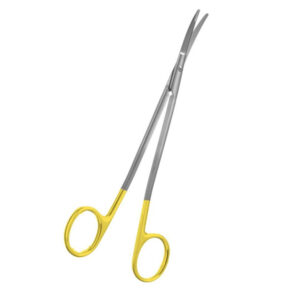
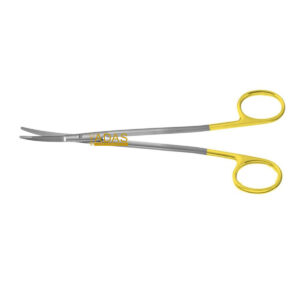
Kaye Freeman Facelift Scissors, Serrated, 14 to 23 cm
Price range: $ 19.50 through $ 28.00
Kaye Freeman facelift scissors are serrated surgical scissors used to advance a dissection pocket under facial and cervical skin. Five shank lengths exist so that reach can be bought to fit the operation, because every centimetre between your fingers and the tips is a centimetre over which small movements become large ones. Curved or straight blades, carbide inserted teeth.
- Teeth hold fibrous septa and greasy fat that a smooth bevel skates across
- Most practices are better served by two pairs, one short and one long, than by one compromise
- Convex surfaces such as a cheek want the curve; the flatter cervical plane wants the straight

What Kaye Freeman facelift scissors are
Kaye Freeman facelift scissors are the long toothed pattern a rhytidectomy tray carries for distance work, where the tissue being divided sits far from the opening it is reached through. The name belongs to the two surgeons whose technique the instrument was shaped around, and catalogues also shorten it to Kaye Freeman scissors.
Reach is the point of the pattern and also its difficulty. A shank can be built to any length, but the further the tips sit from the fingers holding the rings, the more a small tremor at one end becomes a large excursion at the other. Nothing in metallurgy fixes that; only picking the right length does.
Which is why Adas Instruments stocks Kaye Freeman facelift scissors in five lengths rather than one, each with a curved or straight blade and a serrated carbide edge.
Buying reach without losing precision
Most surgeons who own a single pair of Kaye Freeman facelift scissors own a compromise. The length that works through a short scar incision is not the length that crosses a neck, and a pair chosen for one will be wrong for the other in a way that is felt rather than measured.
The useful discipline is to think in terms of the gap between the incision and the furthest tissue the pocket has to include, then choose the shortest shank that covers it. Extra length is not insurance. A 23 cm pair used in the mid face holds the rings so far back that the surgeon loses the fine feedback that tells them which plane they are in. A 14 cm pair taken across a submental pocket forces the hand down into the wound to place the tips, which obstructs the view of the very thing being cut.
Two pairs of Kaye Freeman facelift scissors settle it for nearly everybody: a short one and a long one. Where budget allows only one, 18 cm is the length that never fails outright and never excels.
The five lengths of Kaye Freeman facelift scissors, by how far they reach
| Shank | Working distance it covers comfortably |
|---|---|
| 14 cm, 5½ inches | Up to roughly the width of a palm from the incision. Short scar and periauricular dissection |
| 16 cm, 6¼ inches | Across a cheek from a preauricular entry |
| 18 cm, 7 inches | Most of a standard rhytidectomy pocket from a single incision |
| 20 cm, 8 inches | Past the angle of the jaw and into the lateral cervical plane |
| 23 cm, 9 inches | Submental entry to the mastoid on the opposite side, hand staying outside the wound throughout |
Curved facelift scissors trace a convex surface, which is what a cheek asks for. Straight blades suit the cervical plane, which is flatter, and they are also what divides a suture cleanly.
Where the pattern is used
| Setting | Role of Kaye Freeman facelift scissors |
|---|---|
| Rhytidectomy | Advances the dissection outward from the entry point, sweeping rather than snipping |
| Cervicoplasty | Develops the submental and lateral cervical pocket, the job the 20 cm and 23 cm shanks exist for |
| Limited incision lifts | Keeps the operator’s hand out of a small opening, using the 14 cm shank |
| Deep plane work | Divides the superficial musculoaponeurotic layer with the serration holding what it cuts |
| Secondary rhytidectomy | Works through established scar, where a smooth bevel skates and teeth do not |
| Forehead and temporal lifts | Advances a pocket over a convex cranial surface |
| Head and neck reconstruction | Raising flaps outside cosmetic practice |
Technical specification
Read off the Kaye Freeman facelift scissors on our own shelf, not from a trade catalogue.
| Detail | Specification |
|---|---|
| Instrument type | Kaye Freeman facelift scissors, serrated |
| Blade | Slim, long shanked, curved or straight |
| Edge | Serrated, carbide inserted |
| Lengths | 14 cm, 16 cm, 18 cm, 20 cm and 23 cm |
| Handle | Standard finger ring |
| Material | High quality medical grade stainless steel |
| Sterilisation | Reusable, fully autoclavable, supplied non-sterile |
| Rust prevention | Passivated and boil tested, ultrasonically cleaned before packing |
| Marking | Laser marked with the pattern name and the Adas Instruments reference |
| Reference | AD-222-37 |
| Price | From 19.50 dollars |
Keeping a long shank straight
Kaye Freeman facelift scissors fail in a way short instruments do not, and they fail silently.
A long shank stores leverage. Something resting across it in a tray, or a drawer closed on it, puts the two blades a fraction out of parallel. The instrument still articulates, still feels ordinary in the hand, and the teeth now close on air instead of tissue. Nobody discovers it until a flap that should have lifted cleanly tears instead.
So the inspection is different here: sight along the full length of the closed blades against a light, not just at the ends, and do it before every list. Any pair that has drifted comes out of circulation until someone competent has reset it.
Reprocessing is otherwise routine. Cold rinse immediately, brush along the teeth before ultrasonic cleaning because a wipe leaves protein packed between them, autoclave with the box lock fully open, dry thoroughly, and put a drop of oil on the screw each week. Anything carbide inserted goes only to a sharpener equipped for carbide.
Made by Adas Instruments
Ten combinations of length and blade of these Kaye Freeman facelift scissors are produced here and all ten are held, from 19.50 dollars.
On a long instrument the question worth asking a manufacturer is about stress relief, not about steel grade. A shank that was formed and then sent out without being properly relieved will move on its own after a handful of autoclave cycles, and no storage discipline compensates for that. Ours are heat treated after forming and then sighted along their length before they are packed. Take an evaluation pair of Kaye Freeman facelift scissors in your most used length and put it through two full reprocessing cycles before you decide anything. Orders go out under our mark or unbranded for distributors, and we can engrave a customer reference.
Frequently asked questions
What are Kaye Freeman facelift scissors used for?
Developing the dissection pocket beneath facial and cervical skin in a facelift or neck lift, particularly where the tissue being cut sits a long way from the incision. They also divide the deeper facial layer and cut through established scar in secondary procedures.
How do Kaye Freeman facelift scissors differ from the Kaye pattern?
Both are serrated facelift scissors offered in the same five lengths, and plenty of trays carry both. The distinction is in the pattern rather than the material or the sizing, so it comes down to which one a given hand prefers. Surgeons who already own one commonly buy the other in a different length rather than duplicating.
Which length should I choose?
Measure the gap between your incision and the furthest edge of the pocket, then take the shortest shank that covers it. Extra reach is not free; it costs feedback at the tips. A short pair plus a long pair serves most practices better than one middling compromise.
Curved or straight blades?
Curved where the surface is convex, which means the cheek. Straight for the cervical plane and for dividing sutures. A tray that does much of both carries one of each.
Why a serrated edge on carbide facelift scissors?
Because grip, not sharpness, is the limiting factor on a flap. Fibrous septa and greasy fat alternate under the blade, and a smooth bevel skates off one and bites the other unpredictably. Teeth remove that variable, so the cut lands where it was aimed with no extra force applied.
Related instruments and categories
Filed under plastic surgery scissors, and again under facelift and neck lift instruments beside the retractors, elevators and forceps from the same set.
Its counterpart in identical sizing is the Kaye facelift scissors. Where the requirement is a broad blunt end rather than a toothed edge, each blade of the Trepsat facelift dissection scissors terminates in a flat spatula. Once the plane is established and only fine work remains, the Kaye rhytidectomy dissecting scissors are the lighter choice.
| Weight | 0.06 kg |
|---|---|
| Select Scissors Blades | Curved Blades, Straight Blades |
| Select Size | 14 cm / 5.5", 16 cm/6¼”, 18cm / 7", 20cm / 8", 23 cm / 9" |
Be the first to review “Kaye Freeman Facelift Scissors, Serrated, 14 to 23 cm”
Shipping & Delivery Policy
Processing Time: In-stock items are dispatched within 24-48 hours. For custom or out-of-stock items, production time is approximately 10-15 days.
Global Delivery Estimates
We partner with world-class couriers (DHL, FedEx) to ensure fast, tracked delivery.
- USA & Canada: 3-5 Business Days
- Europe & UK: 4-6 Business Days
- Rest of World: 5-7 Business Days
*We offer Air Cargo and Sea Freight options for bulk wholesale orders.
Customs & Duties
International buyers are responsible for any customs duties or taxes imposed by their country. Adas Instruments is not responsible for delays caused by customs clearance.
Lost Packages & Insurance
If your package is lost in transit, please contact us immediately. We offer full support and replacements for confirmed lost shipments. Note: You must report non-delivery within 3 weeks to be eligible for an insurance claim.
Related products
Reviews
There are no reviews yet.