
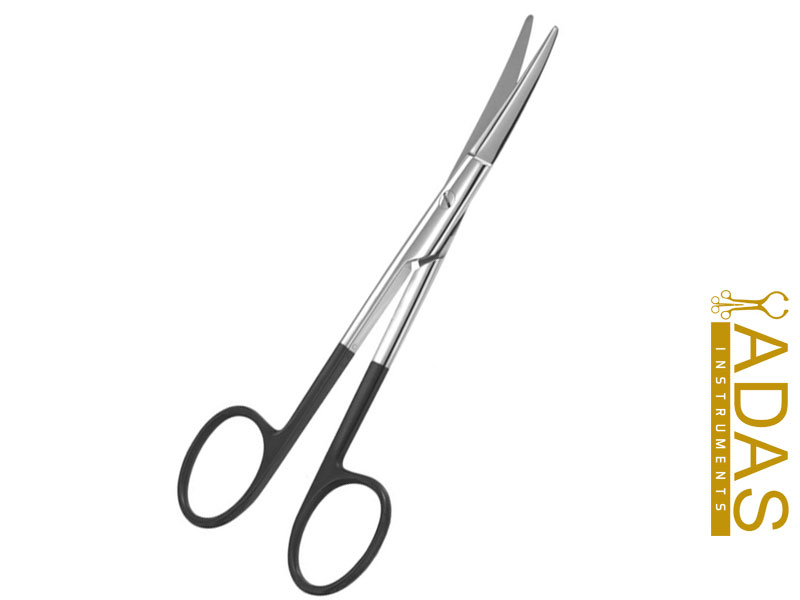
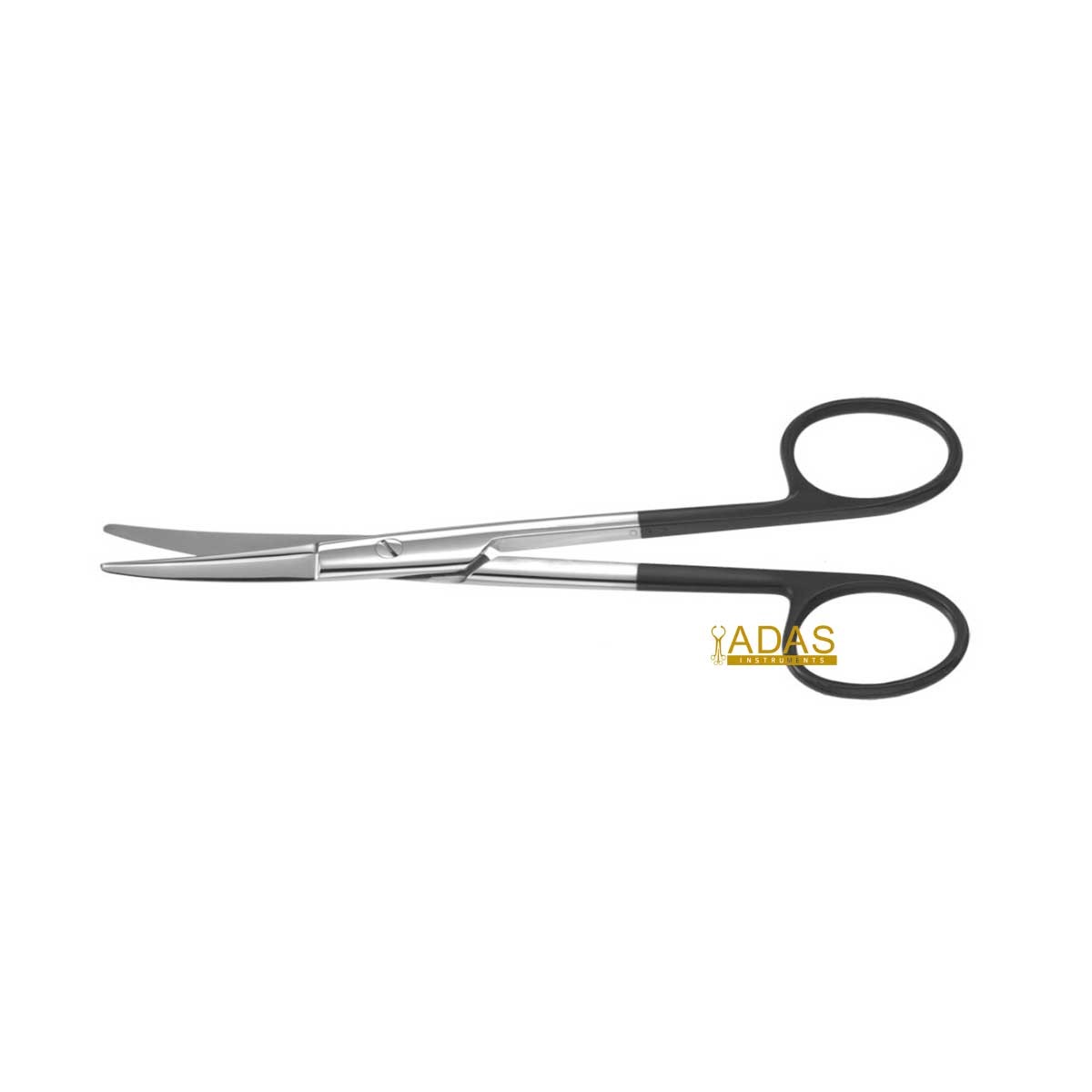

Kaye Rhytidectomy Dissecting Scissors, Razor Edge
Price range: $ 18.50 through $ 29.00
Rhytidectomy dissecting scissors are fine surgical scissors used to raise a skin flap off the layer under it without tearing it. On the Kaye pattern the blades stay thin from the joint right to the end rather than only at the point, and the ends are blunt, so a closed pair can be pushed into the plane to feel where it opens. Supplied from 14.6 cm to 23 cm.
- Three lengths: 14.6 cm for temporal work, 19 cm for the face, 23 cm for the neck
- Curved blades for the cheek and jaw, straight for a flat run
- Standard razor edge, or razor edge with tungsten carbide inserts
- Blunt tips, so the plane is found by feel and not by cutting

What rhytidectomy dissecting scissors are
Rhytidectomy dissecting scissors are the fine pattern reached for in a facelift once the plane has been found and the flap has to come up cleanly. Where a heavier facelift scissor stops being safe, the Kaye pattern takes over. Rhytidectomy dissecting scissors are the instrument that separates the skin flap from the layer beneath it without buttonholing it: thin blades along their whole length, blunt tips, and a razor edge ground fine enough to cut fibrous strands without tearing the dermis. Adas Instruments builds this pattern in 14.6 cm, 19 cm and 23 cm from high quality medical grade stainless steel, so the length matches the field instead of the surgeon reach.
Why rhytidectomy scissors are shaped this way
The subcutaneous plane in a facelift is thin, and the danger is not cutting too little, it is cutting through. Blunt tips let the closed blades be pushed forward to feel where the plane wants to separate, and only then opened. A sharp tipped scissor finds the dermis instead, and the flap is thinner for the rest of the case.
The razor edge matters for the same reason. Fibrous strands in the plane slide away from a plain ground edge, which means a second and third pass over tissue that has already been handled. A razor edge takes them in one pass. On a list that runs every week the tungsten carbide version is what keeps that edge past the first few months. Surgeons who work the periorbital end of this plane often reach for micro dissecting scissors there, and the 14.6 cm Kaye covers the same ground with a longer handle behind it.
Clinical applications
Rhytidectomy dissecting scissors turn up in four places, and the length changes with each one.
| Where it is used | What it does there | Usual length |
|---|---|---|
| Facelift, rhytidectomy | Raising the skin flap in the subcutaneous plane, releasing fibrous strands | 19 cm or 23 cm |
| Neck lift | Working under the jawline and down the neck, where the reach is longest | 23 cm |
| Temporal and periorbital | Short, controlled dissection close to the hairline and the orbital rim | 14.6 cm |
| Breast and body flaps | Subcutaneous dissection where a fine blade is wanted over a long reach | 19 cm or 23 cm |
Size chart
All three lengths of rhytidectomy dissecting scissors are stocked, and the choice is about reach, not about preference.
| Length | In inches | Where it suits |
|---|---|---|
| 14.6 cm | 5 3/4 in | Temporal, periorbital and short flaps |
| 19 cm | 7 1/2 in | The general facelift length, the one most trays carry |
| 23 cm | 9 in | Neck and lower face, where the reach is longest |
Blade and edge options
Both builds are razor edge dissecting scissors. The difference is not the grind, it is what holds the grind.
| Build | What it is | When it is the right choice |
|---|---|---|
| Standard razor edge | A fine ground edge on stainless blades | Occasional facelift work, or a spare pair |
| TC razor edge | The same grind with tungsten carbide set into the cutting faces, which holds an edge several times longer | A weekly list, where edge life decides the cost per case |
Curved or straight
Curved is the facelift default, because the arc sits against the cheek and the jaw as the flap comes up. Straight gives more feedback through the handle on a flat run and suits temporal work. All three lengths of rhytidectomy dissecting scissors come either way, and a practice running full face and neck usually buys a curved 23 cm and a straight 19 cm rather than matching pairs.
Technical specification
| Detail | Specification |
|---|---|
| Instrument type | Rhytidectomy dissecting scissors, Kaye pattern |
| Blade tip | Blunt, for blind plane dissection |
| Edge | Razor edge, standard or tungsten carbide inserted |
| Lengths | 14.6 cm, 19 cm, 23 cm |
| Curve options | Curved or straight |
| Combinations stocked | Twelve |
| Handle | Standard finger ring |
| Material | High quality medical grade stainless steel |
| Sterilisation | Reusable, fully autoclavable, supplied non-sterile |
| Rust prevention | Passivated and boil tested, ultrasonically cleaned before packing |
| Marking | Laser marking to order, OEM available |
| SKU | AD-221-34 |
Care and sterilisation
Get rhytidectomy dissecting scissors under running water while the blood is still wet. On a 23 cm pair the joint sits a long way from the tips, and a joint that has gone tight reads as vagueness at the working end rather than stiffness in the fingers. Ultrasonic bath, neutral detergent, blades open. A drop of instrument milk in the joint before the cycle. 134 C, three minutes, and out of the tray dry, because the thin part of the blade is where corrosion starts. Every pair leaves Adas Instruments passivated and boil tested.
These cannot be the pair that cuts suture, staples or wire. A razor edge carries less steel behind it than a plain grind, and one careless snip is measurable in the next case. The carbide build resists wear rather than impact: a chipped insert cannot be stoned back, so keep them off steel trays and out of drops. Tips that no longer meet along the last centimetre are a sharpening question, and how to sharpen surgical scissors sets out the tests and the four re-grind ceiling.
Frequently asked questions
What are rhytidectomy dissecting scissors used for?
Raising the skin flap in a facelift, in the subcutaneous plane, and releasing the fibrous strands that hold it down. The blunt tips let the closed blades find the plane by feel before they are opened, which is what keeps the flap intact.
Which length should a facelift tray carry?
19 cm is the general length and the one most trays carry. Add 23 cm if the list includes neck lifts, because that is where the reach runs out, and 14.6 cm for temporal and periorbital work.
Curved or straight for a facelift?
Curved, for most surgeons, because the blades follow the contour of the cheek and jaw. Straight blades suit a flat run and give slightly more feel through the handle.
Is the tungsten carbide version worth the extra cost?
On a weekly list, yes. The inserts hold the razor edge several times longer than plain steel and can be replaced when they finally go, which renews the instrument for a fraction of a new pair. For occasional use the standard razor edge is the rational buy.
How is the Kaye pattern different from a Freeman Gorney scissor?
Both are facelift dissectors. Kaye rhytidectomy scissors are the finer, blunter pattern for the plane itself, while the Freeman Gorney is longer bladed and takes the heavier dissection. Trays doing full face and neck usually carry both.
Related instruments and categories
Rhytidectomy dissecting scissors sit in plastic surgery scissors with every other pattern we grind, and in breast surgery instruments, because the same subcutaneous dissection turns up on a breast flap.
For the heavier dissection this pattern is too fine for, the Facelift Dissecting Scissors, Freeman Gorney Pattern carries a longer blade over the same plane. Where a full tray is being built, the Rhytidectomy Scissors Set of 3 covers three lengths in black titanium in one box. And the Gorney Scissors, Titanium Coated is the pattern most facelift trays start from. For blunt dissection in the same plane the Trepsat facelift dissection scissors end in a flat spatula instead of a blade, and many trays carry both.
| Weight | 0.05 kg |
|---|---|
| Select Scissors Blades | Curved Blades, Straight Blades |
| Select Scissors Type | Standard Razor Edge, TC Razor Edge |
| Select Size | 14.6cm / 5 3/4", 19cm / 7 1/2", 23 cm / 9" |
Be the first to review “Kaye Rhytidectomy Dissecting Scissors, Razor Edge”
Shipping & Delivery Policy
Processing Time: In-stock items are dispatched within 24-48 hours. For custom or out-of-stock items, production time is approximately 10-15 days.
Global Delivery Estimates
We partner with world-class couriers (DHL, FedEx) to ensure fast, tracked delivery.
- USA & Canada: 3-5 Business Days
- Europe & UK: 4-6 Business Days
- Rest of World: 5-7 Business Days
*We offer Air Cargo and Sea Freight options for bulk wholesale orders.
Customs & Duties
International buyers are responsible for any customs duties or taxes imposed by their country. Adas Instruments is not responsible for delays caused by customs clearance.
Lost Packages & Insurance
If your package is lost in transit, please contact us immediately. We offer full support and replacements for confirmed lost shipments. Note: You must report non-delivery within 3 weeks to be eligible for an insurance claim.
Related products




Reviews
There are no reviews yet.