
How to Sharpen Surgical Scissors: Tests, Limits and When to Retire
Sep
Knowing how to sharpen surgical scissors, and knowing when not to, saves clinics real money: a dull Metzenbaum that chews instead of cuts is either a fifteen-minute service or a needless replacement order, depending on whether anyone tests it properly. This guide covers the tip tests every sterile processing department should run, what in-house maintenance safely includes, and what belongs with a professional service. We grind and re-grind these at Adas Instruments in Sialkot, so the wear patterns below come off our own bench rather than a catalogue, and the same tests apply to every pair in our plastic surgery scissors range.
Key takeaways
- A sharpening pass removes metal, it never adds any, so a good pair has four or five re-grinds in it and no more.
- Test with material and not by eye: tissue paper for fine patterns, one layer of gauze for general scissors.
- Supercut and tungsten carbide edges are not ordinary sharpening jobs, and a service that accepts one without asking which edge it is should be avoided.
- The first three or four re-grinds cost a fraction of a replacement, so the arithmetic only gets close at the end of the instrument life.
What sharpening actually does to a blade
A pass on the wheel does not put metal back. It takes metal away, re-cutting the bevel behind the worn edge until the two faces meet cleanly again. On a plain surgical scissor that bevel sits at roughly 20 to 25 degrees and a competent re-grind removes a few hundredths of a millimetre. Do that eight or ten times across a working life and the blade is measurably thinner, the screw joint sits differently, and the shear line stops closing along its whole length. That is why a pair can come back sharp and still cut badly at the tip.
A supercut edge is a different job again. The micro serration on one blade is the working surface, and a flat stone run along it takes the teeth off in a single careless pass. Sharpening one properly means re-cutting the serration to the original wheel profile. Most general services will decline it, and one that accepts it without asking which edge it is should not be trusted with the tray. The same caution applies to tungsten carbide surgical instruments, where the insert is replaced rather than sharpened.
The Tests: Five Minutes Per Tray
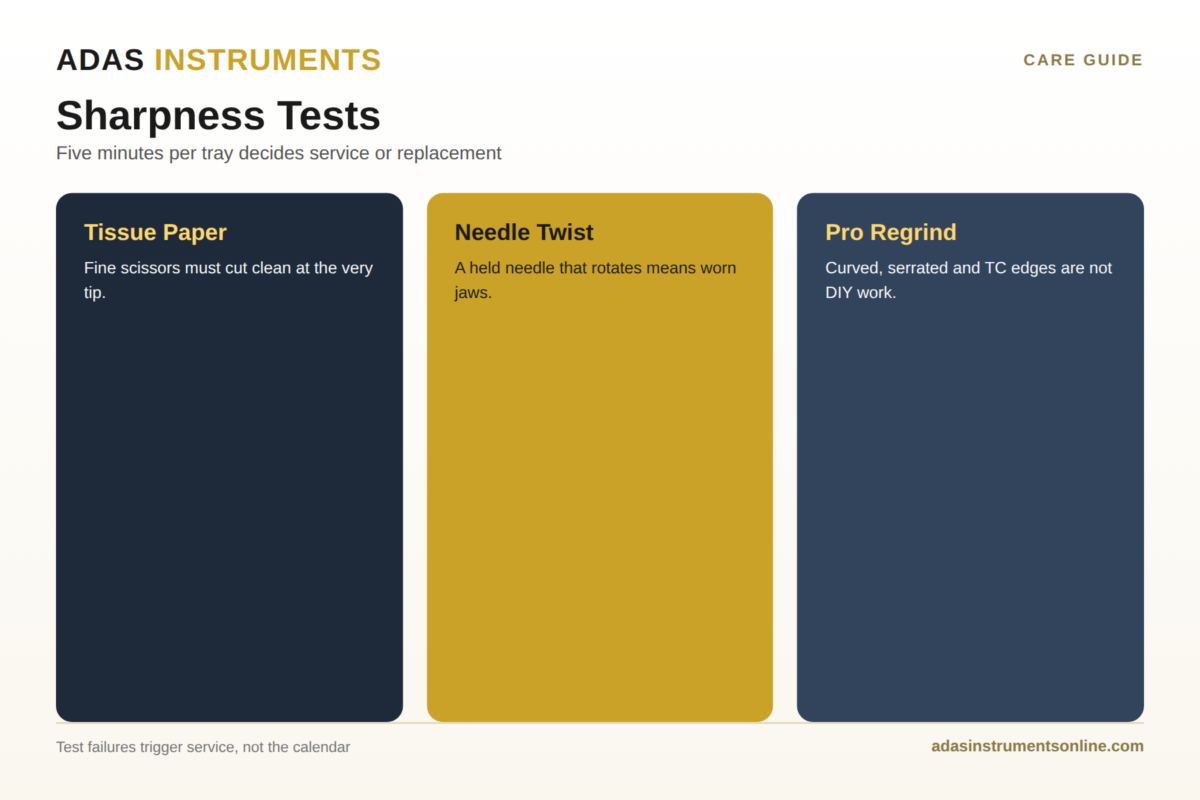
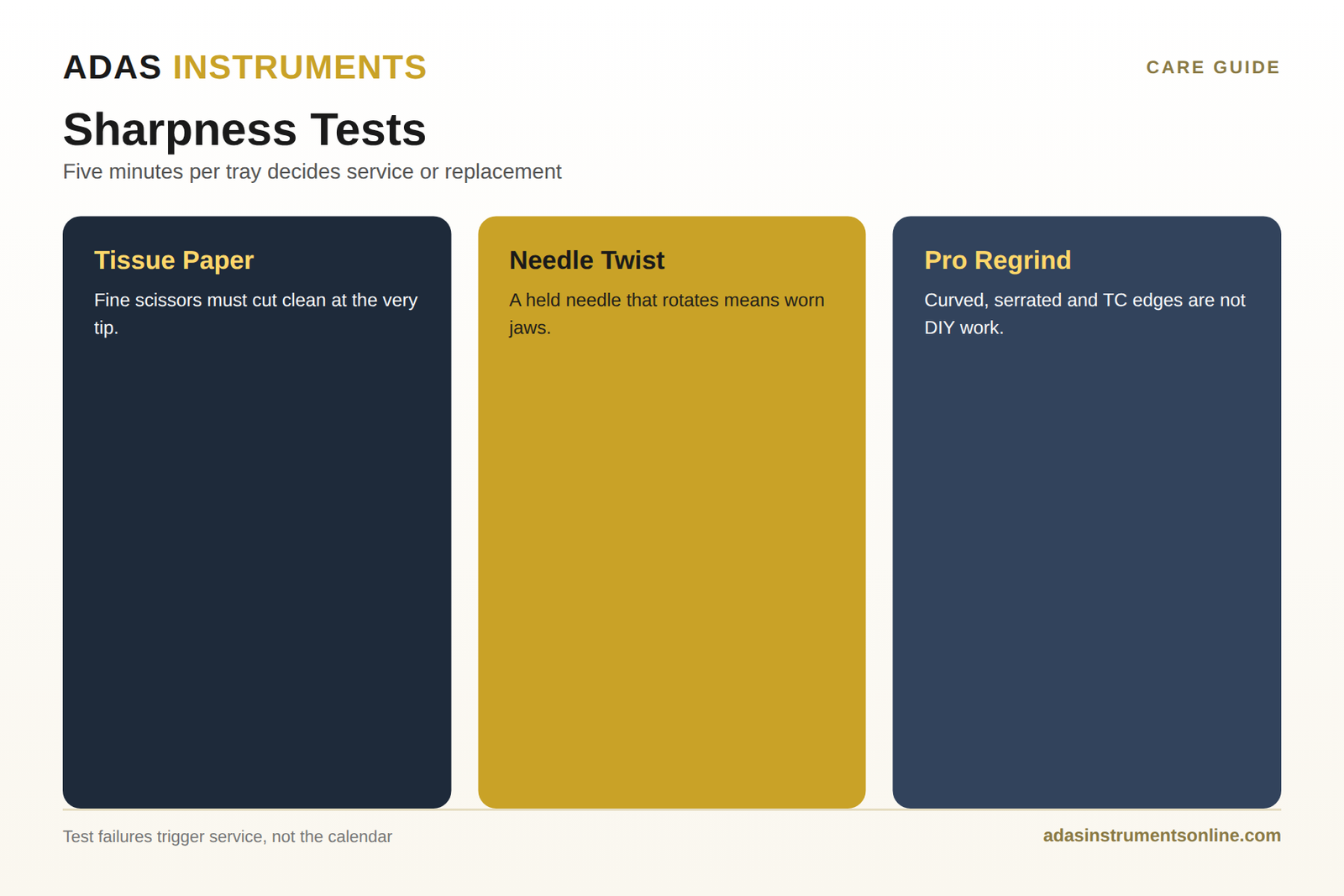
Scissors: cut the right test material for the size, tissue paper for fine patterns like iris and Westcott, a single layer of gauze for Mayo and Metzenbaum, and the cut must be clean at the very tip, where dullness shows first. Needle holders: clamp a needle at the jaw tip and try to rotate it with fingers; slipping means worn jaws. Ratchets: close to the first click and tap the rings against your palm, springing open fails. Forceps: teeth must interdigitate exactly and tips must meet flush. Anything that fails gets tagged, not returned to the tray.
What Dulls Instruments Fastest
Three culprits ahead of all others: tissue scissors used on suture and dressings (the cardinal sin from our scissors guide), instruments tangled loose in a basin during ultrasonic cleaning where edges knock together, and corrosion at the very edge from the moisture and chloride habits covered in our rust guide. Fixing the habits doubles the interval between sharpenings.
[Photo placeholder: tissue paper tip-cut test on iris scissors, needle rotation test on a holder]
In-House vs Professional Sharpening
Honest line: in-house flat-stone touch-ups suit only simple beveled edges on utility scissors, done by someone trained. Surgical patterns, curved blades, serrated edges, tungsten carbide inserts and micro tips, belong with a professional service that regrinds the correct angles and retentions the joint, typically once or twice a year per rotation. Amateur grinding changes blade geometry permanently; one bad wheel pass costs more than years of professional service.
What a re-grind costs against a new pair
The arithmetic settles most of these cases. The cost to sharpen surgical scissors professionally runs a few dollars an instrument in volume, and a mid-range Metzenbaum costs many times that, so the first three or four sharpenings are obvious value. By the fifth the blade is thin, the chance of an instrument failing mid-case rises, and replacement starts to win. Keep the service record per instrument rather than per tray, because a tray record hides the one pair that has already been ground five times. Adas Instruments quotes replacements against the same pattern, so the comparison can be made on one sheet before the decision is taken.
The Retirement Decision
Sharpening has limits: blades thinned by repeated grinding, TC inserts worn through, cracked box locks or pitted edges end the story. The steel quality decides how many sharpening cycles an instrument survives, which is another line in the reusable economics: quality steel takes more services before retirement.
Replacing what failed the tests? Razor edge and TC scissors, needle holders and forceps ready to ship.
People Also Ask
How do you test if surgical scissors are sharp?
Cut the size-appropriate test material at the very tip: tissue paper for fine scissors, single-layer gauze for standard patterns. Clean cut to the point passes; folding, snagging or chewing fails.
Can surgical scissors be sharpened in-house?
Only simple utility edges by trained hands. Surgical patterns with curved, serrated or TC edges need professional regrinding at correct angles; amateur wheels permanently ruin blade geometry.
How often should instruments be professionally sharpened?
Volume decides: busy trays typically once or twice a year, triggered by test failures rather than the calendar. Good handling habits stretch the interval substantially.
When is an instrument beyond sharpening?
Thinned blades, worn-through carbide inserts, cracked box locks or edge pitting mean retirement; grinding past these limits produces an instrument that fails mid-case instead of at the test bench.
Frequently asked questions
How often should surgical scissors be sharpened?
On instruments that cut every list, expect a re-grind every six to twelve months, and judge it by the test material rather than the calendar. A pair that fails the tissue paper test at the tip is due whatever the date says.
Can you sharpen surgical scissors in house?
Only simple bevelled utility scissors, by someone trained, with a flat stone and a jig. Fine patterns, curved blades and any carbide or supercut edge belong with a service. An in-house pass on a Westcott usually ends its working life.
How many times can surgical scissors be sharpened?
Four or five re-grinds is a realistic ceiling on a good pair, because every pass removes metal. After that the blade is thin and the shear line no longer closes evenly along its length.
Does sharpening work on tungsten carbide inserts?
The inserts are not sharpened, they are replaced. A service re-inserts the jaws, which renews the instrument for a fraction of a new one and is the main reason carbide patterns stay in a tray for years.
What dulls surgical scissors fastest?
Cutting suture with tissue scissors, autoclaving with the blades closed, and dried blood left in the box joint, in that order. The first one alone accounts for most of the pairs sent back to us.
