
Types of Surgical Scissors: Mayo, Metzenbaum, Iris and More
Sep
All types of surgical scissors do one of two jobs: cut tissue or cut everything else. Mixing those jobs is how good scissors go blunt. This guide sorts the main patterns by what they are actually for, from Mayo to Metzenbaum to iris, and explains the details, curve, tip, edge, that tell them apart.
Surgical scissors are cutting instruments made in matched patterns, each shaped for one job. Mayo scissors cut heavy fascia and suture, Metzenbaum scissors dissect bluntly without cutting, and iris scissors handle fine work on blades under 4 cm. The pattern names come from the surgeons who designed them and have barely changed in a century. Adas Instruments manufactures every pattern on this page in Sialkot, Pakistan, from German surgical stainless steel, in lengths from 9 cm to 23 cm.
Key takeaways
- Mayo scissors cut, Metzenbaum scissors dissect. Using one for the other is the fastest way to blunt a good instrument.
- Blade length tells you the job. Under 12 cm is fine work, 14 cm to 18 cm is general surgery, over 20 cm reaches into a neck or a body cavity.
- A razor edge parts thin mobile tissue that a standard ground edge pushes flat first. It also dulls faster, so keep suture away from it.
- Tungsten carbide inserts cost more and pay for themselves only if the instrument is used on most lists.
The Two Big Families
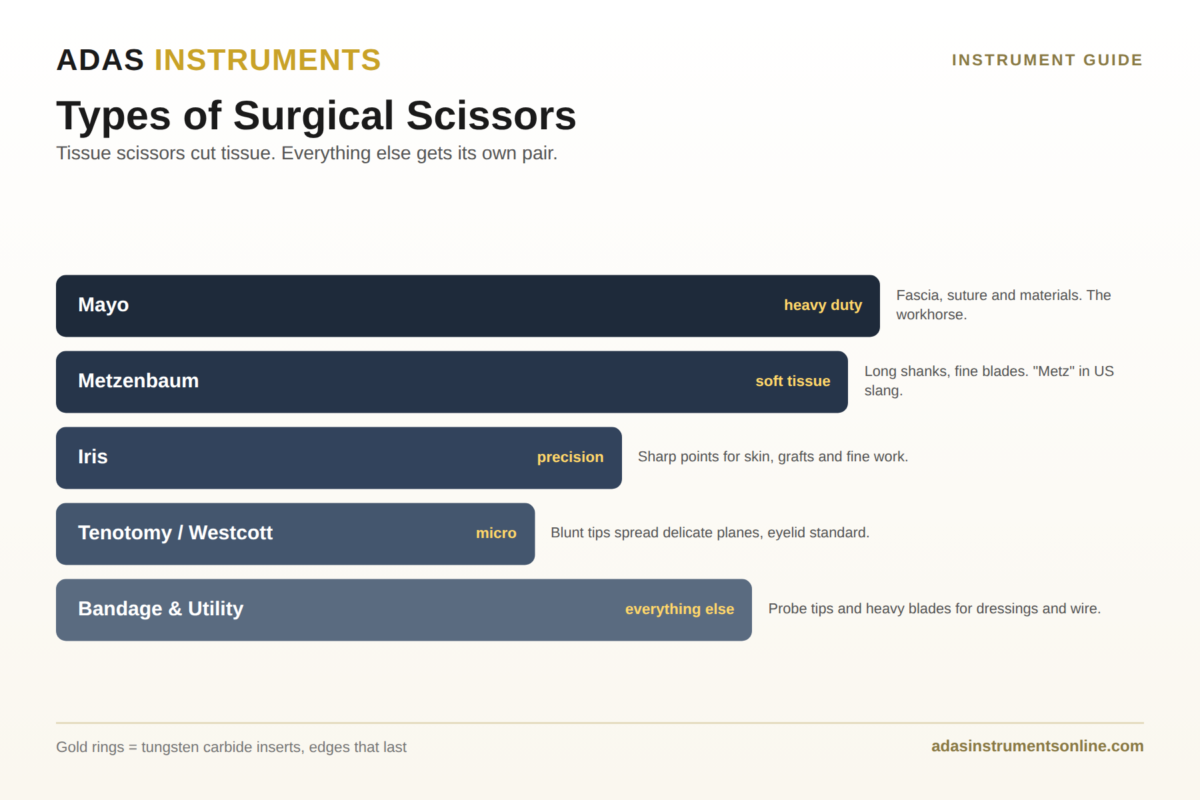
Tissue scissors have finer blades and sharper edges reserved strictly for living tissue. Suture and utility scissors have heavier blades that take the abuse of thread, dressings and drapes. The fastest way to ruin a pair of Metzenbaums is to cut one suture with them; every OR tapes this rule to the wall eventually.
Mayo Scissors: The Heavy Cutter
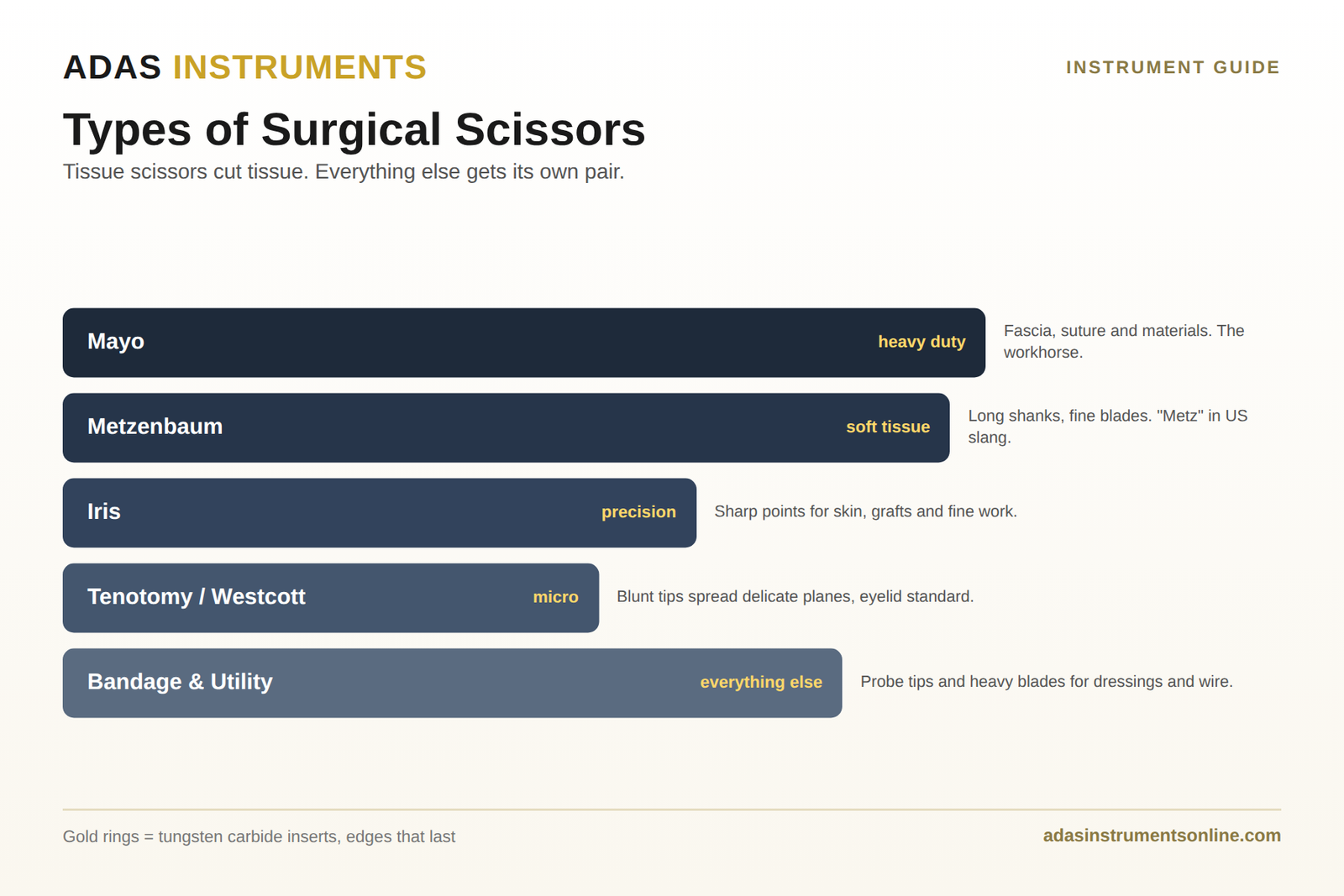
Straight or curved with robust semi-blunt blades, around 14 to 17 cm. Straight Mayos cut suture and materials at the table; curved Mayos cut dense tissue like fascia. If a tray has only one scissor pattern, it is usually a Mayo, but it should never be the only one.
Metzenbaum Scissors: The Dissector
Longer shanks, shorter and finer blades, usually curved. The Metzenbaum, Metz in American OR slang, is the standard soft tissue dissection scissor: the long shank reaches into the wound while the fine blades spread and cut delicate planes. Our razor edge Metzenbaum scissors add a honed edge and optional tungsten carbide inserts for lasting sharpness.
Iris Scissors: The Fine Point
Short, sharp-pointed blades on a small frame, originally for ophthalmic work, now everywhere fine precision is needed: blepharoplasty skin, graft trimming, suture removal in delicate sites. Straight for cutting, curved for sculpting.
Tenotomy and Westcott: The Spreaders
Blunt-tipped Stevens tenotomy and spring-handled Westcott scissors dissect by spreading as much as cutting, protecting structures beneath. They are the eyelid and micro surgery standard.
The Specialists
Bandage scissors with a flat probe tip slide safely under dressings. Wire scissors take stainless suture wire. Facelift patterns like the Trepsat dissection scissors combine long reach with controlled spreading for flap work. Rhinoplasty trays add angled and serrated patterns covered in our rhinoplasty instruments guide.
[Photo placeholder: five scissor patterns fanned out: Mayo, Metzenbaum, iris, tenotomy, bandage]
What Makes a Scissor Worth Buying
Three things: steel (German stainless holds an edge through hundreds of autoclave cycles), the grind (a razor edge cuts at the tip, not just the heel), and tungsten carbide inserts where daily volume justifies them, identified by gold-toned rings. Our full plastic surgery scissors range covers all 31 patterns; the general pattern families are summarized well in the surgical scissors overview.
Rebuilding your scissor tray? Mayo to Metzenbaum to iris, razor edge and tungsten carbide options in German steel.
People Also Ask
What is the difference between Mayo and Metzenbaum scissors?
Mayo scissors are heavier with blades nearly as long as the shanks, for fascia and materials. Metzenbaums have longer shanks and shorter, finer blades for delicate soft tissue dissection. Rule: Mayo for tough, Metz for tissue.
What are iris scissors used for?
Fine precision cutting: eyelid skin, graft edges, vessel work and suture removal in delicate areas. The name comes from ophthalmic surgery, but every plastic surgery tray carries a pair.
Why should tissue scissors never cut sutures?
Suture material work-hardens the fine edge that tissue scissors depend on, dulling the tip within a few cuts. Dedicated suture scissors have edges ground for exactly that abuse.
What do gold rings on scissors mean?
Gold-toned rings mark tungsten carbide inserts: harder jaw surfaces that hold sharpness several times longer than plain stainless, the standard upgrade for high-volume practices.
Further reading on scissors
Three companion guides cover the parts this article only touches. Supercut scissors explained takes the micro serrated edge on its own, including why only one blade carries the teeth. Tungsten carbide surgical instruments works out where the gold rings pay for themselves and where they never will. And how to sharpen surgical scissors covers the tests, the four re-grind ceiling, and when a pair should be retired instead.
Frequently Asked Questions
What is the difference between Mayo and Metzenbaum scissors?
Mayo scissors have short thick beveled blades built to cut heavy fascia and suture. Metzenbaum scissors have short blades on long shanks and are built to spread tissue apart rather than cut it. Cutting suture with a Metzenbaum is the commonest way a good pair is ruined.
Which surgical scissors should a new tray have first?
Four patterns cover almost everything: Mayo for heavy cutting, Metzenbaum for blunt dissection, operating scissors sharp blunt for dressings and suture removal, and iris scissors for fine work. Add the procedure specific patterns after those.
What does a razor edge actually do?
A standard blade is ground to a symmetrical wedge. A razor edge is honed to a much finer angle, so it parts thin mobile tissue instead of pressing it flat before it cuts. The trade is that it dulls sooner.
Are gold ringed scissors different?
Gold rings are a marking convention, not a decoration. They tell you the blades carry tungsten carbide inserts, which hold an edge several times longer than plain steel.
How long should a pair of surgical scissors last?
Years, if they are only used on what they are designed for and are lubricated before every autoclave cycle. Most instruments returned to us for sharpening were dulled by cutting the wrong material, not by age.
The patterns in this guide
Adas Instruments makes each of these in our own workshop in Sialkot. Every pattern below is sold in several lengths, curved or straight, in a standard or razor honed edge.
- Metzenbaum Scissors Razor Edge, the blunt dissection workhorse.
- Mayo Scissors Razor Edge, for fascia and heavy suture.
- Operating Scissors Sharp Blunt, the safe choice for dressings and suture removal.
- Iris Scissors Sharp, short blades and sharp points for fine cutting.
- Stevens Tenotomy Scissors, tapered blades that spread a plane as safely as they cut it.
- Castroviejo Micro Scissors, spring handles for work under a microscope.
The complete range is in plastic surgery scissors.
