

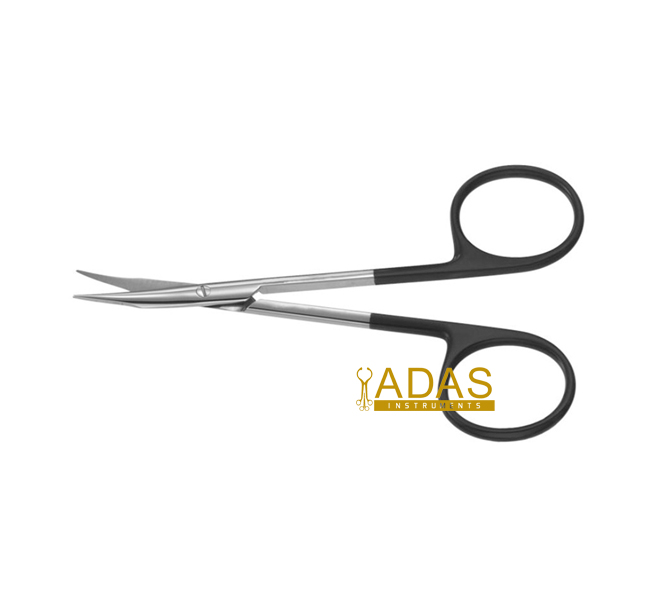
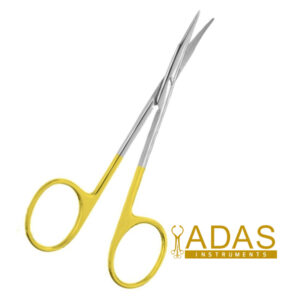
Stevens Tenotomy Scissors, Fine Tissue Dissection Scissors
Original price was: $ 12.50.$ 8.50Current price is: $ 8.50.
Stevens pattern tenotomy scissors from 11.5 cm to 15.5 cm, made by Adas Instruments in Sialkot from German surgical stainless steel. Slim tapered blades that spread a tissue plane as safely as they cut it, for plastic, ophthalmic, hand and paediatric work.
- Blunt or sharp tapered tips
- Standard, SuperCut and tungsten carbide edges
- Fully autoclavable at 134 C
- OEM and private label available
- Ships worldwide direct from the manufacturer
3 in stock (can be backordered)

What are tenotomy scissors used for?
Tenotomy scissors are fine dissecting scissors with slim, tapered blades and blunt or sharp tips, used to separate delicate tissue planes without tearing them. The Stevens pattern is the one most surgeons reach for. It began as a tendon release instrument in ophthalmology and has since become a general workhorse for plastic, hand, paediatric and micro procedures wherever the tissue is too fine for standard operating scissors. Adas Instruments manufactures every pair in Sialkot from German surgical stainless steel and ships worldwide.
Why surgeons choose the Stevens pattern
- Slim blade profile. The blades taper to a narrow point, so they open a tissue plane rather than crush it. This is what separates tenotomy scissors from a small Mayo or a general operating scissor.
- Spreads as well as it cuts. Surgeons push the closed tips through loose areolar tissue, then open the blades to develop the plane. Blunt tips make this safe next to vessels and nerves.
- Controlled ring handles. Balanced ring handles give fingertip control through long cases and reduce hand fatigue.
- Holds an edge. Hardened surgical stainless steel keeps its cutting edge through repeated autoclave cycles. Tungsten carbide inserts are available where cutting volume is high.
- Made, not resold. Every instrument is produced in our own workshop, hand finished and inspected before it leaves.
Clinical applications
Stevens tenotomy scissors are used across several specialties. These are the settings customers order them for most often.
| Specialty | What it is used for | Usual size |
|---|---|---|
| Plastic and reconstructive surgery | Releasing scar bands, undermining skin flaps, trimming fine soft tissue | 12.5 cm |
| Ophthalmic surgery | Tenotomy and recession of extraocular muscles, conjunctival dissection | 11.5 cm |
| Hand and peripheral nerve surgery | Freeing tendons from adhesions, dissecting around digital nerves | 12.5 cm |
| Paediatric surgery | Small anatomy where a full size instrument will not fit | 11.5 cm |
| Dermatology and minor procedures | Excising small lesions, undermining wound edges before closure | 12.5 cm |
| Veterinary practice | Small animal soft tissue dissection | 14 cm |
Size chart
| Overall length | Imperial | Blade shape | Typical use |
|---|---|---|---|
| 11.5 cm | 4 1/2 in | Straight or curved | Paediatric, eyelid and digit work |
| 12.5 cm | 5 in | Straight or curved | The general purpose size, most ordered |
| 14 cm | 5 1/2 in | Straight or curved | Facial and hand procedures needing more reach |
| 15.5 cm | 6 1/4 in | Straight or curved | Deeper cavity dissection |
Curved blades follow the contour of tissue and let you see the tips while you work. Straight blades give a cleaner cut in a flat field. If you are buying a single pair, most surgeons pick the curved tenotomy scissors. If your tray already has a curved pair, the straight tenotomy scissors is the sensible second.
Technical specifications
| Specification | Detail |
|---|---|
| Instrument | Stevens tenotomy scissors, fine dissecting pattern |
| Material | German surgical stainless steel, AISI 420 grade |
| Edge options | Standard, SuperCut, tungsten carbide, tungsten carbide SuperCut |
| Tips | Blunt or sharp, tapered |
| Handle | Ring handle, box joint |
| Finish | Satin, non glare |
| Sterilisation | Fully autoclavable, 134 C for 3 minutes |
| Reusable | Yes, supplied non sterile |
| Origin | Manufactured by Adas Instruments, Sialkot, Pakistan |
| OEM and private label | Available, laser marking on request |
Care and sterilisation
Fine tips bend. Most of the damage we see on returned instruments comes from handling rather than cutting.
- Rinse in cool water straight after use so blood does not dry on the blades.
- Clean ultrasonically with a neutral pH detergent. Avoid scrubbing the tips with a brush.
- Open the joint fully during cleaning so debris does not sit in the box joint.
- Lubricate the joint with instrument milk before every autoclave cycle.
- Autoclave at 134 C for 3 minutes. Dry fully before storage.
- Store with tip guards fitted, never loose in a drawer beside heavier instruments.
Frequently asked questions
What is the difference between tenotomy scissors and iris scissors?
Both are small and fine. Iris scissors have short, straight blades and sharp points made for cutting. Tenotomy scissors have longer, tapered blades and are made for blunt spreading as much as cutting, so they open tissue planes more safely.
Are Stevens tenotomy scissors curved or straight?
We make both. Curved is the more common order because the blades follow tissue contour and stay visible during dissection. Straight is preferred for flat, superficial work.
Can these scissors cut suture?
They will, but it dulls the edge quickly. Keep a separate suture scissor on the tray and reserve this instrument for tissue.
What is the SuperCut edge?
One blade carries a razor honed edge, the other a micro serration. The pair grips tissue instead of pushing it away, which gives a cleaner cut on thin, mobile tissue. It needs sharpening sooner than a standard edge.
Do you supply these for OEM or private label orders?
Yes. We manufacture for distributors and hospital groups and can laser mark your brand, catalogue number and regulatory details. Contact us for volume pricing.
Related instruments
Browse the full plastic surgery scissors range, or the wider plastic surgery instruments catalogue.
- Iris Scissors Sharp, the short bladed cutting scissor that pairs with these on a fine tray.
- Castroviejo Micro Scissors, for work under the microscope where even a tenotomy blade is too large.
- Metzenbaum Scissors Razor Edge, the same blunt dissection principle in a longer instrument for deeper planes.
Related instruments and categories
Iris Scissors Razor Edge, Micro Dissection, 9 cm to 11.5 cm, Standard or is listed alongside it and links back here, so the two can be ordered together.
| Weight | 0.045 kg |
|---|
Be the first to review “Stevens Tenotomy Scissors, Fine Tissue Dissection Scissors”
Shipping & Delivery Policy
Processing Time: In-stock items are dispatched within 24-48 hours. For custom or out-of-stock items, production time is approximately 10-15 days.
Global Delivery Estimates
We partner with world-class couriers (DHL, FedEx) to ensure fast, tracked delivery.
- USA & Canada: 3-5 Business Days
- Europe & UK: 4-6 Business Days
- Rest of World: 5-7 Business Days
*We offer Air Cargo and Sea Freight options for bulk wholesale orders.
Customs & Duties
International buyers are responsible for any customs duties or taxes imposed by their country. Adas Instruments is not responsible for delays caused by customs clearance.
Lost Packages & Insurance
If your package is lost in transit, please contact us immediately. We offer full support and replacements for confirmed lost shipments. Note: You must report non-delivery within 3 weeks to be eligible for an insurance claim.
Related products

Reviews
There are no reviews yet.