
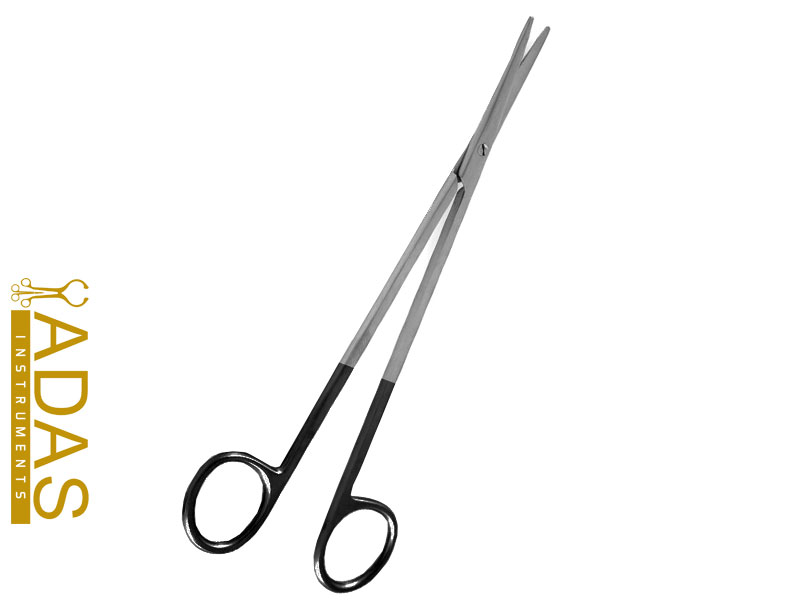
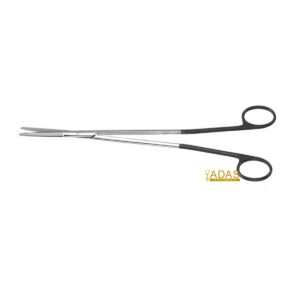
Metzenbaum Scissors, Blunt Dissecting, 14.6 cm to 27.5 cm, Curved or Straight, Razor Edge
Price range: $ 16.00 through $ 26.00
Metzenbaum scissors open a tissue plane by blunt dissection, using short blunt blades on a long slim shank, 14.6 cm to 27.5 cm. Surgeons reach for them in general, plastic, breast and facelift surgery. Adas Instruments makes them in Sialkot, Pakistan.
- Five lengths, 14.6 cm to 27.5 cm
- Curved metzenbaum scissors or straight, in every length
- Standard razor edge or tungsten carbide razor edge with gold rings
- Medical grade stainless steel, fully autoclavable, lifetime technical warranty

What metzenbaum scissors are
Metzenbaum scissors are dissecting scissors with a long slim shank, a short blunt blade and two finger rings, made 14.6 cm to 27.5 cm long. The blade is roughly a third of the total length, which is what gives the instrument its stretched look and lets the tips reach deep without the hand blocking the view. Surgeons use metzenbaum scissors mostly for blunt dissection, pushing the closed tips into a tissue plane and letting them spring apart to open it, and then for dividing the thin soft tissue that plane exposes.
Applications
Adas Instruments supplies this pattern for the following work.
| Procedure | What the metzenbaum does there |
|---|---|
| General surgery | Opening a plane between tissue layers before anything is divided |
| Plastic and reconstructive | Lifting a flap off the layer beneath without tearing it |
| Breast surgery | Working down to the pocket through soft fatty tissue |
| Facelift and neck lift | Spreading through the SMAS layer and dividing fine bands |
| Abdominoplasty | Long blunt dissection across a wide flap |
| Veterinary surgery | The same blunt dissection job in small animal work |
Size chart
Every length is made in curved and straight, and in both blade builds.
| Length | Inches | Typical use |
|---|---|---|
| 14.6 cm | 5 3/4 in | Fine work, shallow planes |
| 18 cm | 7 in | The general purpose length |
| 20 cm | 8 in | Deeper cavity work |
| 23 cm | 9 in | Abdominal and deep pelvic |
| 27.5 cm | 11 in | Long reach, deep dissection |
Curved metzenbaum scissors and straight
Curved metzenbaum scissors follow the tissue plane and let the surgeon see past the blade tip, which is why the curved pattern is the one most trays carry. Straight metzenbaum scissors cut in the line of the hand and suit a shallow, direct division. Both are made here in all five lengths.
Standard razor edge and tungsten carbide razor edge
Metzenbaum scissors razor edge are made in two builds, and both carry the same razor grind. The standard build is plain medical grade stainless steel. The tungsten carbide build adds a carbide insert on the cutting edge and gold plated finger rings, and holds that grind through far more reprocessing cycles, which is what a set autoclaved every day needs.
Technical specification
| Specification | Detail |
|---|---|
| Instrument type | Metzenbaum dissecting scissors, blunt tipped |
| Blade builds | Standard Razor Edge, Tungsten Carbide Razor Edge |
| Blade patterns | Curved blades and straight blades, in every length |
| Tip | Blunt on both blades |
| Lengths | 14.6 cm, 18 cm, 20 cm, 23 cm, 27.5 cm |
| Material | Medical grade stainless steel, passivated. Tungsten carbide insert on the TC build. |
| Handle | Two finger rings. Gold plated rings on the tungsten carbide build. |
| Finish | Satin or matt |
| Sterilization | Reusable, fully autoclavable, supplied non sterile |
| Rust prevention | Passivated and boil tested |
| Cleaning | Ultrasonically cleaned before packing |
| Marking | Laser marked, OEM marking available |
| Packaging | Individually packed |
| Warranty | Lifetime technical warranty |
| Standards | ISO 13485, CE mark compliant |
| SKU | AD-55.114 |
Made in Sialkot by Adas Instruments
Adas Instruments grinds and finishes these metzenbaum scissors in Sialkot, Pakistan. Every pair is passivated, boil tested, ultrasonically cleaned and individually packed, ships non sterile and fully autoclavable, and carries a lifetime technical warranty to ISO 13485 and CE mark.
Care and reprocessing
Wash metzenbaum scissors in an ultrasonic bath and get the fluid into the box joint, because that is where blood dries and stiffens the action. Put a drop of instrument lubricant on the joint after every cycle. A stiff pair spreads tissue instead of releasing cleanly, which is the whole point of the instrument. Autoclave in the open position. Never cut suture, fascia or drape with a metzenbaum. That is the mayo scissor job, and doing it here rolls the fine grind and no sharpening fully brings it back.
Frequently asked questions
What are metzenbaum scissors used for?
Metzenbaum scissors are used for blunt dissection: opening a plane between two tissue layers by pushing the closed blades in and letting them spring apart, rather than cutting. Surgeons also use them to divide thin soft tissue once the plane is open. They are not meant for skin, fascia or suture.
Are metzenbaum scissors curved or straight?
Both are made. Curved metzenbaum scissors are the more common pattern because the curve follows the tissue plane and lets the surgeon see past the tip. Straight metzenbaum scissors suit a cut in the line of the hand. Adas Instruments makes both patterns in all five lengths.
What is the difference between mayo and metzenbaum scissors?
Metzenbaum scissors have long thin shanks, short blades and blunt tips, and are built for delicate blunt dissection. Mayo scissors are heavier with shorter shanks and thicker blades, and are built to cut tough tissue such as fascia and suture. A rough guide on the tray is that the blade is about a third of the total length on a metzenbaum and about half on a mayo.
How do you identify metzenbaum scissors?
Look at the ratio. Metzenbaum scissors have a long slim shank with a short blunt blade at the end, so the instrument looks stretched. The tips are rounded, never pointed. On the tungsten carbide build the finger rings are gold plated.
What does razor edge mean on metzenbaum scissors?
A razor edge is a blade ground to a much finer bevel than a standard surgical blade and then honed. It parts tissue instead of pressing it, so the cut edge stays clean. Adas Instruments grinds this edge in Sialkot, Pakistan, on both the standard and the tungsten carbide build.
Related instruments and categories
Categories these scissors belong to
- Plastic surgery scissors, 31 patterns from micro to heavy dissection
- Facelift and neck lift instruments
Instruments often ordered with this pattern
- Mayo Scissors Razor Edge, the heavier pattern for fascia and suture
- Iris Scissors, Sharp Fine Tip, the short sharp pattern for fine work near the skin
- Stevens Tenotomy Scissors, narrower blades for working along a tendon
For the fine nasal and facial plane work this pattern is too heavy for, see the Joseph Dissecting Scissors, which holds a slim blade along its whole length so the tips stay visible inside the nose.
| Weight | 0.06 kg |
|---|---|
| Select Scissors Blades | Curved Blades, Straight Blades |
| Select Scissors Type | Standard Razor Edge, TC Razor Edge |
| Select Size | 14.6cm / 5 3/4", 18cm / 7", 20cm / 8", 23 cm / 9", 27.5cm / 11" |
Be the first to review “Metzenbaum Scissors, Blunt Dissecting, 14.6 cm to 27.5 cm, Curved or Straight, Razor Edge”
Shipping & Delivery Policy
Processing Time: In-stock items are dispatched within 24-48 hours. For custom or out-of-stock items, production time is approximately 10-15 days.
Global Delivery Estimates
We partner with world-class couriers (DHL, FedEx) to ensure fast, tracked delivery.
- USA & Canada: 3-5 Business Days
- Europe & UK: 4-6 Business Days
- Rest of World: 5-7 Business Days
*We offer Air Cargo and Sea Freight options for bulk wholesale orders.
Customs & Duties
International buyers are responsible for any customs duties or taxes imposed by their country. Adas Instruments is not responsible for delays caused by customs clearance.
Lost Packages & Insurance
If your package is lost in transit, please contact us immediately. We offer full support and replacements for confirmed lost shipments. Note: You must report non-delivery within 3 weeks to be eligible for an insurance claim.
Related products


Reviews
There are no reviews yet.