
Iris Scissors, Sharp Fine Tip, Straight or Curved, 9 cm to 14 cm, Supercut and Tungsten Carbide
Price range: $ 8.50 through $ 22.00
Iris scissors cut thin tissue and lift fine suture, using two sharp pointed blades on a short 9 cm to 14 cm frame. Surgeons reach for them in blepharoplasty, rhinoplasty, ENT work and micro surgery. Adas Instruments makes them in Sialkot, Pakistan.
- Five lengths, 9 cm to 14 cm
- Straight or curved blades, in every length
- Standard, Supercut razor edge or tungsten carbide
- Medical grade stainless steel, fully autoclavable, 3 year warranty

What iris scissors are
Iris scissors, also called iris surgical scissors, are short operating scissors 9 cm to 14 cm from ring to tip, with two fine sharp points and a screw joint between the blades. The surgeon holds them by two finger rings, the same grip as a standard operating scissor, and the short blade keeps the cutting edge close to the hand where small movements stay controlled. Surgeons use them to cut thin tissue, to trim a skin edge and to lift and divide fine suture, mostly in eye surgery, blepharoplasty, rhinoplasty and other plastic surgery work.
Applications
Iris scissors started in the eye and moved outward. These are the procedures they are ordered for at Adas Instruments.
| Procedure | What it does there |
|---|---|
| Blepharoplasty | Trimming the skin ellipse on the upper lid and dividing thin orbicularis fibres |
| Ophthalmic surgery | The original use. Cutting the iris in iridectomy and dividing fine conjunctiva |
| Rhinoplasty | Trimming cartilage edges and releasing soft tissue over the dorsum |
| ENT and micro surgery | Cutting thin membrane and fine suture inside a small field |
| Facelift and neck lift | Trimming skin edges and dividing fine fibrous bands |
| Dermatology | Removing skin tags and trimming small lesions |
| Suture removal | The sharp points slide under a fine stitch and cut it without dragging the knot |
Size chart
Every length below is made in both patterns and in all four blade builds, so a tray can be matched across sizes.
| Length | Inches | Patterns available | Typical use |
|---|---|---|---|
| 9 cm | 3.5 in | Straight or curved | Eyelid and micro work |
| 10.5 cm | 4.2 in | Straight or curved | Blepharoplasty |
| 11.5 cm | 4.5 in | Straight or curved | General fine dissection |
| 12.5 cm | 5.0 in | Straight or curved | Rhinoplasty and facelift |
| 14 cm | 5.5 in | Straight or curved | Deeper plastic surgery work |
Iris scissors curved and iris scissors straight
Curved iris scissors follow the shape of the tissue and let the surgeon see past the blade tip while cutting, which is why curved is the pattern most often reached for in dissection. Straight iris scissors cut in the line of the hand and suit trimming a skin edge or dividing suture. Both patterns are made here in the same five lengths and the same four blade builds, so a surgeon who prefers one is never pushed into a different size.
Technical specification
| Specification | Detail |
|---|---|
| Instrument type | Delicate surgical scissors |
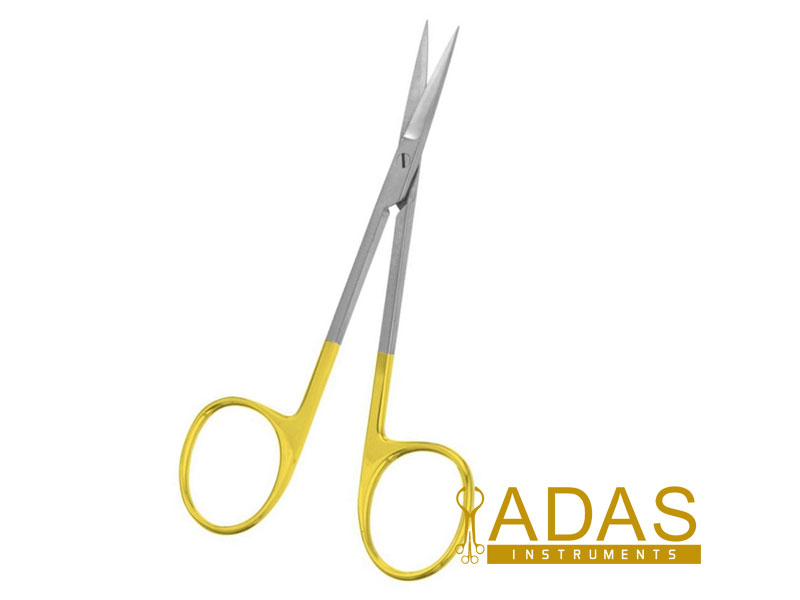
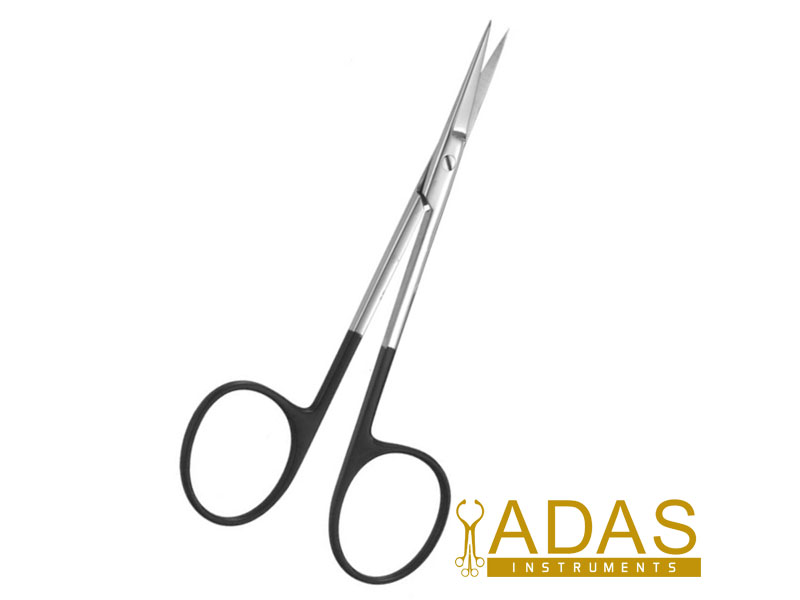
| Blade builds | Standard, Standard Supercut, Tungsten Carbide, Tungsten Carbide Supercut |
| Blade patterns | Iris scissors straight and iris scissors curved, in every length |
| Tip | Fine point, sharp on both blades |
| Lengths | 9 cm, 10.5 cm, 11.5 cm, 12.5 cm, 14 cm |
| Material | Medical grade stainless steel, passivated. Tungsten carbide insert on TC models. |
| Handle | Two finger rings. Black handle on Supercut, gold handle on tungsten carbide. |
| Finish | Polished or satin matt |
| Sterilization | Reusable, fully autoclavable, supplied non sterile |
| Rust prevention | Passivated and boil tested |
| Cleaning | Ultrasonically cleaned before packing |
| Marking | Laser marked, OEM marking available |
| Packaging | Individually packed |
| Warranty | 3 year manufacturer warranty, lifetime against manufacturing defects |
| Standards | ISO 13485, CE mark compliant |
| SKU | AD-02.11 |
Made in Sialkot by Adas Instruments
Adas Instruments makes these iris scissors in Sialkot, Pakistan, in five lengths and four blade builds. The standard blade is plain medical grade stainless steel. The Supercut blade carries a razor ground edge and a black handle, so theatre staff can pick it off a tray without reading the etch. The tungsten carbide blade carries a carbide insert and a gold handle, and holds its edge through far more reprocessing cycles than plain steel. Every pair is passivated, boil tested, ultrasonically cleaned, laser marked and individually packed, and ships non sterile and fully autoclavable.

Care and reprocessing
Wash iris scissors in an ultrasonic bath and make sure the fluid reaches the points, because dried blood at the tip is what blunts a fine scissor first. Put a drop of instrument lubricant on the screw joint after every cycle. A dry joint stiffens, and a stiff scissor pushes tissue ahead of the blade instead of cutting it. Autoclave them in the open position so steam reaches the whole joint. Do not cut wire, suture packets or drape with them. That is what rolls the edge on a fine scissor, and no sharpening fully brings a rolled edge back.
Frequently asked questions
What are iris scissors used for?
Iris scissors cut thin tissue and fine suture. They were made for eye surgery and are now used in blepharoplasty, rhinoplasty, ENT work, micro surgery and general plastic surgery, and for taking out fine stitches after an operation.
Why are they called iris scissors?
Iris scissors are named after the iris of the eye. The pattern was made for iridectomy, the eye operation in which a piece of the iris is cut away, and the name stayed on the instrument even though most pairs sold today are used in plastic surgery rather than in the eye.
What is the difference between curved and straight iris scissors?
The curved pattern lets the surgeon see past the blade tip while cutting, so it is reached for more often in dissection. The straight pattern cuts in the line of the hand and suits trimming a skin edge or dividing suture. Most surgeons keep both on the tray.
How long are iris scissors?
Iris scissors are 9 cm to 14 cm long overall. Adas Instruments makes them in 9 cm, 10.5 cm, 11.5 cm, 12.5 cm and 14 cm, each in a straight and a curved pattern.
What is the difference between iris scissors and Mayo scissors?
Iris scissors have short blades and two sharp fine points, and cut thin tissue and suture near the surface. Mayo scissors are longer, heavier and blunt tipped, and are built to cut tough tissue such as fascia. A surgeon making a fine cut close to the skin takes an iris scissor. A surgeon cutting fascia takes a Mayo.
Related instruments and categories
Browse the categories these iris scissors belong to
- Blepharoplasty instruments, 41 instruments for upper and lower lid surgery
- Plastic surgery scissors, 31 patterns from micro to heavy dissection
Instruments often ordered with this pattern
- Iris Scissors Razor Edge, the same pattern with an ultra sharp razor ground edge
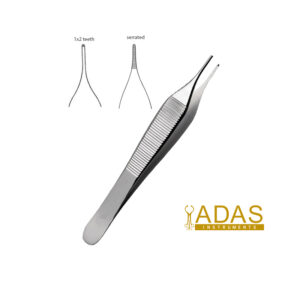
- Iris Forceps Serrated Fine, the forceps normally paired with these on the tray
- Stevens Tenotomy Scissors, longer and blunter, for working along a tendon
Metzenbaum Scissors, Blunt Dissecting, 14.6 cm to 27.5 cm, Curved or Str is listed alongside it and links back here, so the two can be ordered together.
Mayo Scissors, Curved or Straight, 14 cm to 23 cm, Razor Edge and Tungst is listed alongside it and links back here, so the two can be ordered together.
Where the field is larger than an eyelid but still needs a fine blade, the Joseph Dissecting Scissors takes over from the iris pattern, with the same fineness carried over a longer blade.
| Weight | 0.04 kg |
|---|---|
| Blade Type | Standard, Standard Supercut, Tungsten Carbide, Tungsten Carbide Supercut |
| Select Scissors Blades | Curved Blades, Straight Blades |
Be the first to review “Iris Scissors, Sharp Fine Tip, Straight or Curved, 9 cm to 14 cm, Supercut and Tungsten Carbide”
Shipping & Delivery Policy
Processing Time: In-stock items are dispatched within 24-48 hours. For custom or out-of-stock items, production time is approximately 10-15 days.
Global Delivery Estimates
We partner with world-class couriers (DHL, FedEx) to ensure fast, tracked delivery.
- USA & Canada: 3-5 Business Days
- Europe & UK: 4-6 Business Days
- Rest of World: 5-7 Business Days
*We offer Air Cargo and Sea Freight options for bulk wholesale orders.
Customs & Duties
International buyers are responsible for any customs duties or taxes imposed by their country. Adas Instruments is not responsible for delays caused by customs clearance.
Lost Packages & Insurance
If your package is lost in transit, please contact us immediately. We offer full support and replacements for confirmed lost shipments. Note: You must report non-delivery within 3 weeks to be eligible for an insurance claim.
Related products


Reviews
There are no reviews yet.