
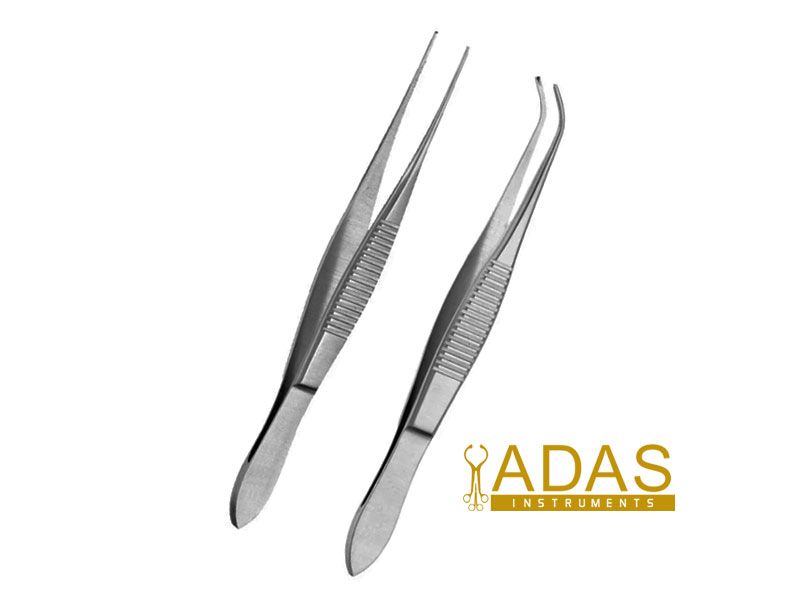
Iris Forceps, Serrated or 1×2 Teeth, Straight and Curved
Price range: $ 12.50 through $ 12.80
Iris forceps are miniature surgical instruments used in eye surgery to grasp, hold and move tissue as fine as the iris itself. With no ratchet and no lock anywhere on them, the jaws close under finger pressure alone, so they act as an extension of the thumb and forefinger rather than as a tool that grips on its own. That control is why they are no longer only an eye instrument, and they now turn up in oculoplastic surgery, in minor skin closure, in veterinary practice and on the laboratory bench.
Key Features
- Fine cross serrations that hold a thin edge without cutting it
- Or 1×2 interlocking teeth, one tooth dropping between two, for a firmer hold on skin
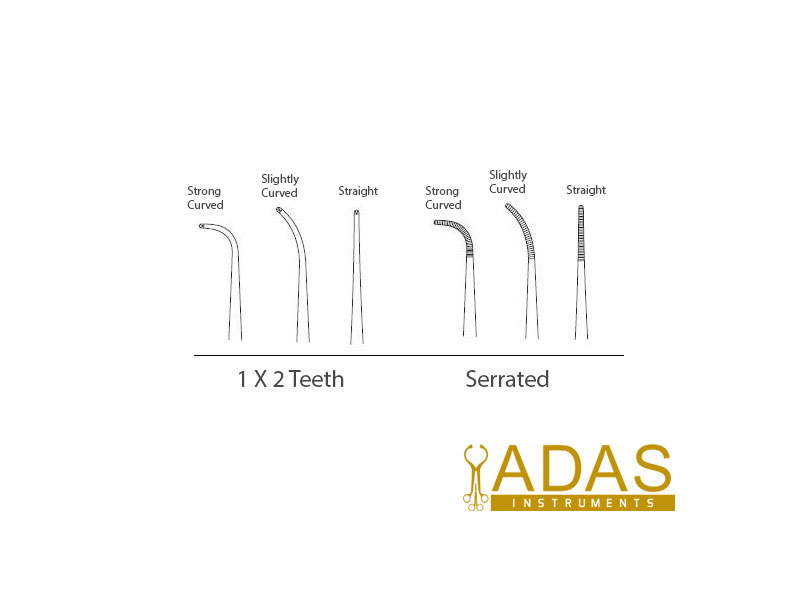
- Three tip angles in both jaws: straight, slightly curved, strong curve
- Spring handle, no lock and no ratchet, so the grip stays under finger control
- High quality medical grade stainless steel, passivated and boil tested
- Satin finish, no glare under an operating room lamp or a microscope light
- Item code AC-16.10

What iris forceps are
Iris forceps are a small spring handled thumb forceps built for the eye. The jaws are closed by finger pressure alone, with no ratchet and no catch anywhere on the instrument, and the tips are fine enough to pick up tissue that a general purpose forceps would simply tear. They are made by Adas Instruments, reusable and fully autoclavable.
The name is literal. The pattern was made to handle the iris during iridectomy, and it kept the name as the rest of surgery found other uses for it.
Two things define the instrument. The jaws are small, so what you grip is measured in millimetres rather than centimetres. And there is no locking mechanism, which means the pressure on a piece of conjunctiva is whatever your fingers decide it is at that moment, and it can be changed without letting go.
The two jaws, and how to choose between them
This is the only decision that really matters when ordering, and it is worth a minute.
The serrated jaw carries fine cross cut texturing over the whole gripping face. It holds by friction spread across a wide area, so nothing is ever punctured. That is what tissue in the eye needs, and it is what a graft edge needs when the same edge is going to be picked up twenty times.
The 1×2 toothed jaw has a single tooth on one blade that drops between two teeth on the other. It holds by interlocking rather than by friction, so it does not slide. On skin that is exactly right. On conjunctiva it would go through.
- Serrated. Iris, conjunctiva, graft edges, suture ends, laboratory work.
- 1×2 teeth. Eyelid skin, minor closure, anything with substance.
- Three tip angles in both. Straight, slightly curved, strong curve.
- No lock. A pure thumb forceps, pressure controlled by the fingers.
Builds we ship
Six builds, two jaws in three tip angles. The serrated jaw is the non toothed forceps of the pair, and it is listed in catalogues as iris forceps serrated fine.
| JAW PATTERN | TIP ANGLE | WHAT IT IS FOR | ITEM CODE |
|---|---|---|---|
| Fine cross serrations | Straight | Deep and narrow access, direct alignment | AC-16.10 |
| Fine cross serrations | Slightly curved | Working under a loupe with the hand out of the sight line | AC-16.10 |
| Fine cross serrations | Strong curve | Work right at a lid margin | AC-16.10 |
| 1×2 interlocking teeth | Straight | Skin edges in minor closure | AC-16.10 |
| 1×2 interlocking teeth | Slightly curved | Eyelid skin under magnification | AC-16.10 |
| 1×2 interlocking teeth | Strong curve | Lid margin skin with a blocked approach | AC-16.10 |
Nothing is listed there that we do not hold. The item code is the same across the builds because the jaw and the angle are specified on the order rather than carried as separate codes.
Where these are used
Most buyers arrive here looking for forceps for eye surgery, and that is where the pattern started. It did not stay only there.
| SPECIALTY | WHY THE IRIS PATTERN |
|---|---|
| Ophthalmology | Iridectomy, cataract extraction and foreign body removal from the anterior chamber |
| Oculoplastic surgery | Blepharoplasty, where the skin is thin and the scar is on the face |
| Dermatology and minor surgery | Wound closure and skin graft handling at a size a larger forceps cannot manage |
| Plastic and reconstructive surgery | Fine flap edges and small graft work |
| Research and laboratory | Microdissection, isolating small structures under magnification |
| Veterinary ophthalmology | The same anatomy at a smaller scale |
| Teaching hospitals | Fine instrument technique, taught on a jaw that punishes a heavy hand |
The reason it travels so well is size. A great deal of surgery involves tissue too small for a general forceps and too solid to need a true microsurgical instrument, and the iris pattern sits exactly in that gap.
Tissue, and the jaw to ask for
The instrument carries no needle and no suture, so the only question is what it is holding.
| TISSUE | JAW PATTERN | WHY THAT JAW |
|---|---|---|
| Iris and anterior chamber tissue | Fine cross serrations | Nothing here tolerates a point |
| Conjunctiva | Fine cross serrations | Thin enough to tear at a single tooth |
| Eyelid skin | 1×2 interlocking teeth | Needs a hold that will not slide during closure |
| Skin edge in minor closure | 1×2 interlocking teeth | Two small marks, both inside the wound edge |
| Graft edge | Fine cross serrations | Held many times over, so no puncture at all |
| Suture ends | Fine cross serrations | Grip without crushing the strand |
| Laboratory specimen | Fine cross serrations | Structure kept intact for what comes next |
Ordering one pair? Take the serrated, slightly curved. It is the pair that gets picked up most often. Ordering two? Make the second a 1×2 toothed straight, and between them you have covered an oculoplastic closure tray.
How it compares with the neighbours
These are the instruments people weigh against each other before ordering.
| BUILD | JAW | WHEN YOU REACH FOR IT |
|---|---|---|
| Iris forceps, serrated | Fine cross serrations | Anything you can see through |
| Iris forceps, 1×2 teeth | One tooth between two | Skin, and only skin |
| Bishop-Harmon iris forceps | Same jaws, three holes in the handle | A long list where handle weight starts to tell |
| Micro Adson forceps | Narrower Adson jaw | Fine tissue away from the eye |
| Adson forceps | Full width Adson jaw | General closure where a bigger hold is wanted |
Two things iris forceps will not do. They will not hold a thick skin edge under tension, because the jaws are too small to spread that load. And a serrated pair will not replace a toothed pair on skin, however fine the serrations are, because friction and interlocking are not the same kind of grip.
Materials and finish
The instrument is made in high quality medical grade stainless steel. The steel itself is made to a German specification. Every pair is passivated and boil tested before packing, and the finish is satin rather than mirror so the tips stay readable against wet tissue and under a microscope light.
On an instrument this fine the tips decide everything. They are ground and then meeting checked by hand, because a pair that meets at the very point but gapes a fraction behind it will hold a suture and drop a piece of conjunctiva, and that fault cannot be seen without looking along the closed jaws against the light.
Care and sterilization
Rinse in cool water straight after use so that nothing dries between the serrations. Clean with a neutral pH enzymatic detergent and an ultrasonic bath, rinse in deionized water, dry fully, then steam autoclave at 134 degrees Celsius.
Store the tips protected. More fine forceps are ruined in a drawer than in a patient: a tip that has been dropped, or that has had something heavier laid across it, will never meet cleanly again. Check along the closed jaws against a bright light before each list, and retire any pair that shows daylight between the tips.
Ordering and wholesale
Iris forceps are supplied by Adas Instruments to hospitals, surgical distributors and OEM buyers, in single units and in bulk. The item code is AC-16.10 and it is printed in the build table above so a procurement search finds it. Backorder items dispatch in 10 to 12 working days. Every instrument carries a three year replacement against manufacturing defects.
For wholesale and OEM orders, instruments ship unpackaged in bulk or individually poly bagged, and laser marking with a distributor code or a hospital asset number is available on the shaft. Tell us the jaw, the tip angle and the quantity and the quotation comes back with the lead time for that run.
Production is controlled under an ISO 13485 quality management system.
Frequently asked questions
What are iris forceps used for?
Holding tissue that is too fine to hold with anything larger. They were built for the eye, where the iris itself gave them the name, and the same tips now turn up in eyelid surgery, in minor skin closure, and on laboratory benches for dissection under a microscope. The job is always the same: lift a thin edge, hold it still, and let go without leaving a mark.
Serrated or 1×2 teeth, which should I order?
Serrated for anything you can see through. Conjunctiva, the iris, a graft edge, a suture end. The cross serrations spread the grip over a wide face so nothing is punctured. Teeth for anything with substance to it, mainly skin. One tooth dropping between two gives a hold that will not slide, and on skin the two small marks it leaves are inside the wound edge anyway.
Why are the tips angled?
So your hand is not in the way. A straight tip lines up with the instrument and reaches straight down, which suits deep and narrow access. A curve lifts your fingers out of the sight line, which matters when you are working under a microscope or a loupe and the view is the whole job. The strong curve does the same thing more aggressively for work right at the edge of a lid.
How are these different from a Bishop-Harmon?
A Bishop-Harmon has three holes through the handle. That is the whole difference people mean: lighter to hold and cooler in the fingers over a long list. The jaws do the same work. If you already know which jaw you want, the choice between the two is about how the handle feels after forty minutes, not about what the tips can do.
Can iris forceps be autoclaved?
Yes, and they are made to be. Rinse in cool water first so nothing dries between the serrations, clean with a neutral pH enzymatic detergent, rinse in deionized water, dry, then steam at 134 degrees Celsius. The tips are the part to watch: check that they still meet cleanly along their whole face before each list, because a tip that has been dropped once will never hold a thin edge again.
Related products and categories
Buyers usually compare iris forceps against the bishop harmon iris tissue forceps, which carry the same jaws in a lighter handle, the narrower micro adson forceps, and the full size adson forceps for general closure. The pattern sits in dressing and tissue forceps, and it is also listed under blepharoplasty instruments.
| Weight | 0.045 kg |
|---|---|
| Tip options | 1 X 2 tooth, serrated |
| Tip Angle | Slightly Curved, Straight, Strong Curves |
Be the first to review “Iris Forceps, Serrated or 1×2 Teeth, Straight and Curved”
Shipping & Delivery Policy
Processing Time: In-stock items are dispatched within 24-48 hours. For custom or out-of-stock items, production time is approximately 10-15 days.
Global Delivery Estimates
We partner with world-class couriers (DHL, FedEx) to ensure fast, tracked delivery.
- USA & Canada: 3-5 Business Days
- Europe & UK: 4-6 Business Days
- Rest of World: 5-7 Business Days
*We offer Air Cargo and Sea Freight options for bulk wholesale orders.
Customs & Duties
International buyers are responsible for any customs duties or taxes imposed by their country. Adas Instruments is not responsible for delays caused by customs clearance.
Lost Packages & Insurance
If your package is lost in transit, please contact us immediately. We offer full support and replacements for confirmed lost shipments. Note: You must report non-delivery within 3 weeks to be eligible for an insurance claim.
Related products




Reviews
There are no reviews yet.