
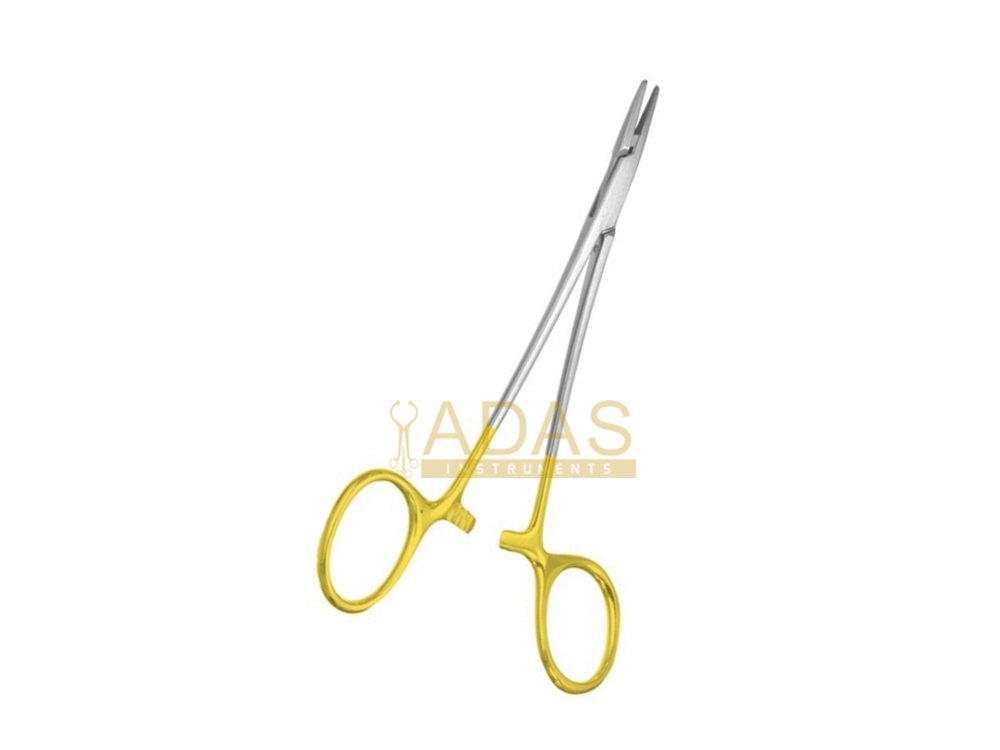
Neivert Needle Holder, Tungsten Carbide Grooved Jaw
$ 21.50
The Neivert needle holder, also called a Neivert needle driver, is an offset ring handled instrument for plastic, reconstructive, ophthalmic and pediatric craniofacial surgery. One thumb ring is bent away from the other, and the short blunt jaws carry lengthwise grooves that hold a fine needle without marking it.
Key Features
- Offset ring handle, one thumb ring angled away from the finger ring
- Short blunt jaws with one to three longitudinal internal grooves
- Brazed tungsten carbide inserts on the jaw faces
- Grooved jaw seats the needle along its length instead of pinching a point
- Gold plated finger rings mark the tungsten carbide build
- Blunt tips, chosen so the instrument cannot nick tissue at depth
- Takes 3-0 down to 8-0 suture on the carbide jaws
- Item code AF-16.32
Available on backorder

What the Neivert needle holder is
The Neivert needle holder is a fine ring handled needle holder with two unusual features: the handle is deliberately asymmetric, and the jaw faces are grooved lengthwise instead of crosshatched. Catalogues list it as a Neivert needle driver, and some invert it to needle holder Neivert. It is named after the surgeon who introduced it for facial and nasal work.
Needle holder and needle driver are the same instrument. The two names come from different training traditions rather than different tools, and we use both here because buyers search both.
Key design features of the Neivert needle holder
Almost every needle holder grips by crosshatch. This one grips by groove, and that single decision shapes what it is for.
- Longitudinal grooves in the jaw. One to three grooves run along the jaw rather than across it, so a fine needle lies down inside the groove and is held along its length. A crosshatch grips a needle at points and can flatten a 7-0 wire. A groove cradles it.
- Offset ring handle. One thumb ring is bent out of the plane of the other. Your hand sits in a half turn rather than square, which stops the fatigue that builds over a long closure and keeps your knuckles out of the sight line when you come in at an angle.
- Short blunt jaws. The tip cannot be used as a dissector, which is the point: a blunt tip working near an eyelid or a cleft margin will not nick what it touches.
- Brazed tungsten carbide inserts, with gold plated finger rings as the trade marker for them.
Put together, the offset handle and the grooved jaw explain why a Neivert needle holder turns up on craniofacial and oculoplastic sets rather than general ones. Neither feature helps on a fascial closure. Both matter when the stitch will be visible on a face for the rest of someone’s life.
The groove is also the limitation. A grooved jaw is built around fine round bodied needles. Give it a heavy cutting needle and the groove has nothing to seat, so the needle sits proud and rolls.
Neivert needle holder sizes and build options
One configuration, built around the grooved jaw.
| Feature | Specification |
|---|---|
| Handle | Offset ring handle, one ring angled |
| Jaw profile | Short and blunt |
| Jaw face | One to three longitudinal grooves, tungsten carbide inserts |
| Tip | Blunt |
| Finger rings | Gold plated on the carbide build |
| Joint | Box joint |
If your set specification calls for a particular overall length, send us the figure with your order and we will confirm the build against it before we make.
Neivert needle holder uses, by specialty
These share fine thread, shallow but confined access, and tissue where a marked or bent needle shows in the result.
| Specialty | What it is used for |
|---|---|
| Plastic surgery | Facial closure, flap inset, scar revision |
| Reconstructive surgery | Fine soft tissue approximation in confined access |
| Ophthalmic surgery | Eyelid and periocular suturing |
| Pediatric craniofacial surgery | Cleft and craniofacial soft tissue closure |
| Otolaryngology | Nasal and intranasal suturing |
| Dermatology | Cosmetic closure where needle marking must be avoided |
Suture sizes the Neivert needle holder handles
The grooved carbide jaw is what lets this pattern reach down to 8-0 without flattening the needle.
| Suture size | Typical use | Which jaw |
|---|---|---|
| 3-0 to 4-0 | Deeper dermal layers | Tungsten carbide |
| 5-0 to 6-0 | Facial skin, nasal, eyelid | Tungsten carbide |
| 7-0 to 8-0 | Fine periocular and craniofacial work | Tungsten carbide |
How the Neivert needle holder compares with other patterns
The choice here is usually between the Neivert’s grooved jaw and a conventional serrated one. Surgeons searching for a needle holder with groove faces rather than crosshatch generally arrive at this pattern, because very few others are built that way.
| Pattern | Handle | Jaw face | Where it wins |
|---|---|---|---|
| Neivert | Offset ring | Longitudinal grooves | Fine needles that must not be marked |
| Webster | Symmetric ring | Smooth or serrated | Fine facial closure with a conventional grip |
| Castroviejo | Flat spring | Smooth, serrated or diamond dust | Microsurgery under magnification |
| Gillies | Asymmetric ring, with scissors | Cross serrated | Fast suturing when you also cut |
For conventional fine facial closure the Webster needle holder is the comparison, under magnification it is the Castroviejo needle holder, and if you also need to cut, the Gillies needle holder. The family sits in plastic surgery needle holders.
Neivert needle holder materials and finish
The body is high quality medical grade stainless steel, hardened at the jaws and the box joint. The steel itself is made to a German specification. The jaw inserts are brazed tungsten carbide, and the grooves are cut into the carbide itself rather than into the steel behind it, which is the only way the groove profile survives repeated use.
The finish is satin, so the instrument does not throw surgical light back at the surgeon during close facial work.
The offset in the handle is forged rather than bent after the fact. That distinction is invisible in a photograph and obvious in use: a forged offset keeps its angle through years of autoclaving and handling, while a handle bent cold will slowly creep back toward flat and take the ergonomic benefit with it.
Neivert needle holder care and sterilization
Rinse immediately after use. The grooves trap blood more readily than a crosshatch does, so brush along each groove from hinge to tip rather than across the jaw. Neutral pH detergent, deionized water rinse, dry completely, then autoclave. Store open.
Never use this instrument to grip anything but a needle. The grooves are shallow and cut for one purpose, and clamping a suture packet or a drain will round the edges that do the holding.
Inspect the grooves under magnification once or twice a year. A groove that has worn shallow will let a fine needle roll, and rolling is what bends it. That wear is gradual and easy to miss until a surgeon starts complaining that needles are turning in the jaw.
Ordering and wholesale
Adas Instruments makes this pattern to order. The item code is AF-16.32. Backorder items dispatch in 10 to 12 working days. Wholesale pricing is available on volume and sets can be built to your own list. Every instrument carries a three year replacement against manufacturing defects.
Production is controlled under an ISO 13485 quality management system.
Frequently asked questions
What is a Neivert needle holder used for?
It is used for fine suturing in plastic, reconstructive, ophthalmic and pediatric craniofacial surgery, and in nasal work. The grooved jaw and blunt tip suit tissue where a bent needle or a nicked edge would show in the finished result.
Is a needle holder and a needle driver the same thing?
Yes. They are two names for one instrument. Needle driver is the more common term in American catalogues and needle holder in British and Commonwealth ones. You will see this pattern listed both ways, and as a Neivert needle driver.
Why does the Neivert needle holder have grooves instead of serrations?
Because it is built for fine needles. A crosshatch grips at points and can flatten thin needle wire. One to three lengthwise grooves let the needle lie along the jaw and be held over its length, which holds it just as firmly without deforming it.
Is it spelled Neivert or Nievert?
Neivert is correct. Nievert is a common misspelling and it appears in search often enough to be worth saying so. Both spellings lead to the same instrument.
What suture size does a Neivert needle holder take?
3-0 down to 8-0 on the tungsten carbide jaws. It is a fine pattern; heavier than 3-0 and the short blunt jaw has less purchase than a longer serrated holder would give you.
Related products and categories
Surgeons who work with the Neivert needle holder usually compare it against the Webster needle holder, the Castroviejo needle holder and the Gillies needle holder. The whole family sits in Plastic Surgery Needle Holders, and this pattern is also listed under Micro Surgery Instruments.
| Weight | 0.05 kg |
|---|
Be the first to review “Neivert Needle Holder, Tungsten Carbide Grooved Jaw”
Shipping & Delivery Policy
Processing Time: In-stock items are dispatched within 24-48 hours. For custom or out-of-stock items, production time is approximately 10-15 days.
Global Delivery Estimates
We partner with world-class couriers (DHL, FedEx) to ensure fast, tracked delivery.
- USA & Canada: 3-5 Business Days
- Europe & UK: 4-6 Business Days
- Rest of World: 5-7 Business Days
*We offer Air Cargo and Sea Freight options for bulk wholesale orders.
Customs & Duties
International buyers are responsible for any customs duties or taxes imposed by their country. Adas Instruments is not responsible for delays caused by customs clearance.
Lost Packages & Insurance
If your package is lost in transit, please contact us immediately. We offer full support and replacements for confirmed lost shipments. Note: You must report non-delivery within 3 weeks to be eligible for an insurance claim.
Related products

Reviews
There are no reviews yet.