
Senn Miller Retractor, Sharp or Blunt Prongs, Double Ended
$ 15.00
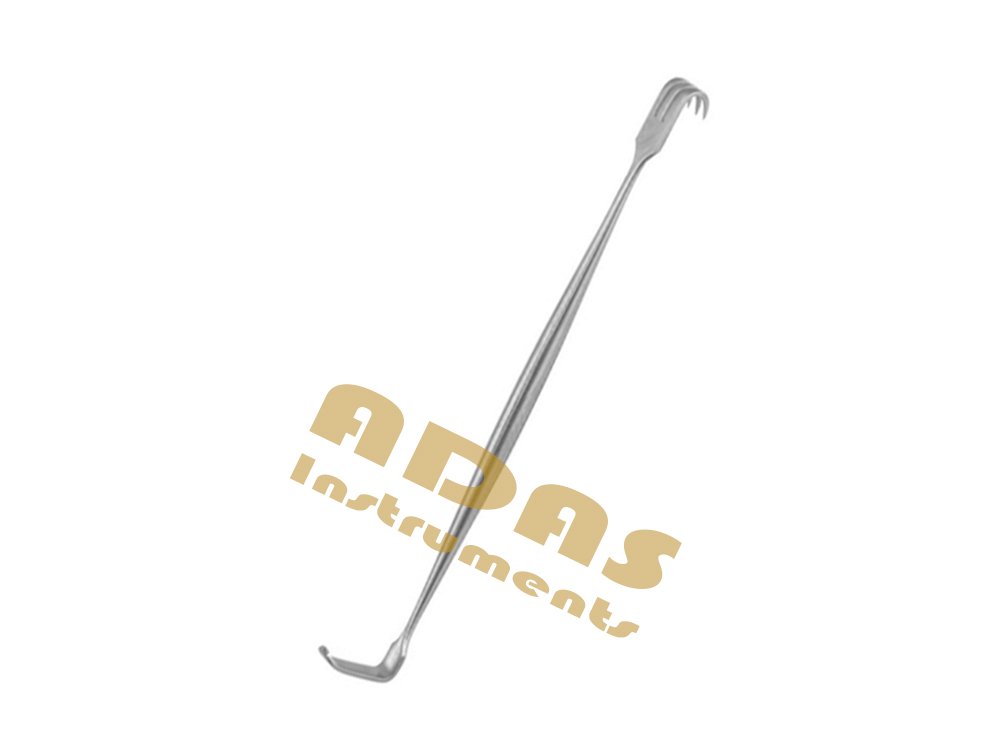
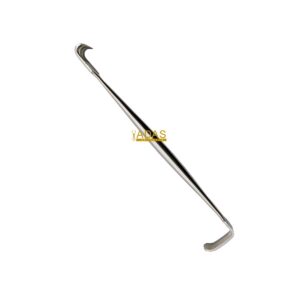
Senn Miller retractors (also frequently called Senn retractors) are small double ended instruments with a different working end at each end of one flat handle: a three prong rake on one side and a smooth L shaped blade on the other. The rake is ordered with sharp prongs, which bite into dermis, tough fascia and dense flaps and will not slip, or with blunt prongs, which hold subcutaneous fat and tissue lying near nerves and vessels without piercing anything. That one choice, plus the blade end for lifting a skin edge cleanly, is why the same small instrument turns up in plastic surgery, hand and foot surgery, dermatology and general minor procedures.
Key Features
- Double ended: a three prong rake at one end, a smooth L shaped blade at the other
- Sharp prong or blunt end prong versions, from our own record
- Sharp prongs for dermis, tough fascia and dense tissue flaps
- Blunt prongs for subcutaneous fat and tissue near nerves and vessels
- Used in plastic, hand, foot, dermatological and general surgery
- High quality medical grade stainless steel, autoclavable and made to be used again
- Three year replacement warranty against manufacturing defects. Item code AP-40.01

What the senn miller retractor is
The senn miller retractor is two instruments on one handle, and choosing which end to use is most of what there is to know about it.
One end carries a three prong rake. The other carries a smooth L shaped blade set at a right angle. A flat handle runs between them. So an assistant holding a small wound open can turn the instrument over rather than put it down and pick up another one, and in a field the size of a hand or an eyelid that matters more than it sounds.
Then there is the second choice, and it is the one made at the order rather than on the table: our own record carries the rake with sharp prongs or with blunt end prongs. That single decision settles what the instrument may safely touch.
Key design features of this senn retractor
Four features, and the first two are the whole instrument.
- A three prong rake at one end. Several holds spread across a wound edge instead of one.
- A smooth L shaped blade at the other. For lifting a skin edge cleanly without engaging it.
- Sharp or blunt prongs. From our own record, and the choice that decides what it may touch.
- A flat central handle. Held like a pen rather than gripped, which is what a small field needs.
Senn miller retractor sizes and options
One row of this table is our own record and the table says which.
| What | Option | Where it comes from | Item code |
|---|---|---|---|
| Prong type | Sharp prongs, or blunt end prongs | Our own product record | AP-40.01 |
| Rake | Three prongs | Family standard, and our own older copy | |
| Blade end | Smooth, L shaped, right angled | Family standard, and our own older copy | |
| Overall length | Not carried | Others publish about 165 mm. Not repeated here as ours | |
| Blade size | Not carried | Others publish about 20 mm by 7 mm. Not repeated here as ours |
Our record carries the prong type and nothing else, so the overall length is the figure worth asking for before a bulk order. Other catalogs publish about 165 mm and a blade around 20 mm by 7 mm; neither is repeated here as ours.
Where a senn rake retractor is used
A senn rake retractor is a small field instrument, and the list below is wider than the category this page sits in.
| Specialty | What the senn miller retractor is used for |
|---|---|
| Plastic surgery | Small flap and skin edge work at shallow depth |
| Hand surgery | The field this pattern was cut for. Short incisions, fine tissue |
| Foot surgery | Same problem, same answer |
| Dermatological surgery | Excisions and closures at skin depth |
| Orthopedic surgery | Skin and fascia held while a small joint is approached |
| ENT and oral surgery | Confined fields where a large blade will not fit |
| General surgery, minor procedures | The instrument most trainees learn small field retraction on |
Sharp prongs, blunt prongs, or the blade
Three working surfaces on one instrument, and each one is right for different tissue. This is the table to read before ordering.
| Tissue | Sharp prongs | Blunt prongs | The blade end |
|---|---|---|---|
| Dermis | YES. The point bites and does not slip | Will slide on a tight edge | Lifts it, does not hold it |
| Tough subcutaneous fascia | YES | Poor grip | Not for this |
| Dense tissue flaps | YES. This is what sharp exists for | Slides off | Not for this |
| Subcutaneous fat | Will cut into it | YES | YES, on a flat face |
| Tissue near a nerve | NO | YES. The only safe choice | YES |
| Tissue near a vessel | NO | YES | YES |
| A thin skin edge you must not engage | NO | NO | YES. What the blade is for |
How this double ended rake retractor compares with the rest of the family
Five of the six rows are instruments we make. For a double ended rake retractor the comparison that matters is the first one, against the Mini Langenbeck, because they cover the same small fields by opposite means.
| Pattern | How it differs | When you reach for it instead |
|---|---|---|
| Mini Langenbeck retractor | A single blunt blade, no rake, narrower profile | A confined channel where nothing may be pierced |
| US Army retractor | Two smooth blades, two depths, far larger | Bulk fat and muscle rather than a small field |
| Insulated US Army retractor | The same, with a non conductive coating | The same work with cautery running |
| Farabeuf double end retractor | Two L shaped blades, no rake, 12 or 15 cm | A wound edge held on blades at both ends |
| Volkman retractor | One to four prongs, single ended | A rake without a blade end, in a range of prong counts |
| Ragnell double ended retractor | Two small blades, both ends smooth | Fine plastics work needing no prongs at all |
Materials and finish
Made from high quality medical grade stainless steel, satin finished so the operating light does not come back off the blade face into a field that is already small. The steel itself is made to a German specification. On the blunt version each prong tip is rounded and polished on its own, which is slower than grinding a point and is the only thing that makes a blunt prong genuinely blunt rather than simply unfinished.
Care and sterilization
Clean with a soft brush under running water, working between the three prongs and into the inside corner of the blade where tissue lodges, then rinse in deionized water and dry fully before autoclaving. Store on a rack or under a tip guard. Keep the sharp and the blunt instruments apart in the tray: they are the same shape at a glance and they are not interchangeable, and a sharp rake reached for near a nerve is a real injury rather than an inconvenience.
Ordering and wholesale
Adas Instruments makes the senn miller retractor uses patterns to order and supplies hospitals, surgical centers and distributors across the United States, Latin America, Europe and Asia. Item code AP-40.01. State whether you want sharp prongs or blunt end prongs. Bulk and wholesale pricing is available, and instruments held on backorder ship in 10 to 12 working days. Every instrument carries a three year replacement warranty against manufacturing defects. Certifications: CE. Production is controlled under an ISO 13485 quality management system.
Frequently asked questions
What is a senn miller retractor used for?
Holding a small, shallow wound open so the surgeon can see into it. The rake end takes hold of a wound edge on three prongs, the blade end lifts a skin edge without engaging it, and between them they cover most of what a small field needs. It is used in plastic, hand, foot, dermatological and general surgery.
Is a senn miller retractor the same as a senn retractor?
Yes. Senn, Senn Miller and Senn Mueller are the same instrument under different catalog names, and Google introduces it as the Senn retractor. The double ended rake and blade pattern is what all of those names describe, so whichever one you searched for, this is the instrument.
Sharp prongs or blunt prongs on a senn miller retractor?
Sharp for dermis, tough subcutaneous fascia and dense tissue flaps, where a blunt prong slides off under load. Blunt for subcutaneous fat, delicate fascia and anything lying near a nerve or a vessel, where the only job is to hold and a point would add an injury. If you are not sure, say what tissue you are holding and we will say which.
What is the blade end for?
Lifting rather than gripping. A prong has to engage tissue to hold it, and there are places you do not want anything engaged at all: a thin skin edge, a flap you are about to close, a superficial muscle margin. The smooth L shaped blade takes those on a flat face and lets go cleanly.
How big is a senn miller retractor?
Small, and deliberately so. Our own record carries the prong type rather than a length, and other catalogs publish around 165 mm, which is roughly the length of a pen. Ask before a bulk order and it will be measured rather than repeated from somebody else.
Related products and categories
Buyers who order the senn miller retractor usually order alongside it the mini langenbeck retractor, the us army retractor and the insulated us army retractor. The whole family sits in hooks and retractors, and the finer patterns are also listed under micro surgery instruments.
| Weight | 0.09 kg |
|---|---|
| Tip options | Blunt End Prong, Sharp Prongs end |
Be the first to review “Senn Miller Retractor, Sharp or Blunt Prongs, Double Ended”
Shipping & Delivery Policy
Processing Time: In-stock items are dispatched within 24-48 hours. For custom or out-of-stock items, production time is approximately 10-15 days.
Global Delivery Estimates
We partner with world-class couriers (DHL, FedEx) to ensure fast, tracked delivery.
- USA & Canada: 3-5 Business Days
- Europe & UK: 4-6 Business Days
- Rest of World: 5-7 Business Days
*We offer Air Cargo and Sea Freight options for bulk wholesale orders.
Customs & Duties
International buyers are responsible for any customs duties or taxes imposed by their country. Adas Instruments is not responsible for delays caused by customs clearance.
Lost Packages & Insurance
If your package is lost in transit, please contact us immediately. We offer full support and replacements for confirmed lost shipments. Note: You must report non-delivery within 3 weeks to be eligible for an insurance claim.
Related products


Reviews
There are no reviews yet.