
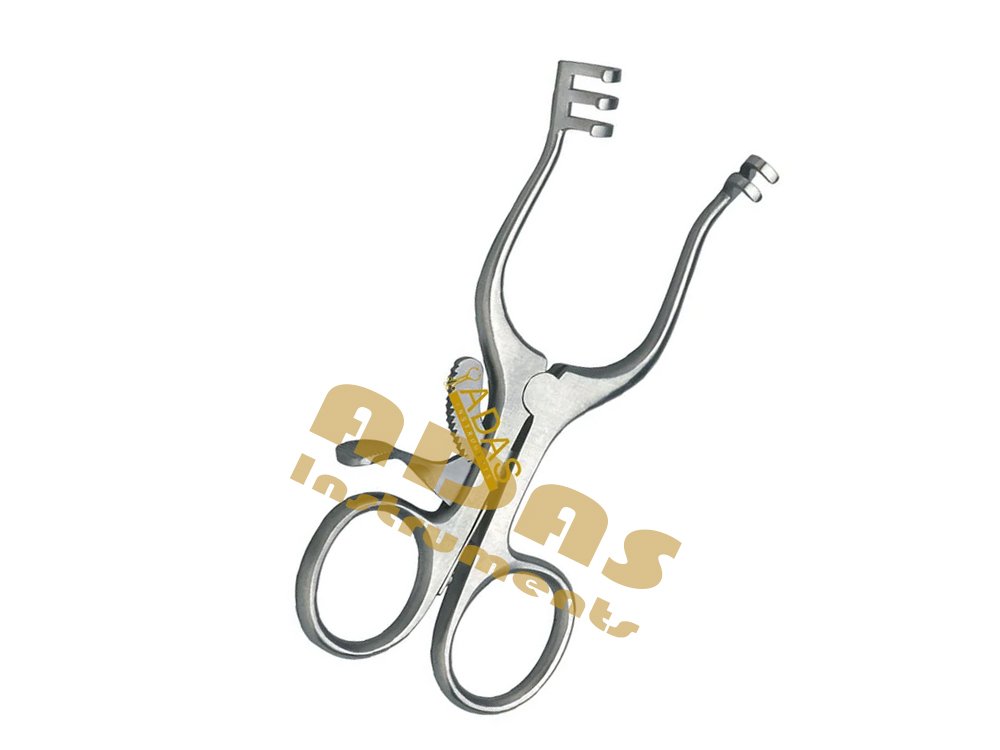
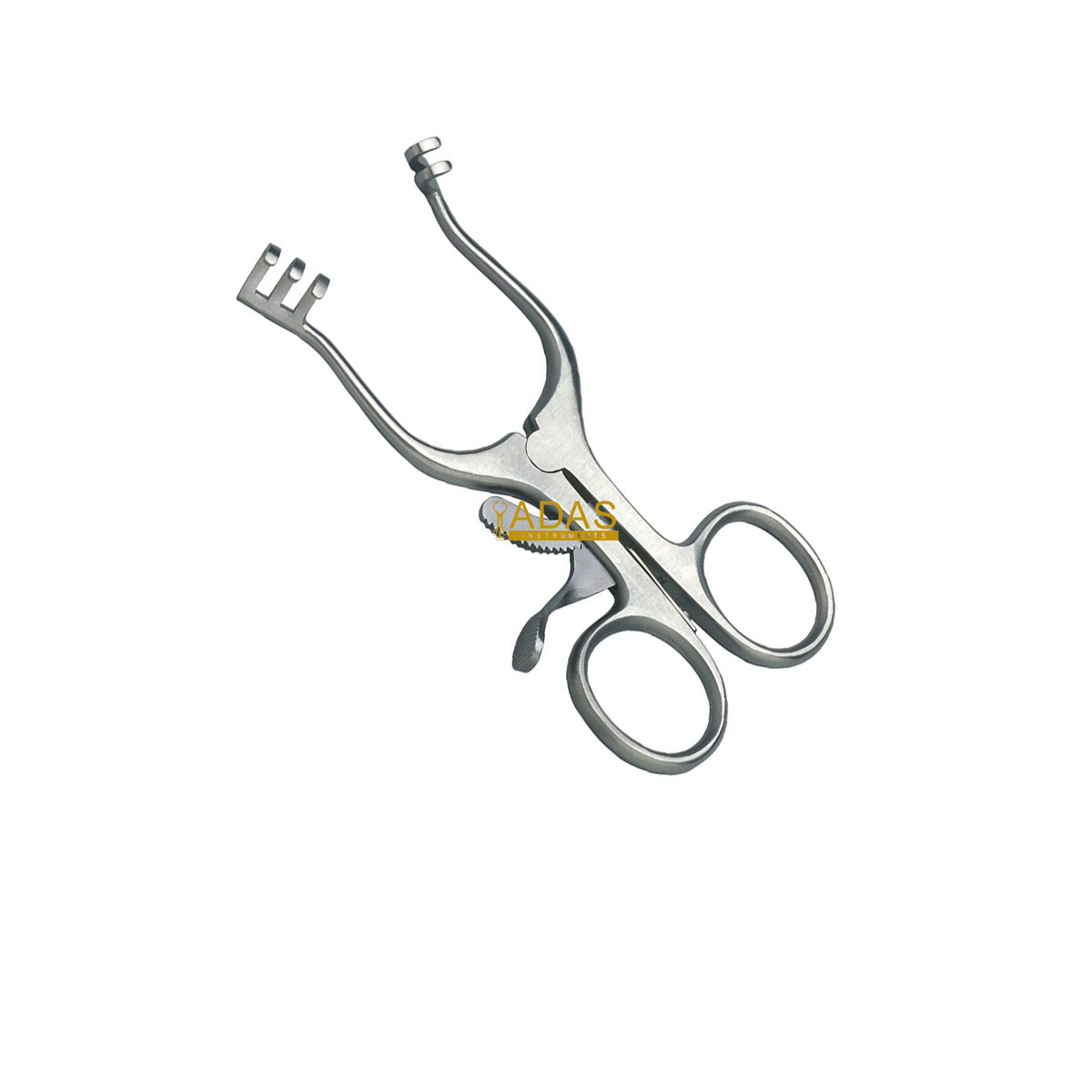

Weitlaner Retractor, Self Retaining, 2×3 and 3×4 Prongs
$ 24.00
Weitlaner retractors are self retaining retractors: once the prongs are set in the wound edges and the ratchet is engaged, the instrument holds the opening by itself. That is the whole point of the pattern, because it gives back the pair of hands that would otherwise be spending the entire operation holding a small incision open. Our own record carries it in 2×3 and 3×4 prong counts with sharp or blunt prongs, and it turns up in orthopedic, spine, neurosurgical, plastic, ENT, vascular, hand and general surgery.
Key Features
- Self retaining: a finger ring ratchet holds the set width with no hand on it
- 2×3 and 3×4 prong counts, from our own record
- Sharp prongs for dermis, dense fascia and skin margins that must not slip
- Blunt prongs where the tissue is to be spared and nothing should be pierced
- Downward curved prongs that interlock when the instrument is closed
- Used in orthopedic, spine, neurosurgical, plastic, ENT, vascular and general surgery
- High quality medical grade stainless steel, autoclavable and made to be used again
- Three year replacement warranty against manufacturing defects. Item code AP-79.13

What the weitlaner retractor is
The weitlaner retractor is a self retaining retractor. Set the prongs into the wound edges, squeeze the finger rings, drop the ratchet into a notch, and the instrument holds the opening on its own for as long as you need it.
That is the entire argument for the pattern. A small incision held open by hand costs a pair of hands for the whole procedure, and on a two person list those hands are not spare. The ratchet buys them back.
Our own record carries two prong counts, 2×3 and 3×4, and two prong tips, sharp or blunt end. Those four combinations are the whole ordering decision, and the rest of this page is about how to make it.
Key design features of this weitlaner retractor use
Four features, and two of them are choices you make when you order.
- A finger ring ratchet. It holds the width you set. Nothing holds it for you and nothing creeps while you work.
- 2×3 and 3×4 prong counts. From our own record. Three against four prongs spreads the same load over more tissue and suits a wider opening.
- Sharp or blunt prongs. Also from our own record, and it is the decision that matters most. Sharp holds dense fascia and skin and will not slip. Blunt holds without piercing.
- Downward curved prongs that interlock. They close into each other, which is why the instrument goes into a small incision before it opens it.
Weitlaner retractor sizes, prong counts and options
Three rows of this table are ours. The last two say plainly that they are not.
| What | Option | Where it comes from | Item code |
|---|---|---|---|
| Prong count | 2×3 or 3×4 | Our own product record | AP-79.13 |
| Prong tip | Sharp prongs, or blunt end prongs | Our own Tip options attribute | AP-79.13 |
| Lock | Finger ring ratchet, holds the set width | The pattern itself | |
| Overall length | Not carried | Others publish figures around 16.5 cm. Not repeated here as ours | |
| Spread | Not carried | Others publish ranges. Not repeated here as ours |
Our record carries the prong count and the prong tip and no dimensions at all. Published figures put the pattern at around 16.5 cm with a range of spreads. Neither is repeated here as ours, because a length we have not measured is somebody else catalogue number, not our specification.
Where a weitlaner retractor is used
It is one of the few retractors that turns up in almost every specialty, and the reason is always the same: a small field, a long procedure, and not enough hands.
| Specialty | What the weitlaner retractor is used for |
|---|---|
| Orthopedic surgery | Holding a small incision open through dissection, and spinal exposure |
| Spine surgery | Lumbar microdiscectomy and posterior approaches |
| Neurosurgery | Craniotomy scalp flap retraction, and anterior cervical approaches |
| Plastic and reconstructive surgery | Scar revision and localized soft tissue flap work |
| ENT | Small neck and mastoid field exposure |
| Vascular surgery | Femoral artery exposure and peripheral bypass |
| Hand surgery | Small fields where an assistant cannot get a hand in |
| General surgery | Inguinal hernia repair, cyst and abscess excision |
| Trauma | Wound debridement and exploration of a deep laceration |
What the prongs hold, and what they protect
On a self retaining retractor the second column matters more than on a handheld one, because the instrument stays where you put it for a long time.
| Structure | What this instrument does with it |
|---|---|
| Skin edges | HOLDS. Sharp prongs bite and will not creep |
| Dense subcutaneous fat | HOLDS, on either prong type |
| Fascia | HOLDS. This is where the sharp version earns its place |
| Superficial muscle | HOLDS, usually on the blunt version |
| Scalp flaps | HOLDS. A named use in neurosurgery |
| Peripheral nerves | PROTECTS, by holding a steady width so nothing is repeatedly grabbed |
| Blood vessels | PROTECTS, and the blunt version is the one to reach for near them |
| Skin at risk of pressure necrosis | PROTECTS. Set the ratchet to the width you need and no further |
| Viscera | NEITHER. Not an abdominal instrument. Use a Deaver |
How this weitlaner retractor blunt option compares with the rest of the family
Three of the seven rows are pages of ours. The Beckman Weitlaner, the Wullstein, the Gelpi and the West are other patterns, and they are here so you can rule them in or out.
| Pattern | How it differs | When you reach for it instead |
|---|---|---|
| Weitlaner self retaining retractor | Our own second Weitlaner page, listed under the full self retaining name | When you search for the pattern by its function rather than by the surname |
| Beckman Weitlaner | Hinged, articulated shanks that reach over a body contour | A deeper site where fixed rigid shanks will not sit down |
| Wullstein | A smaller frame with narrower, more delicate prongs | Ear and mastoid work, where the standard pattern is too much instrument |
| Gelpi | Two single sharp points that spread from one point each side | A narrow field where two points are enough and prongs would be in the way |
| Senn Miller retractor | Handheld, double ended, no lock, and somebody has to hold it | A short procedure where you do not want an instrument parked in the wound |
| Miller rake retractor | Nine blunt prongs on a handle, no ratchet, nothing pierced | Superficial tissue that must not be punctured at all |
| West retractor | A related pattern with curved prongs, catalogued separately | It is a different pattern and we do not list it |
Materials and finish
Made from high quality medical grade stainless steel, satin finished so the operating light does not come back off the shanks into the surgeon eye while the instrument is parked in the wound. The steel itself is made to a German specification. The ratchet teeth are cut and finished as a pair so the catch drops cleanly and holds, and the prongs are ground as a set.
Care and sterilization
Open the ratchet fully before cleaning. Brush between every prong and into the ratchet teeth under running water, because that is where tissue and blood collect on this pattern and a clogged ratchet is the first thing to fail. Rinse in deionized water and dry fully before autoclaving. Store it open, not latched, so the spring is not held under tension on the shelf. Check the prongs as a set: on a 3×4 a single bent prong is easy to miss until it will not interlock.
Ordering and wholesale
Adas Instruments makes the weitlaner retractor to order and supplies hospitals, surgical centers and distributors across the United States, Latin America, Europe and Asia. State the prong count, 2×3 or 3×4, and the prong tip, sharp or blunt end. Bulk and wholesale pricing is available, and instruments held on backorder ship in 10 to 12 working days. Every instrument carries a three year replacement warranty against manufacturing defects. Certifications: CE. Production is controlled under an ISO 13485 quality management system.
Frequently asked questions
What is a weitlaner retractor used for?
Holding a small to medium incision open by itself, so nobody has to stand and hold it. It is used in orthopedic, spine, neurosurgical, plastic, ENT, vascular, hand and general surgery, on skin edges, fat, fascia, superficial muscle and scalp flaps.
What is another name for the weitlaner retractor?
It is catalogued as a self retaining retractor and, in some catalogues, as a self retaining wound retractor. The West retractor is a related but separate pattern with curved prongs, and the Beckman Weitlaner and the Wullstein are separate patterns as well, not other names for this one.
Should I order sharp or blunt prongs?
Sharp where the tissue is tough and the retractor must not creep: dermis, dense fascia, a thick skin margin. Blunt where something underneath must not be pierced, which in practice means near nerves and vessels and on softer tissue. Both are on our own record, so it is a real ordering choice rather than a range somebody else publishes.
What are the different weitlaner retractor sizes?
Our own record carries the prong count rather than a length: 2×3, which is three prongs against two, and 3×4, which is four against three. The larger count spreads the same load over more tissue and suits a wider opening. We do not publish an overall length for this pattern because our record does not carry one.
What are the parts of a weitlaner retractor?
Two finger rings, two shanks hinged in the middle, a ratchet bar with a catch, and a pronged blade at each working end. The prongs curve downward and interlock when the instrument is closed, which is how it enters a small incision before it spreads one.
Related products and categories
Buyers who order the weitlaner retractor usually look next at the weitlaner self retaining retractor, the senn miller retractor and the miller rake retractor. The whole family sits in hooks and retractors, and this pattern is also listed under self retaining retractors.
| Weight | 0.08 kg |
|---|---|
| Tip options | Blunt End Prong, Sharp Prongs end |
Be the first to review “Weitlaner Retractor, Self Retaining, 2×3 and 3×4 Prongs”
Shipping & Delivery Policy
Processing Time: In-stock items are dispatched within 24-48 hours. For custom or out-of-stock items, production time is approximately 10-15 days.
Global Delivery Estimates
We partner with world-class couriers (DHL, FedEx) to ensure fast, tracked delivery.
- USA & Canada: 3-5 Business Days
- Europe & UK: 4-6 Business Days
- Rest of World: 5-7 Business Days
*We offer Air Cargo and Sea Freight options for bulk wholesale orders.
Customs & Duties
International buyers are responsible for any customs duties or taxes imposed by their country. Adas Instruments is not responsible for delays caused by customs clearance.
Lost Packages & Insurance
If your package is lost in transit, please contact us immediately. We offer full support and replacements for confirmed lost shipments. Note: You must report non-delivery within 3 weeks to be eligible for an insurance claim.
Related products


Reviews
There are no reviews yet.