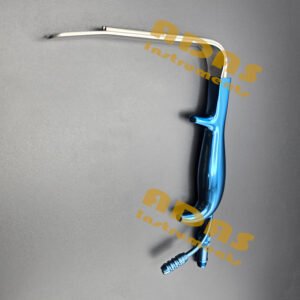
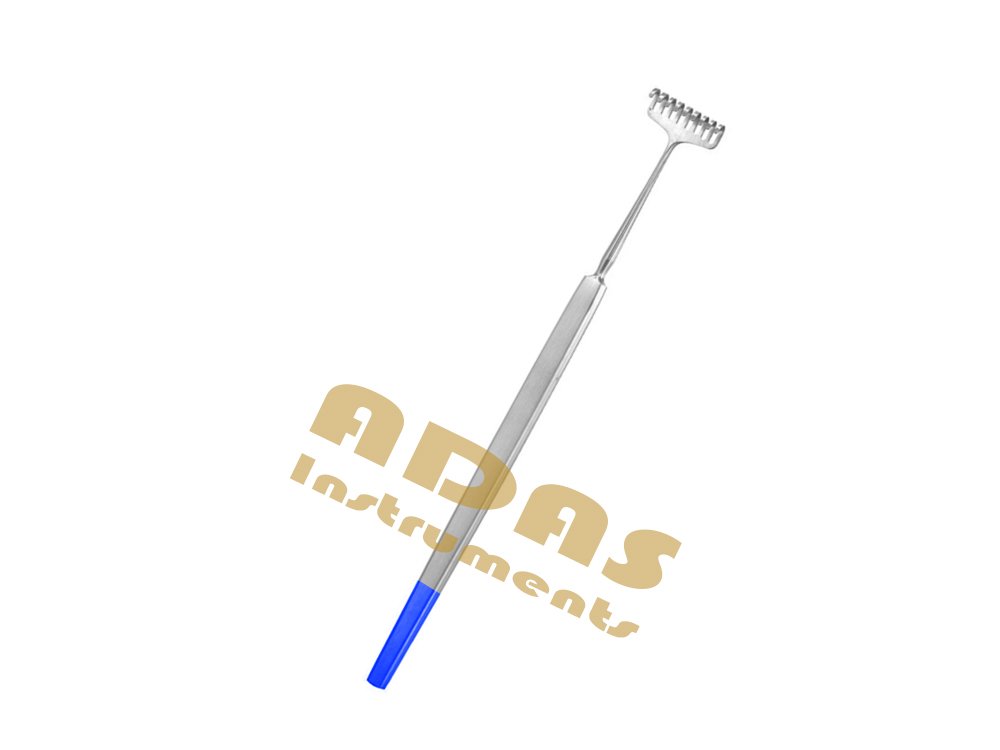
Miller Rake Retractor, 9 Blunt Prongs, 15 mm Wide
$ 22.00
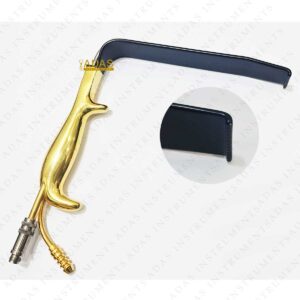
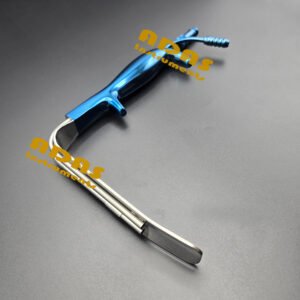
Rake retractors hold skin and soft tissue back on a row of prongs shaped like a small garden rake, and the number of prongs is what decides the job. This one is the Miller pattern, and our own record gives it as nine blunt prongs across a 15 mm head, which is the many-and-blunt end of a family that runs from one prong to nine. It is used in plastic, hand and vascular surgery, on skin edges and superficial soft tissue.
Key Features
- Nine blunt prongs across a 15 mm head, from our own record
- Blunt points, so the tissue is held rather than pierced
- Nine small holds spread the pull far wider than four large ones
- A narrow head for superficial work rather than deep exposure
- Used in plastic surgery, hand surgery and vascular surgery
- High quality medical grade stainless steel, autoclavable and made to be used again
- Three year replacement warranty against manufacturing defects
1 in stock (can be backordered)

What a rake retractor is
A rake retractor is a hand held retractor whose working end is a row of prongs, shaped like a small garden rake. It holds skin, soft tissue and muscle back so the surgeon can see and work, and it does that by taking hold in several places at once rather than one.
Two things vary across the whole family and between them they decide everything: how many prongs there are, and whether those prongs are sharp or blunt. Counts run from one up to nine. Sharp points suit tough superficial tissue and hold it without slipping; blunt points suit deeper or more delicate structures, where a sharp prong would do damage the retraction was never meant to cause.
This one is the Miller pattern, and our own record puts it at the far end of both scales: nine blunt prongs across a 15 mm head. Many small holds, none of them sharp.
Key design features of this miller rake retractor
Four features, and the first two are the whole instrument.
- Nine prongs. The top of the range. Nine holds spread a pull far wider than four do.
- Blunt points. Tissue is held, not pierced.
- A 15 mm head. Narrow, so the nine prongs sit close together and the pull is almost continuous.
- A hand held shaft. Built for superficial work at close range rather than deep exposure.
Miller rake retractor size
The first two rows come from the product name in our own catalog. The rest says where it does not.
| What | Figure | Where it comes from | Item code |
|---|---|---|---|
| Prongs | 9, blunt | Our own product name | AP-90.100 |
| Head width | 15 mm | Our own product name | AP-90.100 |
| Overall length | Not carried | Others publish about 13 cm. Not repeated here as ours | |
| Product attributes | NONE on file | A gap in our own data. Every figure above is read off the product name | |
| Prong range across the family | 1 to 9 | This pattern sits at the top of it |
This item carries no product attribute table at all, so the nine prongs and the 15 mm are read off our own product name rather than a spec field. Published figures for the pattern add a length of about 13 cm, which is not repeated here as ours. Both gaps are worth closing and are named in our file.
Where a blunt rake retractor is used
A blunt rake retractor is chosen for the tissue it will not damage as much as for the tissue it holds.
| Specialty | What the miller rake retractor is used for |
|---|---|
| Plastic surgery | Superficial soft tissue retraction where nothing should be pierced |
| Hand surgery | Small fields with tendons and nerves close to the surface |
| Vascular surgery | Holding tissue near vessels that a sharp prong would threaten |
| Dermatological surgery | Skin edges held on many small blunt points |
| Facelift and neck lift | Delicate flap work alongside the sharp rakes |
| Reconstructive surgery | Superficial dissection over a wide front |
| Teaching sets | A blunt rake is the forgiving instrument to learn retraction on |
What the prongs hold, and what they do not
Nine blunt points have the opposite strengths to four sharp ones, and a buyer deserves both sides.
| Structure | How the prongs take it |
|---|---|
| Superficial soft tissue | The tissue this pattern exists for. Nine holds, low load on each |
| Skin edges | Held without piercing, which a sharp rake cannot do |
| Tissue near tendons and nerves | Held blunt, which is the point of the pattern |
| Tissue near vessels | Blunt points do not threaten what sharp ones would |
| Delicate flaps | Held across 15 mm with almost continuous pull |
| A heavy facelift flap | NOT this one. It needs sharp prongs to hold. Use a Freeman rake |
| Deep exposure | NOT this one. A 15 mm head is a superficial instrument |
How this 9 prong rake retractor compares with the rest of the family
Five of the six rows are instruments we make. A 9 prong rake retractor sits at one end of a family whose other end is a single sharp hook.
| Pattern | How it differs | When you reach for it instead |
|---|---|---|
| Freeman rake retractor 40 mm | Four SHARP prongs on a 40 mm head | A heavy flap that needs to be gripped, not just supported |
| Maxwell flap retractor | Four sharp prongs, 22 or 38 mm, 10 cm long | Sharp hold at short reach |
| Freeman rake retractors 40mm small | A 40 mm sharp head on a 10 cm shaft | A wide sharp bite in a confined field |
| Ferreira face lift retractor | A narrow smooth blade, no prongs at all | A channel, where even blunt prongs are more than you need |
| Freeman face lift retractor | Four sharp prongs, 22 or 36 mm | Facelift flap elevation |
| Senn Miller retractor | Double ended, three prongs one end and a flat blade the other | General surgery and dermatology, not a dedicated rake |
Materials and finish
Made from high quality medical grade stainless steel, satin finished so the operating light does not reflect off the shaft into the field. The steel itself is made to a German specification. The nine prong tips are rounded and polished individually, which is slower than grinding points and is the reason a blunt rake costs what it does: a tip left rough is a sharp prong by another name.
Care and sterilization
Clean with a soft brush under running water, working along the row of prongs where tissue lodges between them and is easy to miss on a head this narrow, then rinse in deionized water and dry fully before autoclaving. Store on a rack. Check the row by eye against a straight edge: with nine prongs, one bent out of line is hard to spot and it will be the one that catches.
Ordering and wholesale
Adas Instruments makes this pattern to order and supplies hospitals, surgical centers and distributors across the United States, Latin America, Europe and Asia. Item code AP-90.100. Bulk and wholesale pricing is available, and instruments held on backorder ship in 10 to 12 working days. Every instrument carries a three year replacement warranty against manufacturing defects. Certifications: CE. Production is controlled under an ISO 13485 quality management system.
Frequently asked questions
What is a rake retractor used for?
Holding skin, soft tissue and muscle back during open surgery so the operative field can be seen. The row of prongs takes hold in several places at once, which keeps the tension even and stops the tissue bunching between holds the way it does on a single hook.
What is a miller rake retractor?
The Miller pattern is a small rake with nine blunt prongs on a narrow head, ours at 15 mm. It is used for superficial soft tissue retraction in plastic, hand and vascular surgery, where a wide bite is wanted but nothing should be pierced.
Sharp prongs or blunt prongs?
Sharp for tough, dense or superficial tissue such as a subcutaneous layer, where the point has to bite to stop the instrument slipping. Blunt for deeper or more delicate structures, where the retraction is the only thing that should be happening and a sharp point would add an injury.
Why nine prongs rather than four?
Because nine small holds across 15 mm is close to a continuous pull, while four large ones across 40 mm is four separate pulls. On delicate tissue that difference matters: the load per hold is far lower, so nothing is dragged at one point even though the instrument grips across its whole width.
Is a miller rake retractor the same as a senn miller retractor?
No, and they are easy to confuse. This is a single rake head with nine blunt prongs. A Senn Miller is a double ended instrument, usually three prongs at one end and a flat blade at the other, and it is a general surgery and dermatology pattern rather than a dedicated multi prong rake.
Related products and categories
Buyers who order the miller rake retractor usually order alongside it the maxwell flap retractor, the ferreira face lift retractor and the freeman rake retractor 40 mm. The whole family sits in hooks and retractors, and this pattern is also listed under facelift and neck lift instruments.
| Weight | 0.08 kg |
|---|
Shipping & Delivery Policy
Processing Time: In-stock items are dispatched within 24-48 hours. For custom or out-of-stock items, production time is approximately 10-15 days.
Global Delivery Estimates
We partner with world-class couriers (DHL, FedEx) to ensure fast, tracked delivery.
- USA & Canada: 3-5 Business Days
- Europe & UK: 4-6 Business Days
- Rest of World: 5-7 Business Days
*We offer Air Cargo and Sea Freight options for bulk wholesale orders.
Customs & Duties
International buyers are responsible for any customs duties or taxes imposed by their country. Adas Instruments is not responsible for delays caused by customs clearance.
Lost Packages & Insurance
If your package is lost in transit, please contact us immediately. We offer full support and replacements for confirmed lost shipments. Note: You must report non-delivery within 3 weeks to be eligible for an insurance claim.
Related products