
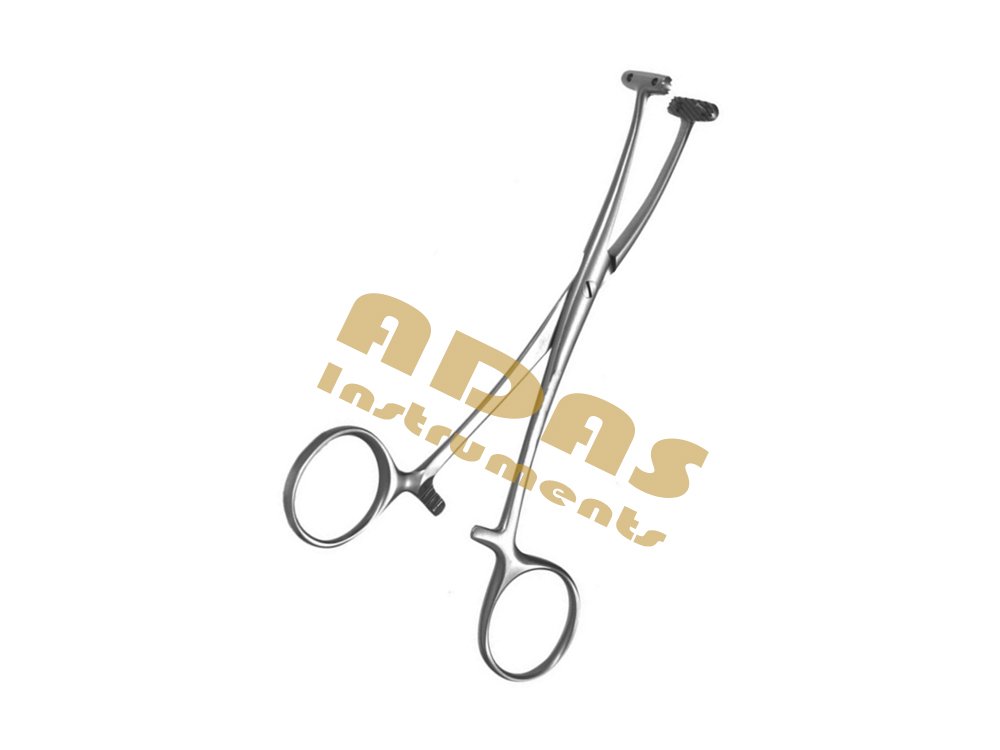

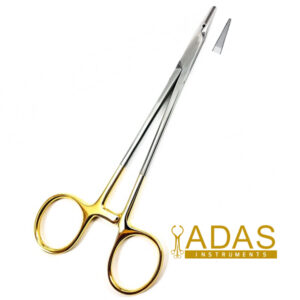
Pitanguy Flap Grasping Forceps, 14 cm
$ 32.00
Pitanguy flap grasping forceps take hold of a skin flap that has already been lifted and keep it under steady traction while the surgeon works underneath it. The jaws curve slightly and close with two teeth dropping into matching openings on the facing jaw, which anchors the flap at two points instead of pinching it along a line. That is why they turn up in facelift surgery, in abdominoplasty and in brow lifts, wherever a flap has to be held open long enough to be trimmed and set.
Key Features
- Slightly curved jaws that follow the line of a lifted flap
- Two teeth closing into matching openings, so the flap is anchored not pinched
- Length 14 cm (5-1/2 in)
- For undermined skin and tissue flaps in facelift, abdominoplasty and brow lift work
- High quality medical grade stainless steel, fully autoclavable
- Three year replacement warranty against manufacturing defects
- Item code AA-31.76
Available on backorder

What the Pitanguy flap grasping forceps is
Pitanguy flap grasping forceps take hold of a skin flap that has already been lifted and keep it under steady traction while the surgeon works underneath it. The jaws curve slightly and close with two teeth dropping into matching openings on the facing jaw. Catalogues also list the pattern as Pitanguy flap forceps and as Pitanguy skin flap forceps.
The pattern carries the name of Ivo Pitanguy, the Brazilian plastic surgeon. The jaw is what matters here: anchoring a flap at two points spreads the load, where a jaw that pinches along a line concentrates it and leaves a mark down the edge.
Key design features of the Pitanguy flap grasping forceps
Four features, and the first two are the reason the pattern exists separately from a general tissue forceps.
- Two teeth into matching openings. The flap is anchored at two points, not squeezed along the whole jaw.
- Slightly curved jaws. The curve follows the line of a lifted flap rather than standing across it.
- Ratchet lock. Traction is set at the handle and stays set, so the hand can go elsewhere.
- Box joint. The halves pass through each other, so the teeth keep finding their openings after years of use.
Pitanguy flap grasping forceps specification
The size chart is short because this pattern ships in one length.
| Detail | Specification |
|---|---|
| Length | 14 cm, 5-1/2 in |
| Jaw | Slightly curved, two teeth closing into matching openings |
| Alternative jaw | Dense serrations, on the pattern without teeth |
| Lock | Ratchet at the finger rings |
| Finish | Satin matte |
| Item code | AA-31.76 |
The 14 cm figure comes from our own catalogue record rather than from a size attribute, because this product carries none. A serrated jaw version of the same pattern exists in the trade for thinner skin, and it is not in this listing. Ask us before you order if you need it.
Pitanguy flap grasping forceps uses by specialty
Every row here is the same moment in a different operation: a flap is up, and it has to stay up and still.
| Specialty | What it is used for |
|---|---|
| Facelift surgery | Holding the undermined skin flap under steady traction while the plane below it is worked |
| Abdominoplasty | Taking the lifted abdominal flap and keeping it clear during dissection and trimming |
| Brow lift | Holding the forehead flap at the coronal incision |
| Breast surgery | Holding a skin flap during reduction and reconstruction |
| Reconstructive surgery | Any procedure where a flap has to be held open long enough to be measured, trimmed and set |
What the jaws hold
This is a grasping instrument and not a needle holder, so there is no suture gauge to quote. What matters is which structures a toothed flap jaw is for, and the last row is the one worth reading twice.
| Structure | How the jaw takes it |
|---|---|
| Undermined skin flaps | Two teeth drop into matching openings, so the flap is anchored at two points instead of pinched along a line |
| Tissue flaps and fascia | Held under steady traction without a second pair of hands |
| Flap edges being trimmed | Gripped firmly, because that edge is coming off |
| Thin or fragile skin | Care needed. The teeth mark, so the serrated pattern is the one to choose |
| Vessels and nerves | NOT this instrument. Nothing that has to be preserved belongs in a toothed jaw |
How the Pitanguy flap grasping forceps compares with other patterns
One confusion comes up more than any other and it is a name confusion rather than a clinical one, so it goes first.
| Pattern | How it differs | When you reach for it instead |
|---|---|---|
| Pitanguy flap demarcator | A marker, not a grasper. It is used to outline where the flap will be cut | Marking a flap, which this instrument does not do |
| Lahey traction forceps | Sharp 3×3 interlocking teeth, built for dense fibrous tissue | Thyroid, goiter and other tough tissue, where a flap jaw is too gentle |
| Allis tissue forceps | Rows of fine teeth on a fenestrated jaw | Fascia and tissue being excised |
| Brand tendon grasping forceps | Alligator jaw sized to a tendon | Tendon work, not skin |
Pitanguy flap grasping forceps materials and finish
The instrument is made from high quality medical grade stainless steel, hardened at the jaw so the two teeth keep meeting their openings. A tooth that has spread stops seating, and on a flap that shows up as a slip at the moment tension is highest. The finish is satin rather than mirror, which cuts glare under operating lights. The steel itself is made to a German specification. The finished instrument carries the CE mark.
Pitanguy flap grasping forceps care and sterilization
Rinse under cold running water straight after use and clear the openings the teeth close into, because tissue collects there and dries. Use a soft brush, never wire. Open the jaws fully for ultrasonic cleaning and for autoclaving so the box joint drains and steam reaches the ratchet. Dry completely, then store with the ratchet released so the spring is not held under load.
Ordering Pitanguy flap grasping forceps and wholesale
Adas Instruments supplies hospitals, clinics and distributors across the United States, from stock and to order. Wholesale quantities and instrument set builds are quoted on request. Backorder items dispatch in 10 to 12 working days. Item code AA-31.76, and every instrument carries a three year replacement warranty against manufacturing defects. Production is controlled under an ISO 13485 quality management system.
Frequently asked questions
What are Pitanguy flap grasping forceps used for?
Holding an undermined skin or tissue flap under steady traction while the surgeon works beneath it. They are used in facelift surgery, in abdominoplasty, in brow lifts and in breast work, wherever a flap has to be held open long enough to be measured, trimmed and set.
What are grasping forceps used for?
Taking hold of a structure and keeping it there while something else is done to it. The jaw decides the job rather than the family name: a flap jaw anchors at two points, a tissue jaw grips along its length, and an atraumatic jaw is smooth and holds nothing firmly at all.
Which instrument is used for grasping and clamping?
Both actions live in this family but they are not the same. A grasper such as this one takes hold and applies traction. A clamp closes a structure off, which is what a hemostatic forceps does to a vessel. An instrument built to do one will do the other badly.
What is the difference between Pitanguy forceps and a Pitanguy demarcator?
They share a surname and nothing else. The forceps grips and holds a flap. The demarcator is a marking instrument used to outline where a flap will be cut. Ordering by surname alone is how one arrives instead of the other.
Will the teeth mark the flap?
On healthy skin, at the edge that is being trimmed, no more than any toothed grasper does. On thin or fragile skin the teeth will leave a mark, so take the flap at the margin that is coming off, or use the serrated version of the pattern instead.
Related products and categories
Buyers who order the pitanguy flap grasping forceps usually order alongside it the lahey traction forceps, the brand tendon grasping forceps and the crile artery forceps. The whole family sits in hemostats and grasping forceps, and this pattern is also listed under breast surgery instruments.
| Weight | 0.065 kg |
|---|
Be the first to review “Pitanguy Flap Grasping Forceps, 14 cm”
Shipping & Delivery Policy
Processing Time: In-stock items are dispatched within 24-48 hours. For custom or out-of-stock items, production time is approximately 10-15 days.
Global Delivery Estimates
We partner with world-class couriers (DHL, FedEx) to ensure fast, tracked delivery.
- USA & Canada: 3-5 Business Days
- Europe & UK: 4-6 Business Days
- Rest of World: 5-7 Business Days
*We offer Air Cargo and Sea Freight options for bulk wholesale orders.
Customs & Duties
International buyers are responsible for any customs duties or taxes imposed by their country. Adas Instruments is not responsible for delays caused by customs clearance.
Lost Packages & Insurance
If your package is lost in transit, please contact us immediately. We offer full support and replacements for confirmed lost shipments. Note: You must report non-delivery within 3 weeks to be eligible for an insurance claim.
Related products



Reviews
There are no reviews yet.