
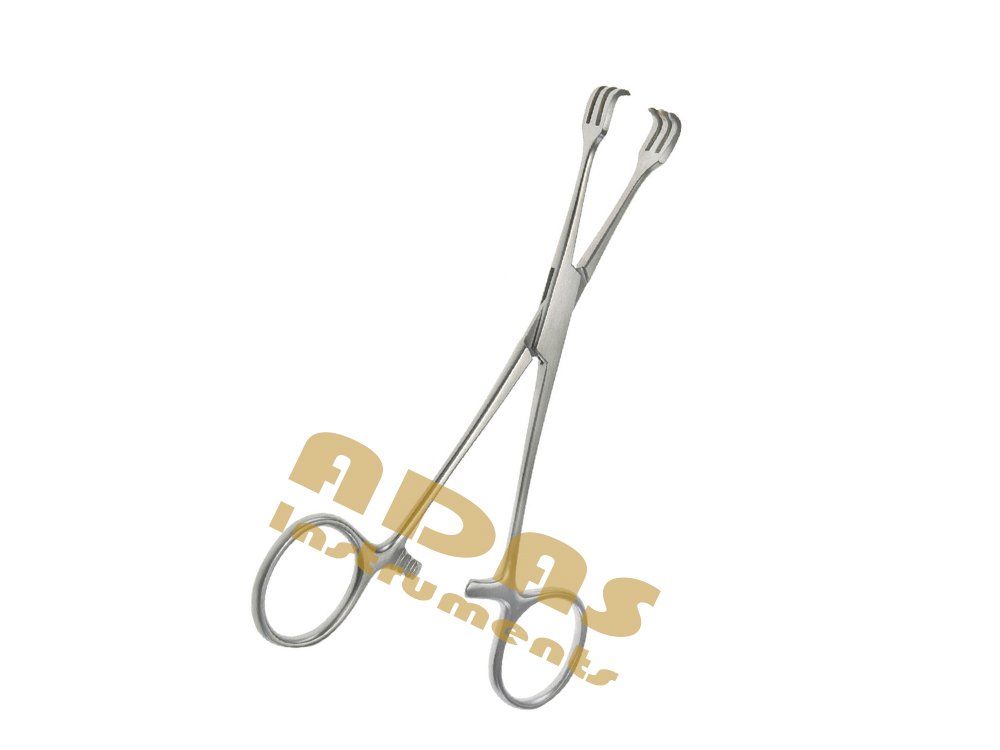
Lahey Traction Forceps, 3×3 Teeth, 15 cm
$ 25.00
Lahey traction forceps (also listed as Lahey goiter vulsellum forceps) take a firm hold of dense fibrous tissue and draw it clear so the surgeon can see what lies behind it. The 3×3 teeth interlock, three on each jaw passing between three on the other, so the hold is a set of anchored points rather than a squeeze, and a ratchet at the rings keeps the tension without a hand on the instrument. The shanks are slender and the handles long for a reason: in a thyroidectomy the gland has to be rolled toward the midline while the team keeps a clear line of sight to the nerves and vessels behind it.
Key Features
- 3×3 sharp interlocking teeth that hold fibrous tissue without sliding
- Multi position ratchet at the finger rings, so traction is set and left
- Slender shanks and long handles that keep the line of sight open
- Length 15 cm (6 in), straight pattern
- Used in thyroidectomy and goiter excision, in mastectomy and in abdominoplasty
- High quality medical grade stainless steel, fully autoclavable
- Three year replacement warranty against manufacturing defects
- Item code 0.05
Available on backorder

What the Lahey traction forceps is
Lahey traction forceps take a firm hold of dense fibrous tissue and draw it clear so the surgeon can see what lies behind it. It is listed as Lahey goiter vulsellum forceps, as Lahey thyroid forceps and simply as a lahey clamp. The jaws carry 3×3 sharp teeth that interlock, and a ratchet sits at the finger rings.
Three teeth on each jaw passing between three on the other is a different kind of hold from a serrated clamp. The tissue is anchored at six points rather than pressed flat, which is what lets the instrument pull on a gland without the gland sliding out.
One thing is worth saying plainly, because catalogues confuse it constantly. There is a second, entirely different instrument called Lahey: a right angled forceps used to dissect and to pass a ligature around a duct. It shares the surname and nothing else. This page is about the toothed traction pattern.
Key design features of the Lahey traction forceps
Four features, and every one of them is about keeping tension on tissue that does not want to be held.
- 3×3 interlocking teeth. Sharp, and arranged so the two jaws mesh rather than meet face to face.
- Multi position ratchet. Traction is set at the handle and left there, which frees the hand that set it.
- Slender shanks. Less metal between the surgeon and the field, which matters at depth in the neck.
- Long handles. They keep the rings and the hand out of the sight line to the wound.
- Box joint. The halves pass through each other, so the teeth keep meshing after years of use.
Lahey traction forceps sizes and build options
The size chart is the variation list, so what is shown is what ships.
| Length | Imperial | Jaw | Item code |
|---|---|---|---|
| 15 cm | 6 in | Straight, 3×3 sharp interlocking teeth | 0.05 |
Imperial figures are given because most United States buyers order in inches. Longer patterns of 20 cm and curved versions of this jaw exist in the trade, and they are not in this listing. Ask us before you order if you need one.
Lahey traction forceps uses by specialty
The first two rows are what the pattern was drawn for. The rest are where surgeons took it afterwards, and they all share one thing: tissue that a smooth jaw lets go of.
| Specialty | What it is used for |
|---|---|
| Thyroid surgery | Rolling the gland toward the midline during thyroidectomy so the vessels and nerves behind it can be seen |
| Goiter excision | Taking hold of a large multinodular gland and drawing it clear |
| Head and neck surgery | Traction on dense tissue planes where a smooth jaw releases |
| Breast surgery | Anchoring slippery breast tissue during dissection and mastectomy |
| Plastic and reconstructive surgery | Holding dense fascial and abdominal structures during abdominoplasty |
| Gynecologic surgery | Traction on fibrous tissue where a firm point hold is wanted |
What the jaws hold
This is a traction instrument and not a needle holder, so there is no suture gauge to quote. What matters is which structures six sharp teeth are for, and the last two rows matter more than the first four.
| Structure | How the jaw takes it |
|---|---|
| Thyroid gland and goiter | Three teeth on each jaw pass between three on the other, so the gland is anchored rather than squeezed |
| Dense fibrous tissue | The hold the pattern exists for. A flat jaw slides on this and a toothed one does not |
| Slippery breast tissue | Anchored at points, which is the only way to keep tension on it |
| Fascia and abdominal wall | Held under traction while dissection continues below |
| Thin or delicate tissue | NOT this instrument. Sharp teeth will go through it |
| Vessels and nerves | NOT this instrument, ever. This is a traction forceps and not a clamp |
How the Lahey traction forceps compares with other patterns
The first row is the name clash, and it is the single most useful line on this page for anyone ordering from a list.
| Pattern | How it differs | When you reach for it instead |
|---|---|---|
| Lahey right angled forceps | A DIFFERENT INSTRUMENT that shares the surname. Right angled jaw, used to dissect and pass a ligature around a duct or vessel. We do not list it under this name | Dissecting and passing a ligature, not applying traction |
| Allis tissue forceps | Rows of fine teeth on a fenestrated jaw, a broader and gentler hold | Fascia, bowel margins being removed, and tissue being excised |
| Kocher clamp forceps | One tooth meeting two, and a fully serrated crushing jaw | Clamping as well as holding, where crushing the tissue is acceptable |
| Foerster sponge forceps | Open oval jaw for gauze and swabs | Swabbing and skin prep, never traction |
Lahey traction forceps materials and finish
The instrument is made from high quality medical grade stainless steel, hardened at the jaw so the six teeth keep their points. A tooth that has worn round stops anchoring and starts tearing, which on a gland under tension is the failure that matters. The finish is satin rather than mirror, which cuts glare under operating lights. The steel itself is made to a German specification. The finished instrument carries the CE mark.
There is no carbide insert and no coating on this pattern. The hold comes from the tooth geometry and from the hardness of the steel behind it, and an insert at the tip would blunt the very thing that does the work.
Lahey traction forceps care and sterilization
Rinse under cold running water immediately after use and give the teeth particular attention, because tissue lodges where they mesh and dries there. Use a soft brush, never wire. Open the jaws fully for ultrasonic cleaning and for autoclaving, so the box joint drains and steam reaches the ratchet. Dry completely, then store with the ratchet released so the spring is not held under load. Check the points under a light when the set is packed, because this instrument fails at the teeth first.
Ordering Lahey traction forceps and wholesale
Adas Instruments supplies hospitals, clinics and distributors across the United States, from stock and to order. Wholesale quantities and instrument set builds are quoted on request. Backorder items dispatch in 10 to 12 working days. Item code 0.05, and every instrument carries a three year replacement warranty against manufacturing defects. Production is controlled under an ISO 13485 quality management system.
Frequently asked questions
What are Lahey forceps used for?
The question has two answers because two instruments carry the name. This one, the traction pattern, grips dense fibrous tissue with 3×3 sharp interlocking teeth and pulls it clear, most often a thyroid gland during thyroidectomy. The other, a right angled forceps, is used to dissect and to pass a ligature. Check the jaw in the photograph before you order.
What are Lahey thyroid forceps used for?
Rolling and elevating the thyroid gland during thyroidectomy and goiter excision. The teeth anchor the gland so it can be drawn toward the midline, which is what exposes the vessels and the nerves running behind it. The ratchet holds that position without a hand on the instrument.
What is another name for Lahey traction forceps?
Lahey goiter vulsellum forceps is the full catalogue name. It is also listed as Lahey thyroid forceps, as a Lahey traction clamp and, in short order lists, simply as a lahey clamp.
What is the difference between Lahey traction forceps and Allis forceps?
The teeth. A Lahey carries three sharp teeth on each jaw that interlock, built to pull hard on dense tissue. An Allis carries rows of finer teeth across a fenestrated jaw, built to hold a broad tissue edge. Reach for the Lahey when you need traction and for the Allis when you need a grip.
Can Lahey traction forceps be used on delicate tissue?
No. Six sharp teeth will pass through thin tissue rather than hold it, and this instrument is never used on a vessel or a nerve. It is for tissue that is tough, for tissue that is being removed, or for a gland that has to be moved as a whole.
Related products and categories
Buyers who order the lahey traction forceps usually order alongside it the foerster sponge forceps, the pitanguy flap grasping forceps and the kocher clamp forceps. The whole family sits in hemostats and grasping forceps, and this pattern is also listed under breast surgery instruments.
| Weight | 0.06 kg |
|---|
Be the first to review “Lahey Traction Forceps, 3×3 Teeth, 15 cm”
Shipping & Delivery Policy
Processing Time: In-stock items are dispatched within 24-48 hours. For custom or out-of-stock items, production time is approximately 10-15 days.
Global Delivery Estimates
We partner with world-class couriers (DHL, FedEx) to ensure fast, tracked delivery.
- USA & Canada: 3-5 Business Days
- Europe & UK: 4-6 Business Days
- Rest of World: 5-7 Business Days
*We offer Air Cargo and Sea Freight options for bulk wholesale orders.
Customs & Duties
International buyers are responsible for any customs duties or taxes imposed by their country. Adas Instruments is not responsible for delays caused by customs clearance.
Lost Packages & Insurance
If your package is lost in transit, please contact us immediately. We offer full support and replacements for confirmed lost shipments. Note: You must report non-delivery within 3 weeks to be eligible for an insurance claim.
Related products



Reviews
There are no reviews yet.