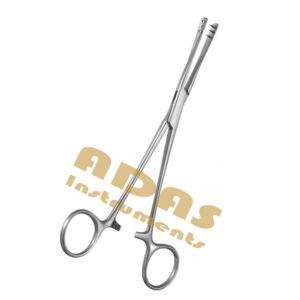
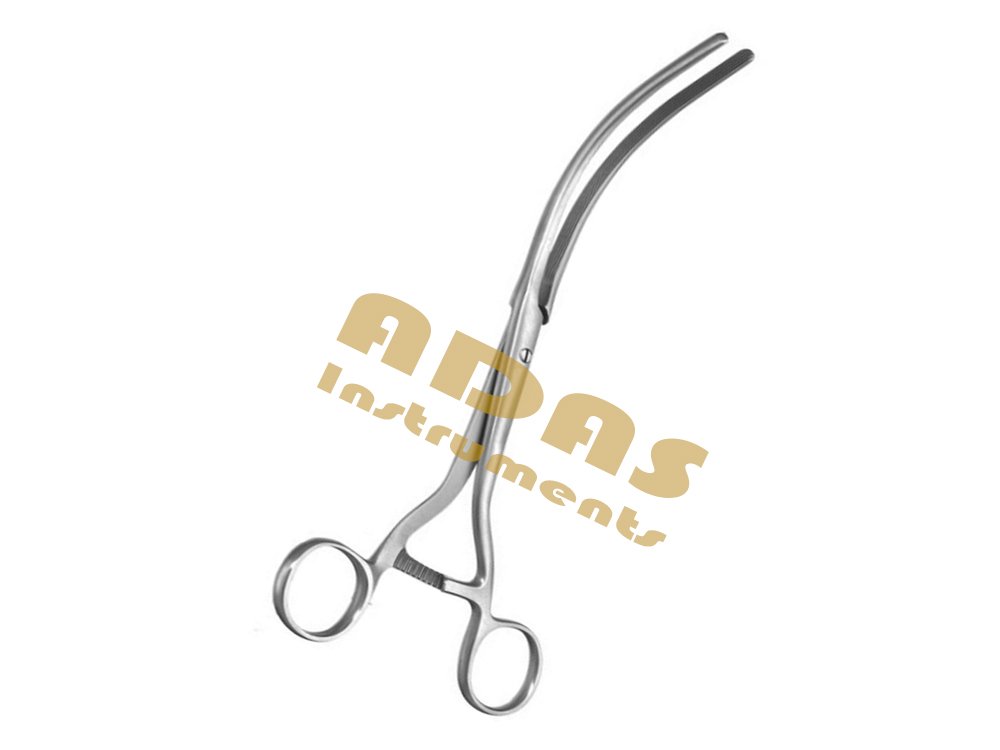
Kocher Clamp Forceps, 10 inch Curved Longitudinal Serrated Hemostat
$ 85.00
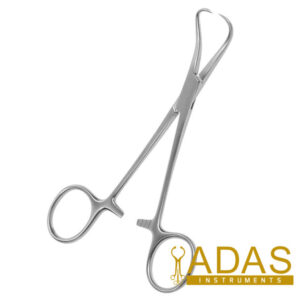
Kocher clamp forceps (also known as an Ochsner clamp) grasp fibrous tissue and clamp large vessels, holding with one sharp tooth on one jaw tip locked into two on the other. It is a crushing instrument rather than an atraumatic one, so it belongs on the rectus sheath, on fascia and on tissue that is coming out, not on anything delicate. Adas Instruments supplies the 10 inch length with curved longitudinal serrations for general, trauma, gynecologic and orthopedic work.
Key Features
- One sharp tooth on one jaw tip locked into two on the other, for a hold that will not slip
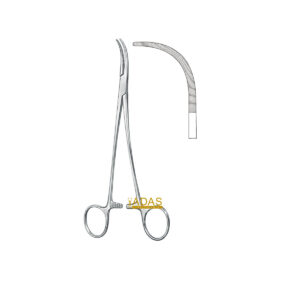
- Curved jaw with longitudinal serrations
- A crushing pattern, for fascia, rectus sheath and tissue being removed
- 10 inch length
- Ring handles with a multi position ratchet
- High quality medical grade stainless steel, satin finish to cut glare
- Item code AA-50.89
1 in stock (can be backordered)

What the Kocher clamp is
The Kocher clamp is a heavy ring handled instrument used to grasp tough tissue and clamp large vessels. In the United States it is as often called an Ochsner clamp, and catalogues list it as Ochsner Kocher forceps, Kocher Ochsner clamp and Rochester Ochsner forceps. The eponym belongs to Emil Theodor Kocher, the Swiss surgeon and Nobel laureate.
The first thing to understand about this pattern is that it is a crushing instrument. It is designed to hold and not to spare, which is why it goes on the rectus sheath, on fascia, on thick ligaments and on tissue that is being removed, and stays off anything delicate. A 10 inch Kocher clamp is the deep end of the range.
Key design features of the Kocher clamp
Three things together make the grip, and none of them works without the others.
- 1×2 interlocking teeth. A single sharp tooth on one jaw tip meets two on the other, anchoring tissue at a point.
- Longitudinal serrations. Ridges running along the jaw, so tissue cannot slide sideways out of the grip.
- Curved jaw. Lets the tip come around a structure and sit behind it.
- Box joint. The halves pass through each other, keeping the teeth meshed under heavy load.
- Multi position ratchet. Steps through several notches, so the clamping pressure is set and held.
Kocher clamp sizes and build options
This listing is the 10 inch build. The chart below is what ships.
| Length | Metric | Jaw | Item code |
|---|---|---|---|
| 10 in | About 25 cm | Curved, longitudinal serrations, 1×2 teeth | AA-50.89 |
The Kocher pattern runs from about 5.5 inches up past 10 inches across the trade. This is the long end, chosen for deep pelvic and abdominal access where the handles need to stay outside the wound. If you want the same tooth on a shorter, lighter jaw, that is the delicate pattern rather than this one.
Length changes how the instrument behaves as much as where it reaches. A 10 inch frame gives more leverage at the jaw for the same squeeze at the handle, which is part of why this pattern holds fascia so firmly. It also means the tip is further from your hand, so the curve matters more: you are working by feel at depth rather than by sight.
There is no carbide insert and no coating on this pattern. The hold comes from the tooth geometry and from the hardness of the steel behind it, and an insert at the tip would blunt the very thing that anchors the tissue.
Where Kocher clamps are used
What these uses share is tissue robust enough that crushing it does not matter. The specialty is in the first column and the procedure words are in the second.
| Specialty | What it is used for |
|---|---|
| General surgery | Holding the rectus sheath and abdominal fascia at entry and closure |
| Trauma surgery | Securing heavy bleeding structures quickly at laparotomy |
| Gynecologic surgery and OB/GYN | Grasping thick uterine ligaments at hysterectomy |
| Orthopedic surgery | Holding periosteum and dense connective tissue while bone is exposed |
| Abdominal surgery | Clamping hollow organs and tissue intended for resection |
| Vascular surgery | Clamping larger vessels where a positive grip matters more than the wall |
What the jaws hold
There is no suture gauge on a clamp. What matters is which structures the toothed jaw is for, and the honest answer includes what it does to them.
| Structure | How the jaw takes it |
|---|---|
| Fascia and rectus sheath | The tooth anchors and the longitudinal serrations stop lateral slip |
| Thick uterine ligaments | Taken as a mass, held under tension while a tie is placed |
| Tendinous and aponeurotic tissue | Gripped at a point, which a flat jaw cannot do |
| Tissue intended for removal | Crushed deliberately, because the specimen is coming out |
| Larger blood vessels | Held closed, accepting that the wall is marked |
How the Kocher clamp compares with other patterns
Two comparisons come up constantly: kocher forceps vs allis, and this pattern against its own delicate sibling. Both are answered in the table and again in the questions below.
| Pattern | How it differs | When you reach for it instead |
|---|---|---|
| Kocher delicate artery forceps | Same 1×2 tooth on a lighter tapered jaw | Confined fields and sensitive tissue |
| Allis tissue forceps | A row of fine teeth across the jaw tip | Holding a broad tissue edge rather than anchoring at a point |
| Rochester Pean forceps | Fully serrated, no teeth | Where crush injury matters and slipping does not |
| Crile artery forceps | Untoothed, fully serrated, shorter | Routine hemostasis on medium vessels |
Kocher clamp materials and finish
The Kocher clamp is made from high quality medical grade stainless steel, hardened so the teeth stay sharp and stay meshed under the loads this pattern is put under. A rounded tooth stops anchoring, and on a heavy clamp that happens faster than on a light one. The finish is satin rather than mirror, which cuts glare under operating lights. The steel itself is made to a German specification. The finished instrument carries the CE mark.
Kocher clamp care and sterilization
Rinse under cold running water immediately after use, and give the teeth particular attention because tissue lodges where they mesh. Use a soft brush, never wire. Open the jaws fully for ultrasonic cleaning and for autoclaving, so the box joint drains and steam reaches the ratchet. Dry completely and store with the ratchet released, because a heavy spring held latched loses tension faster.
Ordering Kocher clamps and wholesale
Adas Instruments supplies hospitals, clinics and distributors across the United States, from stock and to order. Wholesale quantities and instrument set builds are quoted on request. Backorder items dispatch in 10 to 12 working days. Item code AA-50.89, and every instrument carries a three year replacement warranty against manufacturing defects. Production is controlled under an ISO 13485 quality management system.
Frequently asked questions
What is a Kocher clamp used for?
It grasps tough fibrous tissue and clamps large vessels. In practice that means the rectus sheath and abdominal fascia at entry and closure, thick uterine ligaments at hysterectomy, periosteum in orthopedic exposure, and any tissue that is being removed. It is not an instrument for delicate structures.
What is another name for a Kocher clamp?
Ochsner clamp is the usual American name, and you will see Ochsner forceps, Kocher Ochsner clamp and Rochester Ochsner forceps in catalogues. In an operating room the shortest form you will hear is simply a Kocher.
What are the differences between a Kocher clamp and an Allis clamp?
The Kocher anchors at a point with one tooth meeting two at the very tip, and its serrations run along the jaw. An Allis has a row of fine teeth across the width of the jaw tip, so it holds a broad edge of tissue along its length. Use the Kocher on fascia and sheath, and the Allis when you want to hold a tissue margin without concentrating the load.
What is the difference between an artery forceps and a Kocher forceps?
A Kocher is an artery forceps with teeth. A plain artery forceps closes flat and is used on vessels you intend to keep; the Kocher adds the 1×2 tooth so it can hold tough tissue, at the cost of crushing what it grips. That trade off is the whole difference.
Is a Kocher clamp traumatic?
Yes, and deliberately so. It is classed as a crushing instrument, which is why it is reserved for robust tissue or for structures intended for removal rather than for delicate organs or for a vessel you plan to repair. If you need a positive grip without the crush, use the delicate Kocher pattern or an Allis instead.
Related products and categories
Surgeons who work with the Kocher clamp usually compare it against the Crile artery forceps, the baby Mixter artery forceps and the Leriche forceps. The whole family sits in hemostats and grasping forceps, and this pattern is also listed under abdominoplasty instruments.
| Weight | 0.08 kg |
|---|
Shipping & Delivery Policy
Processing Time: In-stock items are dispatched within 24-48 hours. For custom or out-of-stock items, production time is approximately 10-15 days.
Global Delivery Estimates
We partner with world-class couriers (DHL, FedEx) to ensure fast, tracked delivery.
- USA & Canada: 3-5 Business Days
- Europe & UK: 4-6 Business Days
- Rest of World: 5-7 Business Days
*We offer Air Cargo and Sea Freight options for bulk wholesale orders.
Customs & Duties
International buyers are responsible for any customs duties or taxes imposed by their country. Adas Instruments is not responsible for delays caused by customs clearance.
Lost Packages & Insurance
If your package is lost in transit, please contact us immediately. We offer full support and replacements for confirmed lost shipments. Note: You must report non-delivery within 3 weeks to be eligible for an insurance claim.
Related products