
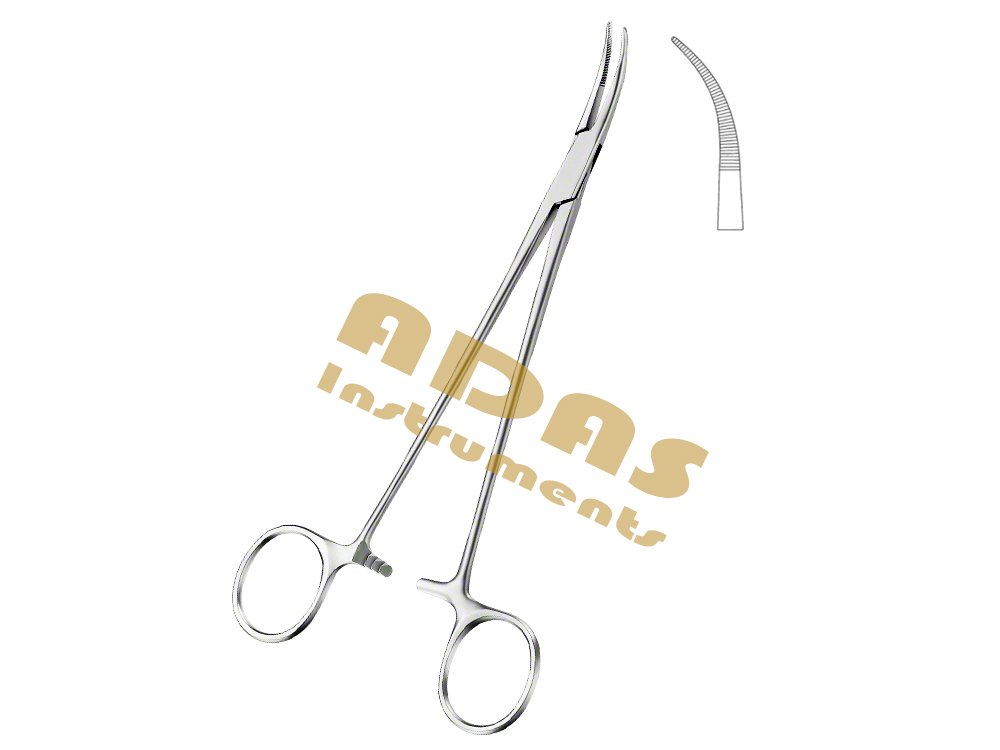

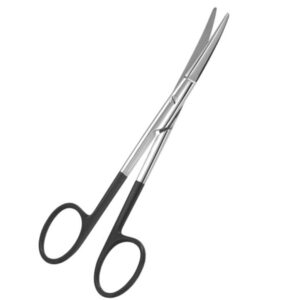
Adson Hemostatic Forceps, Curved, 18 cm
$ 18.00
Adson hemostatic forceps clamp small blood vessels and hold bleeding under control in tonsil, ENT, plastic and neurosurgical work. What sets the pattern apart is its proportion: a slim, elongated shaft carrying jaws only about a quarter of its length, so the working tip stays small while the reach stays long. That is what lets the curved 18 cm build work at the bottom of a deep or narrow field without the handles crowding the view.
Key Features
- Curved jaws with horizontal serrations along the inner face
- Slim shaft with short jaws, for reach into deep or narrow fields
- Ring handles with an interlocking ratchet, locked one handed
- Box joint to keep the jaw tips in line
- 18 cm length, curved
- High quality medical grade stainless steel, satin finish to cut glare
- Item code AE-71.19
Available on backorder

What the Adson hemostatic forceps is
The adson hemostatic forceps is a ring handled clamp used to close a small blood vessel and stop it bleeding. It is listed as an Adson hemostat, an Adson artery forceps, an Adson tonsil forceps and, in American catalogues, as a hemostatic forceps surgical clamp. The eponym belongs to Alfred Washington Adson, the American neurosurgeon.
What separates this pattern from a general hemostatic forceps is its proportion rather than its jaw. The shaft is long and slim and the jaws are short, only about a quarter of the shaft length, so the working tip stays small while the reach stays long. That is why it is reached for at the bottom of a tonsil bed or a narrow flap pocket, where a shorter clamp would put the handles in the way of the eye.
Key design features of the Adson hemostatic forceps
- Slim elongated shaft with short jaws. Reach without bulk at the tip.
- Horizontal serrations. Across the inner face, for a hold that does not slide on a wet vessel.
- No teeth. The jaw closes flat, which is what keeps it usable on a vessel wall.
- Curved tip. Lets the jaw come around a structure rather than across it.
- Finger ring handles with an interlocking ratchet. Set the hold and let go.
- Box joint. The halves pass through each other, so the fine tips stay in line.
Adson hemostatic forceps curved sizes and build options
One length, one tip. The chart is the variation list, so what is shown is what ships.
| Length | Tip | Jaw | Item code |
|---|---|---|---|
| 18 cm | Curved | Short, horizontal serrations, no teeth | AE-71.19 |
The imperial figure is deliberately left off this chart. The metric length and the inch length printed on this page have not agreed with each other, and rather than publish a converted number we cannot stand behind, we state the metric length only and are checking the other. Ask us before you order if the inch figure matters to your set.
Where Adson hemostatic forceps are used
What these uses share is a small vessel at the bottom of a field that a shorter instrument cannot reach into comfortably.
| Specialty | What it is used for |
|---|---|
| Otolaryngology and ENT | Securing bleeding points in the tonsil bed and other deep, narrow cavities |
| Plastic and reconstructive surgery | Controlling small vessels in flap dissection without crowding the field |
| Neurosurgery | Holding a small vessel where the handles must stay clear of the working line |
| Pediatric surgery | Small vessel work where a heavier hemostat is too much instrument |
| General surgery | Routine hemostasis on small and medium vessels in a confined wound |
What the jaws hold
This is a clamp and not a needle holder, so there is no suture gauge to quote.
| Structure | How the jaw takes it |
|---|---|
| Small and medium blood vessels | Short serrated jaw closes evenly along a short length of vessel wall |
| Subcutaneous connective tissue | Held flat, with no tooth to tear it |
| Fascia | Gripped without the shear a toothed jaw applies |
| Vascular pedicles | Taken as a unit while a tie is thrown behind the jaw |
How the Adson hemostatic forceps compares with other patterns
The two comparisons that come up most are against the Crile and against the mosquito, and they pull in opposite directions: one is heavier, one is finer.
| Pattern | How it differs | When you reach for it instead |
|---|---|---|
| Crile artery forceps | Shorter overall with a heavier, fully serrated jaw | Superficial work and heavier vessels, where reach does not matter |
| Halsted mosquito forceps | Much finer jaw, shorter reach | The smallest vessels in a shallow field |
| Insulated Adson hemostatic forceps | Same pattern with an insulating layer on the shaft | An energy device is working beside the clamp |
| Allis tissue forceps | Toothed grasper, not a clamp | Holding tissue rather than closing a vessel |
Adson hemostatic forceps materials and finish
The adson hemostatic forceps is made from high quality medical grade stainless steel, hardened so the serrations keep their shape and the ratchet keeps its bite. The finish is satin rather than mirror, which cuts glare under operating lights. The steel itself is made to a German specification. The finished instrument carries the CE mark.
Adson hemostatic forceps care and sterilization
Rinse under cold running water straight after use, before blood dries into the serrations. A soft brush along the jaw is enough; a wire brush rounds the ridges off. Open the jaws fully for ultrasonic cleaning and for autoclaving, because a closed box joint traps moisture and a latched ratchet will not steam through. Dry fully, then store with the ratchet released.
Ordering Adson hemostatic forceps and wholesale
Adas Instruments supplies hospitals, clinics and distributors across the United States, from stock and to order. Wholesale quantities and instrument set builds are quoted on request. Backorder items dispatch in 10 to 12 working days. Item code AE-71.19, and every instrument carries a three year replacement warranty against manufacturing defects. Production is controlled under an ISO 13485 quality management system.
Frequently asked questions
What are Adson hemostatic forceps used for?
They clamp small and medium blood vessels to stop bleeding, most often in a deep or narrow field. The slim shaft and short jaw are what let them work in a tonsil bed or a flap pocket without the handles blocking the view. We make the curved 18 cm build.
What is the use of hemostatic forceps in surgery?
To occlude a bleeding vessel and hold it closed while it is tied or sealed. A hemostatic forceps grips with serrations and no teeth, so it can stay on a vessel wall without cutting it, and the ratchet holds the pressure so the surgeon can let go and use the hand for something else.
What is the difference between an Adson forceps and a tissue forceps?
They are different tools that share a surname. An Adson hemostatic forceps is a ring handled, ratcheted clamp for closing vessels. An Adson tissue forceps is a thumb forceps, held like tweezers with no rings and no ratchet, used to pick tissue up. If it has finger rings and a ratchet, it is the hemostat.
Do Adson hemostatic forceps have teeth?
Ours do not. The jaw carries horizontal serrations and closes flat, which is what makes it safe on a vessel wall. If you need a toothed tip in this size range, the Kocher delicate pattern is the one to look at instead.
What length are they?
We make the 18 cm curved build. Longer and shorter Adson hemostats exist across the trade, and Google itself offers a choice between roughly 5 and a half and 7 and a quarter inches, but 18 cm curved is the one we supply.
Related products and categories
Surgeons who work with the adson hemostatic forceps usually compare it against the allis tissue forceps, the insulated adson hemostatic forceps and the crile artery forceps. The whole family sits in hemostats and grasping forceps, and this pattern is also listed under breast surgery instruments.
| Weight | 0.065 kg |
|---|
Be the first to review “Adson Hemostatic Forceps, Curved, 18 cm”
Shipping & Delivery Policy
Processing Time: In-stock items are dispatched within 24-48 hours. For custom or out-of-stock items, production time is approximately 10-15 days.
Global Delivery Estimates
We partner with world-class couriers (DHL, FedEx) to ensure fast, tracked delivery.
- USA & Canada: 3-5 Business Days
- Europe & UK: 4-6 Business Days
- Rest of World: 5-7 Business Days
*We offer Air Cargo and Sea Freight options for bulk wholesale orders.
Customs & Duties
International buyers are responsible for any customs duties or taxes imposed by their country. Adas Instruments is not responsible for delays caused by customs clearance.
Lost Packages & Insurance
If your package is lost in transit, please contact us immediately. We offer full support and replacements for confirmed lost shipments. Note: You must report non-delivery within 3 weeks to be eligible for an insurance claim.
Related products


Reviews
There are no reviews yet.