
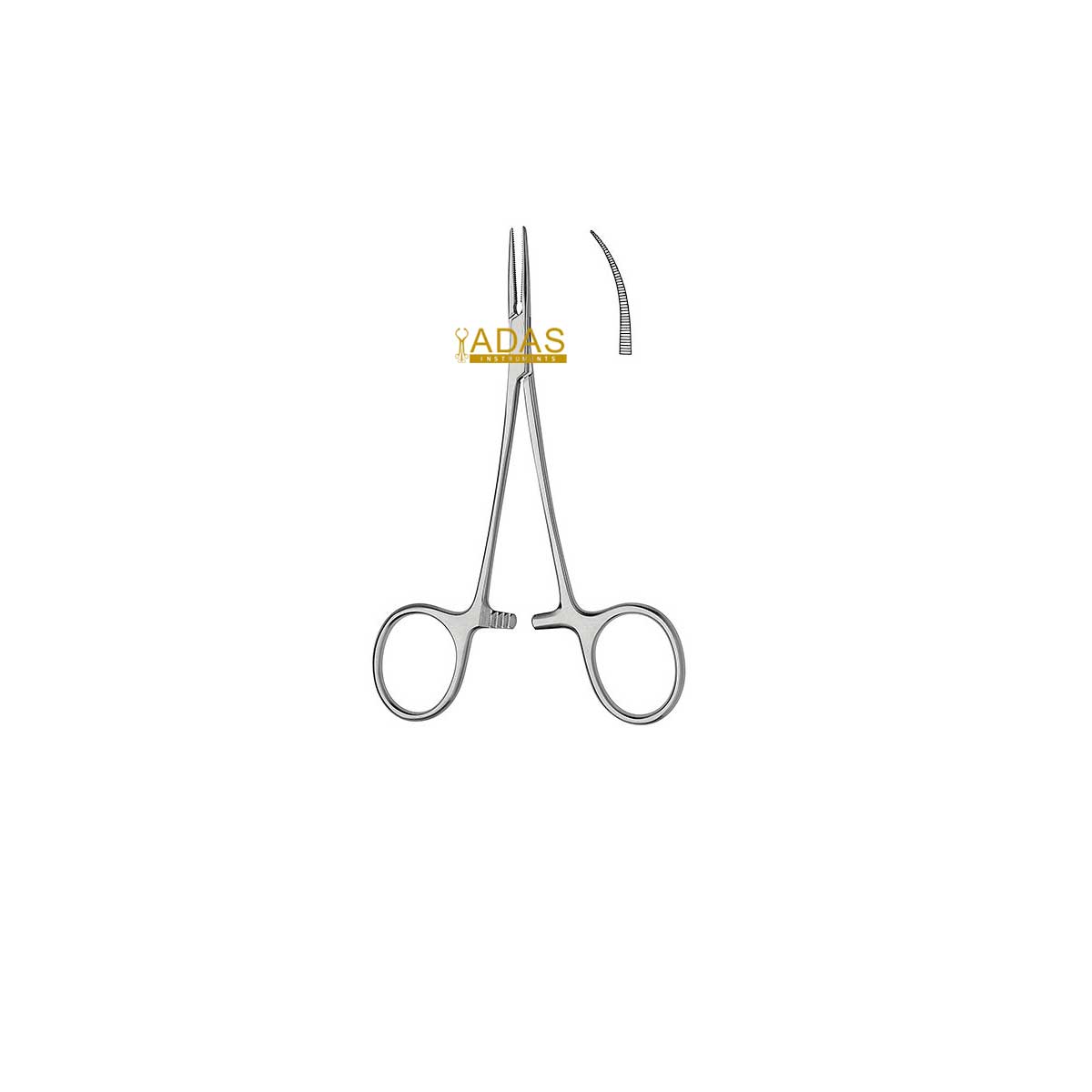
Micro Mosquito Forceps, Delicate Tip, Straight or Curved
$ 12.00
Micro mosquito forceps (also known as micro hemostatic forceps) take hold of an arteriole branch or a venule in a field where a standard clamp would cover the target. Thin tapered jaws, serrated to the tip, land the closing force on a small footprint instead of spreading it across the vessel wall. Against a standard Halsted the difference is the tip, and that is why they go on microsurgery, vascular and hand surgery trays rather than general ones.
Key Features
- Holds arteriole branches, venules and fine suture in a confined field
- Thin tapered jaws, serrated to the tip
- Straight or curved tips
- Closing force lands on a small footprint, not across the vessel wall
- Ratchet lock on the ring handle
- Used in microsurgery, vascular, plastic and hand surgery
- High quality medical grade stainless steel
- Item code AE-07.12

What micro mosquito forceps are
Micro mosquito forceps are the smallest jawed clamp in the mosquito family. The jaws are thinner and more sharply tapered than the standard pattern and the serrations run right to the tip, so the instrument can take a vessel that a regular jaw would simply cover. The trade also lists them as micro hemostatic forceps, as micro-mosquito hemostats and, with the words the other way round, as hemostat mosquito forceps.
The reason for the shape is mechanical, not cosmetic. Closing force lands on whatever area the jaw presents, so a narrower tip puts the same grip onto a smaller footprint and leaves the vessel wall either side of it untouched. That is what lets a surgeon working down a microscope hold a branch without bruising the run of the vessel.
Key design features of the micro mosquito forceps
Three things separate this build from the regular clamp on the same tray.
- Serrations carried to the tip. Nothing is held on a smooth last millimeter, which is where a fine vessel usually slips on a standard jaw.
- A thin tapered profile. The jaw narrows along its whole length rather than stepping down at the end.
- A ratchet on the ring handle. The clamp holds itself shut, which under magnification is the difference between one hand free and none.
Straight or curved is the build choice. Surgeons who work mostly down a microscope tend to order curved mosquito forceps, because the curve keeps the shank out of the light path. The two builds cost the same and most buyers who order a pair take one of each.
Micro mosquito forceps sizes and build options
Two tips. Nothing below is listed that we do not build, and no tip dimension is quoted because our own attributes do not carry one.
| Tip | Jaw | Item code | Where it fits |
|---|---|---|---|
| Straight | Thin, tapered, serrated to the tip | AE-07.12 | A direct line onto a small branch under magnification |
| Curved | Thin, tapered, serrated to the tip | AE-07.12 | Reaching around a structure without lifting the field |
Where micro mosquito forceps are used
What these specialties share is magnification. Every one of them works at a scale where the standard clamp is the wrong tool rather than a slightly large one.
| Specialty | What surgeons do with them |
|---|---|
| Microsurgery | Occluding arteriole branches and venules during anastomosis work |
| Vascular surgery | Small branch control where a standard clamp is too broad |
| Plastic and reconstructive surgery | Flap pedicle dissection and fine perforator work |
| Hand surgery | Digital vessels and nerve sheath margins |
| Ophthalmic surgery | Periocular vessels and fine tissue handling |
| Research and laboratory work | Small animal and bench procedures needing a fine clamp |
What micro mosquito forceps jaws hold
A hemostat is judged on what it can take hold of without damaging it, and micro mosquito forceps sit at the smallest end of that range. The list below is what the jaws are meant for, not everything they will close on.
| What the jaws take | How they take it |
|---|---|
| Arteriole branches | A small tip footprint concentrates the hold without crushing the wall |
| Venules | Light closure across a thin walled vessel |
| Nerve sheath margins | A fine bite for retraction rather than occlusion |
| Fine monofilament suture | Used as a tag clamp so the tail stays clear of the field |
| Small tissue edges | Brief hold under magnification while the stitch is placed |
How micro mosquito forceps compare with the standard patterns
Four clamps and one coagulating instrument, separated by what they can safely close on. The table says where each one stops. Buyers comparing micro mosquito forceps against the regular pattern are really asking how small the target vessel is, and that is the only question the jaw profile answers.
| Pattern | How it differs | When to choose it |
|---|---|---|
| This page, micro mosquito forceps | Thin tapered jaws, serrated to the tip | Work under magnification on branches a standard jaw would cover |
| Mosquito forceps, Halsted | 12.5 cm and 14.5 cm, jaws serrated their full length | The regular tray clamp for small vessels |
| Hartmann mosquito forceps | 10 cm, the shortest frame | Shallow, compact sites and pediatric fields |
| Delicate mosquito forceps, 18 cm | Long reach, small jaws | A small bleeding point that sits deep |
| Jeweler bipolar forceps | Coagulates rather than clamps | When the bleeding point is better sealed than held |
Materials and finish
Each pair is made from high quality medical grade stainless steel, hardened at the jaws and at the box lock so a tip this thin keeps its profile through repeated cycles. The steel itself is made to a German specification. The finish is satin, which matters more here than on a larger clamp because a mirror surface under a microscope light is a glare source.
Micro mosquito forceps care and sterilization
Open the ratchet before cleaning and before the autoclave. Handle the tips the way you would handle a micro needle: never rest the instrument on its points, never use it to lever anything, and store it in a rack rather than loose in a tray. A bent micro tip cannot be trued, and the commonest cause is a heavy instrument landing on it in the washer.
Ordering and wholesale
Order by item code AE-07.12, naming the tip you want. Adas Instruments supplies hospitals, surgery centers, distributors and instrument resellers across the United States, and wholesale quantities are quoted on the set rather than the piece. Backorder items dispatch in 10 to 12 working days. Every instrument carries a three year replacement against manufacturing defects. Production is controlled under an ISO 13485 quality management system.
Frequently asked questions
What are micro mosquito forceps used for?
They occlude arteriole branches and venules and hold fine suture in a field viewed under magnification. They appear on microsurgery, vascular, plastic and hand surgery trays, and in laboratory work where a fine clamp is needed. They are not a general tray instrument; the standard mosquito covers that job.
What is the difference between mosquito forceps and needle holder?
A mosquito clamps and holds a vessel. A needle holder grips a curved needle so it can be driven through tissue, and its jaws are short, flat and cross serrated for exactly that. They look alike at a glance because both have ring handles and a ratchet, but a mosquito used on a needle will let it turn.
How do micro mosquito forceps differ from the standard Halsted?
The tip. The micro jaw is thinner, more sharply tapered and serrated all the way to the end, while the Halsted has a fuller jaw serrated along its length. The Halsted is the regular clamp for small vessels; the micro is for branches that a regular jaw would cover rather than hold.
What is a Jacobson mosquito forceps?
Jacobson is another name used in the trade for a micro mosquito pattern, usually a fine tipped clamp for microvascular work. Catalogues are not consistent about it, so order by the jaw description and the item code rather than by the eponym alone.
What is the difference between hemostatic forceps and mosquito forceps?
A hemostatic forceps is the whole class of clamp used to stop bleeding. Mosquito is one pattern inside that class, the small end of it, and micro is the finest build of the mosquito. So every micro mosquito forceps is a hemostatic forceps, and the two words are not alternatives to each other.
Related products and categories
Surgeons who use micro mosquito forceps usually keep the regular mosquito forceps and the Hartmann mosquito forceps on the same tray, and reach for the 18 cm delicate clamp when the bleeding point sits deep. The whole family sits in hemostats and grasping forceps, and this pattern is also listed under micro surgery instruments.
| Weight | 0.05 kg |
|---|---|
| Tip options | Curved Tip, Straight Tip |
Be the first to review “Micro Mosquito Forceps, Delicate Tip, Straight or Curved”
Shipping & Delivery Policy
Processing Time: In-stock items are dispatched within 24-48 hours. For custom or out-of-stock items, production time is approximately 10-15 days.
Global Delivery Estimates
We partner with world-class couriers (DHL, FedEx) to ensure fast, tracked delivery.
- USA & Canada: 3-5 Business Days
- Europe & UK: 4-6 Business Days
- Rest of World: 5-7 Business Days
*We offer Air Cargo and Sea Freight options for bulk wholesale orders.
Customs & Duties
International buyers are responsible for any customs duties or taxes imposed by their country. Adas Instruments is not responsible for delays caused by customs clearance.
Lost Packages & Insurance
If your package is lost in transit, please contact us immediately. We offer full support and replacements for confirmed lost shipments. Note: You must report non-delivery within 3 weeks to be eligible for an insurance claim.
Related products



Reviews
There are no reviews yet.