
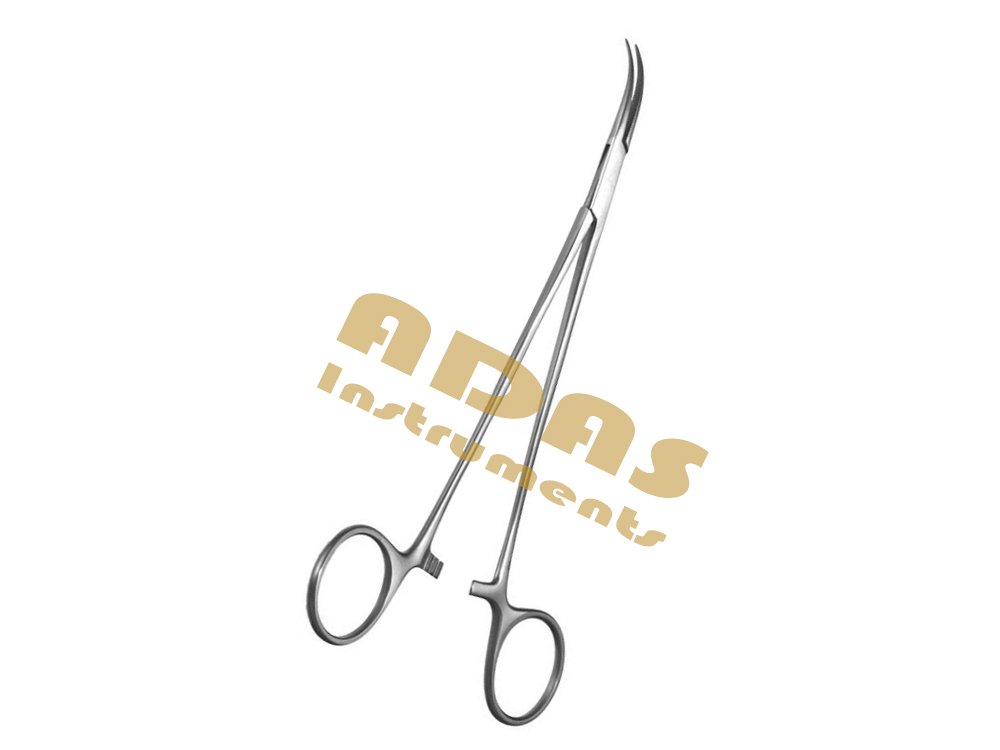
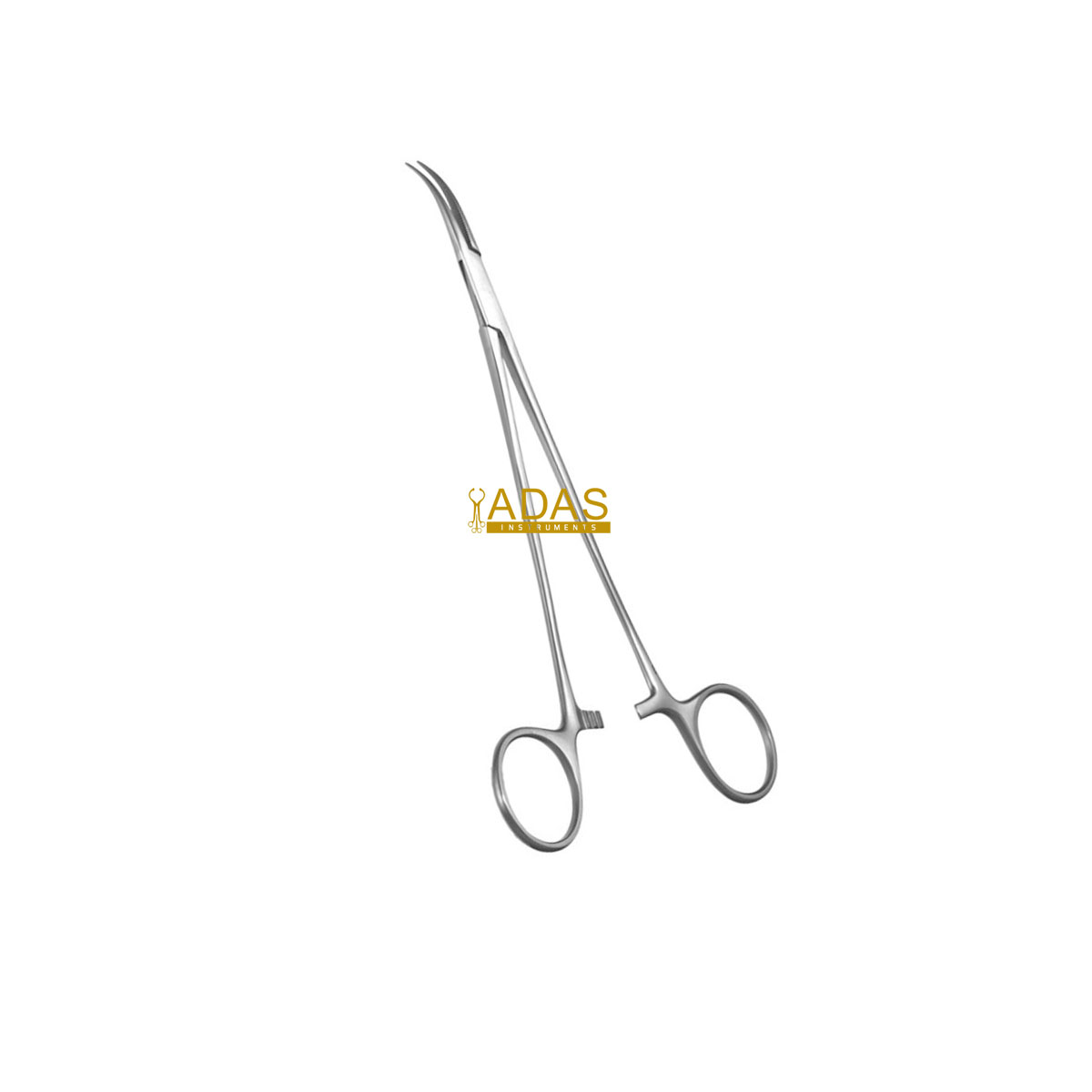
Mosquito Forceps, Fine 18 cm, Straight or Curved
$ 16.00
Mosquito forceps, also called mosquito hemostats, are the smallest of the standard ring handled clamps, closing on a capillary or a small vessel and holding it shut while the surgeon ties or cauterizes. They take their name from the jaws, which are as narrow and as finely tapered as a mosquito’s legs. This 18 cm pattern is the long version of the instrument, made for the same fine work at the bottom of a deeper wound, and it is made with a straight tip or a curved tip.
Key Features
- Fully serrated jaws, with transverse serrations running the whole length of the jaw rather than the distal half
- Ratchet lock above the finger rings, so the jaws stay closed on a vessel without a hand on them
- 18 cm overall, the long pattern. The common mosquito is 12.5 cm, so this one reaches further
- Straight tip or curved tip. Curved keeps the hand out of the line of sight in a deeper field
- Jaws are serrated, not toothed, so a small vessel is held rather than punctured
- High quality medical grade stainless steel, autoclavable and made to be used again
- Three year replacement warranty against manufacturing defects

What the mosquito forceps is
Mosquito forceps are the smallest of the standard ring handled clamps, made to close on a capillary or a small vessel and hold it shut while the surgeon ties or cauterizes. They are also listed as mosquito hemostats and, after the surgeon who refined them, as Halsted mosquito forceps. The jaws taper to a fine point and carry transverse serrations along their whole length, and a ratchet above the finger rings keeps them closed without a hand on the instrument.
The name comes from the jaws. They are as narrow and as finely tapered as a mosquito, and that is what separates the pattern from every heavier clamp in the set. A Kelly or a Crile will close a vessel, but it will also fill a small wound with metal.
This page is the 18 cm pattern. Most mosquito forceps are 12.5 cm, so 18 cm is the long version: the same fine jaw carried on a longer shank so it reaches the bottom of a deeper tunnel. That is a real difference in a facelift plane or a neck dissection, where the bleeder is a long way from the incision and a short instrument means putting a hand into the field.
Key design features of the mosquito forceps
Five features, and each one is about working small in a field that has no room to spare.
- Fully serrated jaws. Transverse serrations run the entire length of the jaw rather than the distal half, so a vessel is gripped evenly from the tip to the joint.
- Fine tapered tip. Narrow enough to take a single capillary without gathering the tissue around it.
- Ratchet lock. Sits above the finger rings and holds the jaw closed through its steps, so the clamp can be left in place and the hand moved on.
- 18 cm shank. Reaches where the 12.5 cm pattern stops, which is the whole reason this length exists.
- Box joint. The two halves pass through one another, so the jaw tips keep meeting after years of use.
Mosquito forceps sizes and lengths
The size chart shows what ships from this page and where the other lengths live, because mosquito forceps size and mosquito forceps length are the two things buyers ask about most.
| Length | Imperial | Tip | Jaw | Item code |
|---|---|---|---|---|
| 18 cm | 7 in | Straight | Fully serrated, fine taper | ADT-153.18 |
| 18 cm | 7 in | Curved | Fully serrated, fine taper | ADT-153.18 |
| 12.5 cm | 5 in | Straight or curved | The common Halsted length, listed separately | see Halsted mosquito forceps |
| 10 cm | 4 in | Straight or curved | The short Hartmann pattern, listed separately | see Hartmann mosquito forceps |
Imperial figures are given because most United States buyers order in inches. Both tips are the same instrument and the same item code; the tip is chosen at the point of order.
Buyers ask which tip to order, so here is the working answer. A straight mosquito forceps is for a vessel you can see, for a structure at the surface, and for holding suture ends where the straight line is easier to pick up again. A curved mosquito forceps is for depth: the curve carries the jaw down and away, and the hand and the rings stay out of the line of sight. Curved is the commoner order of the two, and in a long tunnel such as a facelift plane it is the only sensible choice.
Mosquito forceps uses by specialty
The pattern turns up wherever the vessels are small and the field is narrow.
| Specialty | What it is used for |
|---|---|
| Plastic and reconstructive surgery | Catching small bleeders in a flap before they obscure the plane being raised |
| Facelift and neck lift | Working at the bottom of a long narrow tunnel, which is where the 18 cm length earns its keep |
| Hand and microsurgery | Clamping vessels too small for a Kelly or a Crile to reach without crowding the field |
| ENT and tonsillectomy | Holding a small vessel in the tonsil bed, and tagging ties |
| Pediatric and neonatal surgery | The fine jaw that a small field needs, on tissue that will not take a heavier clamp |
| Dental and oral surgery | Grasping and retrieving small items and holding suture ends |
| Veterinary surgery | The same fine work on small animals, where most of the general set is too big |
What the jaws hold, and what they do not
A fine jaw is a limit as well as a feature, so this table says plainly where the instrument stops.
| Structure | How the jaw takes it |
|---|---|
| Capillaries and small vessels | The whole point of the pattern. Fine transverse serrations close the lumen without cutting it |
| Small bleeders in a flap | Clamped and left on the ratchet while the tie is prepared |
| Suture ends and ties | Held on the straight tip, out of the way and easy to find again |
| Fine connective tissue | Held for blunt dissection, opening a plane rather than tearing it |
| Skin and subcutaneous edges | Held briefly. The serrations mark tissue that is being kept, so this is a short hold |
| Large vessels and thick pedicles | NOT this instrument. The jaw is too fine and will not span them. Use a Crile or a Kelly |
| Bone and fibrous bands | NOT this instrument. It is a hemostat, not a grasper |
How the mosquito forceps compares with other patterns
Three of the rows below are our own mosquito patterns in other lengths, and the rest are the clamps buyers confuse it with.
| Pattern | How it differs | When you reach for it instead |
|---|---|---|
| Halsted mosquito forceps | The same jaw in the standard 12.5 cm length. Halsted is the pattern name for the mosquito itself | A shallow field, where 18 cm is more instrument than the wound needs |
| Hartmann mosquito forceps | Shorter again at about 10 cm, and built for shallow work | Ear, nose and small surface fields |
| Micro mosquito forceps | A finer tip again on a short body | Microsurgery, where even the mosquito tip is too broad |
| Kelly forceps | Larger, around 14 cm, and serrated on the distal half of the jaw only, with a smooth stretch near the joint | Medium vessels and general tissue work |
| Crile forceps | Around 14 to 16 cm and serrated the full length, so it is a Kelly jaw with full serrations | Medium vessels where a full grip is wanted |
| Needle holder | Short heavy jaws that hold a needle, not a vessel | Driving a needle. A mosquito is not a needle holder and will damage the needle |
Mosquito forceps materials and finish
Made from high quality medical grade stainless steel, satin finished so the light in the operating room does not bounce off the shank into the surgeon’s eye. The steel itself is made to a German specification. The jaws are hardened at the serrations, because that is the surface that wears, and the box joint is finished so the halves move without play.
Mosquito forceps care and sterilization
Open the ratchet before cleaning and before sterilizing, so the joint and the serrations are exposed and the steel is not held under load at temperature. Clean with a soft brush under running water, paying attention to the box joint and to the grooves between the serrations, then rinse in deionized water and dry fully before autoclaving. Store with the ratchet open. A mosquito jaw is fine enough that a dropped instrument can be bent out of alignment, so check that the tips still meet before the instrument goes back in the set.
Ordering mosquito forceps and wholesale
Adas Instruments makes this pattern to order in straight and curved, and supplies hospitals, surgical centers and distributors across the United States, Latin America, Europe and Asia. Bulk and wholesale pricing is available, and instruments held on backorder ship in 10 to 12 working days. Every instrument carries a three year replacement warranty against manufacturing defects. Certifications: CE. Production is controlled under an ISO 13485 quality management system.
Frequently asked questions
What are mosquito forceps used for?
Clamping small blood vessels and capillaries to stop bleeding, and holding fine tissue and suture ends while the surgeon works. They are the smallest clamp in a standard set, so they are reached for whenever the vessel is too small for a Kelly or a Crile to take without crowding the wound.
Are mosquito forceps the same as hemostats?
A mosquito forceps is a hemostat. Hemostat is the family, and the mosquito is the smallest member of it, which is why the same instrument is sold as a mosquito hemostat and as a mosquito clamp. The larger members of the same family are the Kelly and the Crile.
What is the difference between Kelly forceps and mosquito forceps?
Size and serrations. A mosquito is about 12.5 cm as standard, with a fine tapered jaw serrated along its whole length. A Kelly is about 14 cm with a broader jaw serrated on the distal half only, leaving a smooth stretch near the joint. Reach for the mosquito on a capillary and for the Kelly on a vessel with some substance to it.
Why are they called mosquito forceps?
Because of the jaws. They are narrow, finely tapered and pointed, and early users thought they looked like a mosquito. The full catalogue name is Halsted mosquito forceps, after William Stewart Halsted, whose fine clamps the pattern comes from.
How do you tell a mosquito forceps from an artery forceps?
Artery forceps is the wider name for any ratcheted clamp used on a vessel, and a mosquito is the smallest of them. If the jaw is fine enough to take a single capillary and the instrument is around 12.5 cm, it is a mosquito. If the jaw is broader and the instrument is 14 cm or more, it is one of the larger artery forceps such as a Kelly, a Crile or a Spencer Wells.
Related products and categories
Buyers who order the mosquito forceps usually order alongside it the halsted mosquito forceps, the hartmann mosquito forceps and the micro mosquito forceps. The whole family sits in hemostats and grasping forceps, and this pattern is also listed under tonsillectomy instruments.
| Weight | 0.07 kg |
|---|---|
| Tip options | Curved Tip, Straight Tip |
Be the first to review “Mosquito Forceps, Fine 18 cm, Straight or Curved”
Shipping & Delivery Policy
Processing Time: In-stock items are dispatched within 24-48 hours. For custom or out-of-stock items, production time is approximately 10-15 days.
Global Delivery Estimates
We partner with world-class couriers (DHL, FedEx) to ensure fast, tracked delivery.
- USA & Canada: 3-5 Business Days
- Europe & UK: 4-6 Business Days
- Rest of World: 5-7 Business Days
*We offer Air Cargo and Sea Freight options for bulk wholesale orders.
Customs & Duties
International buyers are responsible for any customs duties or taxes imposed by their country. Adas Instruments is not responsible for delays caused by customs clearance.
Lost Packages & Insurance
If your package is lost in transit, please contact us immediately. We offer full support and replacements for confirmed lost shipments. Note: You must report non-delivery within 3 weeks to be eligible for an insurance claim.
Related products
Reviews
There are no reviews yet.