
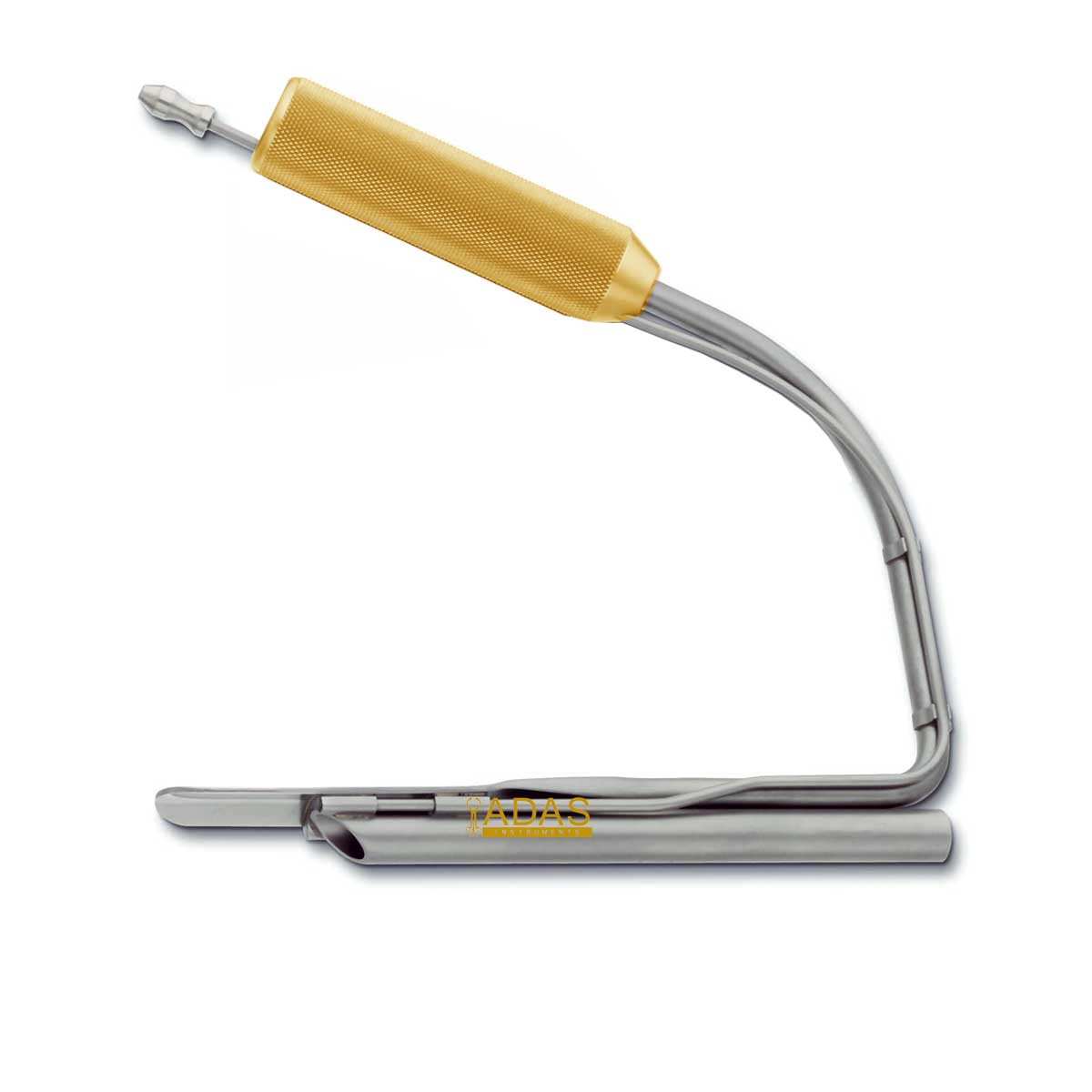
Emory Endoscopic Plastic Retractor | 20 and 25 mm Blades, 12 and 15 cm Lengths
$ 180.00
The Emory endoscopic plastic retractor holds a subcutaneous pocket or a tissue flap open with one hand, giving traction and counter traction at the same time and leaving the surgeon’s dominant hand free to dissect. A channel under the blade seats the endoscope so the view travels with the retractor instead of drifting away from it. Three blades: 20 mm on 12 cm, 25 mm on 12 cm, and 25 mm on 15 cm.
Key Features
- Scope channel under the blade, so the view stays with the blade
- One handed traction and counter traction, dominant hand left free
- Three blades: 20 x 12 cm, 25 x 12 cm, 25 x 15 cm
- One piece of steel, nothing plumbed in and nothing to flush
- Cut from high quality medical grade stainless steel and fully autoclavable
- Three year replacement warranty against manufacturing defects
- Item code AP-521.10

What an Emory endoscopic plastic retractor is
Endoscopic plastic surgery has a staffing problem before it has a surgical one. The pocket has to be held open, the scope has to be aimed into it, and the dissection has to happen, and that is three hands in a space entered through an incision a few centimeters long.
The Emory pattern collapses two of those three into one. Google’s own description of it is exact and worth quoting rather than paraphrasing: it is engineered to maintain a subcutaneous pocket or tissue flap with one hand, simultaneously providing traction and counter traction while leaving the surgeon’s dominant hand free for dissection. The scope rides in a channel under the blade, so the picture goes where the blade goes.
What it gives up in exchange is plumbing. There is no fiber optic guide and no suction channel on this instrument. That is a real limitation in a closed pocket, where electrocautery inside a closed pocket makes smoke that has nowhere to go, and a suction channel on the blade clears it without a second instrument in the wound, and it is why this page says plainly which of our instruments to buy instead if you want those.
It is listed as an Emory endoscopic retractor, and simply as an endoscopic retractor, which is the broader term Keyword Planner reports at 10 to 100 searches a month. Where it is bought for one named operation it is bought as a transaxillary breast augmentation retractor, and that is the phrase Google suggests first on its own seed.
It is also the pattern most associated with transaxillary breast augmentation, where the implant pocket is made and inspected through an incision in the armpit. It is used the same way in endoscopic brow and forehead lifts, in endoscopic abdominoplasty and in flap harvest, which is why it sits in a breast category and in a general plastic surgery one at the same time.
Key design features
The scope channel, and what it is really for
A channel under the blade seats the endoscope and holds it in register with the blade. The point is not that the retractor carries the scope, it is that the scope stops being a separate thing somebody has to keep aiming. When the retraction changes, the view changes with it rather than against it.
One handed traction and counter traction
The blade lifts the flap and the body of the instrument braces against the tissue below it, so one hand produces both halves of the tension that opens a plane. That is the whole reason this instrument exists, and it is the reason it is used where the team is small as well as where the incision is.
Three blades, two lengths
20 mm on 12 cm, 25 mm on 12 cm, and 25 mm on 15 cm. The narrow 20 mm is for brow and forehead work, where the corridor under the scalp is tight. The 15 cm reaches furthest and is the one to order for abdominal or axillary work.
Nothing plumbed into it
No light port and no suction channel: this is one piece of steel with a channel formed into it. Nothing to flush, nothing to dry, nothing to block. If a closed pocket needs smoke clearing as well, that is a second instrument or a different retractor, and we say which one below.
Which blade to order
One decision, and it is mostly about which operation the instrument is bought for.
| Blade | Length | Usually chosen for |
|---|---|---|
| 20 mm | 12 cm | Endoscopic brow and forehead lift, where the corridor is narrow |
| 25 mm | 12 cm | Transaxillary breast work on a shallower pocket |
| 25 mm | 15 cm | Endoscopic abdominoplasty, flap harvest, a deeper axillary pocket |
| All three | A set | A theater running endoscopic work across more than one region |
Where it is used
Four operations, and the blade changes with the region rather than with the surgeon.
| Procedure | What it holds | Blade |
|---|---|---|
| Transaxillary breast augmentation | The implant pocket, made and inspected through the armpit | 25 mm on 12 or 15 cm |
| Endoscopic brow and forehead lift | The scalp flap, for muscle resection underneath | 20 mm on 12 cm |
| Endoscopic abdominoplasty | A long subcutaneous flap | 25 mm on 15 cm |
| Muscle flap harvest and expander placement | Deep tissue, without opening it fully | 25 mm, either length |
What it holds back, and what it must not do
One of these rows is a figure we will not print, and it is the most important row on this page.
| The task | What this retractor does | What it must not do |
|---|---|---|
| Holding the pocket | One handed traction and counter traction | It is not a self retainer. There is no ratchet and nothing locks |
| Carrying the scope | Seats a scope in a channel under the blade and keeps the view registered | It does not LOCK the scope. Some rival patterns have a compression screw; ours is not published as having one and should not be assumed to |
| Being a known scope size | We do NOT publish a scope diameter for this instrument | Nobody should order it for a particular scope until we have measured the channel. Rival pages say 5 mm or 10 mm; OUR record says nothing, so neither does this page. It is on our owed list |
| Clearing smoke | Nothing. There is no suction channel | It must not be relied on to keep a lens clear. Use a second sucker, or an instrument that carries one |
How it compares with the rest of the family
Two instruments in this category carry a scope and the difference between them is everything else.
| Instrument | Scope channel | Light | Suction | Blade |
|---|---|---|---|---|
| Emory endoscopic, this page | Yes, diameter not published by us | No | No | 20 and 25 mm, 12 and 15 cm |
| ADAS OmniView | Yes, 4 or 10 mm | Yes | Yes | 25, 30, 35 mm on 17 cm |
| Ferreira fiber optic and suction | No | Yes | Yes | Four sizes, blunt tip |
| Tebbetts breast retractor | No | Yes | Yes | Four sizes, toothed tip |
Materials and finish
Every Emory endoscopic plastic retractor we make is cut from high quality medical grade stainless steel. The steel itself is made to a German specification. We do not publish a grade number. The number on a certificate tells a surgeon nothing about whether a scope channel still seats a scope cleanly after two hundred autoclave cycles and a few hundred insertions, and the answer to that is in the making rather than in the alloy.
The channel is formed into the blade rather than fixed underneath it. A channel made from a second piece of steel has a seam, and a seam in the one place a scope slides through is where a scope gets scratched.
There is no sharp external edge anywhere along the outline, and that includes the mouth of the channel. It is the opening on this instrument that gets the most traffic, because the scope goes in and out of it several times in a case.
Caring for it
Flush the scope channel even though nothing was suctioned through it. Blood works its way in past the scope and dries into a film, and a film in the channel is what makes the next scope stiff to seat and eventually marks it.
Wash the rest as one piece, warm water and a soft brush. Autoclave with the tray. Store it flat with nothing in the channel, and look down the channel occasionally against the light: a channel that is no longer straight is a channel that will fight a scope, and it is the one fault on this instrument that cannot be cleaned out.
Ordering and wholesale
The Emory endoscopic plastic retractor is made by Adas Instruments in our own workshop and sold direct, which is why the price sits where it does against the catalog houses. Order one for a single tray, or in quantity for a hospital list or a distributor line. We do OEM work under your own brand and your own item numbers. Send us a sample and we will hold a run to your pattern rather than ours. Stock items ship from our own workshop. Backorder items take 10 to 12 working days to make. Every instrument carries a three year replacement warranty against manufacturing defects. Production is controlled under an ISO 13485 quality management system.
Frequently asked questions
What is an Emory endoscopic plastic retractor used for?
Holding a subcutaneous pocket or tissue flap open with one hand while the other dissects, with the endoscope seated in a channel under the blade. It is used in transaxillary breast augmentation, endoscopic brow and forehead lift, endoscopic abdominoplasty and flap harvest.
What size endoscope does the channel take?
We do not publish a figure, because our own product record does not carry one and we will not print a measurement we have not taken. Rival listings for this pattern quote 5 mm and 10 mm. Ask us before ordering if a particular scope has to fit, and it is on our list to measure.
What blade sizes does it come in?
Three: 20 mm on 12 cm, 25 mm on 12 cm, and 25 mm on 15 cm.
Does it have a light or suction?
No. This pattern is one piece of steel with a scope channel and nothing else plumbed into it. If you need light and smoke clearance on the same blade, the ADAS OmniView carries both along with a scope channel.
Does the scope lock into the channel?
Not on ours, and we will not imply otherwise. Some rival patterns add a compression screw that clamps the scope; our record does not describe one on this instrument, so the honest answer is that the channel seats the scope and does not lock it.
Related products and categories
For a plain blunt blade with no channel at all, the Ferreira breast augmentation retractor, or the Ferreira retractor with a fiber optic port. For a blunt blade with both a light and a suction channel, the Ferreira fiber optic and suction retractor.
The rest of this family sits under breast dissectors and spreaders, and the wider set for the operation is under breast surgery instruments.
| Weight | 0.25 kg |
|---|---|
| Blade Size | 20mm x 12cm Blade, 25mm x 12cm Blade, 25mm x 15cm Blade |
Be the first to review “Emory Endoscopic Plastic Retractor | 20 and 25 mm Blades, 12 and 15 cm Lengths”
Shipping & Delivery Policy
Processing Time: In-stock items are dispatched within 24-48 hours. For custom or out-of-stock items, production time is approximately 10-15 days.
Global Delivery Estimates
We partner with world-class couriers (DHL, FedEx) to ensure fast, tracked delivery.
- USA & Canada: 3-5 Business Days
- Europe & UK: 4-6 Business Days
- Rest of World: 5-7 Business Days
*We offer Air Cargo and Sea Freight options for bulk wholesale orders.
Customs & Duties
International buyers are responsible for any customs duties or taxes imposed by their country. Adas Instruments is not responsible for delays caused by customs clearance.
Lost Packages & Insurance
If your package is lost in transit, please contact us immediately. We offer full support and replacements for confirmed lost shipments. Note: You must report non-delivery within 3 weeks to be eligible for an insurance claim.
Related products

Reviews
There are no reviews yet.