

Ferreira Breast Augmentation Retractor | Plain Blade, 23 mm, No Light
$ 45.00
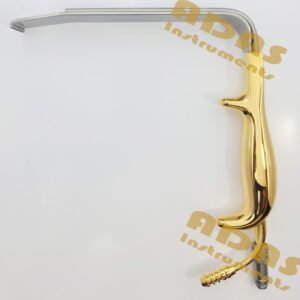
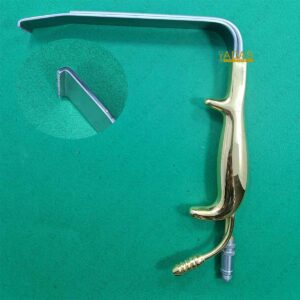
The Ferreira breast augmentation retractor is a handheld retractor with a curved, tapered right angle blade that lifts breast tissue and the pectoral muscle flap clear of the pocket underneath. The tip is smooth and blunt rather than toothed, which is what you want against a tissue plane you would rather not mark, and the right angle is what lets one hand hold a deep pocket open while the other works inside it. This is the pattern on its own: a 23 mm blade in two lengths, no light port and no suction channel, for a surgeon who already has a light source on the field or does not want one on the retractor.
Key Features
- Curved tapered right angle blade, smooth blunt tip
- Blade 23 mm wide, in 17 cm and 19 cm
- No fiber optic port and no suction channel on this pattern
- Hollow handle, so the weight sits in the hand and not at the tip
- Cut from high quality medical grade stainless steel and fully autoclavable
- Three year replacement warranty against manufacturing defects
- Item code AP-103.01

What a Ferreira breast augmentation retractor is
Breast augmentation is done through an opening smaller than the space being worked in. The surgeon lifts a flap of breast tissue, often with the lower edge of the pectoral muscle, and holds it there while a pocket is made underneath. The Ferreira breast augmentation retractor exists for that one job, and its shape is the argument: a blade at a right angle to the handle, curved along its length and tapered to the tip.
The right angle is what makes it a one handed instrument. A straight blade has to be held at an angle to the incision and the hand ends up in the way; a right angle puts the handle outside the wound and the blade flat against tissue. The taper means the narrow end goes in first and the wider part takes the load.
The tip is blunt and smooth, and that is the difference between this family and the Tebbetts family on the same tray. A surgeon on a video Google quotes puts it plainly: the Ferreira has a nice blunt tip, and the Tebbetts has more teeth for extra gripping power.
It is searched for as a Ferreira breast retractor without the middle word, and as a retractor for breast augmentation by people who do not know the pattern name. It is also used as a breast reduction retractor, because lifting a flap off a pocket is the same job whichever way the operation is going.
This page is the plain one. Three of our four Ferreira retractors carry a light, a suction channel, an insulated tip, or all three. This one carries none of them, and it is here because plenty of surgeons want none: the light is on the headlamp, the smoke is somebody else’s job, and a blade with nothing plumbed into it is one less thing to strip and sterilize.
Key design features
The right angle, and why it is not a curve
The blade meets the handle at close to ninety degrees. That single geometry is what keeps the surgeon’s hand out of the operative field and lets the retractor be held steady by an assistant whose arm is not across the incision. A gently curved retractor can be levered to the same depth, but it has to be rolled to get there and the roll is what tears a flap.
A blunt tip, on purpose
There are no teeth and no serrations on this blade. On the pectoral fascia and on the underside of the breast flap, a toothed tip buys grip and pays for it in marks, and the marks are on tissue that has to settle smoothly over an implant. Where tissue does slip and grip matters more than finish, the Tebbetts pattern is the same instrument with teeth at the tip, which stop the blade sliding off denser tissue when it is pulled hard.
23 mm wide, in two lengths
Both of our plain Ferreira blades are 23 mm wide. What changes is reach: 17 cm for most primary augmentations and 19 cm when the pocket is deeper or the patient is taller. Width stays constant because the width is what spreads the load across the flap, and a blade that is too narrow concentrates it into a line.
A hollow handle
The handle is hollow rather than solid. It holds the retractor light enough to be held for a long dissection without the wrist tiring, and it moves the balance back towards the hand so the blade does not want to dive. It is also the reason this instrument can be held by an assistant for forty minutes without being asked to swap.
Which blade length to order
One decision, and both options are the same 23 mm width.
| Blade | Reach | Usually chosen for |
|---|---|---|
| 23 mm x 17 cm | Shorter | Most primary augmentations through an inframammary or periareolar incision |
| 23 mm x 19 cm | Longer | A deeper pocket, a taller patient, or a transaxillary approach |
| Both | A pair on the tray | A list that moves between primary cases and revisions |
| Either, with a light | Same blade, lit | See the comparison table: three siblings carry a fiber optic port |
Where it is used
This is a breast pocket instrument. It is not a general purpose retractor and it does not pretend to be.
| Procedure | What it holds | Note |
|---|---|---|
| Breast augmentation | The breast flap, and the lower edge of the pectoral muscle | The operation the pattern was shaped for |
| Implant exchange and revision | A flap that is now scarred and less forgiving | The blunt tip matters more here, not less |
| Breast reconstruction | A flap over an expander or an implant | Usually with the longer blade |
| Capsulectomy | The pocket wall while the capsule is taken | A smooth blade slides on capsule; a toothed one catches it |
What it holds back, and what it must not do
A retractor is the one instrument in the field that is doing nothing except holding, which is exactly why it gets asked to do more than it should.
| The task | What this retractor does | What it must not do |
|---|---|---|
| Holding the flap | Spreads the load across 23 mm of blade | It is not a lever. Levering on the incision edge is what bruises it |
| Holding the muscle | Lifts the lower pectoral edge clear | It does not cut, and it does not strip muscle off rib |
| Making room | Holds a pocket open so somebody else can work | It does not dissect. The blade is blunt and it stays blunt |
| Working near cautery | Nothing. This blade is bare steel | It must NOT be used as the only barrier beside an active cautery pencil. Our insulated siblings are for that |
How it compares with the rest of the family
Four Ferreira retractors and three Tebbetts retractors sit on the same tray, and the choice between them is two questions: blunt tip or teeth, and how much do you want plumbed into the blade.
| Instrument | Tip | What is built into the blade |
|---|---|---|
| Ferreira, this page | Smooth and blunt | Nothing. Bare blade, 23 mm, two lengths |
| Ferreira fiber optic | Smooth and blunt | A light port, and a choice of insulated or plain tip |
| Ferreira fiber optic and suction | Smooth and blunt | A light port and a suction channel, four blade sizes |
| Tebbetts | Toothed | A light port and a suction channel, four blade sizes |
Materials and finish
Every Ferreira breast augmentation retractor we make is cut from high quality medical grade stainless steel. The steel itself is made to a German specification. We do not publish a grade number. The number on a certificate tells a surgeon nothing about whether a 23 mm blade still sits flat against a flap after two hundred autoclave cycles, and the answer to that is in the making rather than in the alloy.
The blade is finished with no sharp external edge anywhere along its outline. A retractor is held against living tissue for the length of an operation, and a burr on the back of a blade does its damage slowly and invisibly.
There is nothing on this instrument to lubricate and nothing to trap moisture: it is one piece of steel. That is the quiet advantage of the plain pattern over its lit siblings, and it is worth saying out loud because it does not show up in a specification table.
Caring for it
Wash it as one piece, because it is one piece. Warm water, a soft brush along the blade and into the angle where blade meets handle, which is where blood sits on a right angle retractor and where it gets missed.
Autoclave with the rest of the tray. Store it flat or hanging, not loose in a drawer with heavier instruments: the one thing that ruins this pattern is a blade that has been bent a degree or two out of true by something stacked on it, because a right angle that is no longer a right angle has to be rolled to seat, and rolling is what it was shaped to avoid.
Ordering and wholesale
The Ferreira breast augmentation retractor is made by Adas Instruments in our own workshop and sold direct, which is why the price sits where it does against the catalog houses. Order one for a single tray, or in quantity for a hospital list or a distributor line. We do OEM work under your own brand and your own item numbers. Send us a sample and we will hold a run to your pattern rather than ours. Stock items ship from our own workshop. Backorder items take 10 to 12 working days to make. Every instrument carries a three year replacement warranty against manufacturing defects. Production is controlled under an ISO 13485 quality management system.
Frequently asked questions
What is a Ferreira breast augmentation retractor used for?
Holding the breast flap and the lower edge of the pectoral muscle clear while the pocket for an implant is made underneath. It is used in primary augmentation, in implant exchange and revision, and in reconstruction over an expander.
Does this Ferreira retractor have a light?
No. This is the plain pattern: bare blade, no fiber optic port and no suction channel. Three siblings carry a light, and one of those also carries suction and an insulated tip. They are listed in the comparison table above.
What blade sizes does the plain Ferreira come in?
23 mm wide, in 17 cm and 19 cm. The width does not change between the two; only the reach does.
Is a Ferreira retractor the same as a Tebbetts retractor?
No, and the difference is the tip. The Ferreira is smooth and blunt, for tissue planes you do not want to mark. The Tebbetts is angled with teeth or serrations at the tip, for tissue that slips when it is pulled. Most breast trays carry both.
Why would I buy a retractor with no light on it?
Three reasons surgeons give us. The light is already on a headlamp. The smoke is already being cleared by a separate sucker in the assistant’s hand. And a plain blade has nothing plumbed into it, so there is no port to flush, no cable to sterilize and nothing to fail halfway through a list.
Related products and categories
The same pattern with a light is the Ferreira retractor with a fiber optic port, and with a light and a suction channel on four blade sizes it is the Ferreira fiber optic and suction retractor. If you want all three, light, suction and an insulated tip, that is the insulated Ferreira with light and suction.
The rest of this family sits under breast dissectors and spreaders, and the wider set for the operation is under breast surgery instruments.
| Weight | 0.12 kg |
|---|---|
| Blade Size | 23mm x 17cm Blade, 23mm x 19cm Blade |
Be the first to review “Ferreira Breast Augmentation Retractor | Plain Blade, 23 mm, No Light”
Shipping & Delivery Policy
Processing Time: In-stock items are dispatched within 24-48 hours. For custom or out-of-stock items, production time is approximately 10-15 days.
Global Delivery Estimates
We partner with world-class couriers (DHL, FedEx) to ensure fast, tracked delivery.
- USA & Canada: 3-5 Business Days
- Europe & UK: 4-6 Business Days
- Rest of World: 5-7 Business Days
*We offer Air Cargo and Sea Freight options for bulk wholesale orders.
Customs & Duties
International buyers are responsible for any customs duties or taxes imposed by their country. Adas Instruments is not responsible for delays caused by customs clearance.
Lost Packages & Insurance
If your package is lost in transit, please contact us immediately. We offer full support and replacements for confirmed lost shipments. Note: You must report non-delivery within 3 weeks to be eligible for an insurance claim.
Related products
Reviews
There are no reviews yet.