
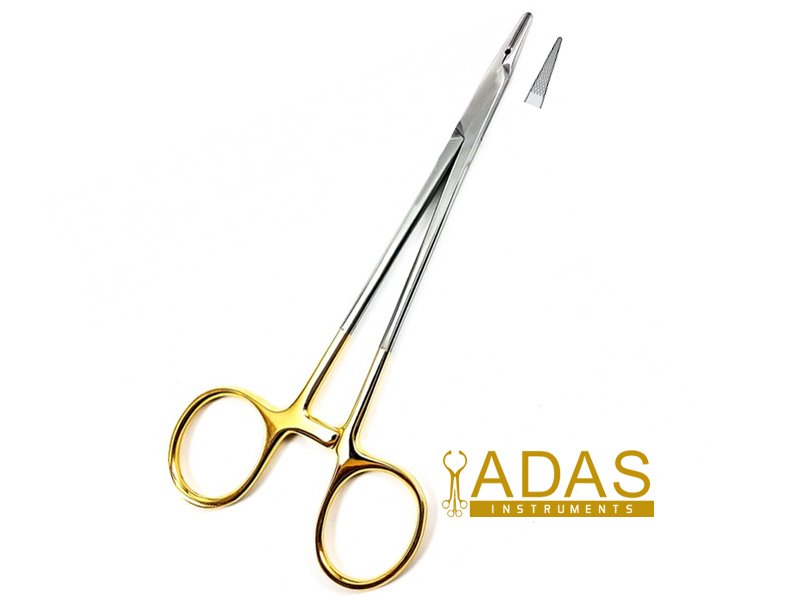
Left Hand Crile Wood Needle Holder, Left Handed Needle Driver
Price range: $ 35.00 through $ 38.00
The left hand Crile Wood needle holder, also called a left handed needle driver, is a surgical instrument for plastic, breast, facelift and rhinoplasty closure done by a left handed surgeon. Its ratchet teeth run the opposite way to the standard pattern, so the lock engages and releases on the natural closing squeeze of the left hand instead of fighting it.
Key Features
- Ratchet teeth reversed for the left hand; the box lock itself stays symmetric
- Two lengths: 15 cm (6 in) and 18 cm (7 in)
- Tungsten carbide inserts brazed into the jaws, marked by the gold plated rings
- Cross serrated jaw faces with a central groove, sized for 4-0 to 6-0 thread
- High quality medical grade stainless steel body with a satin finish
- Autoclavable, and the carbide jaws can be replaced instead of the whole instrument
- Backorder dispatch in 10 to 12 working days
- Item code AF-12.136

What the left hand Crile Wood needle holder is
A left hand Crile Wood needle holder is the Crile Wood pattern built the other way round. The jaw, the length and the serration are the same as the standard instrument. What changes is the ratchet: the teeth are cut in the opposite direction, so a left handed surgeon locks and unlocks the jaws with the same inward squeeze a right handed surgeon uses. The box lock is not reversed and does not need to be; it is symmetric already.
Surgeons also call it a left handed needle driver, a left handed needle holder, or simply a lefty needle driver. Adas Instruments makes it in two lengths with tungsten carbide jaw inserts.
The reason a left hand Crile Wood needle holder exists is small and practical. On a standard holder a left handed operator has to supinate the wrist to release the catch, which moves the needle tip at the exact moment it should stay still. Reversing the ratchet removes that movement, and it is the only change made to the instrument.
Key design features of the left hand Crile Wood needle holder
Four things define this instrument, and each one is a fact about the metal rather than a claim about the surgeon.
- Reversed ratchet. Two to three catch positions, engaged by the left hand. Peer reviewed work on left handed cardiac instruments describes exactly this change: reversed ratchet teeth, unchanged box lock.
- Cross serrated jaws with a central groove. The groove seats the needle so it does not rotate under load; the serrations do the gripping.
- Tungsten carbide inserts. Brazed in, not coated. The gold plated rings are the trade marker that carbide is fitted.
- Ring handles. Finger rings rather than a spring handle, because this pattern is used where the hand needs a positive lock and not a rolling grip.
Left hand Crile Wood needle holder sizes and build options
Two lengths are made, and both carry the same jaw. The size chart matches the options on this page exactly; nothing is listed that cannot be ordered.
| Length | Imperial | Where it suits | Item code |
|---|---|---|---|
| 15 cm | 6 in | Eyelid, nasal and hand work where the field is shallow | AF-12.136 |
| 18 cm | 7 in | Breast, facelift and abdominal closure at a working depth | AF-12.136 |
Both lengths use item code AF-12.136, with the length chosen at order. A left hand Crile Wood needle holder at 15 cm suits a shallow field; at 18 cm the same jaw reaches a deeper one without changing the grip. There is no third length in this pattern, so a chart row you see elsewhere with a 20 cm left handed Crile Wood is not something Adas ships.
Uses by specialty
The left handed build does not change what the instrument is for. It changes who can use it without adapting. These are the fields where Adas ships it most, and the procedure words are what surgeons actually search.
| Specialty | Procedure words | Why the left handed build matters |
|---|---|---|
| Plastic surgery | flap inset, scar revision | the lock releases without rolling the wrist back |
| Breast surgery | reduction, mastopexy closure | long runs of suture with no re-grip of the handle |
| Facelift and neck lift | SMAS suspension, skin closure | the thumb ring sits where the left thumb already is |
| Rhinoplasty | columellar and alar closure | fine thread held at the tip with the hand relaxed |
| General surgery | routine skin and fascia closure | a left handed assistant is not forced to swap hands |
| Veterinary surgery | soft tissue closure | same grip advantage on smaller patients |
Suture sizes the left hand Crile Wood needle holder handles
The jaw is cut for the middle of the closure range, from fascia down to facial skin. The figures below are the range this pattern is built for.
| Suture size | Typical use | Jaw face that holds it |
|---|---|---|
| 4-0 | fascia and deep dermal layers | cross serrated with the central groove |
| 5-0 | skin closure on the trunk and limbs | cross serrated with the central groove |
| 6-0 | facial and eyelid skin | cross serrated, lightest grip on the needle |
For finer thread than 6-0, a spring handle microsurgical pattern is the better tool, and the comparison section says which one. Within its own range a left hand Crile Wood needle holder holds 4-0 without the needle rolling and still closes on 6-0 without flattening it.
How it compares with other Crile Wood patterns
Three of the four rows below are the same base instrument in different builds, which is the most common question buyers ask about this page.
| Pattern | Handle and lock | Jaw | Choose it when |
|---|---|---|---|
| Left hand Crile Wood | ring handle, ratchet reversed for the left hand | cross serrated with a groove | the surgeon closes with the left hand |
| Crile Wood, serrated tip | ring handle, standard ratchet | cross serrated with a groove | the surgeon closes with the right hand |
| Plain tip Crile Wood | ring handle, standard ratchet | smooth, no serrations | monofilament thread must not be scored |
| Derf | short ring handle, standard ratchet | fine cross serrated | a shorter instrument suits the dental or eyelid field |
Materials and finish
The body is high quality medical grade stainless steel with a satin finish, which cuts glare under an operating light. The steel itself is made to a German specification. The jaw inserts are tungsten carbide, brazed into a milled seat rather than sprayed on, and the gold plated finger rings are the trade signal that carbide is fitted rather than a decorative choice.
Carbide matters here for one measurable reason: the insert can be replaced when it wears, so the instrument body outlasts several jaw lives.
Left hand Crile Wood needle holder care and sterilization
Clean the instrument in the open position so the box lock and the ratchet teeth are reachable. Use a soft brush and a neutral pH enzymatic cleaner, rinse in deionized water, and dry before the jaws are closed.
Autoclave at 134 degrees Celsius for the cycle your center validates. Lubricate the joint after each cycle. Store unlocked. A ratchet stored under tension is the most common reason a lock starts to slip, and on a reversed ratchet a slipping catch is felt immediately because the hand is squeezing into it.
Ordering and wholesale
Adas Instruments makes this pattern to order for surgeons, clinics and distributors. Item code AF-12.136. Wholesale and bulk pricing is available, and private label marking on the shank can be arranged for distributor orders.
Backorder items dispatch in 10 to 12 working days. Every instrument carries a three year replacement against manufacturing defects.
Production is controlled under an ISO 13485 quality management system.
If the thread is heavier than 4-0, the left handed mayo hegar needle holder is the same reversed ratchet in a wider jaw and seven lengths.
Frequently asked questions
What is a left handed needle holder used for?
It is used for the same closures as a standard needle holder, by a surgeon who closes with the left hand. The ratchet teeth are reversed so the lock engages on the natural inward squeeze of the left hand. On this pattern the jaw is cross serrated with a central groove and takes 4-0 to 6-0 thread in 15 cm and 18 cm.
How is a left handed needle holder different from a right handed one?
Only the ratchet is different. The teeth are cut in the opposite direction so they catch when the left hand closes. The box lock is symmetric and is not reversed, and the jaw, the length and the serration pattern are identical to the standard instrument.
Can a right handed surgeon use this instrument?
They can hold it, but the lock will work against them. Releasing the catch needs a wrist movement in the opposite direction, which moves the needle tip at the wrong moment. A right handed surgeon should order the standard Crile Wood pattern instead.
Does Adas make a left handed Mayo Hegar as well?
Yes. The left handed Mayo Hegar needle holder is made in seven lengths from 14 cm to 27.5 cm and takes heavier thread, 1-0 to 4-0. The left hand Crile Wood is the finer of the two and stops at 15 cm and 18 cm.
Do you make a left handed Olsen Hegar or a left handed laparoscopic needle holder?
No. Adas makes the left handed Crile Wood and the left handed Mayo Hegar. The Olsen Hegar with integrated scissors and laparoscopic needle holders are made in the standard right handed build only.
Related products and categories
Surgeons who work with the left hand Crile Wood needle holder usually compare it against the crile wood needle holder, the plain tip crile wood needle holder and the derf needle holder. The whole family sits in plastic surgery needle holders, and this pattern is also listed under facelift and neck lift instruments.
| Weight | 0.05 kg |
|---|---|
| Select Size | 15cm / 6", 18cm / 7" |
Be the first to review “Left Hand Crile Wood Needle Holder, Left Handed Needle Driver”
Shipping & Delivery Policy
Processing Time: In-stock items are dispatched within 24-48 hours. For custom or out-of-stock items, production time is approximately 10-15 days.
Global Delivery Estimates
We partner with world-class couriers (DHL, FedEx) to ensure fast, tracked delivery.
- USA & Canada: 3-5 Business Days
- Europe & UK: 4-6 Business Days
- Rest of World: 5-7 Business Days
*We offer Air Cargo and Sea Freight options for bulk wholesale orders.
Customs & Duties
International buyers are responsible for any customs duties or taxes imposed by their country. Adas Instruments is not responsible for delays caused by customs clearance.
Lost Packages & Insurance
If your package is lost in transit, please contact us immediately. We offer full support and replacements for confirmed lost shipments. Note: You must report non-delivery within 3 weeks to be eligible for an insurance claim.
Related products



Reviews
There are no reviews yet.