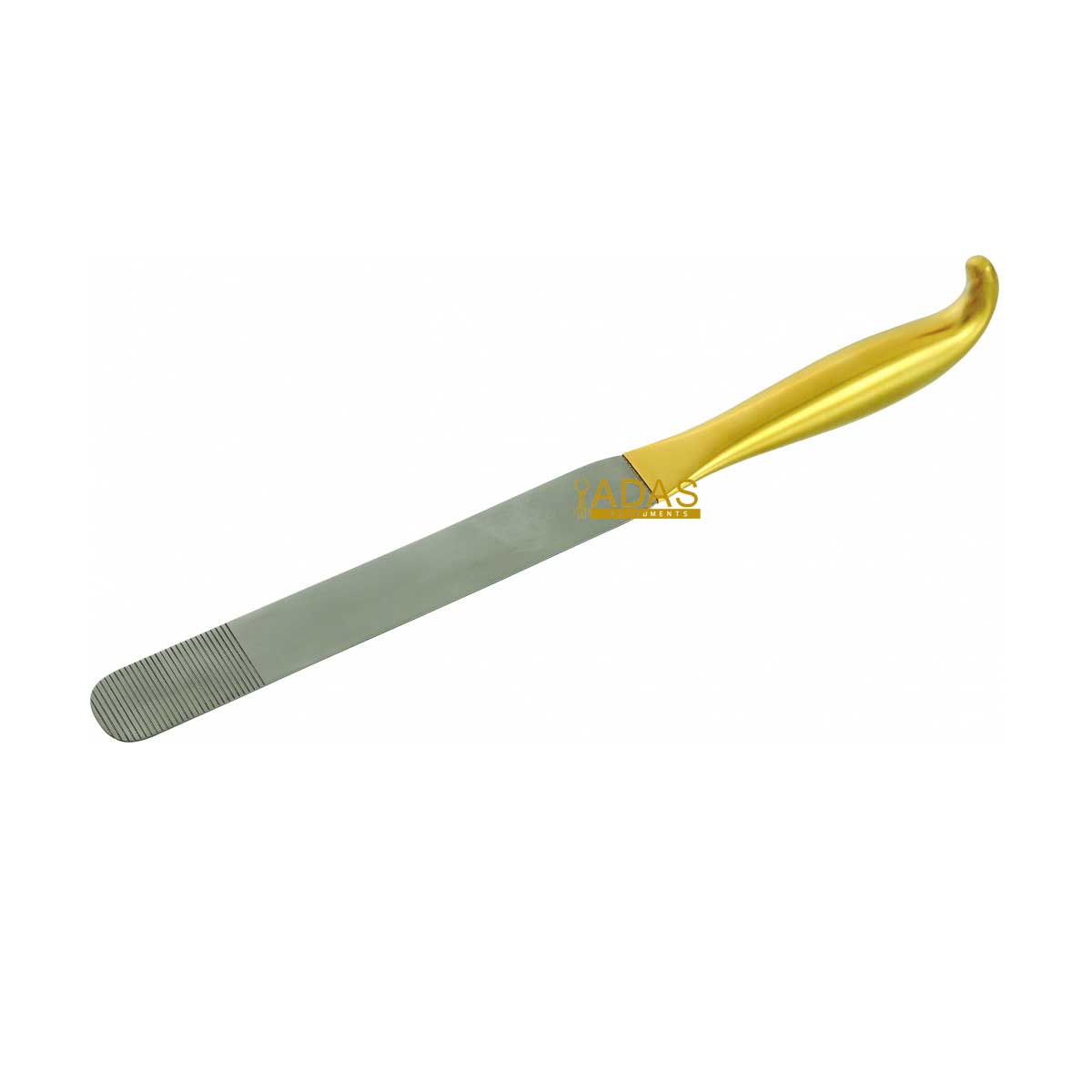
Spatula Retractor Semi Malleable | 25 and 38 mm Wide Blades
$ 39.00
The spatula retractor semi malleable is a flat, blunt blade that is bent by hand to the shape the anatomy needs and then holds that bend under load instead of springing back. It is the instrument for a corridor that is too tight for a fixed shape: the completely flat outline shields tissue without a point or a prong anywhere on it, which is why it goes in where a hooked or pronged retractor cannot. Two widths, 25 mm and 38 mm, in 18.5 cm and 19 cm lengths.
Key Features
- Semi malleable blade: bend it by hand and it holds the bend
- 25 mm wide on 18.5 cm, and 38 mm wide on 19 cm
- Completely flat, blunt outline with no prongs and no teeth
- One piece of steel, nothing plumbed in and nothing to flush
- Cut from high quality medical grade stainless steel and fully autoclavable
- Three year replacement warranty against manufacturing defects
- Item code AP-237.25
Available on backorder

What a spatula retractor semi malleable is
The spatula retractor semi malleable is the instrument that arrives without a shape. Most retractors are a decision somebody else already made. The blade has a shape, and the surgeon either finds a use for that shape or picks up a different instrument. A semi malleable spatula is the opposite: it arrives flat and the surgeon decides what shape it needs to be, once he can see the space it has to fit.
Semi malleable is the important half of the name. Google’s own description of this class explains it better than a specification does: a ductile blade can be custom bent intraoperatively to conform to a patient’s specific anatomy without springing back. Fully malleable steel bends too easily and will not hold a curve under load. Spring steel holds its own shape and refuses yours. Semi malleable sits between the two, which is a forming job rather than an alloy choice.
The second thing about it is what it has not got. No prongs, no teeth, no hook, no point. Google’s own words for what that buys are atraumatic shielding: a completely flat, smooth outline prevents localized trauma, puncture or tearing of fragile deep seated tissue. It is the instrument you put between a structure and whatever is about to happen next to it.
It is listed under several names and they describe the same blade: a semi malleable retractor, a broad spatula retractor, and in breast work a spatulated breast retractor. Our own two widths cover both of those last two, because the 38 mm blade is the broad one.
It also goes where other retractors do not fit. A thin flat profile enters corridors that rigid, hooked or pronged retractors cannot, and in breast and body work that usually means along a plane rather than into a pocket.
Key design features
Semi malleable, and why that is a making job
The amount of give is set in the forming, not in the alloy. Too soft and the blade will not hold the curve the surgeon put in it once tissue leans on it; too hard and it springs back while he is still bending it. Getting that balance right on two different blade widths is the only genuinely difficult thing about this instrument.
A completely flat outline
No prong, no tooth, no hook, no point, and no sharp edge anywhere around the perimeter. The blade works by shielding rather than by gripping, so every square millimeter of it is a surface and none of it is a point. That is what makes it safe against bowel, vessel, implant or a thin flap.
Two widths, two lengths
25 mm wide on an 18.5 cm blade, and 38 mm wide on a 19 cm blade. The narrow one is for a tight corridor; the wide one spreads the same load over half again as much surface, which is what you want when the tissue is thin and the retraction is going to be held for a while.
Nothing plumbed into it
One piece of steel. No light port, no suction channel, no coating, no joint. There is nothing to flush, nothing to dry, nothing to loosen and nothing to wear through, which is why this pattern outlives most of the tray it sits on.
Which blade to order
One decision, and it is width rather than length: the two lengths are within half a centimeter of each other.
| Blade | Width | Usually chosen for |
|---|---|---|
| 25 mm x 18.5 cm | Narrow | A tight corridor, work along a plane, a small frame |
| 38 mm x 19 cm | Wide | Thin tissue held for a long time, where load has to be spread |
| Both | A pair | A tray that works both breast and body cases |
| Either | Bent to shape | Both are flat when they arrive. The shape is the surgeon’s decision |
Where it is used
This is a shielding instrument, so it turns up wherever something fragile has to be kept out of the way of something sharp or hot.
| Procedure | What it shields | Note |
|---|---|---|
| Breast pocket dissection | The flap, or the implant already in place | Bent to the curve of the chest wall |
| Abdominoplasty and body contouring | Bowel and fascia under a long flap | The wide blade, bent to a shallow curve |
| Revision work around an implant | The implant itself, during capsule work | A flat blunt blade is the only safe thing against a shell |
| General soft tissue retraction | Whatever the shape is bent around | Its usefulness is that it has no fixed use |
What it holds back, and what it must not do
An instrument the surgeon reshapes himself needs one honest sentence about how far that goes.
| The task | What this retractor does | What it must not do |
|---|---|---|
| Taking a shape | Bends by hand and holds the bend under load | It is not bent back and forth repeatedly. Steel worked hard enough will eventually crack, and the crack starts where it was bent twice |
| Shielding tissue | A flat blunt surface with no point anywhere on it | It does not grip. If the tissue needs holding rather than shielding, use a toothed retractor |
| Reaching a narrow space | A thin profile enters corridors a pronged retractor cannot | It is not a dissector and it is not pushed through tissue |
| Working near cautery | Nothing. This is bare steel | It is not insulated and should not be the only barrier next to an active pencil |
How it compares with the rest of the family
Three flat bladed instruments on this site do related jobs and the difference between them is how much they give.
| Instrument | How the shape is decided | Grip |
|---|---|---|
| Spatula retractor semi malleable, this page | Bent by hand, holds the bend | None. A flat blunt surface |
| Ribbon retractor malleable | Bent by hand, fully malleable | None. A thinner, more ductile blade |
| Tebbetts breast retractor | Fixed angle, chosen by size | Teeth at the tip |
| C circular breast retractor | A fixed C arc around the breast | None. The arc does the work |
Materials and finish
Every semi malleable spatula retractor we make is cut from high quality medical grade stainless steel. The steel itself is made to a German specification. We do not publish a grade number. The number on a certificate tells a surgeon nothing about whether a blade still holds the bend it is given after two hundred autoclave cycles and a hundred reshapings, and the answer to that is in the making rather than in the alloy.
The thickness is held tight along the whole blade, because a semi malleable blade that is thinner at one point bends at that point and nowhere else. A blade that hinges instead of curving is the one failure mode this pattern has, and it comes from the rolling rather than from the steel.
The perimeter is finished with no sharp external edge anywhere around it, which on a flat blade means the two long sides as well as the tip. A flat retractor is dragged along tissue sideways more often than it is pushed, and a side edge with a burr on it does that damage quietly.
Caring for it
Straighten it before it goes through the washer, not after. A blade stored in a curve takes a set, and a blade with a set in it does not start flat for the next surgeon.
Wash it as one piece, warm water and a soft brush, nothing abrasive along the faces. Autoclave with the rest of the tray. Store it flat, and look at it occasionally for the start of a crease across the blade: that is the sign it has been bent in the same place too many times and it is the point to retire it.
Ordering and wholesale
The spatula retractor semi malleable is made by Adas Instruments in our own workshop and sold direct, which is why the price sits where it does against the catalog houses. Order one for a single tray, or in quantity for a hospital list or a distributor line. We do OEM work under your own brand and your own item numbers. Send us a sample and we will hold a run to your pattern rather than ours. Stock items ship from our own workshop. Backorder items take 10 to 12 working days to make. Every instrument carries a three year replacement warranty against manufacturing defects. Production is controlled under an ISO 13485 quality management system.
Frequently asked questions
What is a spatula retractor used for?
A spatula retractor semi malleable shields tissue and holds it back with a flat, blunt blade that has no prongs or teeth on it. It is used where something fragile has to be kept out of the way, and where the corridor is too tight for a fixed shape.
What does semi malleable mean?
That the blade can be bent by hand during the operation to fit the patient’s anatomy and will hold that bend under load instead of springing back. Fully malleable steel gives too easily; spring steel will not take the shape at all.
What sizes does the semi malleable spatula retractor come in?
Two: 25 mm wide on an 18.5 cm blade, and 38 mm wide on a 19 cm blade.
Is a spatula retractor the same as a malleable ribbon retractor?
They are close relatives and not the same instrument. A ribbon retractor is thinner and fully malleable, which makes it easier to shape and less willing to hold a shape. A semi malleable spatula is stiffer, so it keeps the curve once tissue leans on it.
How many times can it be bent?
We will not put a number on it, because any number would be invented. What we can say is what to look for: a crease forming across the blade means it has been bent in the same place too often, and that is the point to take it off the tray.
Related products and categories
For a fixed C arc around the breast instead of a shape you bend yourself, the C circular breast retractors, or the insulated C circular breast retractor for work beside a cautery pencil. For an instrument with a scope channel in the blade, the ADAS OmniView breast retractor.
The rest of this family sits under breast dissectors and spreaders, and every retractor and hook we make is under hooks and retractors.
| Weight | 0.15 kg |
|---|---|
| Blade Size | 25mm wide – 18.5cm long, 38mm wide – 19cm long |
Be the first to review “Spatula Retractor Semi Malleable | 25 and 38 mm Wide Blades”
Shipping & Delivery Policy
Processing Time: In-stock items are dispatched within 24-48 hours. For custom or out-of-stock items, production time is approximately 10-15 days.
Global Delivery Estimates
We partner with world-class couriers (DHL, FedEx) to ensure fast, tracked delivery.
- USA & Canada: 3-5 Business Days
- Europe & UK: 4-6 Business Days
- Rest of World: 5-7 Business Days
*We offer Air Cargo and Sea Freight options for bulk wholesale orders.
Customs & Duties
International buyers are responsible for any customs duties or taxes imposed by their country. Adas Instruments is not responsible for delays caused by customs clearance.
Lost Packages & Insurance
If your package is lost in transit, please contact us immediately. We offer full support and replacements for confirmed lost shipments. Note: You must report non-delivery within 3 weeks to be eligible for an insurance claim.
Related products

Reviews
There are no reviews yet.