
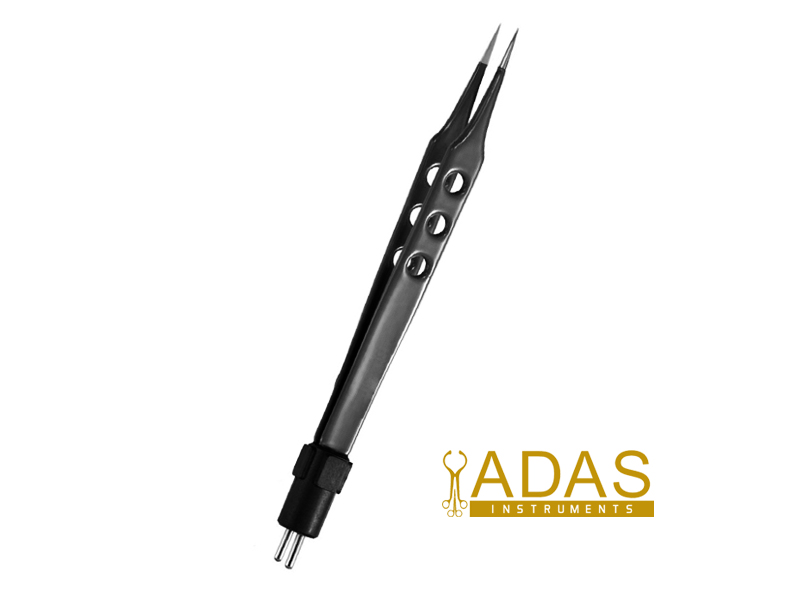


Jeweler Bipolar Forceps, 0.3, 0.5 or 1.0 mm Tip, Straight or Curved
Price range: $ 24.50 through $ 29.50
Jeweler bipolar forceps are electrosurgical instruments used to grip a small vessel and seal it with heat at the same moment, through tips fine enough to sit inside the eye or alongside a nerve. Because the current passes only between the two tips and completes its circuit there, the heat stays in the tissue held between them instead of spreading into what is next to it. That containment is why the pattern is standard in ophthalmology, neurosurgery, plastic and reconstructive surgery and microsurgery.
Key Features
- Tip thickness 0.3 mm, 0.5 mm or 1.0 mm
- Straight or curved tips
- Two lengths, 4-1/4 inch 108 mm and 4-3/4 inch 121 mm
- American style or European style connector
- Jeweler pattern handle, closed by finger pressure with no lock
- High quality medical grade stainless steel, passivated and boil tested
- Satin finish, no glare under an operating microscope
- Item code AC-301.13

What jeweler bipolar forceps are
Jeweler bipolar forceps are a fine tipped electrosurgical instrument that holds tissue and coagulates it in the same movement. The tips are ground to 0.3 mm, 0.5 mm or 1.0 mm, the handle is the jeweler pattern closed by finger pressure with no lock on it, and a cable runs from the shanks to a generator. They are made by Adas Instruments, reusable and fully autoclavable.
The name describes the handle, not the electrical part. A jeweler forceps is the fine pointed pattern a watchmaker uses, and putting a bipolar circuit through that shape is what produced this instrument. Catalogues also list it as bipolar jeweler forceps, and some as a bipolar electrocautery forceps, so orders arrive written several ways.
What separates these from any other bipolar forceps is only the tip size. A bipolar cautery forceps in a standard jaw seals a vessel you can see. This pattern seals one you need a microscope to find.
How the current actually runs
This is the part worth understanding before ordering, because it decides what the instrument can be used near.
Each tip is one pole. The current leaves one tip, crosses the tissue held between the jaws, and returns through the other tip. It has no reason to go anywhere else, so the heated zone is the width of that bite and roughly the depth of it.
A monopolar instrument works differently. The current enters at the tip, travels through the patient, and leaves at a return pad on the thigh. Everything along that route warms slightly. In a big field nobody notices. Two millimetres from an optic nerve it matters a great deal.
- Heat is contained. The tissue outside the jaws is not in the circuit.
- No return pad. Nothing to position, nothing to burn under.
- Lower power settings. A small circuit needs less energy to close a vessel.
- Works in fluid. Inside the eye, where a monopolar current would disperse.
Builds we ship
Three tip thicknesses, each straight or curved, in two lengths and two connector standards.
| TIP THICKNESS | TIP SHAPE | LENGTH | WHAT IT IS FOR |
|---|---|---|---|
| 0.3 mm | Straight | 4-1/4 in 108 mm | Intraocular vessels and work alongside a nerve |
| 0.3 mm | Curved | 4-1/4 in 108 mm | The same, where the tip has to come in around a structure |
| 0.5 mm | Straight | 4-1/4 in 108 mm or 4-3/4 in 121 mm | General micro coagulation, the common choice |
| 0.5 mm | Curved | 4-1/4 in 108 mm or 4-3/4 in 121 mm | Micro coagulation in a deep or angled field |
| 1.0 mm | Straight | 4-3/4 in 121 mm | Tissue with body to it, where a finer tip is slow |
| 1.0 mm | Curved | 4-3/4 in 121 mm | The same, reaching under a flap edge |
Nothing is listed there that we do not hold. The tip thickness, the tip shape, the length and the connector are specified on the order rather than carried as separate item codes.
Where these are used
Buyers reach jeweler bipolar forceps from the eye and from the brain, the two places where heat spreading a millimetre too far costs something that does not grow back.
| SPECIALTY | WHAT THE FORCEPS IS DOING THERE |
|---|---|
| Ophthalmology | Sealing vessels inside the eye and on the lid, where a millimetre of spread is too much |
| Neurosurgery | Coagulating along a nerve or a cord, with the heated zone kept to the tip width |
| Plastic and reconstructive surgery | Bleeding points in a flap that has to stay perfused |
| Microsurgery | Vessel work under a microscope, held and sealed in one movement |
| Oculoplastic surgery | Lid and orbit work where the skin above must not blanch |
| ENT surgery | Small vessels in a narrow field reached with a curved tip |
| Hand surgery | Digital vessels, where the nerve runs beside what is being sealed |
The instrument has spread well past those two. Any field small enough to need a microscope has the same problem, which is a bleeding point beside something that has to survive, and the answer is the same instrument.
What you are sealing, and the tip to ask for
The tip is the only real decision on this page. Everything else follows the generator and the surgeon’s hand.
| WHAT IS BEING SEALED | TIP TO ASK FOR | WHY THAT TIP |
|---|---|---|
| Intraocular vessel | 0.3 mm straight | The target is barely visible and nothing beside it is expendable |
| Vessel beside a nerve | 0.3 mm curved | Comes in from the side so the tip never crosses the nerve |
| Flap bleeding point | 0.5 mm straight | Wide enough to seal first time, narrow enough to spare the flap |
| Conjunctival vessel | 0.5 mm curved | Reaches under the edge without lifting it |
| Lid margin vessel | 0.5 mm straight | Holds the margin flat while the current runs |
| Subcutaneous bleeder | 1.0 mm straight | More tissue in the jaw seals in one application |
| Digital vessel | 0.5 mm curved | A short field, entered around the bone rather than over it |
Ordering one pair? Take 0.5 mm straight. It is the pair that gets picked up most and it will do work in both directions. Ordering two? Make the second 0.3 mm curved, and between them an ophthalmic or microsurgical tray is covered.
How it compares with the neighbours
These are the instruments buyers weigh against each other before the order goes in.
| INSTRUMENT | HOW THE CURRENT RUNS | WHEN YOU REACH FOR IT |
|---|---|---|
| Jeweler bipolar forceps | Between two fine tips | Micro coagulation, the smallest targets we build for |
| Bipolar Adson forceps | Between two Adson tips | The same current in a wider jaw, for general closure |
| Bayonet bipolar forceps | Between two tips on an offset shaft | Deep fields where a straight shaft blocks the view |
| Micro jewelers forceps | No current at all | Holding only. The pattern this one is built on |
| Micro Adson forceps | No current at all | Fine tissue handling where nothing needs sealing |
Two things jeweler bipolar forceps will not do. They will not seal a large vessel, because the jaw cannot hold enough of it at once and trying will only char the tip. And they will not work as a tissue forceps between applications the way a plain jeweler pattern does, because the tips are kept clean for the circuit rather than shaped for grip.
If the field is deep and a straight shaft sits in the line of sight, the bayonet bipolar forceps is the pattern to order instead. That is also where our bipolar non stick forceps build sits, on the bayonet shaft rather than on this one.
Materials and finish
Every pair of jeweler bipolar forceps is made in high quality medical grade stainless steel. The steel itself is made to a German specification. Every pair is passivated and boil tested before packing, and the finish is satin rather than mirror so the tips stay readable under a microscope light.
On a bipolar instrument the tips decide the working life. They are ground and then meeting checked by hand, because tips that touch at the point but gape a fraction behind it will arc instead of coagulating, and that fault cannot be seen without looking along the closed jaws against a light.
Care and sterilization
Coagulated tissue has to come off the tips before it bakes on. Wipe the jeweler bipolar forceps during the case with a wet swab rather than scraping them, then rinse in cool water as soon as the case ends.
Clean with a neutral pH enzymatic detergent and an ultrasonic bath, rinse in deionized water, dry fully, then steam autoclave at 134 degrees Celsius. Do not use a wire brush on the tips at any point. Store them tip protected and check along the closed jaws against a bright light before each list, because a tip that has been dropped will never meet cleanly again and a pair that does not meet does not coagulate.
Ordering and wholesale
Jeweler bipolar forceps are supplied by Adas Instruments to hospitals, surgical distributors and OEM buyers, in single units and in bulk. The item code is AC-301.13 and it is printed in the build table above so a procurement search finds it. The cable is ordered separately and must match the connector standard: we list the matching bipolar cable for forceps alongside this pattern. Backorder items dispatch in 10 to 12 working days, and every instrument carries a three year replacement against manufacturing defects.
For wholesale and OEM orders, instruments ship unpackaged in bulk or individually poly bagged, and laser marking with a distributor code or a hospital asset number is available on the shank. Tell us the tip thickness, the tip shape, the length, the connector and the quantity, and the quotation comes back with the lead time for that run.
Production is controlled under an ISO 13485 quality management system.
Frequently asked questions
What are jeweler bipolar forceps used for?
Coagulating a bleeding point so small that a general instrument would cook the tissue around it. The current runs from one tip to the other and no further, which is what lets a surgeon stop a vessel inside the eye, along a nerve, or under a microscope in a flap, without heat travelling out into what has to survive.
How is a bipolar forceps different from a monopolar one?
Where the current goes. A monopolar instrument sends it through the patient to a pad on the thigh, so everything in that path warms up. A bipolar forceps completes the circuit between its own two tips, so the heated zone is the width of the tissue you are holding and nothing else. That is the whole reason this pattern exists.
0.3, 0.5 or 1.0 mm tip, which should I order?
0.3 mm for work inside the eye and along a nerve, where the vessel is barely visible. 0.5 mm for general micro coagulation, and it is the tip most surgeons keep on the tray. 1.0 mm when the tissue has body to it and a finer tip would take too long to seal it. Buying one pair, take 0.5 mm.
Which connector do I order, American or European?
Whichever your generator takes, and it is worth checking rather than assuming. A flat two pin American plug will not seat in a European socket and the reverse is also true. We build the same forceps with either, so tell us the generator on the order and the right one ships.
Do jeweler bipolar forceps come with a cable?
No, the cable is a separate item, and that is normal for bipolar instruments because the cable wears out long before the forceps do. Match the cable to the same connector standard as the forceps. We list the cables alongside this pattern so the pair can be ordered together.
Related products and categories
Buyers usually compare jeweler bipolar forceps against the bipolar adson forceps, which carries the same current in a wider Adson jaw, and the bayonet bipolar forceps for deep fields, which is also where our bipolar non stick forceps build sits. The cable is ordered with them: see the bipolar cable for forceps. The pattern sits in electrosurgery instruments, and it is also listed under dressing and tissue forceps.
| Weight | 0.07 kg |
|---|---|
| Select Thickness of Tip | 0.3mm, 0.5mm, 1.0mm |
| Tip options | Curved, Straight |
| Select Size | 4-1/4" 108mm, 4-3/4 121mm |
| Handle Type | American style connector, European style Connector |
Be the first to review “Jeweler Bipolar Forceps, 0.3, 0.5 or 1.0 mm Tip, Straight or Curved”
Shipping & Delivery Policy
Processing Time: In-stock items are dispatched within 24-48 hours. For custom or out-of-stock items, production time is approximately 10-15 days.
Global Delivery Estimates
We partner with world-class couriers (DHL, FedEx) to ensure fast, tracked delivery.
- USA & Canada: 3-5 Business Days
- Europe & UK: 4-6 Business Days
- Rest of World: 5-7 Business Days
*We offer Air Cargo and Sea Freight options for bulk wholesale orders.
Customs & Duties
International buyers are responsible for any customs duties or taxes imposed by their country. Adas Instruments is not responsible for delays caused by customs clearance.
Lost Packages & Insurance
If your package is lost in transit, please contact us immediately. We offer full support and replacements for confirmed lost shipments. Note: You must report non-delivery within 3 weeks to be eligible for an insurance claim.
Related products



Reviews
There are no reviews yet.