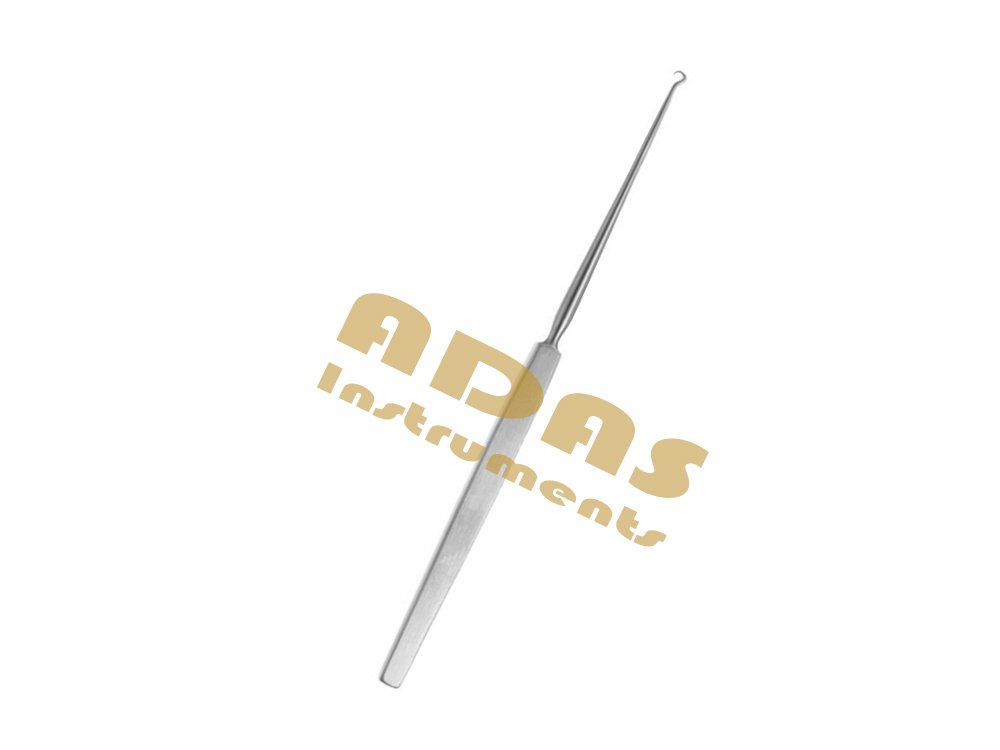
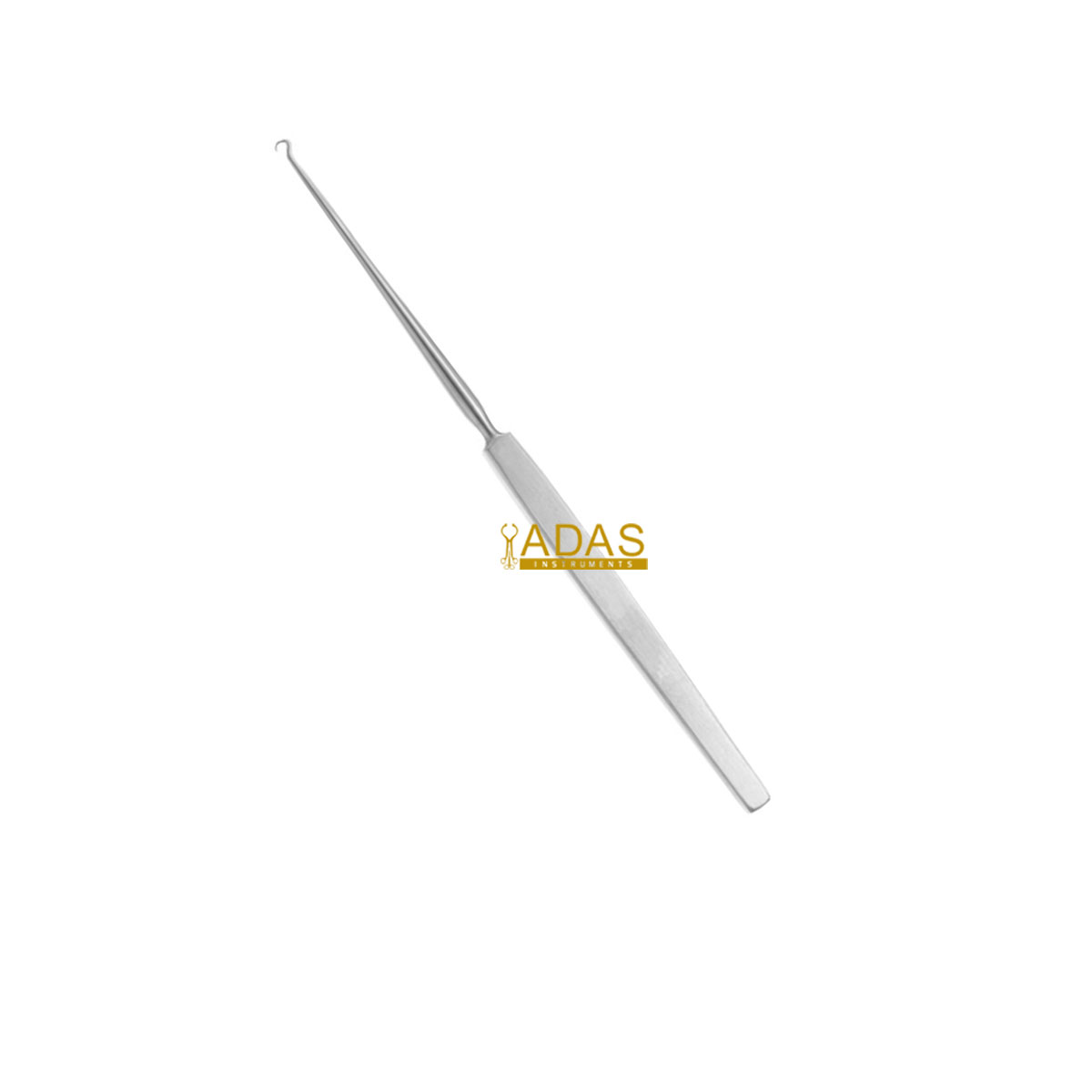
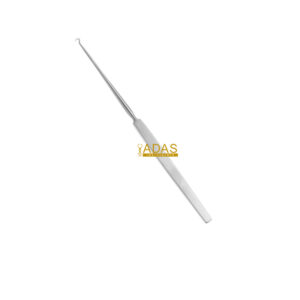
Gillies Skin Hook, Single Sharp Prong, 12 cm or 18 cm
$ 18.00
Gillies skin hooks are single pronged retractors used in plastic, reconstructive and dermatologic surgery to lift a skin edge or a flap clear of the field so the surgeon can see what is underneath. Named after Sir Harold Gillies, the prong is bent into a shepherd’s crook, which holds a full thickness margin on one small point instead of pinching it between two blades. That is why a hook is reached for on tissue that is going back into the wound, where the mark left by a forceps would still be there at closure.
Key Features
- One sharp prong on a shepherd’s crook curve, for full thickness skin margins and subcutaneous flaps
- Two lengths, 12 cm and 18 cm, so the same grip works at the surface and at the bottom of a longer tunnel
- Two prong sizes, 2.5 mm and 5 mm, for the depth of bite the tissue will take
- Round handle, which turns in the fingers when the angle of pull has to change mid dissection
- Used in plastic and reconstructive surgery, dermatology, facial trauma and hand surgery
- High quality medical grade stainless steel, autoclavable and made to be used again
- Three year replacement warranty against manufacturing defects

What the gillies skin hook is
The gillies skin hook is a single pronged retractor used to lift a skin edge or a flap clear of the operative field so the surgeon can see the plane underneath. The prong is bent into a shepherd crook, and that shape is the whole instrument: it takes a full thickness margin on one small point and holds it, rather than pinching it between two blades the way a forceps does.
It is named after Sir Harold Gillies, who worked on facial reconstruction and whose instruments were built around handling tissue that had to survive and be used again. That is still the reason a hook is picked up. On skin that is going back into the wound, a forceps leaves a crush mark that is still visible at closure, and a hook does not.
This is a retractor and nothing else. It does not grasp, it does not cut and it holds nothing on its own, so it stays in a hand or in an assistant hand for as long as the exposure is needed.
Key design features of the gillies skin hook
Four features, and each one is about lifting skin without damaging it.
- Single sharp prong. One point of purchase, which is all a skin edge needs and all the mark it leaves behind.
- Shepherd crook curve. The prong turns back on itself so the tissue sits in the bend rather than on the point, which is what lets a flap be carried on it.
- Two prong sizes. 2.5 mm for a shallow bite on thin skin and 5 mm where there is more thickness to hold.
- Round handle. It turns in the fingers, so the angle of pull can be changed mid dissection without letting go.
Gillies skin hook sizes and lengths
Two lengths and two prong sizes ship from this page, and buyers ask about both, so the chart sets them out together.
| Length | Imperial | Prong | Tip | Item code |
|---|---|---|---|---|
| 12 cm | 4 3/4 in | Single | 2.5 mm sharp | AP-14.25 |
| 12 cm | 4 3/4 in | Single | 5 mm sharp | AP-14.25 |
| 18 cm | 7 in | Single | 2.5 mm sharp | AP-14.25 |
| 18 cm | 7 in | Single | 5 mm sharp | AP-14.25 |
Imperial figures are given because most United States buyers order in inches. The 12 cm hook is the one for surface work, where a longer shank simply gets in the way. The 18 cm hook is for the bottom of a tunnel, a facelift plane or a neck dissection, where a short instrument means putting a hand into the field to reach the edge.
Gillies skin hook uses by specialty
The table below answers gillies skin hook uses directly, specialty by specialty, because that is how buyers ask it.
| Specialty | What the gillies skin hook is used for |
|---|---|
| Plastic and reconstructive surgery | Lifting a full thickness skin margin clear of the plane being raised, so the dissection can be seen rather than felt |
| Facial trauma surgery | Holding a torn edge in position while it is assessed and trimmed |
| Dermatologic surgery | Widening a margin during a biopsy or an excision without laying a forceps on skin that is being kept |
| Facelift and neck lift | Holding the flap edge at the mouth of a long tunnel, where the 18 cm length reaches and the 12 cm does not |
| Hand surgery | Retracting a skin edge on the dorsum, where the tissue is thin and the structures under it are close |
| Rhinoplasty and ENT | Holding the alar or columellar margin during an open approach |
| General soft tissue work | Isolating a small vessel or a nerve on one point, instead of crushing the tissue around it |
What the prong holds, and what it does not
A single sharp point is a limit as much as it is a feature, so this table says plainly where the instrument stops.
| Structure | How the prong takes it |
|---|---|
| Full thickness skin margins | The pattern this hook exists for. One point, one bite, and the edge stays where it is put |
| Subcutaneous tissue flaps | Lifted on the crook, which carries the weight of the flap without folding it |
| Dermis at a wound edge | Held for closure. A hook marks one point where a forceps marks a whole line |
| Delicate fascial edges | Held while the plane beneath is opened |
| Small vessels and nerves | Isolated on the prong for exposure only, never pulled on |
| Eyelid skin and tarsal plate | NOT this instrument. One sharp prong is too much bite. Use a double prong Guthrie |
| Bone, cartilage and tendon | NOT this instrument. A skin hook lifts skin, and a sharp prong on a firm structure simply skids |
How the gillies skin hook compares with other patterns
Three of the rows below are our own hooks and the rest are the instruments buyers weigh it against.
| Pattern | How it differs | When you reach for it instead |
|---|---|---|
| Joseph skin hook | Single or double prong with spreads from 2 mm to 12 mm, and a finer working profile | Nasal and columellar skin, and rhinoplasty generally |
| Guthrie skin hook | Two prongs, so the pull is spread across two points and the tissue cannot rotate | Eyelid margins and any skin thin enough to tear on one point |
| Kleinert Kutz skin hook | A finer tip on a narrow shaft, in 3 mm, 5 mm and 7 mm | Hand and finger work, where the opening will not take a wider instrument |
| Tissue forceps | Two blades that pinch the tissue between them along a line | Tissue that is being removed, where a crush mark does not matter |
| Self retaining retractor | Holds itself open on a frame and needs no hand | A wound that has to stay open for a long time with no assistant |
| Double prong skin hook | The same family, two points instead of one | A broader lift on a longer edge |
Gillies skin hook materials and finish
Made from high quality medical grade stainless steel, satin finished so the light in the operating room does not bounce off the shank into the eye. The steel itself is made to a German specification. The prong is hardened at the tip, because that is the part that blunts, and the handle is finished so it can be turned with a wet glove.
Care and sterilization of a skin hook instrument
Clean with a soft brush under running water, paying attention to the inside of the crook where tissue collects, then rinse in deionized water and dry fully before autoclaving. Store the hook so the prong is not resting against anything: the tip is the working part and a bent or blunted prong tears skin instead of lifting it. Check the point before the instrument goes back into the set, the same way a needle holder is checked at the jaw.
Ordering a surgical skin hook and wholesale
Adas Instruments makes this pattern to order in 12 cm and 18 cm with a 2.5 mm or 5 mm prong, and supplies hospitals, surgical centers and distributors across the United States, Latin America, Europe and Asia. Bulk and wholesale pricing is available for a surgical skin hook ordered by the set, and instruments held on backorder ship in 10 to 12 working days. Every instrument carries a three year replacement warranty against manufacturing defects. Certifications: CE. Production is controlled under an ISO 13485 quality management system.
Frequently asked questions
What are gillies skin hooks used for in surgery?
Lifting and holding a skin edge or a flap so the surgeon can see and work on the tissue underneath. They are used through plastic and reconstructive surgery, dermatology, facial trauma and hand surgery, and they are reached for whenever the skin being held is going back into the wound and must not be crushed.
How do Gillies skin hooks differ from Joseph skin hooks?
Scale and handle. The Gillies is the general purpose single prong hook, built around a round handle that turns in the fingers, and it comes in 12 cm and 18 cm. The Joseph is finer and is offered as a single prong or a double prong with spreads from 2 mm to 12 mm, which is why it is the standard hook for rhinoplasty and for nasal skin. On a facial flap either will work; on a columellar margin the Joseph is the one to pick up.
What is the instrument used for skin grafts?
Several, and a skin hook is one of them. The hook holds the edge of the graft or the donor margin steady while it is trimmed and laid, because it takes the tissue on a single point and does not crush the dermis the way a forceps would. It is used alongside a graft knife or a dermatome, scissors and fine forceps rather than in place of them.
What are surgical hooks used for?
Retraction, in one word. A surgical hook holds tissue out of the line of work, and the family covers skin hooks for skin and flaps, nerve hooks for lifting a nerve, and tenaculum patterns for heavier structures. What they share is that they hold on a point rather than between two blades.
Is a gillies skin hook retractor sharp or blunt?
The gillies skin hook retractor is made with a sharp prong, which is what lets it take a full thickness margin and keep it. Blunt prongs exist across the skin hook family and are chosen for sites too fragile to be pierced, and on this page the Guthrie is the pattern offered with a blunt end.
Related products and categories
Buyers who order the gillies skin hook usually order alongside it the guthrie skin hook, the joseph skin hook and the kleinert kutz skin hook. The whole family sits in hooks and retractors, and this pattern is also listed under rhinoplasty instruments.
| Weight | 0.09 kg |
|---|---|
| Select Size | 12 cm / 4-3/4", 18cm / 7" |
| Tip options | 2.5mm, 5mm |
Be the first to review “Gillies Skin Hook, Single Sharp Prong, 12 cm or 18 cm”
Shipping & Delivery Policy
Processing Time: In-stock items are dispatched within 24-48 hours. For custom or out-of-stock items, production time is approximately 10-15 days.
Global Delivery Estimates
We partner with world-class couriers (DHL, FedEx) to ensure fast, tracked delivery.
- USA & Canada: 3-5 Business Days
- Europe & UK: 4-6 Business Days
- Rest of World: 5-7 Business Days
*We offer Air Cargo and Sea Freight options for bulk wholesale orders.
Customs & Duties
International buyers are responsible for any customs duties or taxes imposed by their country. Adas Instruments is not responsible for delays caused by customs clearance.
Lost Packages & Insurance
If your package is lost in transit, please contact us immediately. We offer full support and replacements for confirmed lost shipments. Note: You must report non-delivery within 3 weeks to be eligible for an insurance claim.
Related products

Reviews
There are no reviews yet.