
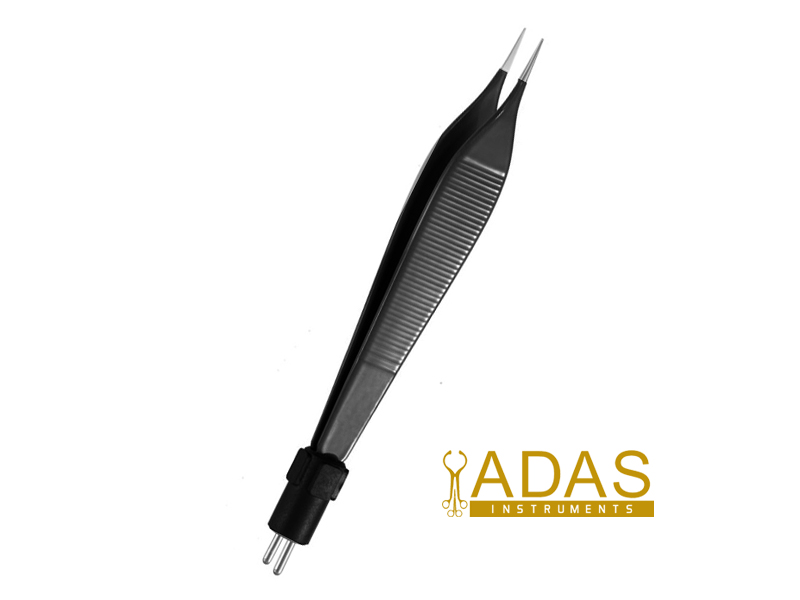
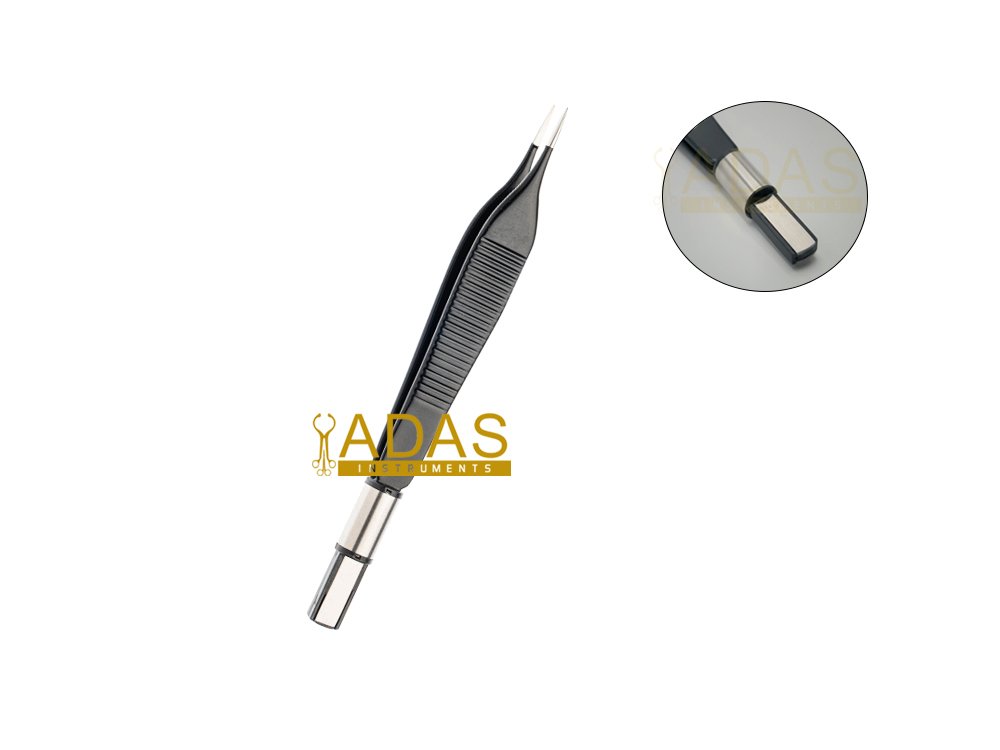
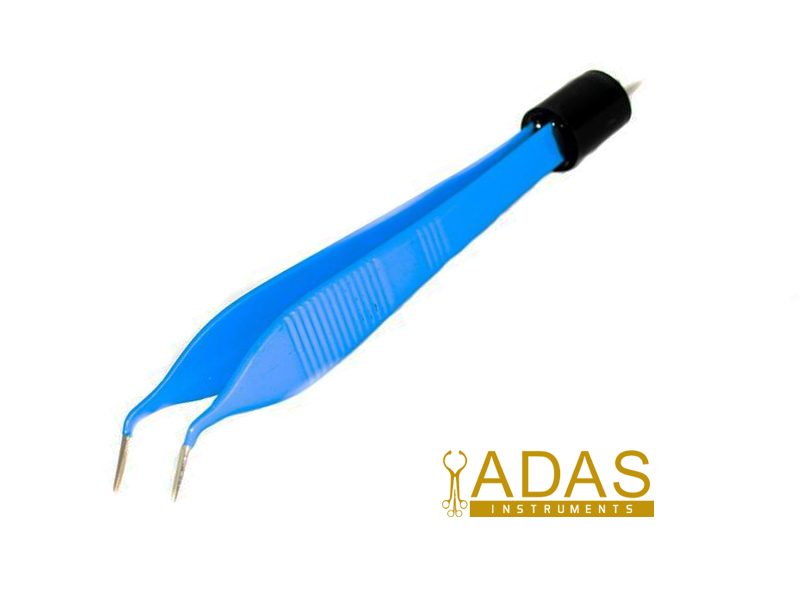
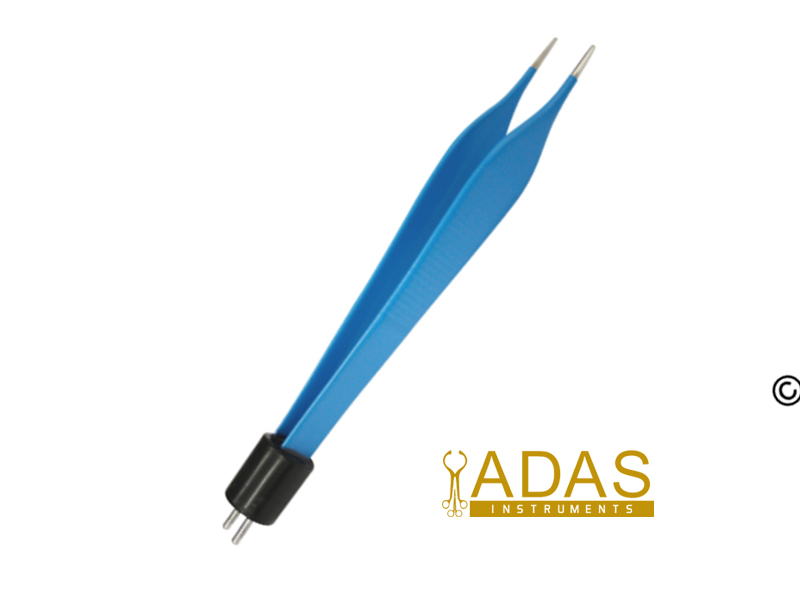
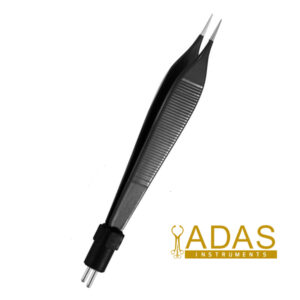
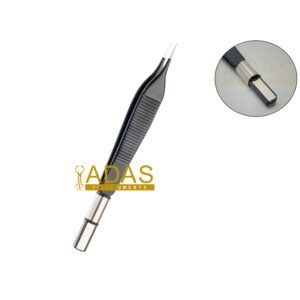
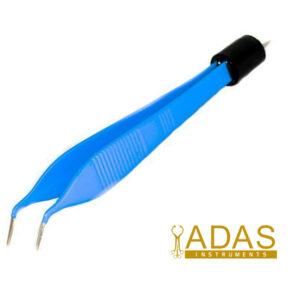
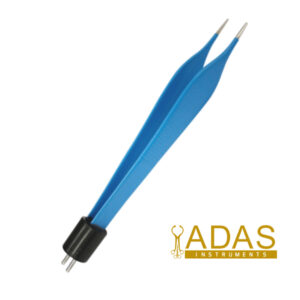
Adson Bipolar Forceps, Non Stick Tips, 12 cm and 15.5 cm
$ 26.50
Adson bipolar forceps carry the wide Adson thumb grip on a bipolar instrument, so the current
passes only between the two tips and the tissue on either side stays cool. Adas Instruments builds this one with
a non stick tip surface, which is the part that decides whether you stop to clean the tips every few seconds or
keep working.
- Tip widths 0.5 mm, 1.0 mm, 1.5 mm and 2.0 mm
- Straight or curved tips
- Two lengths, 12 cm (4 3/4 inch) and 15.5 cm (6 1/4 inch)
- American style or European style connector, so it fits the generator you already own
- Insulated shafts with only the tips left bare
- High quality medical grade stainless steel, fully autoclavable

What adson bipolar forceps are
An adson bipolar forceps is two instruments in one idea. The handle is the Adson pattern: wide and flat where
your thumb and forefinger sit, tapering to a fine working end. The electrical side is bipolar, which means the
current travels from one tip, through the small piece of tissue you are holding, and straight back into the other
tip. It never travels through the patient to a return pad. That is the whole point. You get coagulation in a
few square millimetres instead of a current path across the body.
As electrosurgical forceps go, this is the pattern most plastic surgery trays carry, and the non stick version is the one people come back for. Surgeons reach for it in plastic and reconstructive work, in neurosurgery and spine surgery, and
in ear, nose and throat cases. Anywhere a small bleeder sits next to something you cannot afford to cook.
Key design features
- Non stick tip surface. Eschar sticking to the tip is the reason bipolar forceps get put down
mid case. The non stick finish on this instrument is there to cut that down. - Insulated shafts. The coating runs down the arms and stops short of the tips. Only the
polished working faces conduct. - Four tip widths. 0.5 mm through 2.0 mm, so one pattern covers fine dissection and heavier
haemostasis. - Two connector standards. American style and European style pins. Get this wrong and the
instrument is a paperweight, so it is worth checking your cable before ordering. - Adson thumb grip. A broad flat grip gives more control at low pressure than a round handle.
That matters when you are holding a vessel and not crushing it.
Choosing the combination
Four decisions, and they are not equally important.
The tip width matters most. At 0.5 mm you are working on small vessels and nerve beds, where the coagulated
zone has to stay tight. At 2.0 mm you are sealing something with more body to it and you want the heat spread over
a wider face. If you are buying one pair and you work in plastics, buy the 1.0 mm. It is the width that handles
most of what comes up without being so fine that it bends.
Straight or curved is about sightline, not about function. A curved tip lets you approach from above and still
see past your own hand. Straight is easier to learn on.
Length is about depth. 12 cm for surface and facial work, 15.5 cm when you are reaching into a deeper field.
The connector is not a preference. It has to match the bipolar cable and generator already in your theatre.
Clinical applications
- Plastic and reconstructive surgery. Haemostasis in facial flaps, blepharoplasty, and
scar revision, where a wide burn mark shows on the skin afterwards. - Neurosurgery and spine. Coagulating epidural veins and small cortical vessels, where a
monopolar current path is not acceptable. - Ear, nose and throat. Septal and turbinate work in a narrow channel.
- Microvascular repair. The 0.5 mm tip, under the scope, for vessels you intend to keep.
Size chart
Every figure below comes from the options on this page. Nothing is estimated.
| Option | Choices available |
|---|---|
| Tip width | 0.5 mm, 1.0 mm, 1.5 mm, 2.0 mm |
| Tip shape | Straight or curved |
| Length | 12 cm (4 3/4 inch) or 15.5 cm (6 1/4 inch) |
| Connector | American style or European style |
Care and reprocessing
The non stick surface is the thing you are protecting. Wipe the tips with a damp gauze during the case rather
than scraping them. Never put a wire brush or an abrasive paste anywhere near the working faces, because once
that finish is scratched the tip will start grabbing tissue and the instrument is finished.
After the case, clean with a neutral pH enzymatic detergent, then ultrasonic clean. Rinse with deionised water
and dry fully, especially around the connector pins, since water left in a pin socket is how corrosion starts.
The instrument is fully autoclavable at 134 degrees Celsius. Check tip alignment against the light before you put
it back in the tray. Bipolar tips that no longer meet cleanly will arc instead of coagulating.
Technical information
| Specification | Detail |
|---|---|
| Instrument | Adson bipolar forceps, bipolar adson forceps |
| Also listed as | Non stick bipolar forceps, adson bipolar, electrosurgical forceps |
| SKU | AC-302.11 |
| Tip widths | 0.5 mm, 1.0 mm, 1.5 mm, 2.0 mm |
| Tip shape | Straight or curved |
| Lengths | 12 cm (4 3/4 inch), 15.5 cm (6 1/4 inch) |
| Connector | American style or European style pin |
| Tip finish | Non stick working faces |
| Insulation | Heat resistant coating along both shafts |
| Material | High quality medical grade stainless steel |
| Sterilization | Fully autoclavable at 134 degrees Celsius |
| Finish | Satin, non glare |
| Standards | Made under an ISO 13485 quality management system |
| Reuse | Reusable, supplied non sterile |
The instrument is CE marked.
Made by Adas Instruments
Adas Instruments makes this forceps in its own workshop rather than buying it in and putting a label on it.
The steel itself is made to a German specification. Every pair is passivated, boil tested and checked for tip
alignment by hand before it is packed, because on a bipolar instrument tip alignment is the difference between
a working tool and a spark.
Prices reflect that we sell direct. The same pattern from a US distributor commonly sits in the hundreds of
dollars. We would rather you bought three and kept a spare in the tray.
Questions we get asked
What does the non stick tip actually do?
It stops coagulated tissue from welding itself to the working face. Less sticking means fewer pauses to clean
the tips and less tearing when you open the forceps after a seal.
Why bipolar instead of monopolar?
Bipolar keeps the current between the two tips. Monopolar sends it through the patient to a return pad. Near a nerve,
a named vessel or an implant, that difference is the reason bipolar exists.
Which tip width should I order?
0.5 mm for microvascular and nerve work, 1.0 mm for general plastic surgery, 1.5 mm and 2.0 mm when you are
sealing something with more tissue in the jaw.
How do I know whether I need American or European connectors?
Look at the bipolar cable already plugged into your generator. American style uses a flat two pin spacing,
European style uses a different pin pitch. We supply both, so order to match what is in the room.
Is this the same as an Adson forceps?
Only the handle. A plain Adson forceps is a hand instrument with teeth or
serrations for holding tissue. This one carries current.
Related instruments
If you are fitting out a bipolar tray, the jeweler bipolar
forceps covers the finer end of the same job, down to a 0.3 mm tip. For hand instruments in the same pattern,
see the Adson forceps, the
Adson forceps with tungsten carbide, and the
micro Adson tissue forceps.
Browse the full dressing and tissue forceps range, or the
electrosurgery instruments category for bipolar cables and the rest of the energy tray.
Ordering: choose tip width, tip shape, length and connector above. Every combination is built to order and ships in 3 to 5 days.
| Weight | 0.07 kg |
|---|---|
| Select Thickness of Tip | 0.5mm, 1.0mm, 1.5mm, 2.0mm |
| Tip options | Curved, Straight |
| Select Size | 12 cm / 4-3/4", 15.5cm, 6 1/4" |
| Handle Type | American style connector, European style Connector |
Be the first to review “Adson Bipolar Forceps, Non Stick Tips, 12 cm and 15.5 cm”
Shipping & Delivery Policy
Processing Time: In-stock items are dispatched within 24-48 hours. For custom or out-of-stock items, production time is approximately 10-15 days.
Global Delivery Estimates
We partner with world-class couriers (DHL, FedEx) to ensure fast, tracked delivery.
- USA & Canada: 3-5 Business Days
- Europe & UK: 4-6 Business Days
- Rest of World: 5-7 Business Days
*We offer Air Cargo and Sea Freight options for bulk wholesale orders.
Customs & Duties
International buyers are responsible for any customs duties or taxes imposed by their country. Adas Instruments is not responsible for delays caused by customs clearance.
Lost Packages & Insurance
If your package is lost in transit, please contact us immediately. We offer full support and replacements for confirmed lost shipments. Note: You must report non-delivery within 3 weeks to be eligible for an insurance claim.
Related products

Reviews
There are no reviews yet.