
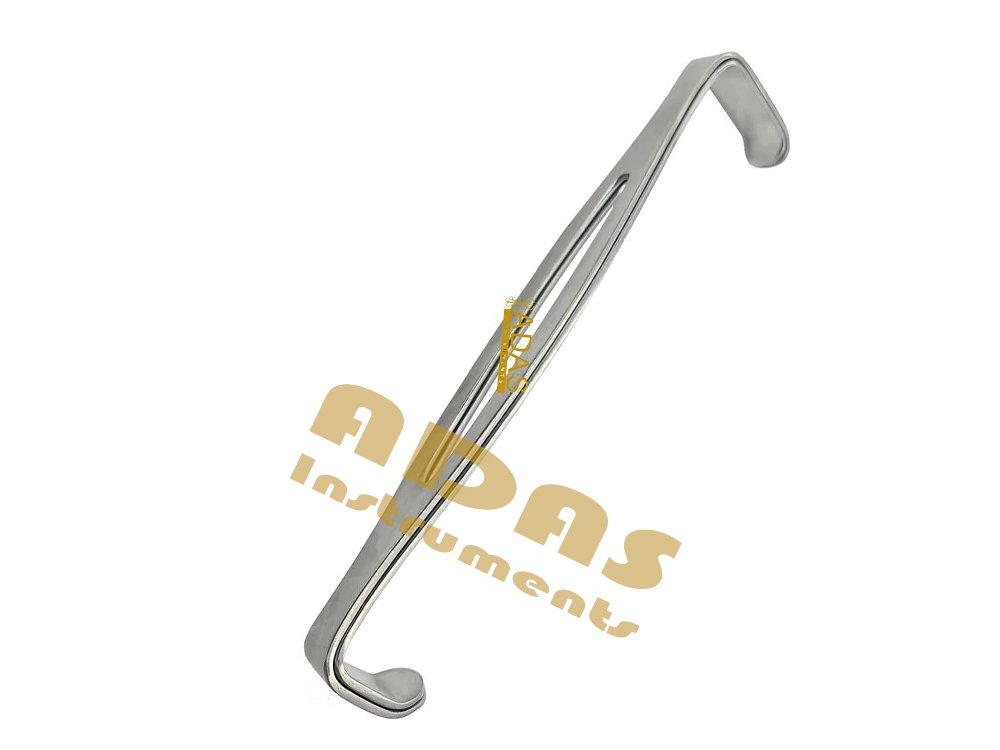
US Army Retractor, Army Navy Pattern, Double Ended, Set of 2
$ 25.00
US Army retractors, known just as often as Army Navy retractors, are double ended handheld retractors with a smooth right angled blade at each end, and the two blades are deliberately different depths. The shorter one is the Army side and it suits a shallow incision; the longer one is the Navy side and reaches a layer deeper, so one instrument covers two depths without anybody swapping it out. They are supplied as a set of two so an assistant can hold both wound edges at once, and they are used on skin, fat, fascia and superficial muscle in general, orthopedic, trauma, breast and gynecologic surgery.
Key Features
- Double ended, with a smooth right angled blade at each end
- Two blade depths on one instrument: the shallow Army side and the deeper Navy side
- Supplied as a set of two, so both wound edges can be held at once
- Fenestrated handle, which cuts weight and stops the hand slipping
- Blunt rounded blade edges, for skin, fat, fascia and superficial muscle
- High quality medical grade stainless steel, autoclavable and made to be used again
- Three year replacement warranty against manufacturing defects. Item code AP-58.01
Available on backorder

What the us army retractor is
The us army retractor is a double ended blade retractor with a smooth right angled blade at each end, and the two blades are not the same depth. That difference is the design.
It is known just as widely as the Army Navy retractor, and the two names are one instrument. It is on more general surgical trays than almost anything else in this category, which is why a buyer searching for it is usually replacing a set rather than discovering the pattern.
It is supplied as a set of two, and that is deliberate rather than commercial: an operation usually needs both wound edges held at once, by two hands, so a single retractor is half an instrument.
Why it is called the army navy retractor
Because the two ends have names. The shorter blade is the Army side and the longer blade is the Navy side, and a surgeon asking for one or the other is asking for a depth, not a brand. One end suits a shallow incision; turn it over and the other reaches a layer deeper. That is the entire reason the instrument is double ended, and it is why an army navy retractor covers two jobs without anybody putting it down.
Us army retractor sizes
This table is mostly other people, and it says so on every row, because this item carries no attribute table of its own.
| What | Figure | Where it comes from | Item code |
|---|---|---|---|
| Supplied as | A set of two retractors | Our own product record and SKU | AP-58.01 |
| Ends | Two, a shorter Army blade and a longer Navy blade | Family standard | |
| Handle | Flat and fenestrated | Family standard | |
| Overall length | Not carried | Others publish about 215 to 220 mm. Not repeated here as ours | |
| Blade width | Not carried | Others publish about 15 mm. Not repeated here as ours | |
| Blade depths | Not carried | Others publish about 23 and 26 mm, and 40 to 45 mm. Not repeated here as ours | |
| Product attributes | NONE on file | A gap in our own data |
That is a real gap in our own data rather than a style choice, and it is stated here rather than covered over with somebody else numbers. The blade width, the two depths and the overall length will be measured and confirmed before a bulk order ships.
Army navy retractor uses
More people search army navy retractor uses than search for any single specialty, which fits an instrument that turns up almost everywhere.
| Specialty | What the us army retractor is used for |
|---|---|
| General surgery | Holding a shallow to medium depth wound open. The home ground |
| Orthopedic surgery | Skin, fat and fascia held clear while bone is approached |
| Trauma surgery | Fast exposure of a wound of unknown depth |
| Breast surgery | Broad soft tissue held on a smooth face |
| Gynecologic surgery | Abdominal wall layers at moderate depth |
| Vascular surgery | Superficial exposure where nothing may be pierced |
| Plastic and reconstructive surgery | Bulk fat and muscle rather than a flap edge |
What the blades hold, and what they do not
A smooth blade holds a broad front of soft tissue and is the wrong answer for anything that needs to be gripped.
| Structure | How the blade takes it |
|---|---|
| Skin | Held on a smooth blunt face |
| Subcutaneous fat | What the deeper Navy blade is for |
| Fascia | Held flat, across a broad front |
| Superficial muscle | Held rather than engaged |
| A thick abdominal wall | The Navy end, at moderate depth |
| A flap edge that must be gripped | NOT this one. A blade cannot grip. Use a rake |
| Deep viscera | NOT this one. Use a Deaver or a malleable ribbon |
How this double ended retractor compares with the rest of the family
Five of the six rows are instruments we make. For a double ended retractor the first row is the comparison that actually comes up, because it is the same instrument with a coating.
| Pattern | How it differs | When you reach for it instead |
|---|---|---|
| Insulated US Army retractor | Identical geometry, with a non conductive coating | Any case where cautery works near the blade |
| Farabeuf double end retractor | Smaller, 12 or 15 cm, blades curve forward to a lip | A smaller incision, or a shorter reach |
| Mini Langenbeck retractor | A single narrow blade, 10 to 22 mm | A confined channel rather than a broad wound |
| Senn Miller retractor | Far smaller, and a rake at one end | A small field, or tissue that has to be gripped |
| Deaver retractor | A deep curved blade for viscera | Inside the abdomen rather than in its wall |
| Balfour self retaining retractor | Holds itself open on a frame | A long case where nobody should have to hold anything |
Materials and finish
Made from high quality medical grade stainless steel, satin finished, which on a broad flat blade is not cosmetic: a polished face at the bottom of a wound throws the operating light straight back at whoever is looking into it. The steel itself is made to a German specification. The blade edges are rolled and the handle is fenestrated, which takes weight out of an instrument an assistant may hold for an hour and stops a wet glove sliding on it.
Care and sterilization
Clean with a soft brush under running water, working along the inside of both right angles and through the handle fenestrations, where tissue and fluid collect and are easy to miss. Rinse in deionized water and dry fully before autoclaving. Store flat. Check both blades sit square to the handle: a blade levered hard can open out by a few degrees, and on a set of two a pair that no longer match is worse than either one alone.
Ordering and wholesale
Adas Instruments makes the army navy retractor set of 2 to order and supplies hospitals, surgical centers and distributors across the United States, Latin America, Europe and Asia. Item code AP-58.01, supplied as a set of two. Bulk and wholesale pricing is available, and instruments held on backorder ship in 10 to 12 working days. Every instrument carries a three year replacement warranty against manufacturing defects. Certifications: CE. Production is controlled under an ISO 13485 quality management system.
Frequently asked questions
What is a us army retractor used for?
Holding skin, fat, fascia and superficial muscle back so a shallow to medium depth wound stays open and visible. It is a general instrument rather than a specialty one, which is why it appears in general, orthopedic, trauma, breast, gynecologic and vascular surgery, and why most trays carry a pair rather than one.
Is the us army retractor the same as an army navy retractor?
Yes, the same instrument under two names, and both are in common use. Some catalogs write US Army, some write Army Navy, and a few write Army Navy US Army on the same line. Whichever name you searched, this is the pattern with a short blade at one end and a longer blade at the other.
Which end is the Army side and which is the Navy?
The shorter blade is the Army side, for a shallow incision. The longer blade is the Navy side, for a layer deeper. It is worth knowing because it is how the instrument is asked for across a table, and because it means one instrument does two depths rather than one.
Why is the us army retractor sold as a set of two?
Because an open wound normally has two edges and both of them need holding, usually by two hands at once. A single retractor holds one side while the other closes over the field. Trays are built around the pair for that reason, and so is our item code.
What is the handle fenestrated for?
Weight and grip. The open slots take metal out of the middle of an instrument that may be held steady for a long time, and they give a wet glove something to key into. It is a small thing that matters a great deal by the end of a long case.
Related products and categories
Buyers who order the us army retractor usually order alongside it the insulated us army retractor, the farabeuf double end retractor and the mini langenbeck retractor. The whole family sits in hooks and retractors, and this pattern is also listed under abdominoplasty instruments.
| Weight | 0.15 kg |
|---|
Be the first to review “US Army Retractor, Army Navy Pattern, Double Ended, Set of 2”
Shipping & Delivery Policy
Processing Time: In-stock items are dispatched within 24-48 hours. For custom or out-of-stock items, production time is approximately 10-15 days.
Global Delivery Estimates
We partner with world-class couriers (DHL, FedEx) to ensure fast, tracked delivery.
- USA & Canada: 3-5 Business Days
- Europe & UK: 4-6 Business Days
- Rest of World: 5-7 Business Days
*We offer Air Cargo and Sea Freight options for bulk wholesale orders.
Customs & Duties
International buyers are responsible for any customs duties or taxes imposed by their country. Adas Instruments is not responsible for delays caused by customs clearance.
Lost Packages & Insurance
If your package is lost in transit, please contact us immediately. We offer full support and replacements for confirmed lost shipments. Note: You must report non-delivery within 3 weeks to be eligible for an insurance claim.
Related products


Reviews
There are no reviews yet.