
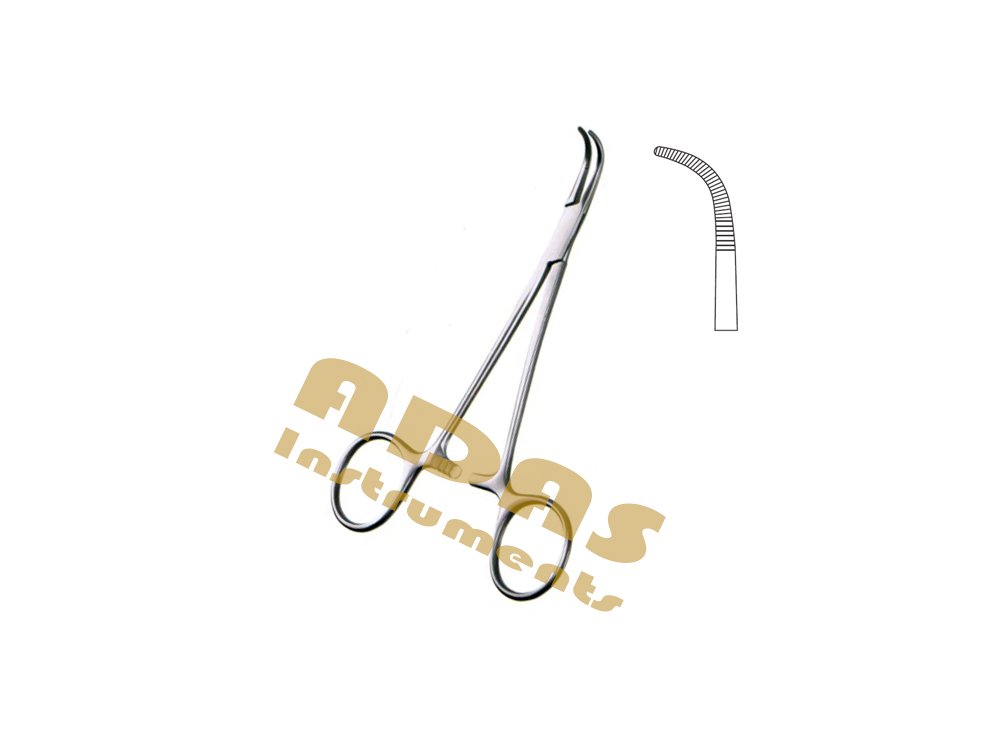
Baby Mixter Artery Forceps, Delicate Curved Tip, 14 cm and 19 cm Sizes
Price range: $ 14.00 through $ 18.00
Baby Mixter artery forceps (also known as baby Mixter hemostatic forceps) clamp small vessels and lift a ligature into place in fields a straight clamp cannot reach, because the tip turns through close to a right angle. That angle lets the jaw pass underneath a vessel or a duct and draw a tie through behind it without disturbing what sits around it. Adas Instruments supplies them in 14 cm and 19 cm for vascular, thoracic, hepatobiliary and pediatric work.
Key Features
- Tip turns through close to a right angle, to pass behind a vessel or a duct
- Draws a suture ligature through from below with little disturbance around it
- Lighter and finer in the jaw than a standard Mixter
- 14 cm and 19 cm lengths
- Ring handles with a ratchet lock
- High quality medical grade stainless steel, satin finish to cut glare
- Item code AE-74.14

What the baby Mixter artery forceps is
The baby Mixter artery forceps is a fine right angle clamp used to isolate a small vessel or a duct and pass a ligature behind it. Catalogues also list it as a baby Mixter hemostatic forceps, a delicate right angle forceps, a baby right angle forceps or a Mixter dissecting and ligature forceps, and United States buyers often search it as a right angle mixter clamp or simply a mixter clamp. The pattern is a lighter, shorter version of the standard Mixter, built for fields where the full size instrument would be too heavy in the jaw.
The defining feature is geometry rather than serration. The jaw turns through close to a right angle, so the tip can travel underneath a structure while the handles stay clear of the wound. That is what makes it a dissecting and ligature instrument as much as a hemostat.
Key design features of the baby Mixter artery forceps
Every element of this pattern exists to get a tie around something without disturbing it.
- Near right angle tip. The jaw turns sharply, so it passes behind a vessel or duct instead of across it.
- Delicate jaw. Finer and shorter than a standard Mixter, for small vessels and pediatric fields.
- Serrated inner face. Enough grip to hold a tie or a vessel without crushing.
- Box joint. The halves pass through each other, so the fine tips stay aligned.
- Ratchet lock. Set the jaw and let go while the other hand works the suture.
Baby Mixter artery forceps sizes and build options
Two lengths, both with the delicate curved right angle tip. The chart is the variation list, so what is shown is what ships.
| Length | Imperial | Tip | Item code |
|---|---|---|---|
| 14 cm | 5.5 in | Delicate curved, near right angle | AE-74.14 |
| 19 cm | 7 1/2 in | Delicate curved, near right angle | AE-74.19 |
The 14 cm is the one most surgeons reach for in a shallow field or in pediatric work. The 19 cm buys reach for thoracic and deep abdominal dissection, where the handles need to stay outside the wound while the tip works at depth. Imperial figures are given because most United States buyers order in inches.
Where baby Mixter artery forceps are used
What these uses share is a structure that has to be gone around rather than simply clamped. The specialty is in the first column and the procedure words are in the second.
| Specialty | What it is used for |
|---|---|
| Vascular surgery | Isolating a small vessel and passing a tie behind it |
| Thoracic surgery | Working around vessels and bronchial structures in a deep field |
| Hepatobiliary surgery | Dissecting around the bile duct and cystic structures |
| Urologic surgery | Passing a ligature behind a ureter |
| Pediatric surgery | Small vessel work where a standard Mixter jaw is too heavy |
| General surgery | Blunt dissection around a pedicle before ligation |
What the jaws hold
This is a clamp and a dissector, not a needle holder, so there is no suture gauge to quote. What matters is what the fine angled jaw can take safely.
| Structure | How the jaw takes it |
|---|---|
| Small arteries and veins | Fine jaw closes without crushing the wall |
| Bile ducts | The angle lets the tip pass behind the duct rather than across it |
| Ureters | Held from below, so the tie can be drawn through without traction |
| Vascular pedicles | Taken as a unit while a suture is passed |
| Connective tissue planes | Opened by blunt dissection with the closed tip |
How the baby Mixter artery forceps compares with other patterns
The instrument it is most often set against is its own full size parent, and after that the Lahey right angle.
| Pattern | How it differs | When you reach for it instead |
|---|---|---|
| Standard Mixter forceps | Longer, heavier jaw, same right angle | Deep fields where the baby pattern is too short or too fine |
| Lahey right angle forceps | Broader tip, stronger bite | Tougher tissue where a fine tip would flex |
| Crile artery forceps | Straight or gently curved, fully serrated | Straightforward hemostasis with no need to pass behind anything |
| Halsted mosquito forceps | Small straight or curved jaw, no right angle | Fine vessels sitting on the surface |
Baby Mixter artery forceps materials and finish
The baby Mixter artery forceps is made from high quality medical grade stainless steel, hardened so a fine jaw does not spring open under load. The finish is satin rather than mirror, which cuts glare under operating lights and matters more on an instrument you are watching at the tip. The steel itself is made to a German specification. The finished instrument carries the CE mark.
There is no carbide insert and no coating on this pattern. A fine right angle jaw works by geometry, and an insert would thicken the tip at exactly the point where thinness is the whole value. The grip comes from the serrations and from the hardness of the steel behind them.
Baby Mixter artery forceps care and sterilization
Rinse under cold water immediately after use, before blood dries in the angle of the jaw, which is the hardest part of this instrument to clean. Use a soft brush and work along the serrations rather than across them. Open the jaws fully for ultrasonic cleaning and autoclaving, because a closed box joint holds moisture. Dry completely, then store with the ratchet released so the spring is not held under tension.
Ordering baby Mixter artery forceps and wholesale
Adas Instruments supplies hospitals, clinics and distributors across the United States, from stock and to order. Wholesale quantities and set builds are quoted on request. Backorder items dispatch in 10 to 12 working days. Item code AE-74.14, and every instrument carries a three year replacement warranty against manufacturing defects. Production is controlled under an ISO 13485 quality management system.
Frequently asked questions
What are Mixter forceps used for?
They isolate a vessel or a duct and pass a ligature behind it. The right angle tip travels underneath the structure so a tie can be drawn through from below, and the same closed tip is used for blunt dissection along a tissue plane. In our range the baby pattern comes in 14 cm and 19 cm.
Is a Mixter a right angle?
Yes. The jaw turns through close to a right angle, which is why the pattern is catalogued as a right angle clamp as often as it is catalogued under the Mixter name. That angle is the reason it can pass behind a vessel while the ring handles stay clear of the wound.
What is a Mixter instrument used for in surgery?
Three jobs, usually in the same operation: clamping a small vessel to control bleeding, dissecting bluntly around a vessel or duct with the tip closed, and carrying a suture ligature behind a structure. Vascular, thoracic and hepatobiliary teams use it most.
What is the difference between a baby Mixter and a standard Mixter?
Size and weight. The baby pattern has a shorter, finer jaw and a lighter frame, so it works in small and pediatric fields where a standard Mixter is too heavy. The right angle geometry is the same on both, so the technique does not change.
What sizes do baby Mixter artery forceps come in?
We make 14 cm, which is 5.5 inches, and 19 cm, which is 7 and a half inches. Both carry the delicate curved right angle tip. Longer Mixter patterns exist in the wider trade, but these are the two we supply.
Related products and categories
Surgeons who work with the baby Mixter artery forceps usually compare it against the Leriche forceps, the Kocher delicate artery forceps and the Kocher clamp forceps. The whole family sits in hemostats and grasping forceps, and this pattern is also listed under breast surgery instruments.
| Weight | 0.06 kg |
|---|---|
| Select Size | 14 cm / 5.5", 19cm / 7 1/2" |
Be the first to review “Baby Mixter Artery Forceps, Delicate Curved Tip, 14 cm and 19 cm Sizes”
Shipping & Delivery Policy
Processing Time: In-stock items are dispatched within 24-48 hours. For custom or out-of-stock items, production time is approximately 10-15 days.
Global Delivery Estimates
We partner with world-class couriers (DHL, FedEx) to ensure fast, tracked delivery.
- USA & Canada: 3-5 Business Days
- Europe & UK: 4-6 Business Days
- Rest of World: 5-7 Business Days
*We offer Air Cargo and Sea Freight options for bulk wholesale orders.
Customs & Duties
International buyers are responsible for any customs duties or taxes imposed by their country. Adas Instruments is not responsible for delays caused by customs clearance.
Lost Packages & Insurance
If your package is lost in transit, please contact us immediately. We offer full support and replacements for confirmed lost shipments. Note: You must report non-delivery within 3 weeks to be eligible for an insurance claim.
Related products



Reviews
There are no reviews yet.