
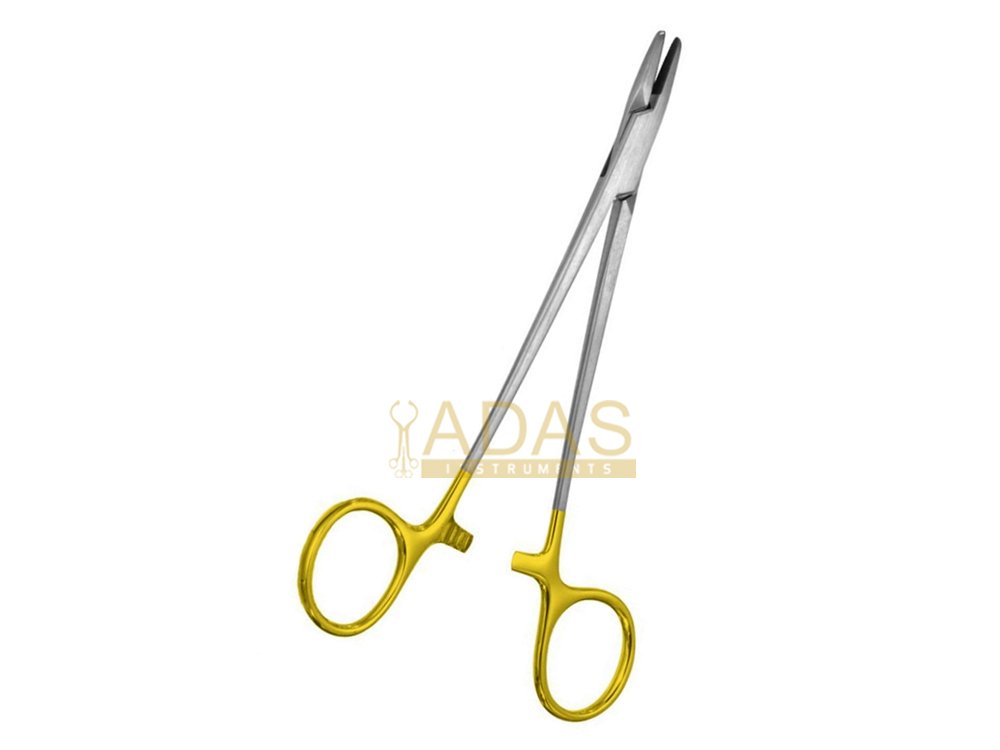
Mayo Hegar Needle Holder Tungsten Carbide
Price range: $ 15.00 through $ 27.00
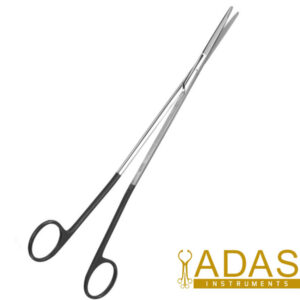
The Mayo Hegar needle holder is a ring handled needle driver with broad, cross serrated jaws that hold a curved needle steady while it is driven through medium and thick tissue. It is the general purpose needle driver for fascia, muscle and abdominal closure, in seven lengths.
Key Features
- Tungsten carbide inserts brazed into the jaw, replaceable rather than worn out with the instrument
- Gold plated finger rings, the trade marker that the jaw carries carbide
- Cross serration with a central longitudinal groove to seat the needle and stop it rolling
- Multi position ratchet lock in the shank, released with a sideways thumb pressure
- Seven lengths from 14 cm (5.5 inch) to 27.5 cm (11 inch) for shallow and deep fields
- Box joint shank, matte anti glare finish, full autoclave compatible
- High quality medical grade stainless steel body
- Made by Adas Instruments, SKU AF-10.34, left handed version available

What a Mayo Hegar needle holder is
The Mayo Hegar needle holder is a ring handled instrument that clamps a curved suturing needle in a broad, cross serrated jaw and drives it through tissue. It is the general purpose pattern on most trays. The jaws are shorter and wider than those of a fine tipped driver, the shank is heavier, and the ratchet sits close to the ring handles so the lock can be set and released without letting go. Charles Mayo and Hegar gave the pattern its name. Surgeons also call it a Mayo Hegar needle driver or Mayo Hegar suture forceps, and the names describe the same instrument.
How this pattern differs from the drivers next to it
The choice between needle holder patterns is really a choice about tissue weight. A Mayo Hegar is built for medium and thick tissue: fascia, muscle, deep soft tissue and abdominal closure. Its broad jaw spreads the clamping force across a heavier needle, and the wider shank gives the wrist more mechanical advantage.
An Olsen Hegar needle holder carries a scissor blade behind the jaw so the surgeon can cut the thread without reaching for a second instrument. It is the single operator choice. A Crile Wood needle holder has narrower, finer jaws for smaller suture and more delicate planes. A Webster needle holder goes finer again, with smooth jaws that will not fray very fine thread. A Castroviejo micro needle holder is a spring loaded micro instrument for ophthalmic and vascular work and sits in a different class altogether.
Clinical applications
Mayo Hegar needle holder uses fall into a small number of clear groups, from general surgery and OB/GYN to orthopedic, dental, veterinary and emergency work. The shorter lengths suit shallow, visible fields. The longer ones reach into a deep cavity while the hand stays outside it. Across all of them the working suture range is 1-0 to 4-0, heavier gauge thread on medium to thick tissue.
| Specialty | Typical use | Length usually chosen |
|---|---|---|
| General surgery | Abdominal wall and fascial closure, deep soft tissue repair | 20 cm to 27.5 cm |
| Obstetrics and gynecology, OB/GYN | Cesarean section closure, pelvic floor repair | 20 cm to 25 cm |
| Cardiovascular and thoracic | Thoracic closure and heavy wire handling | 23 cm to 27.5 cm |
| Orthopedic soft tissue | Capsule and tendon sheath closure | 18 cm to 23 cm |
| Dental and oral surgery | Flap closure inside the oral cavity | 14 cm to 15.5 cm |
| Veterinary surgery | Routine closure in small and large animal work | 14 cm to 20 cm |
| Emergency laceration repair | Wound closure at the bedside or in the field | 15.5 cm to 18 cm |
Size chart
Seven lengths are stocked. US buyers usually search in inches, so both units are given. Choose the length by how deep the field is, not by hand size.
| Length (cm) | Length (inch) | Where it fits |
|---|---|---|
| 14 cm | 5.5 inch | Oral cavity, dermatology, small animal and other shallow fields |
| 15.5 cm | 6 1/4 inch | Facial and superficial closure, emergency repair |
| 18 cm | 7 inch | General ward and operating room work, the most ordered length |
| 20 cm | 8 inch | Abdominal and gynecological closure |
| 23 cm | 9 inch | Deeper pelvic and thoracic fields |
| 25 cm | 10 inch | Deep cavity closure |
| 27.5 cm | 11 inch | The longest reach, for work at the base of a deep field |
A left handed Mayo Hegar is made in the same seven lengths and is listed as a separate instrument, because the ratchet and the box joint are built in mirror image rather than simply reversed in the hand.
Jaw, carbide and handle
The working face is cross serrated with a central longitudinal groove. The groove seats the body of the needle and stops it rolling under load, which is what keeps the needle on its arc through fascia. The serration supplies the friction.
Two jaw builds exist. A plain steel jaw is machined from the instrument itself and wears with it. A tungsten carbide needle holder has carbide plates brazed into the jaw faces, and carbide is harder than the needle, so the grip stays sharp for far longer. When the plates eventually polish smooth the jaws can be reinserted rather than the instrument replaced.
This is what the gold finger rings are for. Across the trade, gold plated rings are the agreed marker that the jaw carries brazed carbide. A gold handle needle holder on a tray is telling the scrub nurse what is inside the jaw before anyone picks it up. Gold rings mean carbide, plain steel rings mean steel. It is a code, not a decoration, and our plain steel models never carry it.
The body is high quality medical grade stainless steel with a matte anti glare finish, so operating room lighting does not bounce off the shank into the surgeon eye line. The steel itself is made to a German specification.
Technical specification
| Specification | Detail |
|---|---|
| SKU | AF-10.34 (left handed AF-10.34-1) |
| Pattern | Mayo Hegar, straight jaw, ring handle |
| Jaw face | Cross serrated with central longitudinal groove |
| Jaw insert | Tungsten carbide, brazed and replaceable |
| Finger rings | Gold plated on carbide models |
| Lock | Multi position ratchet in the shank |
| Joint | Box joint |
| Lengths | 14, 15.5, 18, 20, 23, 25 and 27.5 cm |
| Material | High quality medical grade stainless steel |
| Finish | Matte, anti glare |
| Reprocessing | Steam autoclave, 134 C, fully immersible |
| Handedness | Right handed standard, left handed listed separately |
Care and reprocessing
Rinse in cool water straight after use. Warm water sets blood and protein into the box joint, and that is where corrosion starts. Clean with a soft brush and a neutral pH enzymatic detergent, open the joint fully so the brush reaches the ratchet teeth, then rinse with deionized water.
Dry completely before storage and autoclave in the open position. A ratcheted instrument locked shut during a cycle carries stress in the shank and the lock can distort. Steam sterilize at 134 C for the cycle your unit validates. Store dry, on a rack or in a pouch, not loose in a drawer where the carbide faces can be chipped by other instruments.
Inspect the Mayo Hegar jaw before each use. Hold the instrument to the light, close it on the first ratchet click and look through the tips. Daylight between the carbide faces means the grip is gone and the inserts need replacing.
Made by Adas Instruments
Adas Instruments manufactures this pattern in house, which is why we can supply it in seven lengths, in both hands, and in plain steel or carbide without a minimum order. We sell to hospitals, surgical distributors, dental and veterinary practices and university teaching labs across the United States, Latin America and Europe.
For bulk and O.R. grade orders, hospital and clinic supply, or a wholesale quote on Mayo Hegar needle drivers in mixed lengths, contact us directly with the SKU and the quantities. Items shown as backorder are made to order, with a typical dispatch time of 10 to 12 working days.
Production is controlled under an ISO 13485 quality management system.
The same pattern is also made as a left handed mayo hegar needle holder, with the ratchet teeth reversed, in the same seven lengths.
Frequently asked questions
What is a Mayo Hegar needle holder used for?
It is the standard driver for closing medium and thick tissue. In general surgery that means fascia, muscle layers, abdominal wall closure and deep soft tissue repair, and it is equally common in obstetrics, dental and veterinary work. The broad cross serrated jaw of a Mayo Hegar takes a heavier curved needle without letting it rotate, and the ratchet holds the needle while the wrist turns. The working suture range is 1-0 to 4-0.
Which Mayo Hegar needle holder size should I order?
Match the length to the depth of the field. 14 cm and 15.5 cm for oral, dermatological and superficial work; 18 cm as a general operating room length; 20 cm and 23 cm for abdominal and pelvic closure; 25 cm and 27.5 cm where the hand must stay outside a deep cavity. Most buyers order 18 cm first and add a longer pair later.
Why do some Mayo Hegar needle holders have gold finger rings?
On a Mayo Hegar, as on every pattern in the family, gold plated rings are the trade signal for tungsten carbide jaw inserts. The plating is on the rings only, never the jaw, and it exists so the instrument can be identified across a tray at a glance. An instrument with plain steel rings has plain steel jaws.
Is there a left handed Mayo Hegar needle holder?
Yes, in all seven lengths. It is listed as its own instrument under SKU AF-10.34-1, because the box joint and the ratchet are built in mirror image rather than simply passed to the other hand. A left handed surgeon using a right handed ratchet has to break the lock across the palm.
Can a Mayo Hegar needle holder be autoclaved?
Yes. It is fully immersible and steam autoclavable at 134 C. Sterilize it open, never locked on the ratchet, and dry it fully before it goes back into storage.
Related products and categories
Surgeons who work with the Mayo Hegar needle holder usually compare it against the Crile Wood needle holder, the Olsen Hegar needle holder and the Heaney needle holder. The whole family sits in Plastic Surgery Needle Holders, and this pattern is also listed under Breast Surgery Instruments.
| Weight | 0.05 kg |
|---|---|
| Select Size | 14 cm / 5.5", 15.5cm, 6 1/4", 18cm / 7", 20cm / 8", 23 cm / 9", 25cm / 10", 27.5cm / 11" |
Be the first to review “Mayo Hegar Needle Holder Tungsten Carbide”
Shipping & Delivery Policy
Processing Time: In-stock items are dispatched within 24-48 hours. For custom or out-of-stock items, production time is approximately 10-15 days.
Global Delivery Estimates
We partner with world-class couriers (DHL, FedEx) to ensure fast, tracked delivery.
- USA & Canada: 3-5 Business Days
- Europe & UK: 4-6 Business Days
- Rest of World: 5-7 Business Days
*We offer Air Cargo and Sea Freight options for bulk wholesale orders.
Customs & Duties
International buyers are responsible for any customs duties or taxes imposed by their country. Adas Instruments is not responsible for delays caused by customs clearance.
Lost Packages & Insurance
If your package is lost in transit, please contact us immediately. We offer full support and replacements for confirmed lost shipments. Note: You must report non-delivery within 3 weeks to be eligible for an insurance claim.
Related products


Reviews
There are no reviews yet.