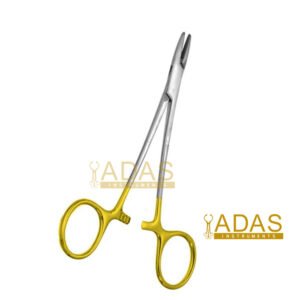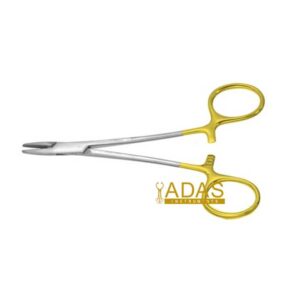
Ryder Needle Holder Tungsten Carbide, Fine 1 mm Tip Suture Driver
Price range: $ 24.50 through $ 32.50
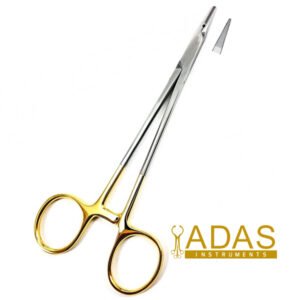
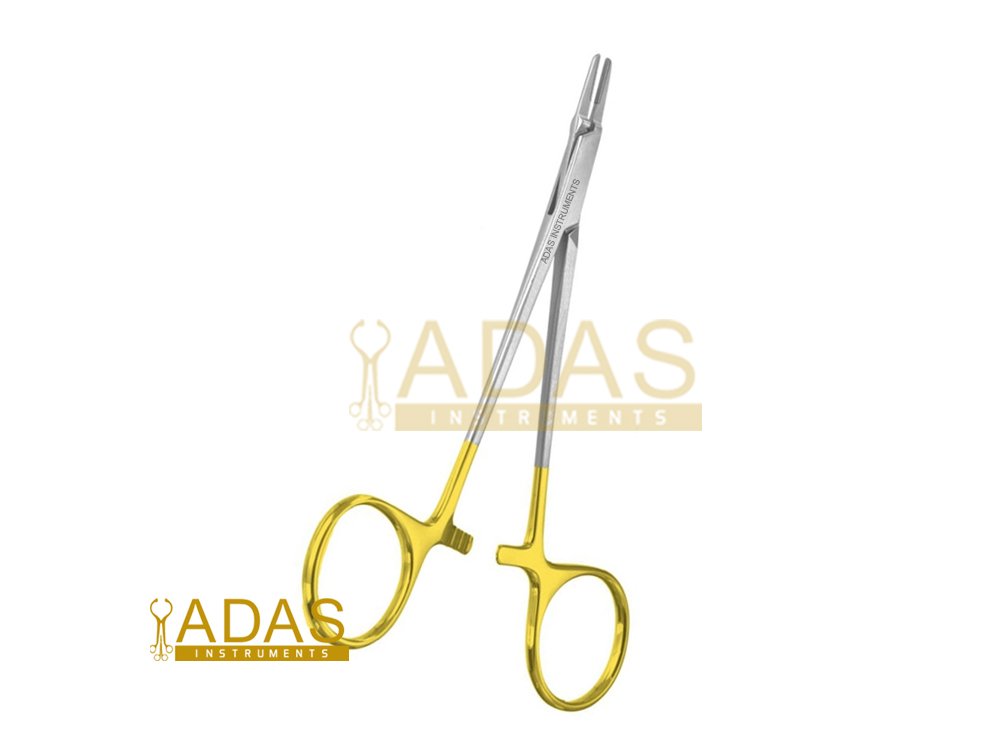
The Ryder needle holder is a ring handled needle driver built around an unusually narrow jaw, roughly 1 mm wide, so a small vascular needle cannot twist or flatten in the grip. Five lengths run from 12 cm to 20 cm, and the longer builds carry that fine jaw on a slim shaft that reaches into the chest or a deep cavity without the bulk of a general purpose needle driver blocking the view.
- Jaws: approximately 1 mm wide, cross serrated, tungsten carbide inserts
- Handle: finger ring with a multi position ratchet lock; rings in gold, blue titanium color coating or black titanium color coating
- Lengths: 12 cm, 14 cm, 16 cm, 18 cm and 20 cm, 4.75 to 8 inches
- Shaft: slim and elongated for deep, narrow access
- Sutures: 4-0 through 6-0, down to 7-0 monofilament
- Item code: AF-75.36

What a Ryder needle holder is
A Ryder needle holder is a fine tipped ring handled instrument for grasping and driving small suture needles through delicate or deep tissue. The pattern is defined by one number: the jaw is about 1 mm wide, roughly half the width of a general closure driver. Everything else about the instrument follows from that.
A narrow jaw does two things. It holds a small needle along its shaft rather than across it, so the needle cannot twist or flatten when the wrist turns, and it takes up almost no room at the tip, so the surgeon can see the vessel being sutured. Those are exactly the two problems in a cardiovascular anastomosis, which is why this pattern is a standard cardiothoracic tray instrument and why it is also listed as a Ryder needle holder intracardiac needle holder.
In American practice it is more often ordered as a Ryder needle driver. The two names refer to the same instrument.
Key design features of the Ryder needle holder
One millimeter jaws. The jaw faces are cross serrated and about 1 mm across. That is fine enough to hold a 6-0 or 7-0 vascular needle securely without crushing it, and narrow enough that the tip does not obscure the field.
Tungsten carbide inserts. Carbide is not optional on a jaw this small. A plain steel jaw of 1 mm smooths off quickly under the pressure needed to hold a needle, whereas carbide holds its bite for years and can be replaced when it finally wears. Colored finger rings mark the carbide build on a crowded tray: choose gold, blue titanium color coated or black titanium color coated rings.
Multi position ratchet. The Ryder needle holder ring handles carry a multi position catch, so jaw pressure can be set light for a 7-0 needle or firmer for a 4-0. Once locked, the hand can relax completely between passes, which matters across an anastomosis that may take thirty stitches.
Slim elongated shaft. The shanks are drawn thinner than on a general driver. In a 20 cm build working in the chest, that slimness is what keeps the line of sight open to the suture line.
Ryder needle holder sizes and build options
Five lengths of Ryder are made, and length is chosen purely by depth of field. The jaw stays the same 1 mm at every length, so a 20 cm instrument is not a coarser instrument.
| Length | Imperial | Typical field |
|---|---|---|
| 12 cm | 4.75 inches | Superficial vessel, eyelid, fine facial closure |
| 14 cm | 5.5 inches | Peripheral vascular, facial and nasal work |
| 16 cm | 6.25 inches | Breast, neck, moderate depth vascular |
| 18 cm | 7 inches | Deep vascular, thoracic access |
| 20 cm | 8 inches | Intracardiac and deep cavity work |
All five lengths carry cross serrated tungsten carbide jaws, a choice of gold, blue titanium or black titanium color coated finger rings, and the multi position ratchet. Item code AF-75.36.
Ryder needle holder uses by specialty
Cardiovascular and vascular surgery is the primary use of the Ryder needle holder. Vessel anastomosis, graft attachment and valve suturing all require a needle held along its shaft in a field where the tip must not block the view, and the 18 cm and 20 cm builds are the intracardiac standard.
Plastic and reconstructive surgery takes the 12 cm and 14 cm for fine facial closure, eyelid work and free flap anastomosis, where the narrow jaw gives control on 6-0 monofilament. Neurosurgery uses it to place tight sutures around fragile cranial and spinal structures in confined access. Microsurgery and microdissection is a fourth use, in spaces where a bulkier driver risks incidental trauma. Ophthalmic and pediatric teams use the shortest build on very fine work.
Below 7-0 and under a microscope, a pen grip instrument gives better feel: see the Castroviejo micro needle holder and the micro vascular needle holder. For general closure on heavier tissue, the Crile Wood needle holder is the pattern. All twenty sit together on the plastic surgery needle holders page.
Suture sizes the Ryder needle holder handles
| Suture size | Fit | Typical use |
|---|---|---|
| 3-0 | Too heavy | The jaw is too narrow to hold it well |
| 4-0 | Good | Graft attachment, thicker vessel |
| 5-0 | Ideal | Vascular anastomosis, general fine closure |
| 6-0 | Ideal | Coronary and peripheral vessel, facial closure |
| 7-0 | Good | Small vessel, delicate monofilament |
| 8-0 and finer | Not recommended | Move to a micro pattern with a spring handle |
Ryder needle holder sizes and how the pattern compares
Buyers usually arrive here deciding between a fine ring handled driver and a general one. The jaw width is the whole decision.
| Pattern | Jaw width | Length | Where it wins |
|---|---|---|---|
| Ryder | About 1 mm | 12 to 20 cm | Vascular needles, deep narrow access, clear view |
| Crile Wood | About 2 mm | 15 to 23 cm | General closure at depth, wider suture range |
| Mayo Hegar | Broad | 14 to 27.5 cm | Thick tissue, heavy suture, most force |
| Webster | Fine | 12.5 cm | Very fine facial work, shallow field only |
| Castroviejo micro | Micro | 12 to 18 cm | Microscope work below 8-0, pen grip rotation |
The short answer: a 1 mm jaw is what you want when the needle is small and the field is deep or must stay visible. Anywhere else, a 2 mm jaw is more forgiving. A Ryder needle holder is a specialist instrument and it rewards being used as one.
Ryder needle holder materials and finish
Every unit is made from high quality medical grade stainless steel, hardened, passivated and satin finished so it does not throw glare back under operating room lights. The steel itself is made to a German specification. Cross serrated tungsten carbide inserts are brazed into the jaw faces and are replaceable, and the finger rings come in gold, blue titanium color coating or black titanium color coating, so the carbide build is identifiable at a glance on a crowded tray.
Ryder needle holder care and sterilization
A 1 mm jaw is the most vulnerable part of any Ryder, and it is damaged by contact with other instruments far more often than by use. Rinse immediately after the case, before blood dries into the serrations or the ratchet. Clean with a soft brush and a neutral pH enzymatic detergent, then rinse in deionized water and dry fully. Steam autoclave at 134 degrees Celsius on your validated cycle with the ratchet released, and store in a rack or with a tip protector so the jaws never carry the weight of a heavier instrument. Check the tips under magnification every few cycles: jaws that no longer meet cleanly along their full length will let a vascular needle rotate, and that is the point to take the instrument off fine work.
Ordering and wholesale
Adas Instruments manufactures this Ryder needle holder and ships it worldwide. All five lengths can be ordered individually, and wholesale pricing applies to bulk orders for distributors, hospital purchasing groups and cardiothoracic units. Backorder items dispatch in 10 to 12 working days. Every instrument carries a three year replacement against manufacturing defects. If you are building a cardiovascular tray, tell us the procedure and we will quote the set.
Production is controlled under an ISO 13485 quality management system.
Where the suturing is orthodontic or dental and held in the palm, the Mathieu needle holder is the pattern to compare.
Frequently asked questions
What is a Ryder needle holder used for?
It is used to hold and drive small suture needles, mainly 5-0 and 6-0, in cardiovascular and vascular surgery. Vessel anastomosis, graft attachment and valve suturing are the core uses, along with fine plastic and reconstructive closure, neurosurgery in confined access, and microdissection. The 18 cm and 20 cm builds are the intracardiac standard.
Why does this pattern have 1 mm jaws?
Two reasons. A narrow jaw holds a small needle along its shaft so the needle cannot twist or flatten under load, and a narrow tip does not obscure the suture line the surgeon is watching. On a coronary anastomosis both of those decide whether the stitch is placed once or twice.
What are the Ryder needle holder sizes?
Five: 12 cm, 14 cm, 16 cm, 18 cm and 20 cm, which is 4.75 to 8 inches. The jaw is the same 1 mm width at every length, so the choice is purely about how deep the field is, not how fine the suture is.
How is it different from a Crile Wood needle holder?
Jaw width. A Crile Wood jaw is about 2 mm and handles a wider range of suture at depth; a Ryder needle holder jaw is about 1 mm and is built for small vascular needles with a clear view of the vessel. A Crile Wood is the general instrument, a Ryder is the specialist one.
Do I need the tungsten carbide build?
On a jaw this narrow, yes. Plain steel at 1 mm wears smooth quickly under the pressure required to hold a needle, and once it does the needle begins to rotate. Carbide inserts hold their bite for years and can be replaced when they finally wear, so the carbide build is the cheaper instrument over its working life.
When the chest approach is narrow, the inward bending shanks of the Senning needle holder keep the jaws in view where a straight shank crowds the field.
Related products and categories
Surgeons who work with the Ryder needle holder usually compare it against the Senning needle holder, the Castroviejo needle holder and the Mathieu needle holder. The whole family sits in Plastic Surgery Needle Holders, and this pattern is also listed under Rhinoplasty Instruments.
| Weight | 0.065 kg |
|---|---|
| Select Size | 12 cm / 4-3/4", 14 cm / 5.5", 16 cm/6¼”, 18cm / 7", 20cm / 8" |
Shipping & Delivery Policy
Processing Time: In-stock items are dispatched within 24-48 hours. For custom or out-of-stock items, production time is approximately 10-15 days.
Global Delivery Estimates
We partner with world-class couriers (DHL, FedEx) to ensure fast, tracked delivery.
- USA & Canada: 3-5 Business Days
- Europe & UK: 4-6 Business Days
- Rest of World: 5-7 Business Days
*We offer Air Cargo and Sea Freight options for bulk wholesale orders.
Customs & Duties
International buyers are responsible for any customs duties or taxes imposed by their country. Adas Instruments is not responsible for delays caused by customs clearance.
Lost Packages & Insurance
If your package is lost in transit, please contact us immediately. We offer full support and replacements for confirmed lost shipments. Note: You must report non-delivery within 3 weeks to be eligible for an insurance claim.
Related products