
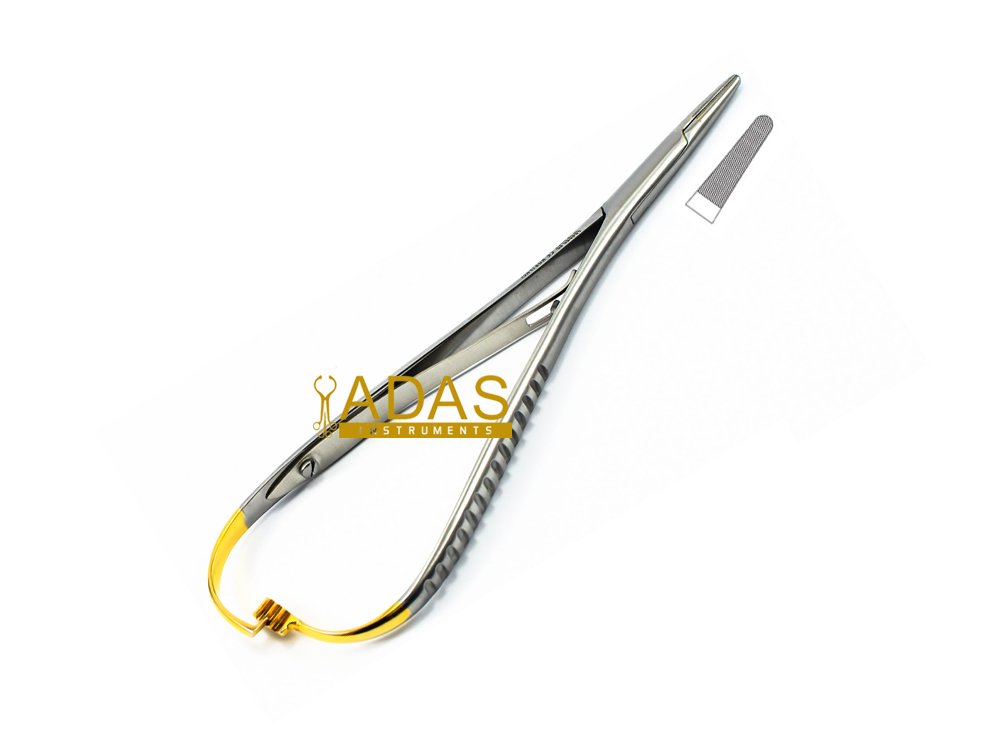
Mathieu Needle Holder Tungsten Carbide, Palm Held TC Suture Driver
Price range: $ 24.00 through $ 32.00
The Mathieu needle holder is a palm held needle driver with spring loaded handles and a multi stage ratchet at the base, worked by squeezing rather than by finger rings. One squeeze locks the jaws on the needle and the next squeeze releases them, which is why this pattern is the one chosen where the same movement has to be repeated many times over, in oral surgery, in orthodontic ligature work and on the veterinary table.
- Handle: palm held spring handles, squeeze to lock, squeeze again to release
- Ratchet: multi stage catch at the base of the handles
- Lengths: 14 cm, 17 cm and 20 cm, 5.5 to 8 inches
- Jaws: cross serrated with tungsten carbide inserts
- Sutures: 3-0, 4-0 and 5-0, plus ligature wire
- Item code: AF-76.14

What a Mathieu needle holder is
A Mathieu needle holder is a suturing instrument held in the palm rather than through finger rings. The two handles are sprung apart at rest and curve back toward the wrist, and a multi stage ratchet sits at the base where the handles meet. Closing the hand drives the jaws shut and engages the catch; closing the hand again past that point releases it. There is nothing to thread fingers into and nothing to unhook.
That single action is the reason the pattern exists. A ring handled driver has to be re-seated in the fingers between stitches, and over forty stitches that adds up to forty small interruptions. A Mathieu needle driver, as it is usually called in American practice, never leaves the palm. Grip, place, squeeze, release, move on.
The pattern is also sometimes spelled Mathew needle holder in catalogues and search boxes. It is the same instrument; Mathieu is the correct spelling.
Key design features of the Mathieu needle holder
Palm grip handles. The Mathieu needle holder handles are shaped to sit across the palm and are driven by the whole hand rather than by two fingers. That recruits stronger muscles, so repeated closure over a long list produces far less fatigue than a ring handle does.
Multi stage ratchet. The catch has several positions, so the jaws can be set lightly on a 5-0 needle or firmly on a 3-0 one. Because it locks and releases through the same squeezing motion, the hand never changes grip.
Tungsten carbide jaws. Cross serrated carbide inserts are brazed into the jaw faces. Carbide matters more on this pattern than most, because palm action delivers real force and a plain steel jaw will smooth off faster under it. Worn inserts can be replaced.
Jaw geometry. The jaws are short relative to the overall length and meet flat, with cross serrations running in both directions. That multi directional bite is what stops a needle rotating when the hand drives it, and it is also what lets the same instrument handle stainless ligature wire without the wire spinning out of the grip.
Mathieu needle holder sizes and build options
Three lengths of Mathieu are made. The shortest is the dental and orthodontic standard; the longest reaches into deeper tissue on larger cases.
| Length | Imperial | Typical use |
|---|---|---|
| 14 cm | 5.5 inches | Oral surgery, orthodontic ligatures, small animal work |
| 17 cm | 6.75 inches | General closure, periodontal flaps, breast and body |
| 20 cm | 8 inches | Deeper tissue, abdominal wall, larger veterinary cases |
All three lengths carry cross serrated tungsten carbide jaws and the multi stage ratchet. Item code AF-76.14.
Mathieu needle holder uses by specialty
Dental and oral surgery is the largest single use of the Mathieu needle holder. Flap closure after extraction, implant site suturing and periodontal graft fixation all involve many short stitches in a space where ring handles cannot open freely, and the palm action works comfortably inside the mouth.
Orthodontics is the second and fastest growing use. The Mathieu needle holder in orthodontics is used to place and seat elastomeric ligatures around bracket wings, and to tie steel ligatures. It is the instrument most orthodontic setups own for exactly this job, and demand for it has risen sharply over the past year. The serrated carbide jaw grips a small elastic module without tearing it, and the squeeze and release action suits a procedure that repeats twenty times per arch.
Veterinary surgery is a genuine third audience. Vets and veterinary technicians close a high volume of routine wounds, and a palm held driver with a self releasing ratchet is faster over a long list than a ring handle. The 14 cm suits small animals and the 20 cm larger patients.
Plastic, maxillofacial and body contouring teams use the 17 cm and 20 cm builds for abdominoplasty and breast closure, where the tissue is thick, the suture is 3-0 or 4-0 and the stitch count is high.
Where a ring handle is preferred for the same tissue, compare the Crile Wood needle holder and the Mayo Hegar needle holder. The full range is on the plastic surgery needle holders page.
Suture sizes the Mathieu needle holder handles
| Suture size | Fit | Typical use |
|---|---|---|
| 2-0 | Good on the 20 cm | Thick tissue, abdominal wall |
| 3-0 | Ideal | Oral flap, body closure, veterinary |
| 4-0 | Ideal | Periodontal, facial, general closure |
| 5-0 | Good | Fine oral and facial closure |
| 6-0 and finer | Not recommended | Move to a fine ring handled or micro pattern |
| Ligature wire | Ideal | Orthodontic steel ligatures, elastic modules |
How the Mathieu needle holder compares with other patterns
The comparison that matters is palm against ring, because that decides how the instrument feels over a long list rather than on a single stitch.
| Pattern | Handle | Length | Where it wins |
|---|---|---|---|
| Mathieu | Palm, squeeze release | 14 to 20 cm | High stitch counts, orthodontics, inside the mouth |
| Crile Wood | Finger ring | 15 to 23 cm | General closure at depth, finest control of force |
| Mayo Hegar | Finger ring | 14 to 27.5 cm | Broad jaws, thick tissue, heavier suture |
| Castroviejo with ratchet | Flat pen grip | 14 to 23 cm | Needle angle control in confined fields |
| Olsen Hegar | Finger ring with scissors | 12.5 to 19 cm | Cuts the suture without a second instrument |
Put simply: if you are placing many stitches or ligatures and your hand tires, the Mathieu is the answer. If you need the finest control over how hard the jaws close on a single critical stitch, a ring handle still gives more feel.
Mathieu needle holder materials and finish
Every unit is made from high quality medical grade stainless steel, hardened, passivated and satin finished to cut glare under operating room lights. The steel itself is made to a German specification. The cross serrated tungsten carbide inserts are brazed into the jaw faces and are replaceable, so a heavily used instrument can be serviced rather than scrapped.
Mathieu needle holder care and sterilization
The ratchet is the part that fails on a Mathieu needle holder, and it fails because it is not cleaned. Rinse immediately after the case and brush the catch at the base of the handles specifically, with a soft brush and a neutral pH enzymatic detergent. Rinse in deionized water, dry fully, then steam autoclave at 134 degrees Celsius on your validated cycle with the ratchet released. Store unlocked so the springs are not held compressed between cases. Test the action before every list: the catch should engage crisply at each stage and release on a single further squeeze. A catch that slips under load will drop a needle mid stitch.
Ordering and wholesale
Adas Instruments manufactures this Mathieu needle holder and ships it worldwide. All three lengths can be ordered individually, and wholesale pricing applies to bulk orders for distributors, dental and orthodontic practices, hospital purchasing and veterinary clinics. Backorder items dispatch in 10 to 12 working days. Every instrument carries a three year replacement against manufacturing defects. Orthodontic buyers ordering by the dozen should ask for a quote rather than use the listed price.
Production is controlled under an ISO 13485 quality management system.
Frequently asked questions
What is a Mathieu needle holder used for?
It is used to grip and drive suture needles, and to place ligatures, in procedures with a high stitch count. The main uses are dental and oral surgery, orthodontic ligature placement, veterinary wound closure, and body and breast closure on 3-0 and 4-0 suture. It is held in the palm and locked by squeezing rather than through finger rings.
What are the Mathieu needle holder uses in orthodontics?
Two jobs. Placing and seating elastomeric ligature modules over bracket wings, and tying steel ligature wire. The cross serrated carbide jaw grips a small elastic module without tearing it, and because locking and releasing are both done by squeezing, the instrument never leaves the palm across a full arch.
How do you unlock a Mathieu needle holder?
Squeeze again. The ratchet is multi stage: closing the hand steps the catch tighter through its positions, and closing past the last position releases it completely. There is no separate lever or lateral movement, which is what makes the action fast.
Is it also spelled Mathew needle holder?
You will see that spelling in catalogues and search results, and it refers to the same instrument. The correct spelling is Mathieu, after the French surgeon the pattern is named for.
Can it be used in veterinary surgery?
Yes, and it is a common choice. Veterinary practice involves a high volume of routine closures, and a palm held driver that locks and releases in one motion is quicker over a long list than a ring handle. The 14 cm suits small animals and the 20 cm larger patients.
Where the approach is deep and pelvic rather than palm held, the curved Heaney needle holder is the pattern surgeons reach for.
Related products and categories
Surgeons who work with the Mathieu needle holder usually compare it against the Heaney needle holder, the Mayo Hegar needle holder and the Olsen Hegar needle holder. The whole family sits in Plastic Surgery Needle Holders, and this pattern is also listed under Maxillofacial Instruments.
| Weight | 0.085 kg |
|---|---|
| Select Size | 14 cm / 5.5", 17 cm / 7", 20 cm / 8" |
Be the first to review “Mathieu Needle Holder Tungsten Carbide, Palm Held TC Suture Driver”
Shipping & Delivery Policy
Processing Time: In-stock items are dispatched within 24-48 hours. For custom or out-of-stock items, production time is approximately 10-15 days.
Global Delivery Estimates
We partner with world-class couriers (DHL, FedEx) to ensure fast, tracked delivery.
- USA & Canada: 3-5 Business Days
- Europe & UK: 4-6 Business Days
- Rest of World: 5-7 Business Days
*We offer Air Cargo and Sea Freight options for bulk wholesale orders.
Customs & Duties
International buyers are responsible for any customs duties or taxes imposed by their country. Adas Instruments is not responsible for delays caused by customs clearance.
Lost Packages & Insurance
If your package is lost in transit, please contact us immediately. We offer full support and replacements for confirmed lost shipments. Note: You must report non-delivery within 3 weeks to be eligible for an insurance claim.
Related products
Reviews
There are no reviews yet.