
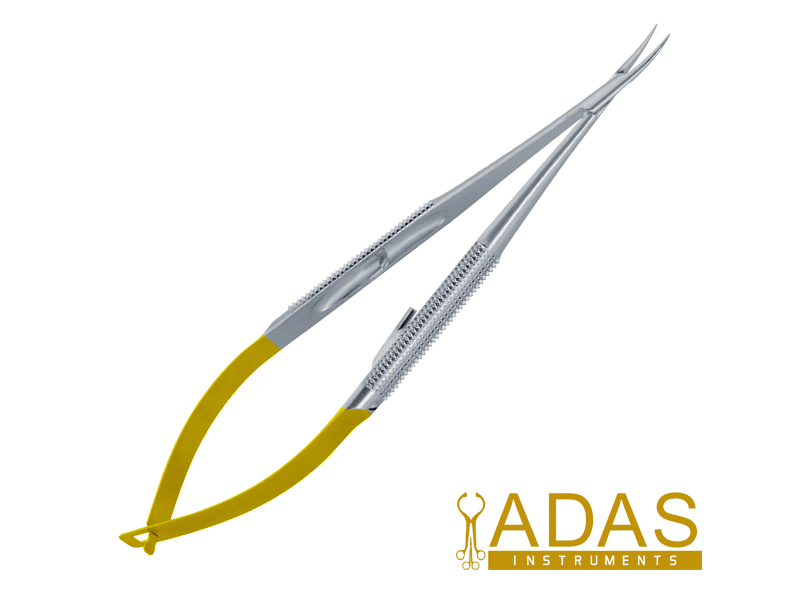
Castroviejo Micro Needle Holder, Fine Suture (TC / Smooth), Round Bodies
Price range: $ 24.50 through $ 39.50
The Castroviejo micro needle holder, also called a Castroviejo micro needle driver, is a round handled, spring action instrument held like a pen rather than gripped through finger rings, built for suture down to 10-0. The spring opens the jaws on its own, so the hand never has to release and re-set between passes, which is what keeps a 9-0 needle steady through a corneal or microvascular stitch.
- Handle: round knurled body, spring action, pen grip, rotates freely in the fingers
- Lengths: 12 cm, 15 cm and 18 cm, 4.75 to 7 inches
- Jaw faces: smooth or cross serrated, plain steel or tungsten carbide
- Tips: straight or curved, with or without a locking catch
- Sutures: 6-0 to 10-0, and 11-0 with the smooth carbide jaw
- Item code: AMC-02.12

What a Castroviejo micro needle holder is
A Castroviejo micro needle holder is a microsurgical instrument for grasping and guiding very small, very delicate suture needles. What separates it from a ring handled driver is the handle itself. The body is round and knurled, and it is held like a pen. A leaf spring inside the handle holds the jaws apart at rest and closes them under fingertip pressure, so opening the jaws costs no separate hand movement at all.
That matters more than it sounds. On a 9-0 or 10-0 stitch the surgeon is working under a microscope, and the jarring motion of releasing a ring handled ratchet is enough to tear the tissue being repaired. A round handle Castroviejo needle holder removes that motion, and because the body is round it can be rolled between the fingers to change needle angle without letting go.
In American operating rooms this instrument is usually called a Castroviejo micro needle driver, and it is often shortened further in conversation to a Castro micro needle holder or simply a Castro driver. All three names describe the same pattern.
Key design features of the Castroviejo micro needle holder
Round spring handle. The knurled round body gives a positive pen grip from any rotation, which is what allows the wrist to stay still while the fingers turn the needle. It is also ambidextrous by nature, with no handed build required.
Optional locking catch. The Castroviejo micro needle holder is offered with and without a catch. With the catch, the jaws can be held closed on the needle without continuous fingertip pressure, which reduces fatigue across a long anastomosis. Without the catch there is nothing to release, which some microsurgeons prefer because a releasing catch is one more movement near fragile tissue. Both builds are available here, so the choice is yours rather than ours.
Smooth or serrated jaws. Smooth jaws are the microsurgical default below 8-0, because serrations can nick a very fine monofilament and a nicked suture breaks. Cross serrated jaws grip harder and suit 6-0 and 7-0 work. Both are offered in plain steel and tungsten carbide.
Straight or curved tips. Every Castroviejo micro needle holder here is offered both ways. Straight tips give the most direct line of sight and are the general choice. Curved tips let the hand sit below the line of view, which is the advantage in a deep or recessed field such as the posterior orbit.
Castroviejo micro needle holder sizes and build options
Three lengths of Castroviejo are made, and the choice is driven by how deep the field is rather than how fine the suture is. Every length takes every jaw and tip combination.
| Option | Choices | Note |
|---|---|---|
| Length | 12 cm (4.75 in), 15 cm (6 in), 18 cm (7 in) | Longer bodies reach deeper fields |
| Jaw face | Smooth or cross serrated | Smooth below 8-0 |
| Jaw material | Plain steel or tungsten carbide | Carbide inserts are replaceable |
| Tip angle | Straight or curved | Curved for recessed fields |
| Locking | With catch or without catch | Surgeon preference |
| Handle | Round knurled body, spring action | Ambidextrous |
| Item code | AMC-02.12 |
Castroviejo micro needle holder uses by specialty
Ophthalmic surgery is where the Castroviejo originated and still where it is used most: corneal transplant, cataract wound closure, lid margin and eyelid repair, strabismus work. The tissue is fragile and the field is shallow but narrow, which is exactly the case a pen grip answers.
Microvascular surgery is the Castroviejo micro needle holder’s second home. Vessel anastomosis under the microscope is done with 8-0 to 10-0 monofilament, and the spring handle is what allows a stitch to be placed without disturbing the clamped vessel. Plastic and reconstructive teams use it for nerve coaptation, free flap anastomosis and delicate facial closure. Neurosurgical use is in deep, confined sites where control matters more than force. In oral and maxillofacial work it appears in micro endodontic and periodontal microsurgery, where fine tactile feedback is the requirement.
For eyelid and facial closures at 5-0 and 6-0, where a micro instrument is more than the job needs, the Derf needle holder and the Webster needle holder are the ring handled alternatives. The full range is listed on the plastic surgery needle holders page.
Suture sizes the Castroviejo micro needle holder handles
| Suture size | Jaw to choose | Typical use |
|---|---|---|
| 5-0 | Cross serrated | Workable, but a ring handled driver is easier |
| 6-0 | Cross serrated | Fine facial and oral closure |
| 7-0 | Serrated or smooth | Lid margin, small vessel |
| 8-0 | Smooth | Microvascular anastomosis |
| 9-0 | Smooth carbide | Corneal, nerve coaptation |
| 10-0 | Smooth carbide | Corneal transplant, fine microvascular |
| 11-0 | Smooth carbide | Achievable, at the limit of the pattern |
How the Castroviejo micro needle holder compares with the flat handle build
We make two Castroviejo drivers and they are not interchangeable. The difference is the handle, and the handle decides the job.
| Round body (this page) | Flat handle with ratchet | |
|---|---|---|
| Handle | Round knurled, rolls in the fingers | Flat spring blade |
| Lengths | 12, 15, 18 cm | 14, 16, 18, 20, 23 cm |
| Locking | Optional catch | Catch lock, one position |
| Suture range | 6-0 to 10-0 | 4-0 to 8-0 |
| Best at | Microscope work, needle rotation | Deep fields, firmer hold, longer reach |
| Page | Castroviejo micro needle holder | Castroviejo needle holder with ratchet lock |
Put simply: if you are at a microscope and you need to turn the needle in the jaw, take the round body. If you need a firmer hold at depth on a heavier suture, take the flat handle. Buyers looking at the wider family should also see the micro vascular needle holder and the Ryder needle holder, which cover the same vessels with a ring handle.
Castroviejo micro needle holder materials and finish
Every unit is made from high quality medical grade stainless steel, hardened, passivated and given a satin finish that stops glare reflecting back up the microscope. The steel itself is made to a German specification. The tungsten carbide build has carbide inserts brazed into the jaw faces; these hold an edge and a grip far longer than steel and can be replaced when they eventually wear, which is the reason carbide is the economical choice on an instrument that will be used weekly.
Castroviejo micro needle holder care and sterilization
A Castroviejo micro needle holder fails at the tip, and almost always from handling rather than from use. Rinse immediately after the case. Clean with a soft brush and a neutral pH enzymatic detergent, never an ultrasonic bath with the tips touching other instruments. Rinse in deionized water and dry fully. Steam autoclave at 134 degrees Celsius for your validated cycle, with the catch released and a tip protector fitted. Store in a rack or a tray with tip guards so the jaws never carry the weight of another instrument. Inspect the tips under magnification: a bent or sprung tip will not hold a 10-0 needle and cannot be corrected on the bench.
Ordering and wholesale
Adas Instruments manufactures this Castroviejo micro needle holder and ships it worldwide. Every combination of length, jaw face, jaw material, tip angle and locking option can be ordered individually, and wholesale pricing applies to bulk orders for distributors, hospital groups and ophthalmic clinics. Backorder items dispatch in 10 to 12 working days. Each instrument carries a three year replacement against manufacturing defects. Tell us the procedure and the suture you use and we will recommend the combination rather than leave you to guess.
Production is controlled under an ISO 13485 quality management system.
Frequently asked questions
What is a Castroviejo micro needle holder used for?
It is used to hold and guide very fine suture needles, from 6-0 down to 10-0, under magnification. The main uses are ophthalmic surgery such as corneal transplant and eyelid repair, microvascular anastomosis, nerve coaptation in plastic and reconstructive surgery, and micro endodontic and periodontal work.
Should I choose the version with the locking catch or without?
With the catch if your cases are long and you want the jaws to hold the needle without continuous fingertip pressure. Without the catch if you work at very high magnification and would rather have no release movement at all near the tissue. Neither is better; it is a working preference, so both are stocked.
Why are smooth jaws recommended for the finest sutures?
Serrations grip by biting into the needle and, at 9-0 and 10-0, the same serrations can score the monofilament running beside the needle. A scored suture breaks under tension. Smooth jaws hold by friction across a flat face and leave the suture alone, which is why they are the microsurgical default below 8-0.
Is this the same as a Barraquer needle holder?
No. Both are micro drivers with round bodies, but a Barraquer is shorter with a lighter spring and no catch, and is aimed squarely at corneal work. This pattern is offered in three lengths, with or without a catch, and covers microvascular and reconstructive work as well as ophthalmic. We do not currently make a Barraquer.
What is the difference between this and the flat handle Castroviejo?
The handle, and with it the job. The round body rolls between the fingers for needle rotation under a microscope and carries 6-0 to 10-0. The flat handle version has a single position catch lock, reaches 23 cm and carries 4-0 to 8-0, so it suits deeper fields and heavier suture.
For fine facial and craniofacial work with a conventional ring handle, compare the grooved jaw Neivert needle holder.
Related products and categories
Surgeons who work with the Castroviejo micro needle holder usually compare it against the Castroviejo needle holder, the Neivert needle holder and the Webster needle holder. The whole family sits in Plastic Surgery Needle Holders, and this pattern is also listed under Micro Surgery Instruments.
| Weight | 0.06 kg |
|---|---|
| Tip options | Serrated Standard, Serrated Tungsten Carbide, Smooth Standard, Smooth Tungsten Carbide |
| Tip Type | Straight, Curved |
| Locking System | Without Lock, With Lock |
| Select Size | 15cm / 6", 18cm / 7", 12cm / 4.75" |
Be the first to review “Castroviejo Micro Needle Holder, Fine Suture (TC / Smooth), Round Bodies”
Shipping & Delivery Policy
Processing Time: In-stock items are dispatched within 24-48 hours. For custom or out-of-stock items, production time is approximately 10-15 days.
Global Delivery Estimates
We partner with world-class couriers (DHL, FedEx) to ensure fast, tracked delivery.
- USA & Canada: 3-5 Business Days
- Europe & UK: 4-6 Business Days
- Rest of World: 5-7 Business Days
*We offer Air Cargo and Sea Freight options for bulk wholesale orders.
Customs & Duties
International buyers are responsible for any customs duties or taxes imposed by their country. Adas Instruments is not responsible for delays caused by customs clearance.
Lost Packages & Insurance
If your package is lost in transit, please contact us immediately. We offer full support and replacements for confirmed lost shipments. Note: You must report non-delivery within 3 weeks to be eligible for an insurance claim.
Related products



Reviews
There are no reviews yet.