
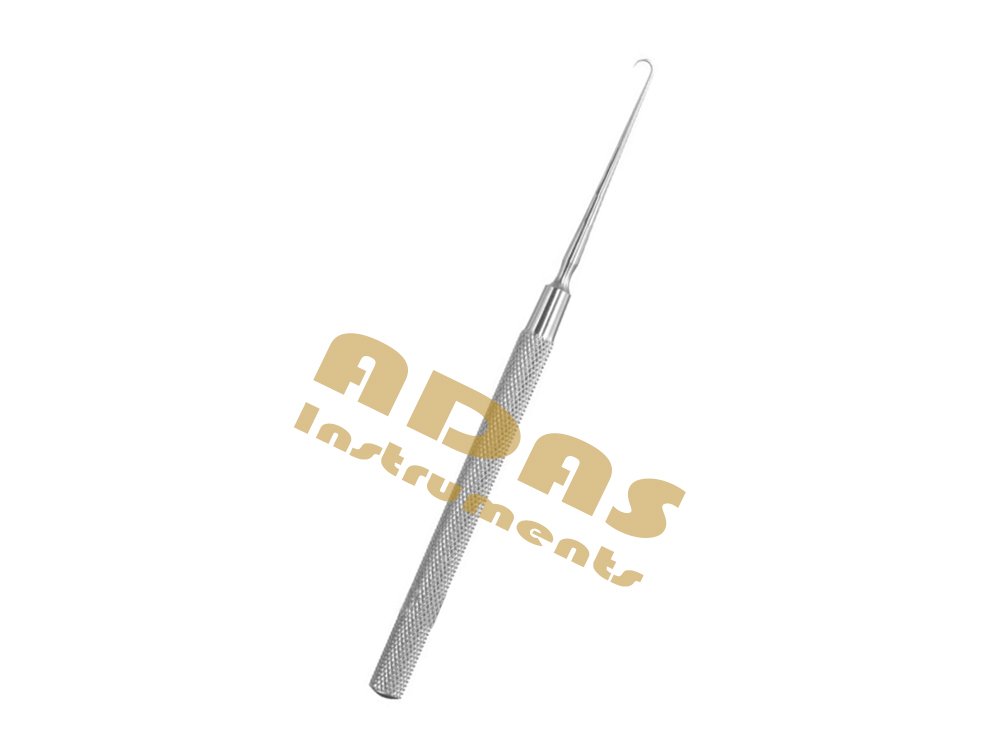


McCoy Micro Dermal Single Hook, Sharp or Blunt Tip
$ 16.00
The micro dermal single hook is the smallest hook in the skin hook family, made for work at a scale where a standard skin hook is too much instrument. One very fine prong lifts a dermal margin or a micro flap on a single point, with a bite small enough to leave nothing behind on tissue that is going back into the closure. It is used in micro surgery, facelift and neck lift work and rhinoplasty, on thin subcutaneous edges that will not take a forceps.
Key Features
- One very fine prong, for micro flaps and thin dermal margins
- Sharp tip for a positive hold, or blunt tip where the skin is too fragile to be pierced
- The smallest hook in the family, working below the Kleinert Kutz 3 mm tip
- For lifting and holding only. It does not grasp, it does not cut and it does not crush
- Used in micro surgery, facelift and neck lift surgery and rhinoplasty
- High quality medical grade stainless steel, autoclavable and made to be used again
- Three year replacement warranty against manufacturing defects

What the micro dermal single hook is
The micro dermal single hook is the smallest hook in the skin hook family. It carries one very fine prong, and it exists for work at a scale where a standard skin hook is simply too much instrument for the tissue in front of you.
The bite is small enough that a dermal margin or a micro flap can be lifted and held with almost nothing left behind, which is the whole argument for using a hook on skin the patient is keeping. Both a sharp tip and a blunt tip are made: sharp for a positive hold where the skin has substance, blunt where it has none and a point would pass straight through.
This pattern is also catalogued as the McCoy micro dermal hook, and it is listed by that name in the United States. We use the name, and we say nothing about the person behind it, because the record is not clear enough to state.
Key design features of the micro dermal single hook
Four features, and every one is about scale.
- One very fine prong. The smallest working point in the family, below the 3 mm Kleinert Kutz tip.
- Sharp or blunt tip. Two instruments in one pattern, chosen by how much the skin will take.
- Fine shaft. Narrow enough to leave the field visible under magnification, where a wider hook blocks the view.
- Lift and hold only. It does not grasp, it does not cut and it does not crush, which is what keeps the margin usable.
Micro dermal single hook options
One pattern, two tip choices, and the tip is chosen at the point of order.
| Option | Prong | Tip | What it suits | Item code |
|---|---|---|---|---|
| Micro dermal single hook | One | Sharp tip | A positive hold on a fine dermal margin | AP-17.04 |
| Micro dermal single hook | One | Blunt tip | Skin too fragile to be pierced | AP-17.04 |
Our own record carries the tip options and not a length or a prong figure, so neither is stated here. Competitor listings for this pattern quote figures of their own, and none of them is repeated on this page, because a number we cannot stand behind is worse than no number at all. Ask and it will be measured.
Where a dermal hook is used, by specialty
A dermal hook at this scale earns its place wherever the margin is too small for anything larger.
| Specialty | What the micro dermal single hook is used for |
|---|---|
| Micro surgery | Lifting a micro flap on a single point, at a scale where a standard hook is too much instrument |
| Facelift and neck lift | Holding a thin flap edge during the fine part of the dissection |
| Rhinoplasty | Holding a very fine nasal or columellar margin |
| Plastic and reconstructive surgery | Fine dermal handling on tissue that is going back into the closure |
| Dermatologic surgery | Steadying a thin margin during a small excision |
| Oculoplastic surgery | Holding fine periocular skin, where the bite has to be as small as it can be |
| Hand and digital surgery | The smallest skin edges on a finger, below what a wider hook can take cleanly |
What the prong holds, and what it does not
The smallest hook in the family has the tightest limits, so they are set out plainly.
| Structure | How the prong takes it |
|---|---|
| Fine dermal margins | The pattern this hook exists for. One small point, and almost nothing left behind |
| Micro flaps | Lifted whole on a single prong, because the flap is small enough that one point is the center of it |
| Thin subcutaneous edges | Taken on the sharp tip where there is substance, on the blunt tip where there is not |
| Fragile or atrophic skin | The blunt tip only. A sharp prong goes straight through skin with nothing left in it |
| Periocular skin | Held on the smallest bite available in the family |
| A thick flap or a long edge | NOT this instrument. One micro prong cannot carry it. Use a Joseph or a Gillies |
| Cartilage, bone and tendon | NOT this instrument, and not any skin hook |
How this single prong skin hook compares with the rest of the family
Every hook in the table below is a single prong skin hook or one of the hooks beside it, and four of the rows are ours. The pattern on this page sits at the fine end of that run.
| Pattern | How it differs | When you reach for it instead |
|---|---|---|
| Kleinert Kutz skin hook | One fine prong in 3 mm, 5 mm and 7 mm on a narrow shaft | Hand and finger work, and anywhere 3 mm is the right bite rather than smaller |
| Joseph skin hook | Single or double prong in five spreads from 2 mm to 12 mm | Rhinoplasty and any facial flap with length to it |
| Gillies skin hook | A general purpose single prong on a round handle, 12 cm and 18 cm | A thick flap or a deep field |
| Guthrie skin hook | Two prongs, so the pull is shared and the tissue cannot rotate | A longer edge, and fragile skin that needs two points |
| Micro tissue forceps | Grips between two blades and marks a line | Tissue being removed under magnification |
| Nerve hook | Blunt, and made to lift a nerve rather than skin | Picking up the nerve itself |
Materials and finish
Made from high quality medical grade stainless steel, satin finished so the operating light does not reflect off the shaft into the eye, which matters under magnification more than anywhere else. The steel itself is made to a German specification. The prong is hardened at the tip, because on a hook this fine the tip is almost the entire working part.
Care and sterilization of a single skin hook surgical instrument
A single skin hook surgical instrument at this scale is the easiest in the set to damage. Clean with a soft brush under running water, working inside the curve where tissue collects, then rinse in deionized water and dry fully before autoclaving. Store so nothing rests on the tip, and keep it away from the heavier instruments in the tray. Check the point under magnification rather than by eye before it goes back into the set, because a bend too small to see is still enough to tear a dermal margin.
Ordering the mccoy micro dermal hook single and wholesale
Adas Instruments makes this pattern to order with a sharp or a blunt tip. Buyers who search for the mccoy micro dermal hook single by that catalogue name will find it here under the same pattern. We supply hospitals, surgical centers and distributors across the United States, Latin America, Europe and Asia, bulk and wholesale pricing is available, and instruments held on backorder ship in 10 to 12 working days. Every instrument carries a three year replacement warranty against manufacturing defects. Certifications: CE. Production is controlled under an ISO 13485 quality management system.
Frequently asked questions
What is the main use of the McCoy micro dermal hook?
Lifting and holding a fine dermal margin or a micro flap on a single point. It is used in micro surgery, in facelift and neck lift work and in rhinoplasty, on thin subcutaneous edges that would be marked by a forceps and are too small for a standard skin hook.
What is a surgical hook?
An instrument with a curved working end that holds tissue on a point instead of between two blades. Skin hooks hold skin and flaps, nerve hooks lift a nerve clear, and tenaculum patterns take heavier tissue. What they have in common is that they retract without squeezing.
What is a skin hook used for?
Holding a skin edge or a flap out of the line of work so the surgeon can see the plane beneath. Because it holds from one side only and carries the load in the bend of the hook, it leaves no crush mark on tissue that is going back into the closure.
What types of skin hooks are there?
They divide first by the number of prongs and then by scale. Single prong patterns include this one, the Gillies and the Kleinert Kutz; double prong patterns include the Guthrie and the double prong Joseph. Within each, the working scale runs from a 12 mm Joseph spread down to the micro prong on this page.
Sharp tip or blunt tip, which should I order?
Sharp where the skin has enough substance to hold a point, which covers most dermal and flap work. Blunt where it does not: atrophic skin, very thin periocular skin, and any margin where a sharp prong would pass through rather than hold. Sets that see both usually carry one of each.
Related products and categories
Buyers who order the micro dermal single hook usually order alongside it the gillies skin hook, the guthrie skin hook and the joseph skin hook. The whole family sits in hooks and retractors, and this pattern is also listed under micro surgery instruments.
| Weight | 0.05 kg |
|---|---|
| Tip options | Blunt Tip, Sharp Tip |
Be the first to review “McCoy Micro Dermal Single Hook, Sharp or Blunt Tip”
Shipping & Delivery Policy
Processing Time: In-stock items are dispatched within 24-48 hours. For custom or out-of-stock items, production time is approximately 10-15 days.
Global Delivery Estimates
We partner with world-class couriers (DHL, FedEx) to ensure fast, tracked delivery.
- USA & Canada: 3-5 Business Days
- Europe & UK: 4-6 Business Days
- Rest of World: 5-7 Business Days
*We offer Air Cargo and Sea Freight options for bulk wholesale orders.
Customs & Duties
International buyers are responsible for any customs duties or taxes imposed by their country. Adas Instruments is not responsible for delays caused by customs clearance.
Lost Packages & Insurance
If your package is lost in transit, please contact us immediately. We offer full support and replacements for confirmed lost shipments. Note: You must report non-delivery within 3 weeks to be eligible for an insurance claim.
Related products

Reviews
There are no reviews yet.