Essential Guide to Rhinoplasty Instruments: A Surgeon’s Toolkit

Mar
Rhinoplasty, commonly known as a “nose job,” is one of the most intricate cosmetic procedures performed today. Whether for aesthetic reshaping or functional correction (improving breathing), the success of the surgery depends heavily on two factors: the surgeon’s skill and the precision of the Rhinoplasty Surgery Instruments used.
At Adas Instruments, we manufacture precision-engineered Rhinoplasty Surgery Instruments from high quality medical grade stainless steel to ensure every cut, rasp, and suture is flawless. In this guide, we explore the essential instruments required for a successful Rhinoplasty.
Understanding Rhinoplasty Procedures
Before selecting instruments, it is important to understand the surgical approach:
- Open Rhinoplasty: Involves an incision across the columella, giving the surgeon full access to the nasal structure. This requires precise retractors and fine scissors.
- Closed Rhinoplasty: All incisions are made inside the nostrils, requiring specialized internal speculums and elevators.
- Functional Rhinoplasty (Septoplasty): Aimed at straightening a deviated septum to improve breathing.
- Revision Rhinoplasty: A secondary surgery to correct issues from a previous procedure, often requiring delicate cartilage grafting tools.
1. Rhinoplasty Scissors
Scissors are the primary tools for dissecting tissue and trimming cartilage.
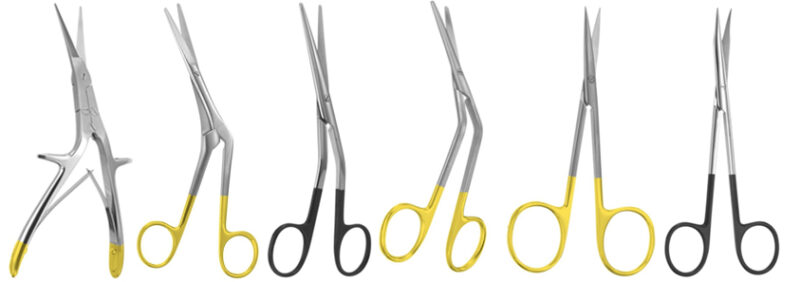
- Iris Scissors: A versatile scissor used for fine tissue cutting in almost every rhinoplasty.
- Stevens Tenotomy Scissors: Featuring sharp, tapered tips, these are essential for delicate dissection in tight nasal spaces.
- Fomon & Cottle Dorsal Scissors: Specifically angled to navigate the nasal dorsum (bridge) for precise hump reduction.
- Converse Scissors: Curved blades designed for trimming mucosal flaps and cartilage grafts.
- Heymann Turbinectomy Scissors: Heavy-duty scissors used to reduce enlarged turbinates.
2. Rhinoplasty Needle Holders
Suturing inside the nasal cavity requires a secure grip and fine control.
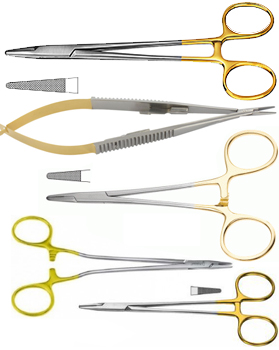
- Crile-Wood Needle Holder: A standard for general closure with a fine jaw pattern.
- Castroviejo Needle Holder: A spring-action micro needle holder, perfect for delicate 6-0 or 7-0 sutures.
- Mayo-Hegar Needle Holder: A robust driver for heavier needles and cartilage suturing.
- Neivert Needle Holder: Features an angled ring for better ergonomic comfort during long procedures.
3. Osteotomes, Chisels & Gouges
Bone reshaping (Osteotomy) is a critical step in rhinoplasty. These tools must be extremely sharp to prevent bone splintering.
- Osteotomes: Used to cut bone. Popular models include the Cinelli (Double Guarded) for safety and the Cottle Osteotome for precise cuts.
- Chisels: The Silver Cartilage Chisel and Ballenger Swivel Knife are essential for harvesting septal cartilage.
- Gouges: Instruments like the Freer and Killian Gouge are used for removing bone spurs or carving graft beds.

4. Nasal Rasps & Saws
Once the bone is cut, it must be smoothed to create a natural profile.
- Tungsten Carbide (TC) Rasps: Featuring a durable, cross-cut grit (like the Fomon or Maltz Rasp) for smoothing the nasal bridge.
- Diamond Dusted Rasps: Used for final polishing and fine contouring (e.g., Aufricht Glabellar Rasp).
- Joseph Bayonet Saw: Used for precise lateral osteotomies to narrow the nasal base.

5. Forceps for Rhinoplasty
Forceps are used to grasp tissue, cartilage, and needles.
- Adson Forceps: Available as “Adson-Brown” (teeth for gripping) or “Adson Dressing” (serrated for delicate tissue).
- Jansen-Middleton Forceps: A double-action instrument designed specifically for removing septal cartilage and bone.
- Takahashi & Blakesley Forceps: Through-cutting forceps used to remove soft tissue and polyps.
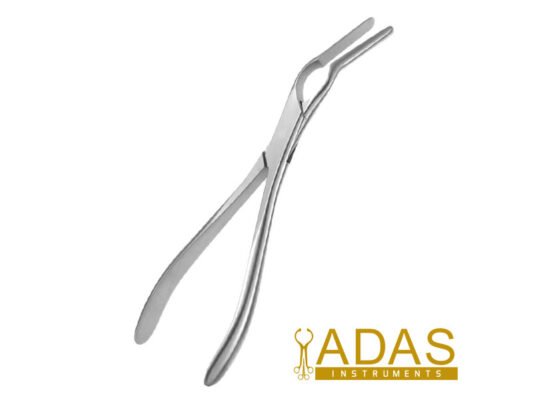
- Asch Septum Forceps: Used to straighten the nasal septum after fracture or deviation.
6. Retractors & Speculums
Visibility is key in the small nasal cavity.
- Nasal Speculums: The Vienna and Killian Speculums hold the nostrils open for examination and surgery.
- Aufricht Retractor: Used to lift the nasal skin envelope for a clear view of the dorsum.
- Cottle Retractor: A sharp double-prong hook for retracting skin edges.
- Gruber Retractor: A weighted retractor that hangs in place, freeing the surgeon’s hands.

7. Cartilage & Bone Crushers
- Cottle Cartilage Crusher: Used to flatten harvested cartilage (from the septum or ear) to create smooth grafts for the nasal tip or bridge.
- Cartilage Cutting Block (Teflon): A durable surface for carving grafts without dulling the scalpel.

Most surgeons build their rhinoplasty surgery instruments around these seven groups and then add patterns for their own technique. Buying rhinoplasty surgery instruments as a matched set keeps sizes and finishes consistent across the tray, while every pattern above can also be ordered on its own to fill a gap in existing rhinoplasty surgery instruments.
Summary: The Complete Rhinoplasty Surgery Instruments Set
Selecting individual instruments can be overwhelming. To ensure surgeons have everything they need, Adas Instruments offers a complete Rhinoplasty Surgery Instruments Set containing 68 essential tools for Open and Closed Rhinoplasty.
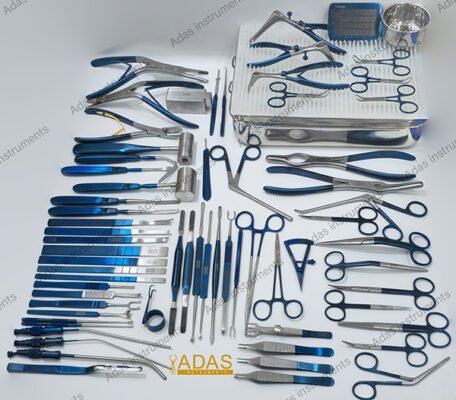
The Complete Set of Rhinoplasty Surgery Instruments
Why Choose Adas Instruments?
- Material: Premium medical grade stainless steel.
- Warranty: 3-Year Warranty on all instruments.
- Customization: OEM services available for clinics and distributors.
For inquiries or wholesale orders: 📧 Email: adas.surgical@gmail.com 📞 WhatsApp: +92 321 612 6225
Frequently Asked Questions About Rhinoplasty Instruments
What instruments are used in rhinoplasty surgery?
A complete rhinoplasty setup includes nasal speculums, Cottle and Freer elevators, Joseph and Aufricht retractors, osteotomes (straight, curved and guarded), nasal rasps, Fomon and Converse scissors, Adson-Brown and Walsham forceps, cartilage crushers and fine needle holders. The guide above explains each group in detail.
What is included in a rhinoplasty instrument set?
A professional set — like our 66-piece Advance Rhinoplasty Set — contains forceps and clamps, TC scissors and knives, osteotomes and rasps, retractors and hooks, speculums and elevators, suction tubes, a mallet, a cartilage crusher and a sterilization box, covering both open and closed techniques.
Which scissors are used in rhinoplasty?
The workhorses are Fomon dorsal scissors for reshaping the dorsum, Converse scissors for precise tip work, and Stevens tenotomy scissors for delicate dissection. Tungsten-carbide (TC) versions hold their edge through tough cartilage.
What is the difference between septoplasty and rhinoplasty instruments?
They overlap heavily: septoplasty relies on speculums, Freer/Cottle elevators, Ballenger swivel knives and Asch or Walsham forceps for the septum, while cosmetic rhinoplasty adds osteotomes, rasps and shaping scissors for the bony-cartilaginous framework. Septorhinoplasty sets combine both.
What are Walsham and Asch forceps used for?
Both are heavy septum forceps: Walsham forceps reduce and straighten fractured nasal bones, while Asch forceps realign the septum after fracture or during septoplasty. They are standard in post-trauma nasal reduction sets.
What is an osteotome used for in rhinoplasty?
Osteotomes are fine surgical chisels used to make controlled cuts in the nasal bones — lateral, medial or intermediate osteotomies — to narrow the bony vault or close an open roof after hump removal. Guarded designs protect the surrounding soft tissue.
