
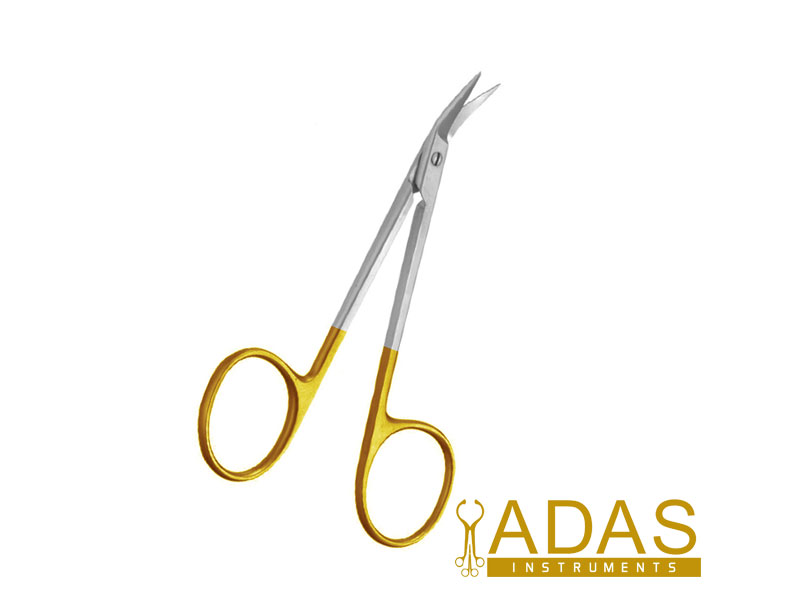
Converse Scissors, 10 cm, Fine Curved Rhinoplasty and Cartilage
Price range: $ 8.50 through $ 22.00
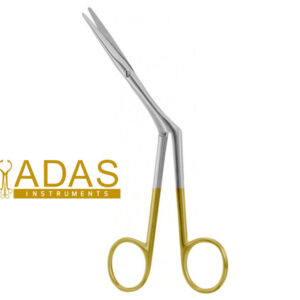
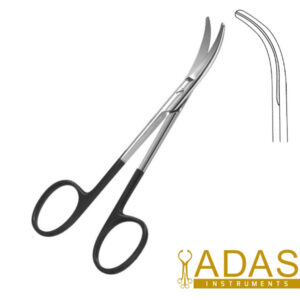
Converse scissors are small angled surgical scissors used inside the nose for fine dissection and for trimming cartilage, mostly at the tip and along the dorsum. The bend sits at about 45 degrees and holds the blades flat, so your hand never crosses what you are looking at. At 10 cm the pair is short enough to hold like a pen.
- Length: 10 cm, 4 inches
- Blades: curved or straight, with sharp or blunt tips
- Edges: standard, supercut, tungsten carbide or carbide supercut

What Converse scissors are
Converse scissors are small angled rhinoplasty scissors used inside the nose, where the work is a few millimetres across and the surgeon needs to see the tips at all times. Catalogues also list them as Converse nasal scissors, and the two names mean the same instrument. The pattern is 10 cm long, which is short for a surgical scissor, and the length is the point: a 10 cm instrument is held like a pen rather than like a tool, and that is how you get control at the nasal tip.
The angle is what people notice in the photograph. The blades leave the shank at roughly 45 degrees and sit flat, so the hand stays below the sightline while the tips work at the dorsum or the tip cartilages. Adas Instruments makes Converse scissors with either curved or straight blades and either a sharp or a blunt tip.
The angle, and why 10 cm
Two things go wrong with a long scissor in a nose. The hand ends up over the field, and small movements at the rings become large movements at the tips. A 10 cm pattern fixes both. The lever arm is short, so a millimetre of finger travel is close to a millimetre of blade travel, and the wrist stays out of the way.
The trade is reach. Converse scissors are not the instrument for the posterior septum or the back of a turbinate; they are for the tip, the dorsum and the alar cartilages, which is where most of the shaping in a rhinoplasty actually happens. Surgeons searching for Converse scissors rhinoplasty patterns are almost always after this 10 cm size rather than a longer one.
Clinical applications
Converse scissors do the fine work in nasal surgery, and Converse scissors ENT trays carry them as often as plastic surgery trays do.
| Procedure | What the instrument does | Why this pattern |
|---|---|---|
| Nasal tip shaping | Trims the lower lateral cartilages to refine the tip | 10 cm gives millimetre control where it matters most |
| Dorsal work | Fine dissection over the cartilaginous dorsum | Angled on flat keeps the hand below the sightline |
| Septoplasty | Cuts mucosa and small vessels along the septum | Fine tips reach into a narrow corridor |
| Suture trimming | Cuts deep internal sutures without a second instrument | Short blades reach the knot and nothing else |
| Nasal reconstruction | Trims cartilage grafts to shape | Straight sharp blades cut cartilage to a line |
Blade, tip and edge options
Every combination below is a real stock configuration rather than a special order, which is why the price moves with the edge rather than with the length.
| Edge | What it is | Price | When to choose it |
|---|---|---|---|
| Standard | Conventional ground edge | 8.50 dollars | The everyday choice for a general tray |
| Standard supercut | One razor ground blade | 16 dollars | Cuts cartilage with less crushing |
| Tungsten carbide | Carbide inserts at the cutting surfaces | 18 dollars | Holds an edge through far more autoclave cycles |
| Tungsten carbide supercut | Carbide plus the razor grind | 22 dollars | For a tip list that runs every week |
Technical specification
| Detail | Specification |
|---|---|
| Instrument type | Converse scissors, angled on flat |
| Overall length | 10 cm, 4 inches |
| Blade | Fine, curved or straight |
| Tips | Sharp or blunt |
| Handle | Standard finger ring |
| Edge options | Standard, standard supercut, tungsten carbide, tungsten carbide supercut |
| Material | High quality medical grade stainless steel |
| Sterilisation | Reusable, fully autoclavable, supplied non-sterile |
| Rust prevention | Passivated and boil tested, ultrasonically cleaned before packing |
| Marking | Laser marked with the pattern name and the Adas Instruments reference |
| Reference | AD-07.10 |
Care and sterilisation
A 10 cm scissor is the easiest thing on a tray to lose and the easiest to damage. It disappears under a swab, and it gets bent when something heavier is stacked on it. Keep Converse scissors in a bracketed micro tray with the tips protected, not loose in a box.
Rinse cold straight off the field. Cartilage debris and dried blood in a small box lock stiffen the action faster than on a large instrument, because there is less joint to work with. Ultrasonic clean, autoclave with the joint open, dry fully, and put a drop of oil on the screw weekly.
Check the tips under a light before every list. On a fine pointed pattern a bent tip is not always visible at arm’s length, and a bent tip in a nasal tip is how mucosa gets torn.
Made by Adas Instruments
Adas Instruments makes Converse scissors in house, so blade curve, tip shape and the edge are set during manufacture rather than quoted as specials. The standard edge starts at 8.50 dollars and a tungsten carbide supercut pair is 22 dollars, which is the whole range for one instrument.
Sample pairs go out for evaluation before a hospital buys a set, and we supply under our own name or plain for distributors. Converse nasal scissors are held in stock in every combination listed above rather than made to order.
Frequently asked questions
What are Converse scissors used for?
Fine dissection and cartilage trimming in rhinoplasty, mostly at the nasal tip, the dorsum and the lower lateral cartilages. As rhinoplasty scissors go they are among the smallest on the tray. They are also used to trim mucosa, small vessels and deep sutures in septoplasty and nasal reconstruction.
Why are Converse scissors angled?
So the hand sits below the line of sight while the blades work inside the nose. The blades leave the shank at roughly 45 degrees and lie flat, which keeps the tips visible in a space too narrow for a straight instrument.
Curved or straight blades?
Straight for trimming cartilage to a line and for cutting sutures. Curved for following the contour of the alar cartilage or the dorsum. Both are stocked, and surgeons who do a lot of tip work usually keep one of each.
Sharp or blunt tips?
Sharp for cutting cartilage and mucosa cleanly. Blunt where the instrument is being used to spread a plane as much as to cut, and where the nasal lining is close enough that a point is a risk.
What does supercut mean here?
One blade carries a razor ground edge instead of a conventional one, so the instrument cuts with less crushing. It costs more and it needs resharpening by someone who knows the grind, which is why both plain and supercut versions are stocked.
Related instruments and categories
Converse scissors sit in two places on this site: the rhinoplasty instruments pages, alongside the elevators, osteotomes and rasps that share the tray, and the plastic surgery scissors pages, alongside every other scissor pattern we make.
For work on the dorsum itself the Fomon dorsal scissors are the second angled pattern we stock, the Cottle dorsal scissors come from the Cottle septorhinoplasty range, and for soft tissue away from the cartilage the Joseph dissecting scissors are the usual choice.
| Weight | 0.04 kg |
|---|---|
| Blade Type | Standard, Standard Supercut, Tungsten Carbide, Tungsten Carbide Supercut |
| Tip options | Blunt Tip, Sharp Tip |
| Select Scissors Blades | Curved Blades, Straight Blades |
Be the first to review “Converse Scissors, 10 cm, Fine Curved Rhinoplasty and Cartilage”
Shipping & Delivery Policy
Processing Time: In-stock items are dispatched within 24-48 hours. For custom or out-of-stock items, production time is approximately 10-15 days.
Global Delivery Estimates
We partner with world-class couriers (DHL, FedEx) to ensure fast, tracked delivery.
- USA & Canada: 3-5 Business Days
- Europe & UK: 4-6 Business Days
- Rest of World: 5-7 Business Days
*We offer Air Cargo and Sea Freight options for bulk wholesale orders.
Customs & Duties
International buyers are responsible for any customs duties or taxes imposed by their country. Adas Instruments is not responsible for delays caused by customs clearance.
Lost Packages & Insurance
If your package is lost in transit, please contact us immediately. We offer full support and replacements for confirmed lost shipments. Note: You must report non-delivery within 3 weeks to be eligible for an insurance claim.
Related products
Reviews
There are no reviews yet.